Market Summary
Executive Summary and Global Market Analysis
Automotive dosing control units are electronic systems used to manage the precise injection of fluids such as diesel exhaust fluid and fuel additives into vehicle exhaust and engine systems. These units play a critical role in reducing harmful emissions, improving fuel efficiency, and ensuring compliance with environmental regulations. They are widely used in passenger cars, commercial vehicles, and advanced powertrain systems equipped with emission control technologies. The Automotive Dosing Control Unit market is expanding as vehicle manufacturers focus on meeting stringent emission standards and improving engine performance. Growing adoption of selective catalytic reduction systems, advanced fuel injection technologies, and intelligent exhaust after-treatment solutions is further supporting market development.
There are several challenges that may affect market growth. The integration of advanced dosing control systems increases vehicle manufacturing costs and requires sophisticated electronic architectures. Fluctuations in raw material prices and semiconductor supply constraints can also impact production and supply chain efficiency. In addition, maintaining precise dosing performance under varying operating conditions remains a technical challenge, particularly for heavy-duty and high-performance vehicles. Regulatory requirements continue to evolve across different regions, requiring manufacturers to invest in continuous product development and testing. These factors can increase operational costs and create complexities for both manufacturers and vehicle operators.
Despite these challenges, the market is expected to witness steady growth due to ongoing advancements in emission control and vehicle electrification technologies. Opportunities are emerging from the development of smart dosing systems equipped with sensors, real-time monitoring capabilities, and advanced control algorithms. The increasing adoption of connected vehicles and intelligent powertrain management systems is creating demand for more efficient and reliable dosing solutions. Growing investments in sustainable transportation and cleaner mobility technologies are also supporting innovation in this sector. As automotive manufacturers continue to focus on environmental performance and regulatory compliance, the Automotive Dosing Control Unit market is expected to benefit from technological advancements and the growing demand for efficient emission reduction solutions.
Segment Analysis
Automotive Dosing Control Unit Market Segmentation
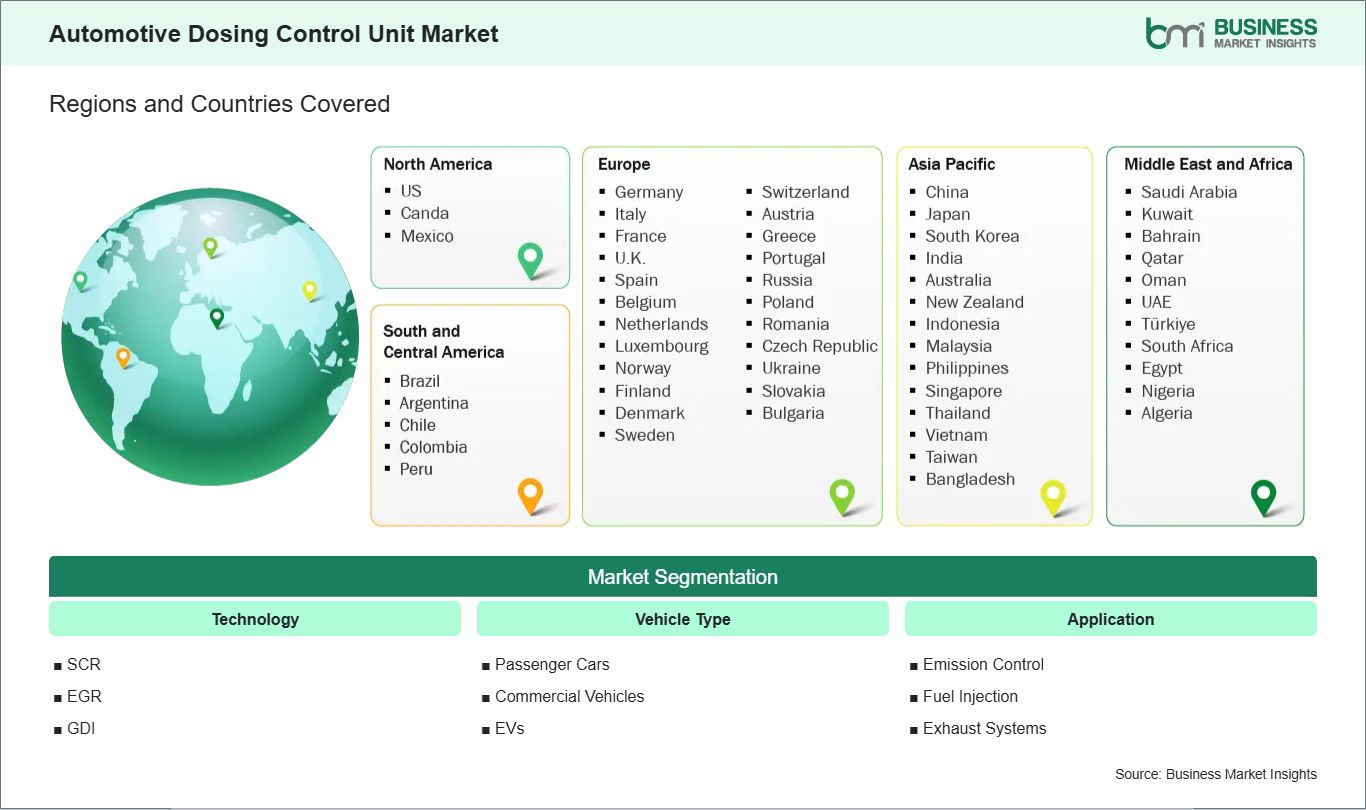
The Automotive Dosing Control Unit market is segmented based on technology, vehicle type, and application, reflecting the diverse operational requirements of modern vehicle emission and fuel management systems.
By Technology
- SCR: Widely adopted for precise diesel exhaust fluid dosing and emission reduction compliance
- EGR: Supports emission control through exhaust gas recirculation management systems
- GDI: Enhances fuel delivery accuracy and engine efficiency in gasoline-powered vehicles
By Vehicle Type
- Passenger Cars: Largest adoption segment driven by high vehicle production volumes
- Commercial Vehicles: Significant demand due to stringent emission regulations and fleet operations
- EVs: Emerging opportunities through advanced vehicle control and thermal management systems
By Application
- Emission Control: Dominates usage due to increasing environmental compliance requirements
- Fuel Injection: Supports optimized fuel delivery and engine performance
- Exhaust Systems: Enables effective monitoring and management of exhaust treatment processes
Market Forces
Automotive Dosing Control Unit Market Drivers and Opportunities
Rising Emission Regulations Supporting Advanced Dosing Technologies
The growing implementation of stringent vehicle emission regulations across major automotive markets is a key factor driving the Automotive Dosing Control Unit market. Governments and regulatory agencies are introducing stricter standards to reduce nitrogen oxide emissions and improve air quality. These regulations require vehicle manufacturers to adopt advanced emission control technologies capable of delivering precise fluid dosing and monitoring functions.
Dosing control units have become essential components within SCR and other aftertreatment systems because they help ensure accurate delivery of treatment fluids under varying operating conditions. Improved dosing accuracy contributes to higher emission reduction efficiency while maintaining vehicle performance and fuel economy. As regulatory requirements continue to evolve, manufacturers are investing in intelligent control systems equipped with enhanced sensors, diagnostics, and software capabilities. The increasing focus on compliance, operational efficiency, and environmental sustainability is encouraging broader adoption of advanced dosing control units across passenger and commercial vehicle segments. This trend is expected to remain a significant driver for market growth over the forecast period.
Integration of Smart Vehicle Electronics Creating Future Growth Potential
The ongoing transformation toward connected, software-defined, and intelligent vehicles is creating new opportunities for the Automotive Dosing Control Unit market. Modern vehicles increasingly rely on advanced electronic architectures that enable real-time communication between multiple vehicle systems. This trend is encouraging the development of more sophisticated dosing control units capable of supporting predictive maintenance, remote diagnostics, and adaptive control functions.
Future vehicle platforms are expected to integrate emission management systems more closely with central vehicle control architectures. This integration can improve overall system efficiency while providing enhanced monitoring and performance optimization capabilities. Advances in artificial intelligence, sensor technologies, and cloud-based vehicle management solutions are further expanding the possibilities for intelligent dosing control applications. Growing investment in hybrid vehicles, next-generation commercial transportation systems, and advanced emission reduction technologies is also expected to create additional opportunities. As vehicle manufacturers continue to prioritize digitalization and sustainability, demand for innovative dosing control solutions is likely to increase across multiple automotive segments.
Size and Share Analysis
Automotive Dosing Control Unit Market Size and Share Analysis
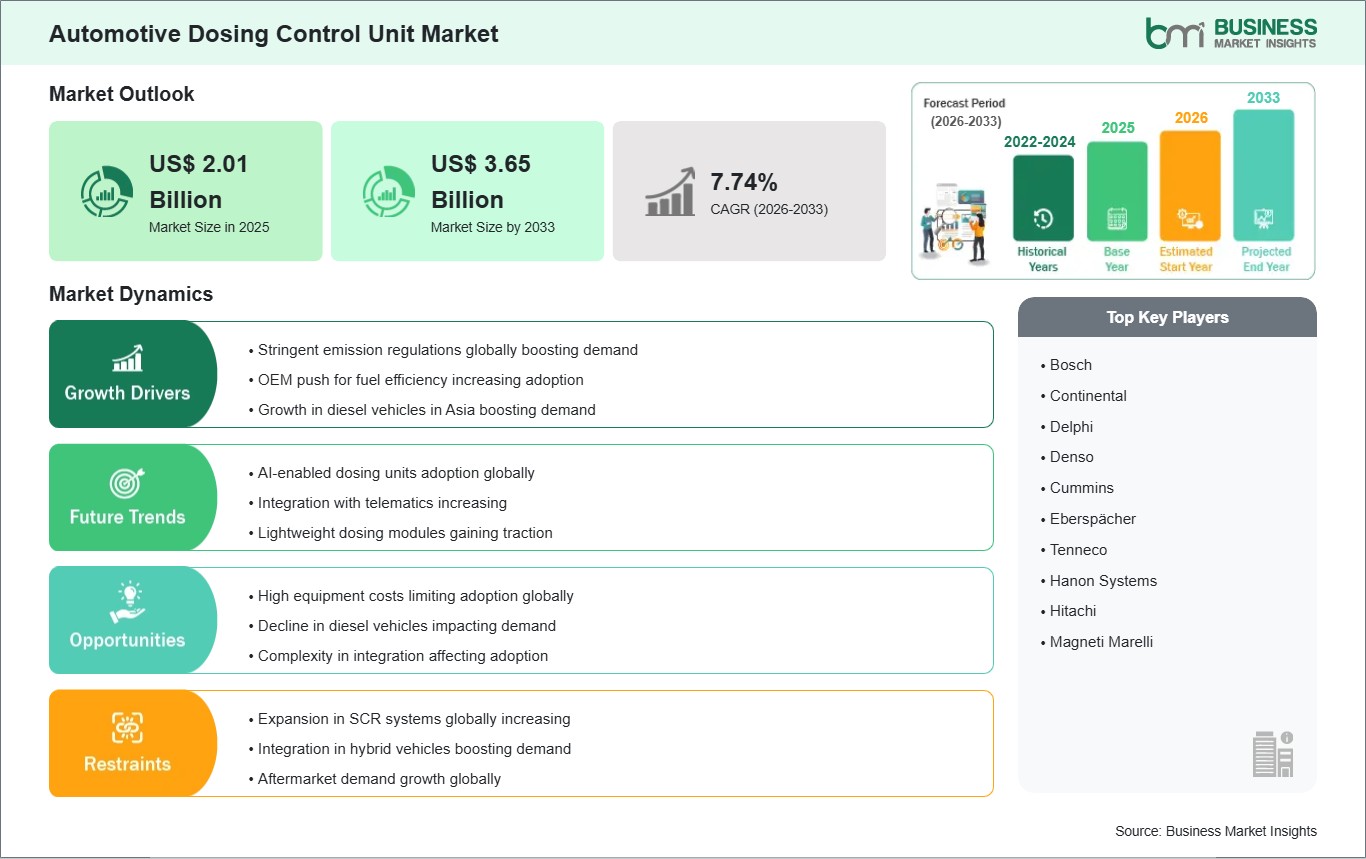
The Automotive Dosing Control Unit market size is expected to reach US$ 3.65 billion by 2033 from US$ 2.01 billion in 2025. The market is estimated to record a CAGR of 7.74% from 2026 to 2033.
By technology, SCR systems account for a significant share due to their widespread adoption in modern emission control applications. EGR technologies continue to support conventional vehicle platforms, while GDI-related systems are gaining importance as manufacturers focus on improving fuel efficiency and combustion performance.
By vehicle type, passenger cars represent a major share of market demand owing to large-scale production and increasing integration of advanced emission control systems. Commercial vehicles remain an important segment because of strict environmental regulations and operational requirements. EVs are emerging as a potential growth area as vehicle electronics become increasingly sophisticated.
By application, emission control dominates the market due to growing regulatory emphasis on reducing harmful vehicle emissions. Fuel injection applications continue to benefit from the need for enhanced engine efficiency and performance optimization, while exhaust system applications are expanding through the adoption of advanced aftertreatment technologies.
Report Coverage
Automotive Dosing Control Unit Market Report Coverage and Deliverables
The "Automotive Dosing Control Unit Market Size and Forecast (2022–2033)” report provides a detailed analysis of the market covering below areas:
- Market size and forecast at global, regional, and country levels for all the key market segments covered under the scope
- Market trends, as well as market dynamics such as drivers, restraints, and key opportunities
- Market analysis covering key market trends, global and regional framework, major players, regulations, and recent market developments
- Industry landscape and competition analysis covering market concentration, heat map analysis, prominent players, and recent developments for the market
- Detailed company profiles, including SWOT analysis
Geographic Insights
Automotive Dosing Control Unit Market Geographic Insights
The Automotive Dosing Control Unit Market shows diverse regional adoption patterns influenced by emission regulations, vehicle production activities, technological advancements, and growing focus on environmental sustainability.
North America, being a developed automotive market, has a strong adoption rate of advanced emission control technologies and intelligent vehicle systems. The region comprises the United States and Canada, where stringent environmental regulations encourage the use of sophisticated dosing control units in passenger and commercial vehicles. Automotive manufacturers continue to invest in advanced exhaust treatment systems and connected vehicle technologies. The presence of established automotive suppliers, strong research capabilities, and a mature transportation infrastructure supports consistent demand for Automotive Dosing Control Unit solutions across multiple vehicle categories.
Asia Pacific is growing significantly, driven by expanding automotive production, industrial development, and evolving emission standards. The region comprises countries such as China, India, and Japan, where increasing vehicle ownership and manufacturing activities are supporting the adoption of advanced emission control technologies. Governments across the region are implementing stricter environmental policies, encouraging manufacturers to integrate efficient dosing control systems into new vehicle platforms. Rapid technological development, infrastructure expansion, and rising investments in next-generation mobility solutions are further strengthening market growth. The region also benefits from a large automotive supply chain network and growing demand for fuel-efficient and environmentally compliant vehicles.
Both regions are contributing significantly to the growth of the Automotive Dosing Control Unit Market, focusing on emission reduction, vehicle efficiency improvements, technological innovation, and compliance with evolving environmental standards.
Industry Activity
Recent Developments
The Automotive Dosing Control Unit Market is analyzed using a mix of primary and secondary research sources, including corporate publications, industry associations, and verified databases. This approach ensures accurate tracking of innovation trends and strategic developments influencing the market.
- In March 2026, Schaeffler Group successfully consolidated the exhaust aftertreatment and fluid tracking assets acquired through its strategic merger with Vitesco Technologies. The organizational integration streamlines the volume production of advanced, 32-bit standalone Dosing Control Units (DCUs) designed to manage high-precision urea injection across complex, multi-stage catalyst configurations. The operational alignment highlights an intense tier-one corporate consolidation trend aimed at capturing high-margin commercial fleet and heavy duty hybridization programs.
- In October 2025, Robert Bosch GmbH announced a technological expansion of its Denoxtronic 5 Dosing Control Unit ecosystem, debuting a pre-validated double-injection SCR software algorithm tailored to satisfy strict Euro 7 emission targets. The updated mechatronic architecture dynamically divides the delivery of Diesel Exhaust Fluid (DEF/AdBlue) between a close-coupled upstream doser and a secondary underfloor injector. This hardware rollout directly addresses the market's engineering requirement to optimize high NOx conversion efficiencies during difficult low-temperature engine operations.
Trust & Transparency
Research Methodology
The market analysis combines proprietary research with secondary data from government agencies, company disclosures, regulatory filings, industry databases and expert interviews. Market estimates are validated through data triangulation, cross-market benchmarking and analyst
review.
View Full Research Methodology
Key Sources Referred:
World Bank - Global Trade IndicatorsWorld Trade Organization (WTO)International Monetary Fund (IMF)International Trade Administration (ITA)Company WebsitesCompany Annual ReportsCompany Investor Presentations