Market Summary
Executive Summary and Global Market Analysis
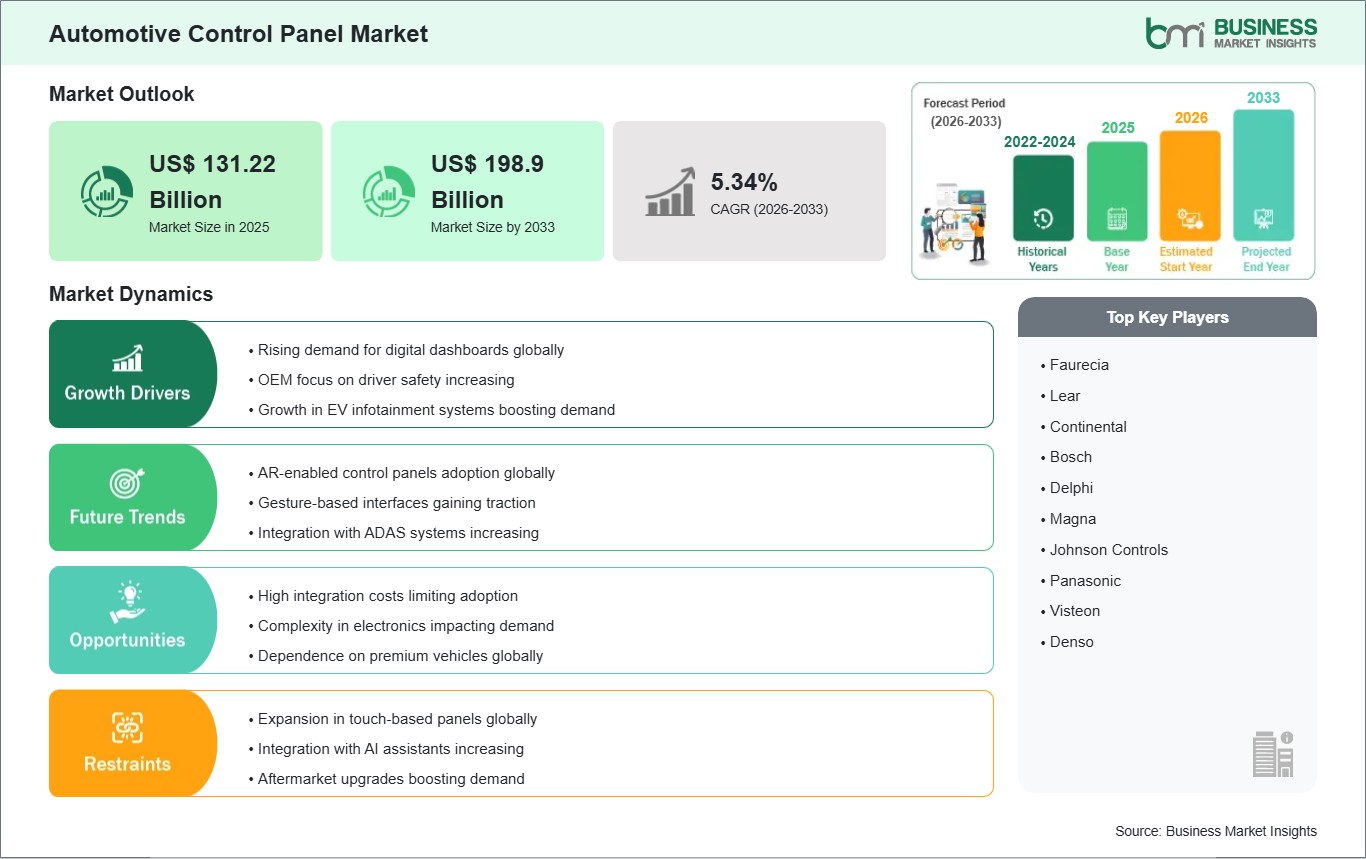
Automotive control panels serve as the central interface through which drivers and passengers manage vehicle functions such as infotainment, climate control, lighting, navigation, safety systems, and connectivity features. These panels have evolved from simple analog switches and buttons to sophisticated digital and hybrid systems that integrate touchscreens, voice controls, haptic feedback, and connected vehicle technologies. The Automotive Control Panel market is growing as vehicle manufacturers focus on improving user experience, enhancing vehicle connectivity, and supporting the increasing digitalization of modern vehicles. Rising consumer demand for intuitive interfaces, personalized settings, and seamless integration with smartphones and cloud-based services is accelerating adoption across passenger cars, commercial vehicles, and electric vehicles.
Several challenges continue to influence market development. Advanced digital control panels require complex electronic components, software integration, and display technologies, which can increase production costs and design complexity. Maintaining system reliability, cybersecurity, and user safety remains important as vehicles become increasingly connected. Manufacturers must also address driver distraction concerns by designing interfaces that remain easy to operate while providing access to numerous vehicle functions. Supply chain disruptions affecting semiconductors and display components can further impact production schedules and technology deployment.
Despite these challenges, the Automotive Control Panel market continues to offer strong opportunities driven by innovations in human-machine interface technologies, artificial intelligence, and connected mobility solutions. The growing adoption of electric vehicles and software-defined vehicles is creating demand for more advanced digital dashboards and centralized control systems. Developments in augmented reality displays, voice assistants, and customizable interfaces are expected to enhance user engagement. As automotive manufacturers continue to prioritize comfort, connectivity, and digital experiences, control panels will remain a critical component of next-generation vehicle architectures.
Segment Analysis
Automotive Control Panel Market Segmentation
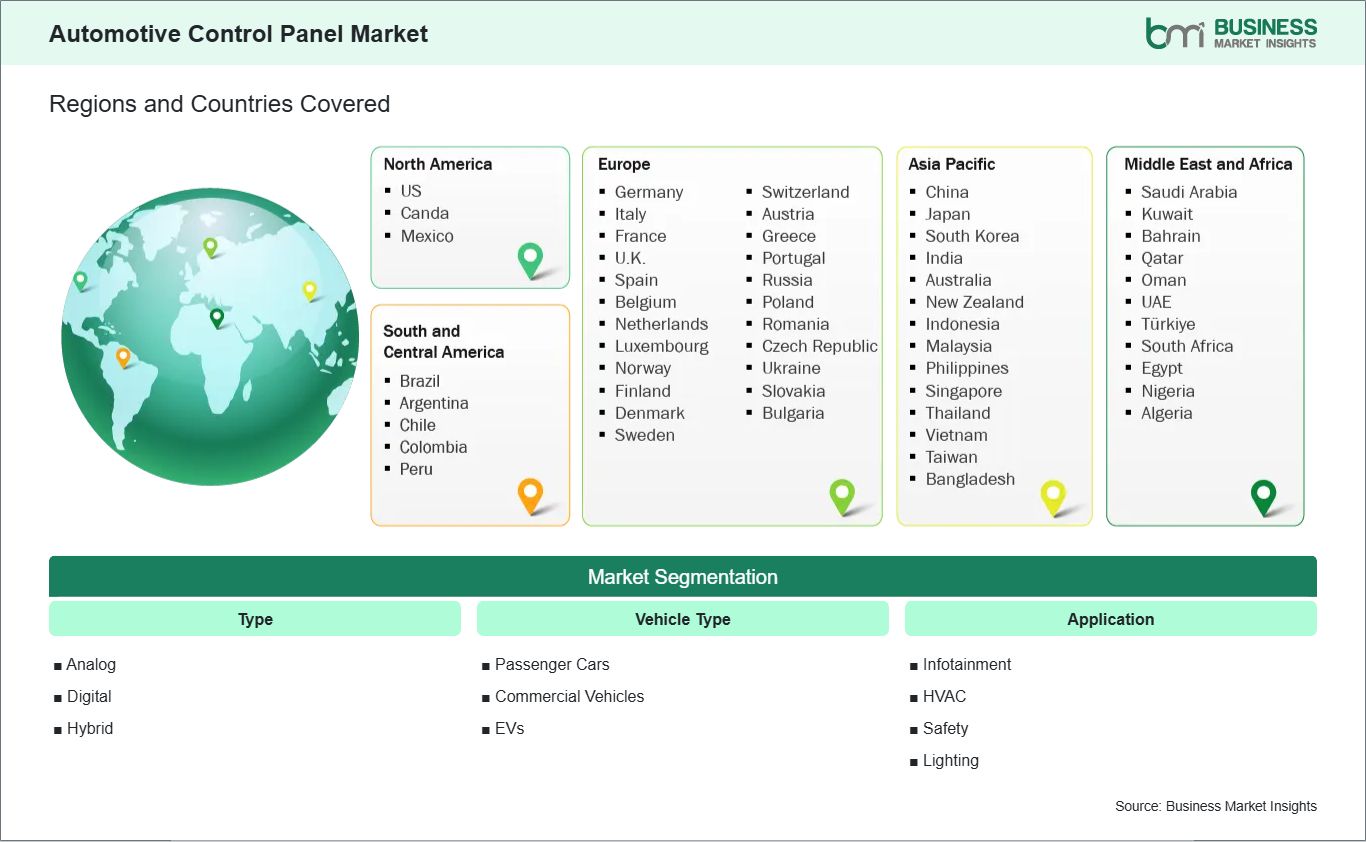
The Automotive Control Panel market is segmented based on type, vehicle type, and application. These categories reflect the diverse control and interface requirements of modern vehicles.
By Type
- Analog: Traditional control panels that use physical switches, knobs, and gauges for vehicle operation.
- Digital: Advanced touchscreen-based systems offering integrated vehicle controls, connectivity, and software-driven functionality.
- Hybrid: Combines physical controls with digital displays to enhance usability and driver convenience.
By Vehicle Type
- Passenger Cars: Major users of advanced infotainment, connectivity, and comfort-oriented control panel systems.
- Commercial Vehicles: Utilize control panels for operational management, fleet functions, and driver assistance features.
- EVs: Increasingly adopt digital control interfaces to manage battery systems, energy monitoring, and connected services.
By Application
- Infotainment: Supports media access, navigation, smartphone integration, and connected services.
- HVAC: Controls heating, ventilation, and air conditioning functions for passenger comfort.
- Safety: Manages vehicle safety features, driver alerts, and assistance systems.
- Lighting: Enables control of interior and exterior vehicle lighting functions.
Market Forces
Automotive Control Panel Market Drivers and Opportunities
Rising Demand for Digital Cockpit and Connected Vehicle Experiences
The automotive industry is rapidly shifting toward digital cockpit environments that provide a seamless and interactive driving experience. Consumers increasingly expect vehicles to offer advanced infotainment systems, connected services, and intuitive control interfaces similar to those found in smartphones and consumer electronics. This trend is encouraging manufacturers to invest in advanced control panel technologies that improve convenience and user engagement.
The growing adoption of connected vehicles is further driving demand for sophisticated control systems. Modern vehicles require centralized interfaces capable of managing navigation, communication, climate control, entertainment, and safety functions through a unified platform. The integration of voice recognition, touchscreens, and personalized settings is helping improve the overall driving experience while supporting greater connectivity. In addition, vehicle manufacturers are focusing on enhancing interior design and cabin aesthetics. Advanced digital control panels help reduce dashboard complexity while offering improved functionality. As software-defined vehicles become more common, the need for flexible and upgradeable control systems continues to strengthen the market outlook.
Innovation in Human-Machine Interface Technologies
Advancements in human-machine interface technologies are creating significant opportunities for the Automotive Control Panel market. Emerging technologies such as augmented reality displays, gesture recognition, artificial intelligence-powered voice assistants, and haptic feedback systems are transforming how drivers interact with vehicles. These innovations enable safer and more intuitive access to vehicle functions.
The growing adoption of electric vehicles is creating additional opportunities for advanced control panel solutions. EVs rely heavily on digital interfaces for battery monitoring, charging management, and energy optimization, increasing the importance of sophisticated dashboard systems. Manufacturers are also exploring customizable user interfaces that allow drivers to personalize vehicle settings and display preferences. Future mobility trends such as autonomous driving and shared mobility services are expected to further expand the role of control panels. As vehicles become more intelligent and connected, control systems will evolve into comprehensive digital hubs capable of managing complex vehicle operations. These developments are expected to support long-term innovation and market growth.
Size and Share Analysis
Automotive Control Panel Market Size and Share Analysis
The Automotive Control Panel Market size is expected to reach US$ 198.9 billion by 2033 from US$ 131.22 billion in 2025. The market is estimated to record a CAGR of 5.34% from 2026 to 2033.
By type, digital control panels account for a significant share of the market due to increasing demand for touchscreen displays, connected vehicle features, and software-based functionality. Hybrid control panels continue to gain popularity as they combine the convenience of digital interfaces with the reliability of physical controls. Analog systems remain relevant in selected vehicle categories where simplicity and cost-effectiveness are priorities.
By vehicle type, passenger cars represent a major portion of demand because of rising consumer expectations for advanced infotainment systems, connectivity solutions, and premium cabin experiences. Commercial vehicles continue to adopt modern control interfaces to improve operational efficiency, while EVs are witnessing rapid growth due to their dependence on digital dashboards and connected ecosystems.
By application, infotainment remains one of the largest segments as manufacturers focus on enhancing entertainment, navigation, and connectivity capabilities. HVAC and safety applications continue to support steady demand, while lighting control systems are increasingly integrated into centralized digital interfaces to improve convenience and vehicle customization.
Report Coverage
Automotive Control Panel Market Report Coverage and Deliverables
The "Automotive Control Panel Market Size and Forecast (2022-2033)" report provides a detailed analysis of the market covering below areas:
- Market size and forecast at global, regional, and country levels for all the key market segments covered under the scope
- Market trends, as well as market dynamics such as drivers, restraints, and key opportunities
- Market analysis covering key market trends, global and regional framework, major players, regulations, and recent market developments
- Industry landscape and competition analysis covering market concentration, heat map analysis, prominent players, and recent developments for the market
- Detailed company profiles, including SWOT analysis
Geographic Insights
Automotive Control Panel Market Geographic Insights
The Automotive Control Panel Market shows diverse regional adoption patterns influenced by vehicle digitalization trends, connected mobility investments, consumer preferences, and advancements in automotive electronics infrastructure.
North America represents a mature market characterized by high adoption of connected vehicles, advanced infotainment systems, and digital cockpit technologies. The United States leads regional demand due to strong consumer interest in premium vehicle features and intelligent user interfaces. Automotive manufacturers continue to integrate larger displays, voice-controlled systems, and connected services into new vehicle models. Canada also contributes to market growth through increasing adoption of electric vehicles and connected mobility solutions. Well-established technology infrastructure and strong demand for advanced automotive electronics support the continued evolution of digital control panel technologies across the region.
Asia Pacific is experiencing significant growth due to expanding vehicle production, rising disposable incomes, and increasing adoption of connected vehicle technologies. China remains a major market driven by rapid electric vehicle deployment, advanced manufacturing capabilities, and consumer demand for digital vehicle experiences. Japan continues to emphasize innovation in automotive electronics and user interface technologies. South Korea is advancing connected vehicle development through investments in smart mobility and next-generation display technologies. India is witnessing growing demand for digital control systems as vehicle manufacturers introduce more feature-rich models. The region's strong automotive manufacturing ecosystem and technology investments continue to support market expansion.
Industry Activity
Recent Developments
The Automotive Control Panel Market is analyzed using a mix of primary and secondary research sources, including corporate publications, industry associations, and verified databases. This approach ensures accurate tracking of innovation trends and strategic developments influencing the market.
- In January 2026, Panasonic Automotive announced advancements in its next-generation digital cockpit platform designed to integrate infotainment, climate controls, vehicle settings, and connected services into a unified interface. The solution focuses on improving user experience through larger displays, enhanced connectivity, and software-driven functionality for modern vehicles.
- In October 2025, Forvia HELLA expanded its collaboration with automotive manufacturers to develop advanced human-machine interface solutions featuring intelligent displays, touch controls, and integrated vehicle communication systems. The initiative supports the growing demand for digital dashboards and connected vehicle experiences across multiple vehicle categories.
Trust & Transparency
Research Methodology
The market analysis combines proprietary research with secondary data from government agencies, company disclosures, regulatory filings, industry databases and expert interviews. Market estimates are validated through data triangulation, cross-market benchmarking and analyst
review.
View Full Research Methodology
Key Sources Referred:
World Bank - Global Trade IndicatorsWorld Trade Organization (WTO)International Monetary Fund (IMF)International Trade Administration (ITA)Company WebsitesCompany Annual ReportsCompany Investor Presentations