
Hydrogen Combustion Engine Market Outlook: Size, Share, Trends, Growth Analysis, Competitive Landscape & Forecast, 2026-2033

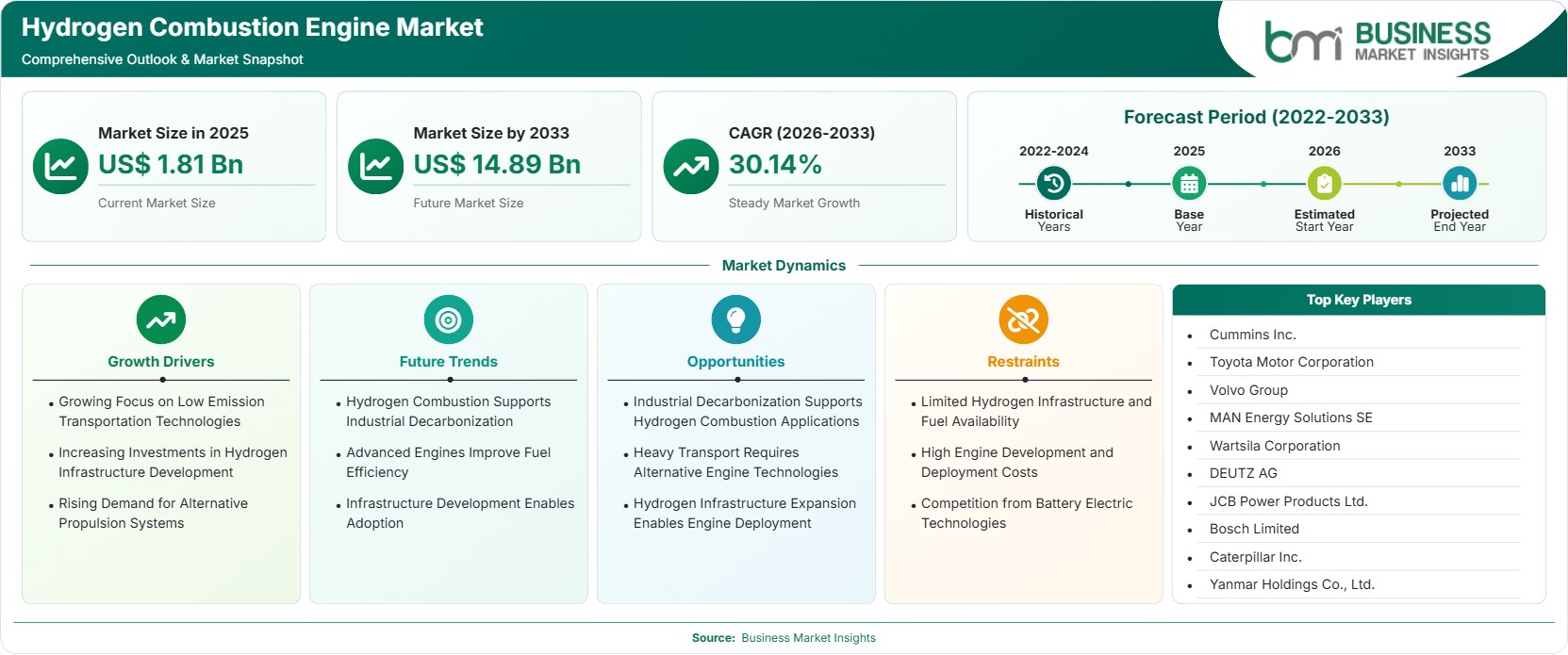
The Hydrogen Combustion Engine Market size was valued at US$ 1.81 Billion in 2025 and is projected to reach US$ 14.89 Billion by 2033, growing at a CAGR of 30.14% during 2026–2033. Key growth catalysts include hydrogen infrastructure expansion, heavy-duty transport decarbonization, supportive policy frameworks, industrial emissions reduction targets, and accelerating investments in hydrogen-powered mobility and marine applications.

Report Coverage
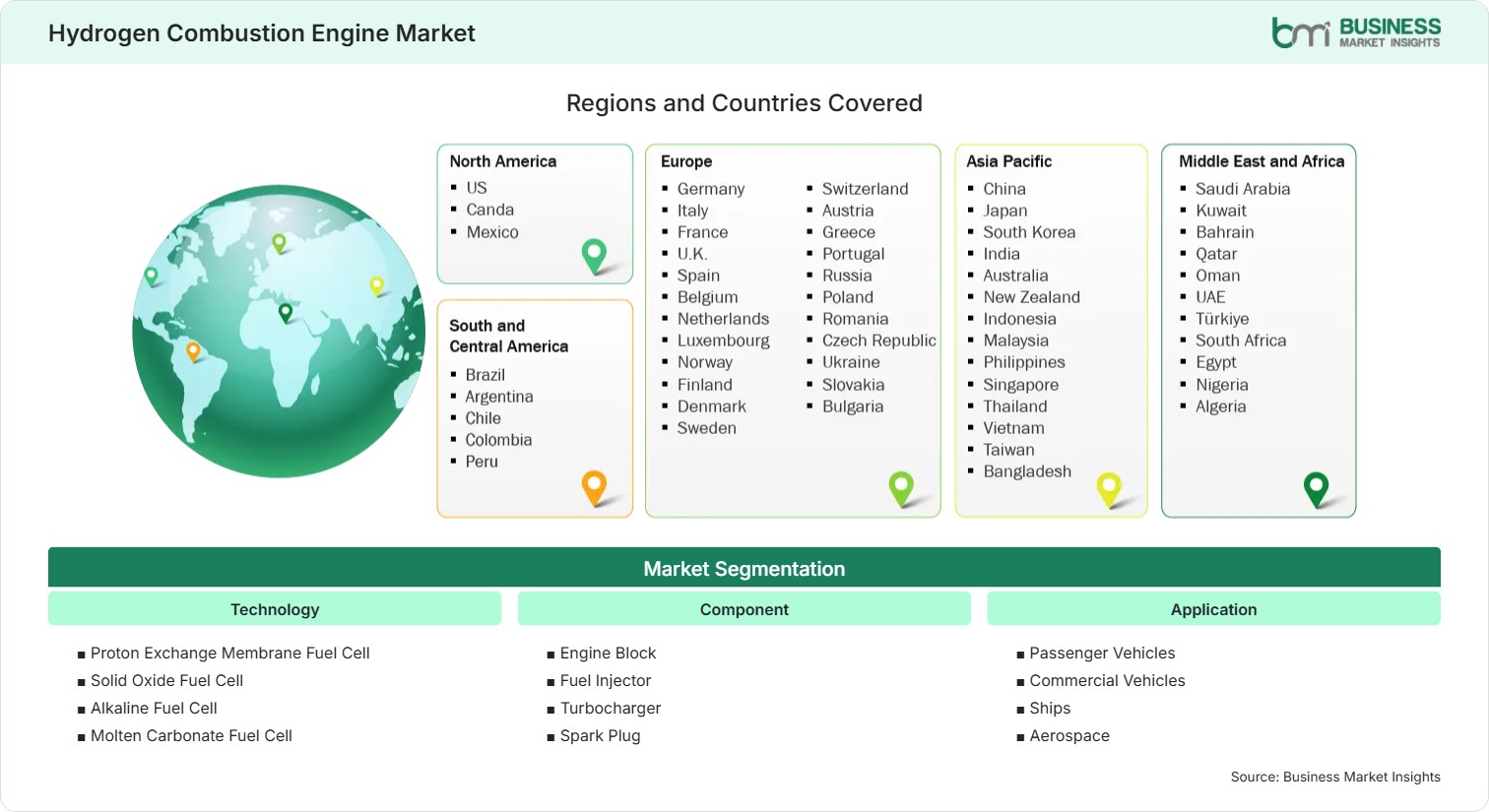
  • Technology: Proton Exchange Membrane Fuel Cell, Solid Oxide Fuel Cell, Alkaline Fuel Cell, Molten Carbonate Fuel Cell
  • Component: Engine Block, Fuel Injector, Turbocharger, Spark Plug
  • Application: Passenger Vehicles, Commercial Vehicles, Ships, Aerospace
US$ 1.81 Bn Market size in 2025
US$ 14.89 Bn Market Size by 2033
30.14% CAGR, 2026 - 2033
2026-2033 Forecast Period

AI Overview

Hydrogen Combustion Engine Market Summary

  • North America Region: Holds a market share of 34%–38% in 2025, growing at a CAGR of 27%–30% during 2026–2033. Growth is supported by hydrogen hub investments, commercial fleet decarbonization, industrial engine deployment, advancing refueling networks, supportive tax incentives, emissions compliance strategies, OEM partnerships, and expanding clean-energy infrastructure programs. The U.S. market benefits from federal hydrogen initiatives, logistics electrification alternatives, and an anticipated CAGR of 28%–31%.
  • Fastest Growing Region: Asia Pacific accounts for a 28%–32% share of the Hydrogen Combustion Engine Market in 2025 and advances at a CAGR of 33%–36% during 2026–2033. Rapid industrialization, hydrogen economy roadmaps, commercial vehicle demand, maritime decarbonization goals, domestic manufacturing incentives, fuel diversification priorities, and accelerating infrastructure investments support sustained regional expansion.
  • Leading Segment: Passenger Vehicles represent a 36%–40% share in 2025 and grow at 28%–31% CAGR during 2026–2033. Automotive manufacturers are leveraging familiar engine architectures, utilizing hydrogen-ready platforms, improving emissions performance, accelerating pilot deployments, developing supply chains, promoting low-carbon mobility, and expanding consumer awareness.
  • High Growth Segment: Aerospace commands 10%–14% share in 2025 and records 35%–38% CAGR during 2026–2033. Aviation decarbonization targets, hydrogen propulsion research, lightweight engine innovation, aviation-sector funding, airport hydrogen infrastructure planning, long-term sustainability commitments, and collaborative demonstration projects are driving momentum.
  • Key Market Opportunity: Expanding hydrogen-powered heavy-duty transport corridors create opportunities for engine manufacturers, infrastructure developers, fuel suppliers, logistics operators, and component specialists to build scalable zero-carbon transportation ecosystems globally.
  • Major Market Players: Cummins Inc., Toyota Motor Corporation, Volvo Group, MAN Energy Solutions SE, Wärtsilä Corporation, DEUTZ AG, JCB Power Products Ltd., Bosch Limited, Caterpillar Inc., and Yanmar Holdings Co., Ltd.
Strategic Insights

Hydrogen Combustion Engine Market: Strategic Insights

Hydrogen Combustion Engine Market Strategic Framework
FREE PDF
Request your free sample
Request free sample
Stakeholder View

Key Takeaways

  • The value chain is evolving from standalone engine production toward integrated ecosystems incorporating hydrogen generation, storage, transportation, refueling, and engine maintenance services.
  • Commercial mobility, maritime transport, and aviation demonstration programs offer attractive opportunities because these sectors require high-energy-density propulsion systems and faster refueling cycles.
  • Research priorities are shifting toward direct injection technologies, enhanced combustion control software, thermal efficiency improvements, and advanced component durability.
  • Japan, South Korea, Germany, and the United States provide compelling investment environments due to policy support, infrastructure commitments, and manufacturing capabilities.
  • Strategic alliances between automotive OEMs, industrial engine manufacturers, and hydrogen suppliers are increasing as stakeholders seek accelerated commercialization.
  • Component suppliers with expertise in fuel delivery systems, turbocharging, and advanced materials are positioned to capture value as deployment scales.
Geographic Outlook

Hydrogen Combustion Engine Market Regional Highlights

North America Hydrogen Combustion Engine Market

North America accounts for approximately 34%–38% of the Hydrogen Combustion Engine Market share in 2025 and is projected to expand at a CAGR of 27%–30% through 2033. Regional adoption is supported by hydrogen hub initiatives, industrial emissions mandates, and growing fleet demand. Heavy-duty trucking, construction equipment, and off-road machinery remain important demand centers. Strong manufacturing capabilities and increasing hydrogen production investments provide commercialization advantages. The region maintains leadership through policy support, technological expertise, and substantial clean-energy funding commitments.

  • U.S. and Canadian hydrogen hub programs are strengthening production capacity and distribution infrastructure, improving operational feasibility for transportation and industrial engine deployments.
  • Commercial fleet operators increasingly evaluate hydrogen-powered solutions where long operating ranges and rapid refueling provide advantages over alternative low-emission technologies.
  • Industrial decarbonization commitments across logistics, mining, and construction sectors continue creating demand for hydrogen-ready engine platforms and associated components.
  • Collaborations between energy companies and OEMs support pilot projects focused on real-world performance validation and total-cost-of-ownership optimization.

US Hydrogen Combustion Engine Market

The United States represents 78%–82% of North American revenue and is forecast to record a CAGR of 28%–31% during the assessment period. Federal clean-energy incentives, hydrogen funding mechanisms, and commercialization initiatives continue encouraging investment. Demand is particularly evident in freight transportation and industrial machinery applications. Engineering expertise, established manufacturing bases, and access to research institutions support domestic innovation. Public-sector commitments toward low-carbon fuels enhance market visibility and accelerate pilot-scale deployment activity.

  • National hydrogen initiatives stimulate project development across generation, storage, and transportation infrastructure supporting future engine adoption.
  • Freight and logistics operators prioritize technologies that preserve payload capacity while helping achieve corporate sustainability objectives.
  • Industrial equipment manufacturers expand product portfolios to include hydrogen-compatible engines for construction and heavy-duty applications.
  • Technology partnerships accelerate testing programs targeting efficiency improvements, emissions reduction, and reliability enhancement.

Europe Hydrogen Combustion Engine Market

Europe holds a 26%–30% share in 2025 and advances at a CAGR of 29%–32% in the Hydrogen Combustion Engine Market. Ambitious climate objectives, renewable hydrogen strategies, and industrial modernization programs are supporting deployment. Germany remains the leading market with growth near 30%–33%, while Nordic countries and the Netherlands emerge as high-growth adopters. Maritime applications contribute strongly because regional shipping operators pursue decarbonization solutions. The presence of advanced engineering firms and powertrain manufacturers reinforces innovation activity throughout the European ecosystem.

  • Germany leads regional deployment through industrial decarbonization initiatives, automotive innovation, and hydrogen infrastructure investments.
  • Maritime operators increasingly examine hydrogen combustion as a pathway toward compliance with tightening environmental standards.
  • Cross-border hydrogen corridor projects improve fuel availability and support future commercial deployment across transportation networks.
  • Government grants encourage technology demonstration programs involving trucking, shipping, and industrial machinery.
  • Nordic countries exhibit above-average adoption rates due to renewable energy resources and supportive regulatory environments.

Asia Pacific Hydrogen Combustion Engine Market

Asia Pacific is expected to hold a market share of 28% to 32% in 2025 and to have the highest growth rate of 33% to 36% during the forecast period. In terms of deployment, Japan and China are leading players, whereas South Korea and India are emerging as high-growth regions. Governments in these regions are supporting the adoption of a hydrogen economy, local production, and energy security. Investments in production infrastructure and transportation applications boost competitiveness in this region. Increasing industrial activity, vehicle manufacturing capabilities, and public-sector support continue positioning Asia Pacific as a strategic engine-development hub globally.

  • Japan maintains leadership through hydrogen mobility programs and long-term industrial decarbonization strategies.
  • China expands investments across production, storage, transportation, and vehicle manufacturing ecosystems.
  • South Korea benefits from coordinated hydrogen roadmaps supporting industrial and transportation adoption.
  • India demonstrates strong potential through renewable hydrogen initiatives and growing commercial vehicle demand.
  • Regional manufacturers continue expanding R&D programs focused on combustion efficiency and cost reduction.

Rest of World Hydrogen Combustion Engine Market

The Rest of World region accounts for an 8%–12% share and is expected to grow at a CAGR of 28%–31%. South and Central America are gradually exploring hydrogen opportunities linked to renewable-energy development and industrial diversification. In the Middle East and Africa, national hydrogen export strategies encourage infrastructure investments and technology partnerships. Countries including the United Arab Emirates and Saudi Arabia are emerging as growth centers. Expanding hydrogen production capacity strengthens long-term commercialization prospects across transportation and industrial sectors.

  • Renewable-energy resources support competitive hydrogen production opportunities across several Latin American economies.
  • Middle Eastern governments invest heavily in hydrogen-export ecosystems, benefiting future engine deployments and refueling infrastructure.
  • Saudi Arabia and the UAE demonstrate strong growth potential through industrial-scale hydrogen projects.
  • Mining, heavy transport, and industrial machinery applications provide practical entry points for regional adoption.
  • International partnerships facilitate technology transfer, pilot projects, and commercialization planning.
Global Market Geography
FREE PDF
Request your free sample
Request free sample
Segment Analysis

Hydrogen Combustion Engine Market Segmentation

Technology

Technology was an important contributor to the creation of value, with the integration of the proton exchange membrane fuel cell ecosystem seen as adopted early on. The market was estimated to have around 38%-42% market share in 2025, while it is projected to grow at a 29%-32% CAGR. The hydrogen combustion engine market scope continues to expand as performance and economy improve over time, durability, infrastructure compatibility, and operating economics improve across transportation and industrial applications.

  • Proton Exchange Membrane Fuel Cell: Widely supported by transportation projects due to responsiveness, operational flexibility, and compatibility with emerging hydrogen mobility ecosystems.
  • Solid Oxide Fuel Cell: Gains traction in industrial and stationary applications where efficiency advantages and continuous operating conditions create favorable economics.
  • Alkaline Fuel Cell: Supported by established technology maturity and suitability for selected industrial environments emphasizing cost-effective deployment pathways.
  • Molten Carbonate Fuel Cell: Primarily evaluated for large-scale energy applications requiring high-temperature operation and integration with industrial processes.

Component

The component section denotes increased spending in customized engine design. It has a 30% to 34% market share for 2025 and a 31% to 34% CAGR. Suppliers are focusing on enhancing durability, heat management, precise fuel injection, and optimization solutions. Improvements in engineering increase dependability and expand commercialization opportunities.

  • Engine Block: Advanced materials and redesigned structures improve durability under hydrogen combustion conditions and support long operating lifecycles.
  • Fuel Injector: Precision fuel delivery technologies enhance combustion control, emissions performance, and overall engine efficiency across multiple applications.
  • Turbocharger: Increasingly integrated to optimize power output while improving operational efficiency under varying load conditions.
  • Spark Plug: Specialized designs improve ignition stability, performance consistency, and long-term reliability in hydrogen-fueled powertrains.

Application

The application dynamics remain of utmost importance in the commercialization approach. Passenger Cars hold the prime position, with a share of 36%-40% in 2025, and are projected to grow at a 28%-31% CAGR. The Hydrogen Combustion Engine Market trends show greater diversification towards commercial mobility, marine transport, and aviation programs as stakeholders pursue decarbonization while maintaining operational flexibility.

  • Passenger Vehicles: OEM pilot programs and hydrogen mobility initiatives support adoption while leveraging existing vehicle manufacturing expertise.
  • Commercial Vehicles: Long-distance operations and rapid refueling needs make this category an attractive commercialization target.
  • Ships: Maritime operators evaluate hydrogen-powered propulsion systems to align with tightening environmental regulations and sustainability objectives.
  • Aerospace: Research programs and demonstration projects accelerate development of hydrogen-based propulsion technologies for future aviation applications.
Market Forces

Hydrogen Combustion Engine Market Dynamics

Key Market Drivers

Expansion of National Hydrogen Economy Programs

Governments across North America, Europe, and Asia continue allocating funding toward hydrogen production, transport infrastructure, and end-use commercialization. According to organizations such as the International Energy Agency, hydrogen is a key means of decarbonizing sectors that are hard to electrify. The provision of financial assistance makes hydrogen deployment less risky for manufacturers and fleet operators. In the case of the Hydrogen Combustion Engine Market growth will be shaped by policies that facilitate infrastructure development, piloting, and technology verification. With improved hydrogen availability, its adoption will become more feasible in transport, marine, and industrial sectors. Public-private collaboration also accelerates ecosystem formation and supports long-term market scalability.

Heavy-Duty Transport Decarbonization Requirements

Propulsion systems for long-haul trucking, mining operations, construction sites, and industrial mobility must be designed to provide sustained power output and flexibility. One appealing aspect of hydrogen combustion is that it allows the existing engine design and fueling system to be retained. Companies looking to reduce their emissions without significant changes to their operations are interested in hydrogen engines. Hydrogen Combustion Engine Market growth can be stimulated by the practical possibilities of using it instead of battery-electric systems due to charging-time constraints or effects on load. Consequently, commercial transportation remains among the most promising application areas.

Advancements in Engine Efficiency and Component Design

There are further developments by manufacturers in the control of the combustion process, fuel injection technology, turbochargers, and thermal management technologies. This helps increase efficiency and reduce operational difficulties associated with hydrogen fuel use. Hydrogen Combustion Engine Market trends indicate greater engineering development, leading to improved performance and more reliable operation in challenging conditions. Component makers have begun producing components that will improve durability and increase efficiency. The number of research activities has increased, helping improve performance and efficiency. This has helped increase the market for hydrogen-powered vehicles, operators, industrial users, and infrastructure stakeholders.

Key Market Opportunities

Development of Green Hydrogen Freight Corridors

The development of dedicated freight transport corridors that run on renewable hydrogen fuel creates many opportunities. Freight carriers need easily scalable, carbon-neutral technology for their trucks to perform long-distance tasks. The implementation of the infrastructure ensures that the fuel is easily accessible and utilized. Hydrogen Combustion Engine Market Forecasts pay more attention to freight transport corridors as enablers of the broad use of such engines. Engine producers, hydrogen fuel providers, and fleet owners will benefit from the development of such ecosystems. In addition, profitable business models for corridor operations may emerge. Investments targeting transportation hubs and supply-chain networks are therefore expected to generate attractive long-term returns.

Marine Decarbonization and Alternative Fuel Adoption

Shipping companies are increasingly being asked to reduce their emissions without compromising performance. Hydrogen engine technology could provide a way forward for select ship types compatible with hydrogen. International maritime rules have encouraged the investigation of different fuels and engines. Engine companies could leverage this demand to design new engine types tailored for the sea, with high efficiency and longevity. The development of infrastructure at key ports could increase the likelihood that such systems become a widely adopted strategic option within broader decarbonization initiatives.

Emerging Aerospace Demonstration Programs

Players in the aviation industry are exploring ways to use hydrogen propulsion technologies to address future sustainability challenges. The initiatives by airports, aircraft manufacturers, and energy producers provide opportunities for technology validation and ecosystem building. Investment is increasing as the parties involved seek suitable alternatives to replace existing aviation fuels. Growth is not limited to engine-related technologies; it also encompasses storage and safety technologies. A partnership between aerospace companies, research institutes, and public bodies is helping to foster innovation pipelines. Successful pilot projects may be able to lead to substantial commercial potential.

Market Restraints and Challenges

High Infrastructure Costs and Limited Refueling Networks

Factor: There is an enormous cost required for the creation of hydrogen-producing, storing, transporting, and fueling infrastructure. Impact: The limited availability of the infrastructure makes commercialization difficult, creates operational uncertainties, and slows fleet utilization. Many would-be users of hydrogen vehicles are reluctant due to differences in infrastructure availability across locations. The engine technology might be feasible, but the lack of fueling infrastructure limits its use. There should be concerted efforts made by the government, utilities, fuel producers, and the transport industry to deploy large-scale fleets. Economics for a project can be difficult in the initial phase of the market, when usage is low. The scenario makes it tough for the technology to keep pace with the rapidly growing interest in hydrogen-powered technologies.

Fuel Cost Volatility and Supply Constraints

Factor: Hydrogen production costs remain influenced by energy prices, economies of scale, and the level of infrastructure development. Impact: High energy costs will reduce the attractiveness of hydrogen-powered automobiles compared to other drive technologies. Business entities in the industrial sector or those providing transport services are usually concerned with operating costs when choosing a new technology. Variations in hydrogen supply across regions can affect investment planning. Efficient hydrogen production and distribution are essential for commercial success in hydrogen use. Until economies of scale and developed infrastructure are in place, some parties may postpone their investment decisions.

Company Analysis

Competitive Landscape

Hydrogen Combustion Engine Market analysis indicates a competitive environment characterized by established engine manufacturers, automotive OEMs, industrial equipment providers, and technology developers pursuing hydrogen-based propulsion strategies.

Company Name

Overview

Products and Services relevant to this market

Cummins Inc.

Global power solutions provider advancing hydrogen internal combustion technologies for heavy-duty transport and industrial applications.

Hydrogen engines, powertrain systems, fuel technologies, commercial vehicle propulsion solutions, engineering services.

Toyota Motor Corporation

Major automotive manufacturer investing in hydrogen mobility, combustion engine innovation, and low-carbon transportation platforms.

Hydrogen-powered vehicles, combustion technologies, mobility solutions, engineering development programs.

Volvo Group

Commercial vehicle and equipment leader focused on sustainable propulsion technologies and hydrogen deployment initiatives.

Heavy-duty trucks, hydrogen engines, transport solutions, fleet technologies.

MAN Energy Solutions SE

Industrial engineering company developing hydrogen-based propulsion systems for marine and industrial applications.

Large engines, marine propulsion systems, energy solutions, hydrogen technologies.

Wärtsilä Corporation

Energy and marine technology specialist supporting decarbonization through advanced propulsion innovation.

Marine engines, energy systems, hydrogen-ready technologies, lifecycle services.

DEUTZ AG

Engine manufacturer expanding hydrogen engine development for off-highway and industrial applications.

Hydrogen engines, industrial power solutions, construction equipment powertrains.

JCB Power Products Ltd.

Construction equipment specialist actively developing hydrogen combustion engine platforms.

Hydrogen-powered machinery, engines, construction equipment technologies.

Bosch Limited

Technology supplier enabling hydrogen engine development through advanced component and systems expertise.

Fuel injection systems, sensors, engine electronics, mobility technologies.

Caterpillar Inc.

Industrial machinery leader exploring hydrogen-fueled technologies for energy and heavy equipment markets.

Industrial engines, mining equipment power systems, hydrogen-ready technologies.

Yanmar Holdings Co., Ltd.

Diversified engine manufacturer engaged in sustainable powertrain and hydrogen development initiatives.

Compact engines, marine propulsion technologies, hydrogen research programs.

Trust & Transparency

Research Methodology

The market analysis combines proprietary research with secondary data from government agencies, company disclosures, regulatory filings, industry databases and expert interviews. Market estimates are validated through data triangulation, cross-market benchmarking and analyst review.

View Full Research Methodology

Questions Answered

Frequently Asked Questions

What does a Hydrogen Combustion Engine Market Report typically evaluate?

A Market Report generally covers market size, technology developments, competitive positioning, regulatory frameworks, adoption trends, segmentation performance, and future growth prospects.

Which regions are expected to attract the most investment?

North America, Europe, Japan, South Korea, China, and selected Middle Eastern countries are expected to attract substantial investment due to supportive policies and infrastructure programs.

How does hydrogen combustion differ from fuel-cell technology?

Hydrogen combustion engines burn hydrogen directly within modified internal combustion systems, while fuel cells generate electricity electrochemically to power electric drivetrains.

What factors most influence adoption decisions?

Fuel availability, hydrogen cost, infrastructure proximity, emissions regulations, engine reliability, maintenance requirements, and total cost of ownership strongly influence purchasing decisions.

Which application area offers the strongest commercial potential?

Commercial vehicles provide strong potential because operators prioritize range, uptime, payload preservation, and rapid refueling. These operational characteristics align effectively with hydrogen-fueled propulsion systems.

Access the Full Hydrogen Combustion Engine Market Report

Get segment-level forecasts, regional estimates, competitive benchmarking, company profiles and downloadable Excel datasets.

Access the full Hydrogen Combustion Engine Market Report
350 pages PDF & Excel | 2026-09-04