Market Summary
Executive Summary and Global Market Analysis
Utility electric vehicles are low-speed, battery-operated transport technologies used in material handling, people moving, and operations within controlled environments. They are more energy efficient and cost-effective to operate than their fuel-based counterparts because they produce less pollution during operation. The use of electric utility vehicles has gained popularity in agricultural production systems, governmental establishments, airports, industries, and recreational areas looking for sustainable means of transportation.
The move towards a future with sustainable transportation technologies has motivated many organizations to embrace electric utility vehicles for environmental reasons and due to their easy maintenance and efficiency. Improvements in battery systems and other features of electric utility vehicles are making the technologies more appealing than ever.
Demand patterns differ by vehicle configuration, battery technology, and application area. Utility task vehicles maintain a strong market presence due to their versatility in transporting equipment, materials, and personnel. Lithium-ion batteries are gaining preference because of their longer service life, faster charging capabilities, and improved energy efficiency. Expanding use across agriculture, municipal services, and airport operations is also contributing to broader market penetration.
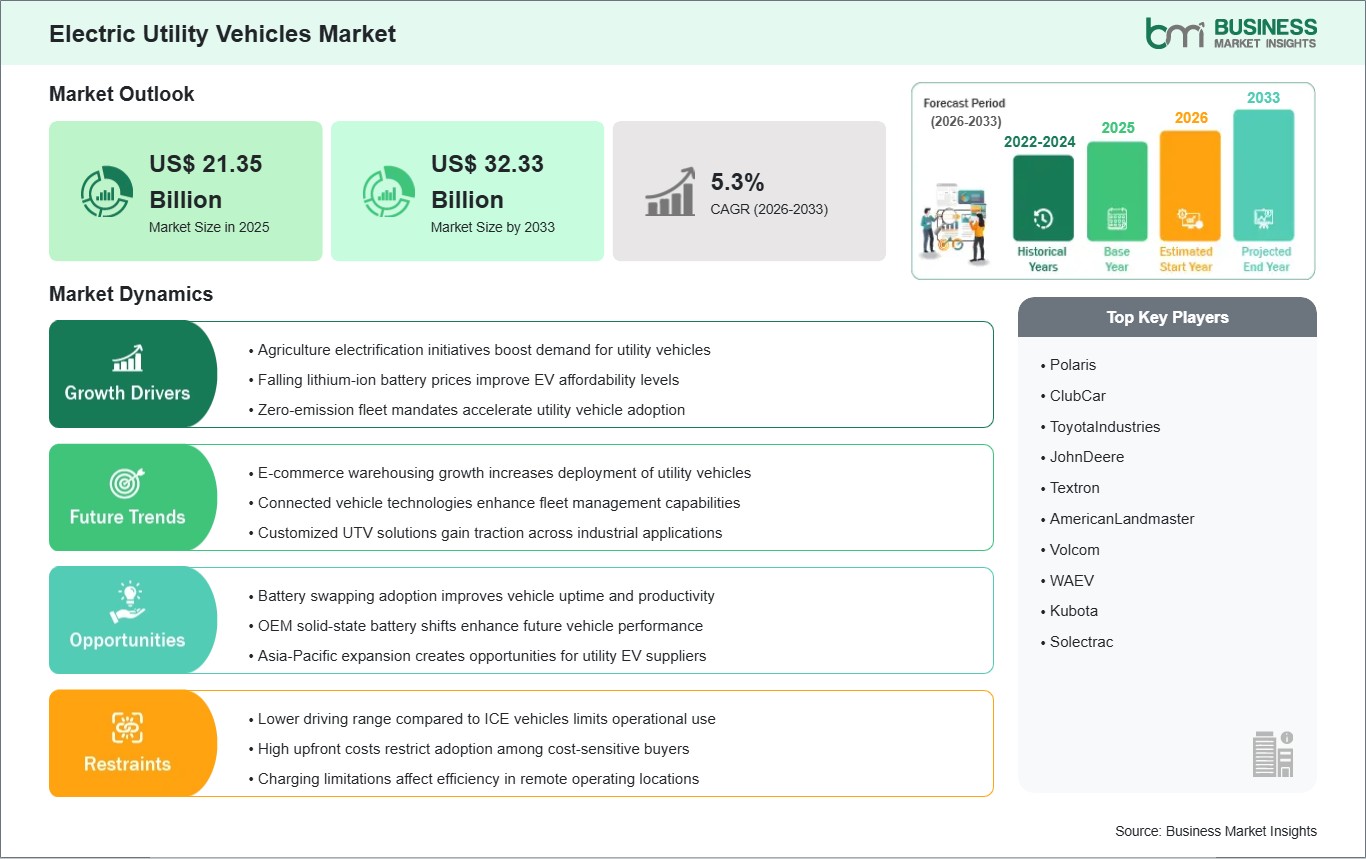
Competitive strategies in the industry will revolve around improving vehicle performance, batteries, and products developed for specific purposes. Manufacturers are focusing on developing vehicles with improved range, carrying capacity, and fleet management functionalities to meet the changing needs of consumers. Increased attention will be paid to developing technologies such as connected vehicles, battery swapping, and sustainable mobility systems.
Segment Analysis
Electric Utility Vehicles Market Segmentation
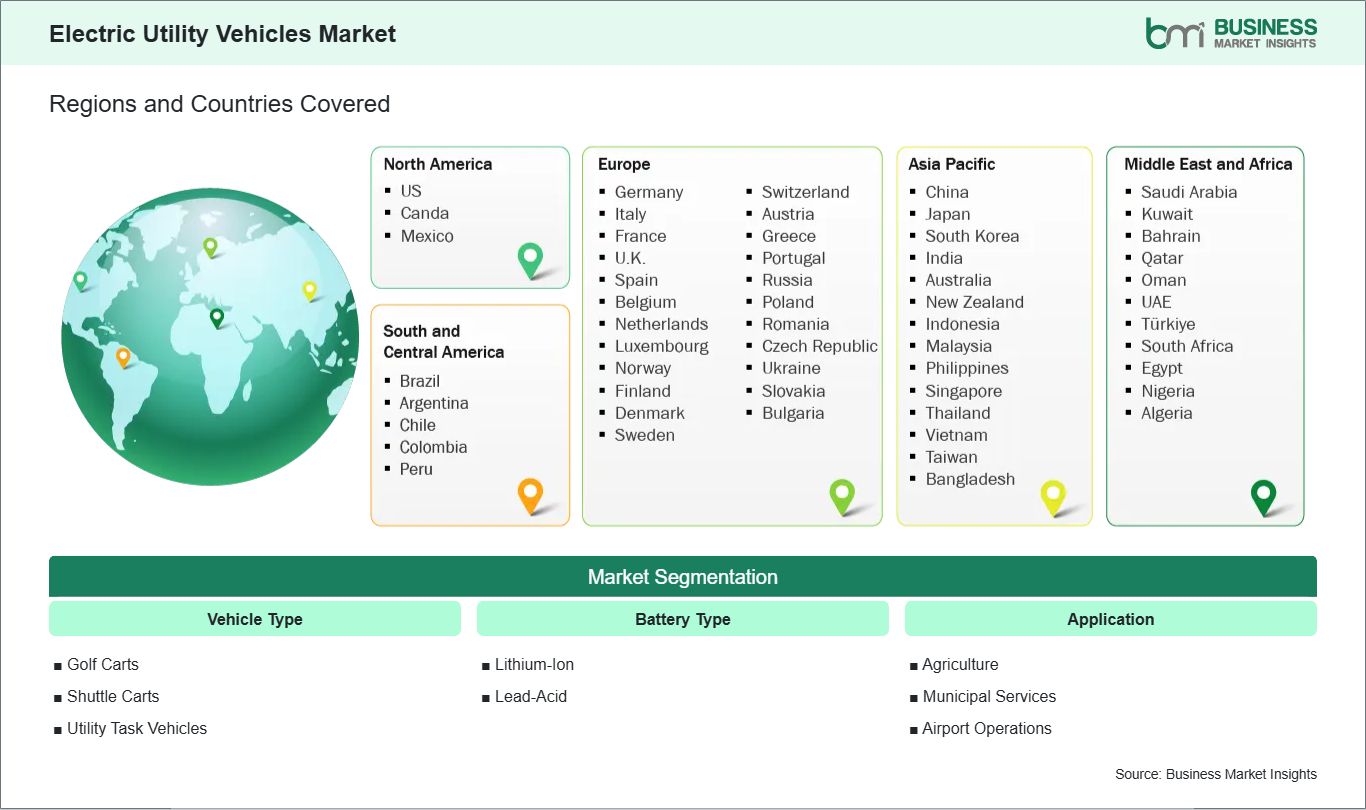
The electric utility vehicles market is segmented based on vehicle type, battery type, and application, reflecting the growing adoption of electric mobility solutions across operational, commercial, and public-service environments.
By Vehicle Type
- Golf Carts: Compact design and efficient mobility capabilities support utilization across recreational and institutional facilities.
- Shuttle Carts: Personnel transportation requirements encourage deployment in airports, campuses, and hospitality environments.
- Utility Task Vehicles: Cargo handling versatility and operational flexibility strengthen adoption across industrial and agricultural applications.
By Battery Type
- Lithium-Ion: Superior energy density and longer operational lifespan support increasing deployment across modern vehicle fleets.
- Lead-Acid: Established technology and lower acquisition costs sustain utilization in cost-sensitive operating environments.
By Application
- Agriculture: Farm transportation and field-support activities encourage integration of electric utility vehicles into daily operations.
- Municipal Services: Sustainable fleet initiatives support adoption across maintenance, sanitation, and public service activities.
- Airport Operations: Efficient personnel and equipment movement requirements reinforce utilization within airport infrastructure environments.
Market Forces
Electric Utility Vehicles Market Drivers and Opportunities
Agriculture electrification push
Electrified equipment and vehicles are now widely utilized within agriculture to achieve greater levels of sustainability and efficiency. In search of a replacement for traditional fuel-based vehicles, farmers and agricultural businesses aim to lower their costs, make maintenance easier, and meet their environmental goals. Utility vehicles powered by electricity offer a reliable method for moving people, equipment, and supplies around on a farm.
The advantages of electrification have been found to be consistent with the demands of modern agricultural activities. Silent performance, lesser maintenance cost, and suitability with renewable energy systems increase their adaptability within the agricultural sector. With the increasing focus on sustainable agriculture by government bodies and other organizations involved in agriculture, electric utility vehicles can play an essential role in agricultural transportation solutions.
Battery swapping adoption
Battery swapping technology presents a promising opportunity to improve vehicle utilization and reduce operational downtime associated with conventional charging methods. Fleet operators increasingly seek solutions that allow continuous vehicle availability, particularly in environments requiring frequent transportation and material handling activities. Battery swapping systems enable rapid energy replenishment, improving productivity and operational flexibility across utility vehicle fleets.
Potential future applicability ranges from agriculture-related vehicles, city vehicle fleets, airports, and factories where constant vehicular access is required. Common battery types and battery swapping technology can ease fleet management and minimize charging constraints. As batteries improve technologically, battery swapping technology may play a key role in the expansion of utility EVs.
Size and Share Analysis
Electric Utility Vehicles Market Size and Share Analysis
The Electric Utility Vehicles market is projected to grow from US$ 21.35 billion in 2025 to US$ 32.33 billion by 2033, registering a CAGR of 5.3% from 2026 to 2033.
By vehicle type, the utility task vehicles accounts for a significant share due to its ability to support cargo transport, equipment movement, and operational tasks across a broad range of commercial and industrial environments. Its versatility and functional utility have strengthened adoption among professional fleet operators.
By battery type, the lithium-ion segment leads the market owing to its superior energy efficiency, extended service life, and faster charging performance. Growing preference for high-performance battery systems and declining lifecycle costs have accelerated deployment across modern electric utility vehicle fleets.
Report Coverage
Electric Utility Vehicles Market Report Coverage and Deliverables
The "Electric Utility Vehicles Market Size and Forecast (2022-2033)" report provides a detailed analysis of the market covering below areas:
- Market size and forecast at global, regional, and country levels for all key market segments covered under the scope
- Market trends, along with market dynamics such as drivers, restraints, and key opportunities
- Market analysis covering key trends, global and regional frameworks, major players, regulations, and recent developments
- Industry landscape and competitive analysis covering market concentration, heat map analysis, prominent players, and recent developments
- Detailed company profiles, including SWOT analysis
Geographic Insights
Electric Utility Vehicles Market Geographic Insights
The Electric Utility Vehicles market shows diverse regional adoption patterns influenced by electrification policies, sustainability initiatives, agricultural modernization efforts, and investments in low-emission transportation infrastructure. Demand varies according to fleet replacement trends, operational requirements, and the pace of electric mobility adoption across different regions.
The region of North America exhibits high levels of market activity owing to the extensive use of utility vehicles in agricultural operations, recreational purposes, and municipal and institutional activities. In order to ensure operational efficiency and achieve their environmental goals, fleet operators are opting to shift towards electric vehicle use.
The region of Asia Pacific showcases increased usage due to agricultural mechanization efforts, infrastructural developments in cities, and sustainability initiatives. Increasing trends of electrification and modernization within the region are expected to create an enabling environment for increased adoption of electric utility vehicles.
Europe continues to witness steady adoption supported by stringent environmental regulations, decarbonization initiatives, and strong emphasis on sustainable mobility solutions. Emerging markets across Latin America, the Middle East, and Africa are gradually increasing utilization as agricultural development programs, tourism infrastructure projects, and municipal modernization initiatives encourage investment in electric utility vehicle fleets.
Industry Activity
Recent Developments
The electric utility vehicles market is evaluated by gathering qualitative and quantitative data post primary and secondary research, which includes important corporate publications, association data, and databases. Recent developments and news in the market include:
- In October 2025, John Deere announced that it expanded its zero-emissions utility vehicle portfolio by introducing the all-electric Gator GX and GX Crew models. Both vehicles feature high-capacity electric powertrains designed for near-silent, reliable performance during residential, rural, and light commercial jobs.
- In February 2025, Textron Specialized Vehicles Inc., a Textron Inc company, announces the launch of the Cushman Hauler XL utility vehicle, a new addition to the durable Hauler line-up designed to meet the demand for more hauling capacity with a 68.5-inch-long aluminum flat bed and 1,600-lb payload.
Trust & Transparency
Research Methodology
The market analysis combines proprietary research with secondary data from government agencies, company disclosures, regulatory filings, industry databases and expert interviews. Market estimates are validated through data triangulation, cross-market benchmarking and analyst
review.
View Full Research Methodology
Key Sources Referred:
Society of Automotive Engineers Institute of Electrical and Electronics Engineers (IEEE) European Automobile Manufacturers' Association (ACEA) Japan Automobile Manufacturers Association (JAMA) China Association of Automobile Manufacturers (CAAM) Indian Automotive Component Manufacturers Association (ACMA) International Energy Agency (IEA) Electric Drive Transportation Association (EDTA) International Road Transport Union (IRU) Company Websites Company Annual Reports Company Investor Presentations