
Commercial Vehicle Automotive Thermal System Market Outlook: Size, Share, Trends, Growth Analysis, Competitive Landscape & Forecast, 2026–2033

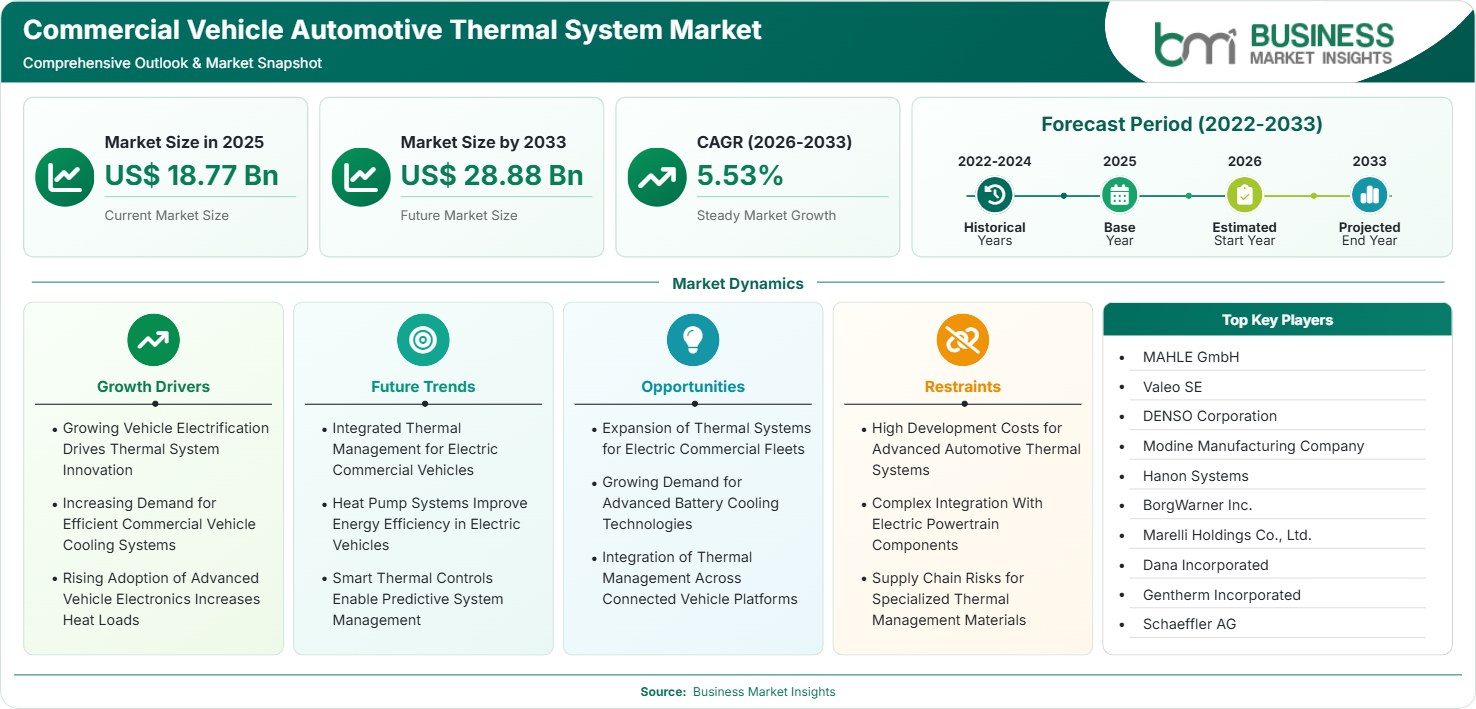
The Commercial Vehicle Automotive Thermal System Market size was valued at US$ 18.77 Billion in 2025 and is projected to reach US$ 28.88 Billion by 2033, growing at a CAGR of 5.53% during 2026–2033, supported by electrification, higher electronic loads, efficient HVAC, and integrated thermal management.

Report Coverage
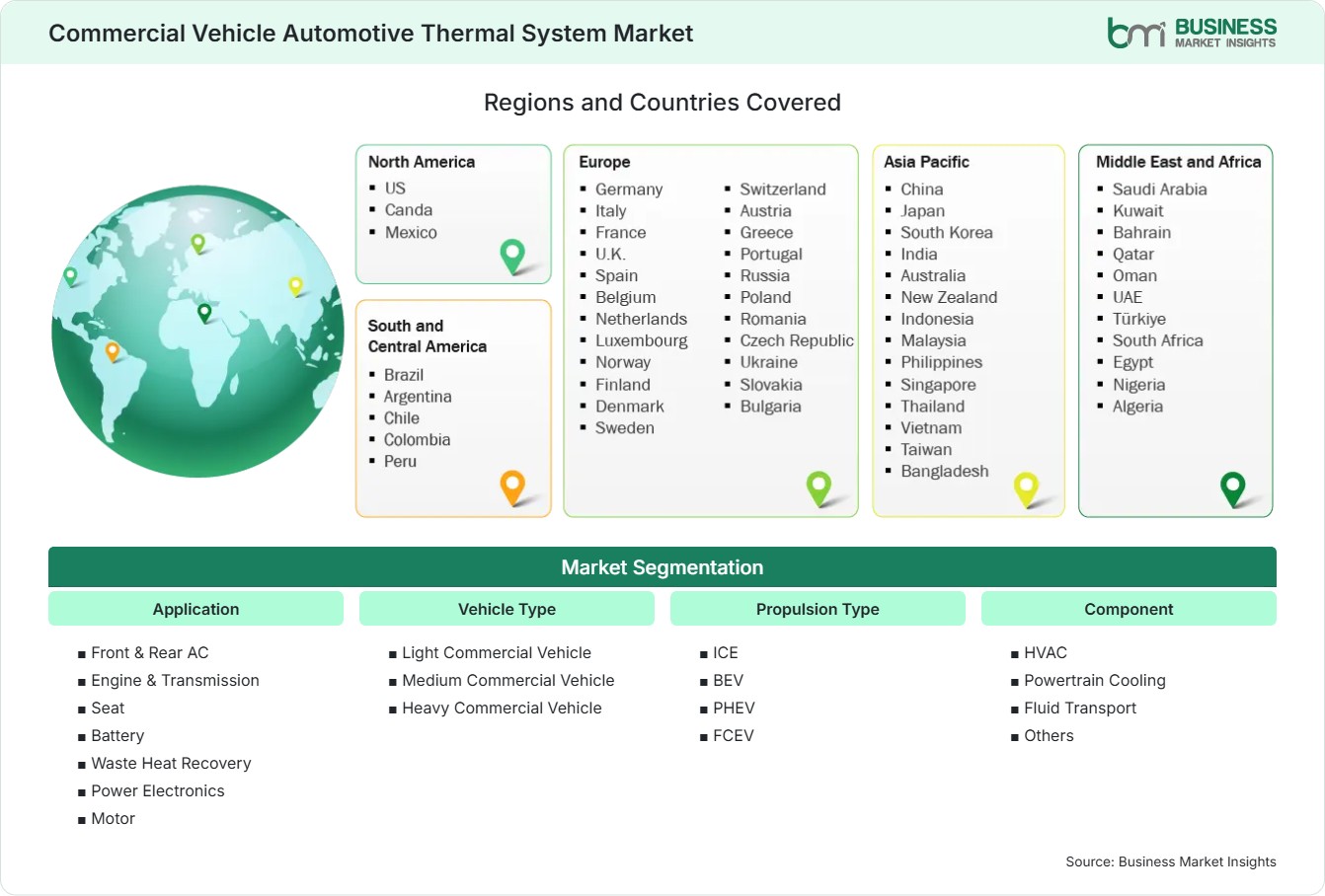
  • Application: Front & Rear AC, Engine & Transmission, Seat, Battery, Waste Heat Recovery, Power Electronics, Motor
  • Vehicle Type: Light Commercial Vehicle, Medium Commercial Vehicle, Heavy Commercial Vehicle
  • Propulsion Type: ICE, BEV, PHEV, FCEV
  • Component: HVAC, Powertrain Cooling, Fluid Transport, Others
US$ 18.77 Bn Market size in 2025
US$ 28.88 Bn Market Size by 2033
5.53% CAGR, 2026 - 2033
2026-2033 Forecast Period

01 AI Overview

Commercial Vehicle Automotive Thermal System Market Summary

  • North America Region: North America holds a 22%–26% share in 2025 and grows at a 5.0%–5.6% CAGR during 2026–2033, supported by commercial fleet electrification, stricter efficiency requirements, and replacement demand. The US remains the principal market, supported by fleet modernization, electric truck deployment, higher thermal loads, and increasing demand for integrated cooling systems.
  • Fastest Growing Region: Asia Pacific holds a 39%–43% share in 2025 and grows at a 6.0%–6.7% CAGR during 2026–2033, driven by commercial vehicle production, electrification, battery manufacturing, urban logistics, advanced HVAC adoption, and expanding electric bus and truck fleets.
  • Leading Segment: Front & Rear AC holds a 32%–36% share in 2025 and grows at a 5.2%–5.8% CAGR during 2026–2033, supported by cabin comfort requirements, climate-control efficiency, fleet utilization, larger vehicle cabins, and increasing integration of intelligent HVAC controls.
  • High Growth Segment: Battery holds a 12%–16% share in 2025 and grows at an 8.5%–9.3% CAGR during 2026–2033, driven by commercial EV deployment, battery temperature control, charging performance, thermal safety, range optimization, and higher battery-pack energy density.
  • Key Market Opportunity: Electric commercial fleets are creating demand for integrated battery, cabin, power electronics, and motor thermal systems, creating opportunities for modular cooling platforms, intelligent controls, and localized manufacturing.
  • Major Market Players: MAHLE GmbH; Valeo SE; DENSO Corporation; Modine Manufacturing Company; Hanon Systems; BorgWarner Inc.; Marelli Holdings Co., Ltd.; Dana Incorporated; Gentherm Incorporated; Schaeffler AG.
02 Strategic Insights

Commercial Vehicle Automotive Thermal System Market: Strategic Insights

Commercial Vehicle Automotive Thermal System Market Strategic Framework
FREE PDF
Request your free sample
Request free sample
03 Stakeholder View

Key Takeaways

  • OEMs increasingly prefer coordinated thermal architectures that manage several heat sources through shared controls, pumps, valves, and heat exchangers.
  • Electric trucks and buses require precise temperature control to support range, charging performance, battery durability, and operational safety.
  • Sensor-driven controls can optimize cooling and heating according to vehicle load, ambient conditions, battery state, route requirements, and powertrain operating conditions.
  • Commercial vehicle production, electric bus deployment, battery supply chains, and domestic component manufacturing provide a broad customer base for thermal-system suppliers.
  • OEMs increasingly require thermal suppliers to participate earlier in vehicle development, platform engineering, validation, and production integration.
  • High vehicle utilization makes reliable pumps, compressors, cooling modules, HVAC components, diagnostics, and replacement parts commercially important throughout fleet operating cycles.
04 Geographic Outlook

Commercial Vehicle Automotive Thermal System Market Regional Highlights

North America Commercial Vehicle Automotive Thermal System Market

North America holds a 22%–26% share in 2025 and North America Commercial Vehicle Automotive Thermal System Market forecast to grow at a 5.0%–5.6% CAGR through 2033. The region benefits from commercial fleet replacement, electric truck deployment, advanced HVAC adoption, and increasing electronic content. The US accounts for most regional demand, while Canada contributes through buses, vocational vehicles, and fleet modernization.

  • Commercial fleet electrification is increasing demand for battery cooling, high-voltage heaters, e-compressors, and thermal controls designed for long operating cycles.
  • Heavy-duty vehicle manufacturers are prioritizing thermal systems capable of maintaining powertrain and electronic components within controlled operating ranges during demanding duty cycles.
  • Fleet operators increasingly evaluate HVAC efficiency alongside vehicle uptime because climate-control energy consumption can influence operating costs and electric range.
  • Domestic manufacturing and localized sourcing are becoming more important as OEMs seek resilient supply chains for critical thermal components and assemblies.

US Commercial Vehicle Automotive Thermal System Market

The US Commercial Vehicle Automotive Thermal System Market represents 79%–83% of North American demand in 2025 and grows at a 5.1%–5.7% CAGR through 2033. Demand is supported by electric commercial vehicles, fleet replacement, stricter efficiency requirements, and growing electronic content. Medium and heavy commercial vehicles provide important opportunities because operating conditions create high thermal loads.

  • Electric truck and bus deployment is expanding demand for battery cooling systems, high-voltage heaters, e-compressors, and integrated thermal modules.
  • Fleet operators place strong emphasis on uptime, making durable thermal components and predictive diagnostics important purchasing considerations.
  • Higher electronic content increases heat generation, strengthening demand for efficient cooling of inverters, controllers, motors, and auxiliary electrical systems.

Europe Commercial Vehicle Automotive Thermal System Market

Europe Commercial Vehicle Automotive Thermal System Market holds a 24%–28% share in 2025 and grows at a 4.8%–5.4% CAGR through 2033. Germany, France, Italy, Spain, and the United Kingdom remain leading markets, while Germany and France provide substantial technology opportunities. European OEMs are advancing electrified trucks, buses, and vans while improving ICE efficiency.

  • Germany remains a major engineering and manufacturing center, supporting demand for sophisticated thermal modules across commercial vehicle platforms.
  • France provides opportunities through electric buses, commercial vans, fleet modernization, and increasing demand for efficient cabin and powertrain thermal systems.
  • Southern European markets benefit from high ambient temperatures, increasing the importance of HVAC performance, battery cooling, and thermal durability.
  • European efficiency and emissions requirements encourage suppliers to develop integrated systems that reduce parasitic energy consumption while maintaining component temperature stability.

Asia Pacific Commercial Vehicle Automotive Thermal System Market

Asia Pacific Commercial Vehicle Automotive Thermal System Market holds a 39%–43% share in 2025 and grows at a 6.0%–6.7% CAGR through 2033, making it the largest regional market. China, Japan, South Korea, and India are leading markets, while India and Southeast Asia offer stronger growth potential.

  • China remains a major market because of its extensive commercial vehicle production base and rapid development of electric buses, trucks, and delivery vehicles.
  • India provides strong growth potential through commercial vehicle electrification, electric buses, urban logistics, and increasing localization of automotive component manufacturing.
  • Japan and South Korea support advanced demand through established OEMs, hybrid vehicles, battery technologies, electronics integration, and sophisticated thermal engineering capabilities.
  • Southeast Asia offers emerging opportunities as urban delivery, commercial transportation, and electric mobility investments increase across major metropolitan markets.

Rest of World Commercial Vehicle Automotive Thermal System Market

Rest of World holds a 9%–13% share in 2025 and grows at a 4.6%–5.3% CAGR through 2033. South and Central America contribute demand through commercial transportation, buses, logistics fleets, and agricultural vehicles. Brazil and Mexico are leading markets, while Chile and Colombia provide higher-growth opportunities. Thermal-system demand is influenced by vehicle utilization, climate conditions, fleet modernization, and increasing adoption of electronically controlled HVAC and powertrain systems. Middle East and Africa provide additional opportunities through buses, logistics vehicles, construction fleets, and commercial transportation. The Commercial Vehicle Automotive Thermal System Market share in these regions remains influenced by fleet operating conditions, high ambient temperatures, vehicle replacement cycles, and gradual electrification.

  • Brazil and Mexico provide diversified commercial vehicle demand across logistics, passenger transportation, construction, and industrial applications requiring durable thermal systems.
  • High ambient temperatures across Middle Eastern markets increase requirements for effective cabin cooling, battery temperature management, and powertrain thermal control.
  • South Africa provides opportunities through bus and commercial fleet modernization, where reliability and operating-cost reduction remain important purchasing considerations.
  • Electric mobility programs across selected markets are creating early demand for battery cooling, high-voltage heating, and integrated electric powertrain thermal systems.
Global Market Geography
FREE PDF
Request your free sample
Request free sample
05 Segment Analysis

Commercial Vehicle Automotive Thermal System Market Segmentation

Application

Front & Rear AC holds a 32%–36% Commercial Vehicle Automotive Thermal System Market share in 2025 and grows at a 5.2%–5.8% CAGR through 2033, remaining the leading application. Battery is the fastest-growing application as commercial EV adoption increases. Engine & Transmission, Seat, Waste Heat Recovery, Power Electronics, and Motor applications provide additional thermal-management requirements across conventional and electrified platforms.

  • Front & Rear AC: Cabin climate control remains essential for driver comfort and passenger service, with demand shifting toward efficient compressors, heat pumps, controls, and compact HVAC modules.
  • Engine & Transmission: ICE and hybrid platforms require controlled temperatures for engines, transmissions, lubricants, and auxiliary systems, supporting continued demand for radiators, pumps, coolers, and heat exchangers.
  • Seat: Thermal seat technologies improve occupant comfort while allowing localized heating or cooling, supporting premium commercial vehicles and long-duration fleet operations.
  • Battery: Battery cooling and heating are critical for electric commercial vehicles, supporting cell durability, charging performance, thermal safety, range, and consistent operation.
  • Waste Heat Recovery: Recovery systems capture otherwise unused thermal energy to improve efficiency, particularly where commercial vehicles operate for extended periods under sustained loads.
  • Power Electronics: Inverters and related electronics require controlled temperatures as higher power density increases heat generation and places greater demands on cooling architecture.
  • Motor: Electric motors require efficient heat removal to maintain performance, efficiency, durability, and reliable operation under continuous commercial duty cycles.

Vehicle Type

Heavy Commercial Vehicles hold a 40%–44% share in 2025 and grow at a 5.3%–5.9% CAGR through 2033. Their long operating hours and high-power requirements increase thermal loads. Light Commercial Vehicles benefit from electrification in urban delivery, while Medium Commercial Vehicles provide demand from buses, regional logistics, and vocational applications requiring balanced thermal performance.

  • Light Commercial Vehicle: Urban delivery and last-mile fleets increasingly require compact HVAC, battery cooling, and powertrain thermal systems as electrification expands.
  • Medium Commercial Vehicle: Regional logistics, buses, and vocational applications require balanced thermal systems capable of handling varied operating loads and increasing electronic content.
  • Heavy Commercial Vehicle: Trucks and long-haul vehicles require robust cooling for engines, transmissions, batteries, motors, and power electronics under sustained high-load operation.

Propulsion Type

ICE vehicles hold a 61%–65% share in 2025 and grow at a 4.2%–4.8% CAGR through 2033. BEV is the fastest-growing propulsion type as battery-electric trucks and buses expand. PHEV provides transitional demand through hybrid architectures, while FCEV requires dedicated thermal control for fuel-cell stacks, batteries, motors, and power electronics.

  • ICE: Conventional powertrains continue generating demand for engine cooling, transmission cooling, HVAC, exhaust heat management, and thermal components across established commercial fleets.
  • BEV: Battery-electric vehicles require coordinated battery, motor, inverter, cabin, charging, and power-electronics temperature management to protect range and operating reliability.
  • PHEV: Plug-in hybrids require thermal architectures capable of switching between combustion and electric operation while managing battery, engine, cabin, and power electronics.
  • FCEV: Fuel-cell commercial vehicles require precise thermal control for fuel-cell stacks, batteries, motors, and power electronics to maintain efficiency and durability.

Component

HVAC holds a 34%–38% Commercial Vehicle Automotive Thermal System Market share in 2025 and grows at a 5.0%–5.6% CAGR through 2033. Powertrain Cooling remains important across ICE and hybrid fleets, while Fluid Transport supports circulation across increasingly complex thermal loops.

  • HVAC: HVAC systems manage cabin temperature and air quality, with commercial fleets increasingly requiring efficient compressors, heat pumps, controls, and compact thermal modules.
  • Powertrain Cooling: Cooling systems protect engines, transmissions, motors, inverters, and other high-load components, supporting durability and consistent performance under demanding duty cycles.
  • Fluid Transport: Pumps, valves, hoses, and related systems circulate coolants and refrigerants across multiple thermal circuits, requiring precise flow management and durable construction.
06 Market Forces

Commercial Vehicle Automotive Thermal System Market Dynamics

Key Market Drivers

Growing Vehicle Electrification Drives Thermal System Innovation

Electrification is impacting commercial vehicle thermal demands, as the electrical drivetrain components, such as battery pack, motor, inverter, charger, and passenger cabin, generate heating and cooling loads in an integrated manner. As compared to the conventional vehicle systems, it is essential to consider the temperature management in electric commercial vehicles without impacting the driving range and charging efficiency. This is boosting the adoption of liquid cooling, high voltage heater, electric compressor, heat pump, cooling plates, and electronic valves in vehicles.

Increasing Demand for Efficient Commercial Vehicle Cooling Systems

Commercial vehicles operate for a greater period, and under more heavy loads compared to passenger cars. Thermal efficiency becomes important due to its direct influence on reliability and economic aspects of operation of such vehicles. Proper cooling preserves engines, transmissions, electric motors, electronic control units, and batteries without additional use of energy. Operators of commercial fleets seeking for solutions to provide stable vehicle temperature conditions without any additional weight and losses of energy. This is encouraging improvements in heat exchangers, fans, pumps, compressors, coolant circuits, and electronic controls.

Rising Adoption of Advanced Vehicle Electronics Increases Heat Loads

Commercial vehicles are incorporating more sensors, controllers, power electronics, connectivity equipment, automated systems, and electrically driven auxiliaries. Higher electronic content increases heat generation and creates additional temperature-sensitive components that must operate reliably under demanding conditions. Effective thermal control therefore becomes essential for maintaining performance and preventing premature component degradation. The Commercial Vehicle Automotive Thermal System Market trends are moving toward integrated cooling circuits that coordinate multiple heat sources instead of relying on isolated component-level solutions.

Key Market Opportunities

Expansion of Thermal Systems for Electric Commercial Fleets

Electric buses, delivery vans, trucks, and vocational vehicles create new thermal requirements that do not exist in the same form on conventional platforms. Battery packs, electric motors, inverters, charging systems, and cabins must be managed through coordinated heating and cooling circuits. This creates opportunities for suppliers offering integrated modules rather than individual components. Thermal systems can also be differentiated through compact packaging, intelligent controls, low auxiliary energy consumption, and simplified serviceability.

Growing Demand for Advanced Battery Cooling Technologies

Battery cooling is becoming one of the most strategically important thermal applications as commercial EVs move toward larger packs, higher charging rates, and longer operating ranges. Temperature uniformity affects battery life, safety, charging behavior, and usable energy, making cooling-system design central to vehicle performance. Suppliers can capture value through cooling plates, liquid circuits, pumps, valves, sensors, heat exchangers, and integrated battery thermal modules. Immersion and other advanced approaches can provide additional development opportunities where conventional liquid cooling reaches packaging or heat-transfer limitations.

Integration of Thermal Management Across Connected Vehicle Platforms

Connected commercial vehicles provide opportunities to combine thermal hardware with software-based monitoring and control. Sensors can continuously track temperatures, coolant flow, battery conditions, component loads, and environmental factors, allowing the vehicle to adjust thermal operation dynamically. This can reduce unnecessary energy consumption and help identify developing component problems before failures affect fleet operations. Fleet connectivity can also support maintenance planning by identifying abnormal temperature behavior across vehicles operating under similar conditions. The opportunity is particularly relevant to large fleets where uptime, energy use, and predictive maintenance.

Market Restraints and Challenges

High Development Costs for Advanced Automotive Thermal Systems

Factor: Advanced thermal systems require extensive engineering, simulation, prototyping, testing, validation, and integration across vehicle platforms, particularly for electrified commercial vehicles. Impact: High development expenditure can increase supplier investment requirements and make smaller technology programs difficult to commercialize profitably. Thermal suppliers must validate systems under different temperatures, loads, charging conditions, duty cycles, and vehicle configurations before production approval.

Complex Integration with Electric Powertrain Components

Factor: Electric commercial vehicles require thermal coordination between battery, motor, inverter, charger, cabin systems, and high voltage systems, which have different temperature requirements. Impact: Coordination may take more time and lead to more complications due to energy requirements, space limitations, and control system requirements during vehicle design and development. The thermal circuit needs to keep the right temperature without wasting excess energy.

07 Company Analysis

Competitive Landscape

The Commercial Vehicle Automotive Thermal System Market Analysis shows that the market is highly competitive with players from diversified automotive supply chain players who have experience in HVAC systems, powertrain cooling, fluid management systems, battery thermal management systems, power electronics, and vehicle electrification. The competitive differentiation comes from system integration capability and developmental competence.

Company Name

Overview

Products and Services relevant to this market

MAHLE GmbH

Global automotive supplier with strong capabilities in thermal management and electrification for commercial vehicles.

HVAC, battery cooling plates, electric pumps, fans, thermal modules, cooling systems, and electrified powertrain solutions.

Valeo SE

Major automotive technology supplier with broad thermal, electrification, and comfort-system capabilities.

Thermal management systems, HVAC, battery cooling, electric compressors, heat pumps, and thermal control technologies.

DENSO Corporation

Global automotive supplier with extensive expertise in thermal systems, air conditioning, and powertrain technologies.

Commercial vehicle HVAC, compressors, heat exchangers, cooling modules, thermal controls, and related components.

Modine Manufacturing Company

Thermal-management specialist serving automotive and commercial vehicle applications worldwide.

Radiators, heat exchangers, battery thermal systems, cooling modules, charge-air coolers, and thermal solutions.

Hanon Systems

Thermal-management specialist focused on climate control and electrified vehicle thermal technologies.

HVAC modules, compressors, heat pumps, battery cooling, powertrain cooling, and thermal-management systems.

BorgWarner Inc.

Automotive technology supplier expanding integrated electrification and thermal-management capabilities for commercial vehicles.

eCoolers, high-voltage heaters, eFans, battery systems, thermal modules, power electronics, and integrated drive technologies.

Marelli Holdings Co., Ltd.

Global automotive supplier with expertise spanning thermal, electronics, propulsion, and vehicle systems.

HVAC systems, compressors, cooling technologies, thermal controls, and integrated automotive components.

Dana Incorporated

Supplier of drivetrain and thermal technologies serving commercial and electrified vehicle applications.

Thermal-management systems, cooling modules, fluid-management technologies, heat exchangers, and electrified drivetrain solutions.

Gentherm Incorporated

Specialist in thermal technologies focused strongly on occupant comfort and vehicle climate applications.

Thermal comfort systems, seat heating and cooling, climate technologies, thermal controls, and related electronics.

Schaeffler AG

Global mobility supplier combining mechanical, thermal, electrification, and drivetrain engineering capabilities.

Thermal-management components, pumps, cooling systems, electric mobility technologies, drivetrain components, and integrated systems.

10 Trust & Transparency

Research Methodology

The market analysis combines proprietary research with secondary data from government agencies, company disclosures, regulatory filings, industry databases and expert interviews. Market estimates are validated through data triangulation, cross-market benchmarking and analyst review.

View Full Research Methodology

11 Questions Answered

Frequently Asked Questions

How does the Commercial Vehicle Automotive Thermal System Market Report support suppliers?

The Market Report helps suppliers assess application demand, propulsion transitions, and technology priorities across commercial vehicle platforms.

Which vehicle classes offer strong opportunities?

Heavy commercial vehicles provide attractive opportunities because of high thermal loads and long operating cycles.

How are thermal systems changing with vehicle electrification?

Thermal architectures are moving from independent engine and cabin cooling toward coordinated systems managing batteries, motors, and HVAC through shared circuits and intelligent controls.

Why is battery cooling strategically important?

Battery temperature directly affects durability, charging performance, safety, usable energy, and vehicle range. Effective cooling therefore becomes essential as commercial EVs adopt larger battery packs and higher charging capabilities.

What is driving thermal-system demand in commercial vehicles?

Electrification, higher electronic content, rising cabin-comfort expectations, stricter efficiency requirements, and demanding fleet duty cycles are increasing the number and complexity of thermal functions required within commercial vehicles.

Access the Full Commercial Vehicle Automotive Thermal System Market Report

Get segment-level forecasts, regional estimates, competitive benchmarking, company profiles and downloadable Excel datasets.

Access the full Commercial Vehicle Automotive Thermal System Market Report
350 pages PDF & Excel | 2026-08-19