
Commercial Vehicles Automotive Axle Market Outlook: Size, Share, Trends, Growth Analysis, Competitive Landscape & Forecast, 2026-2033

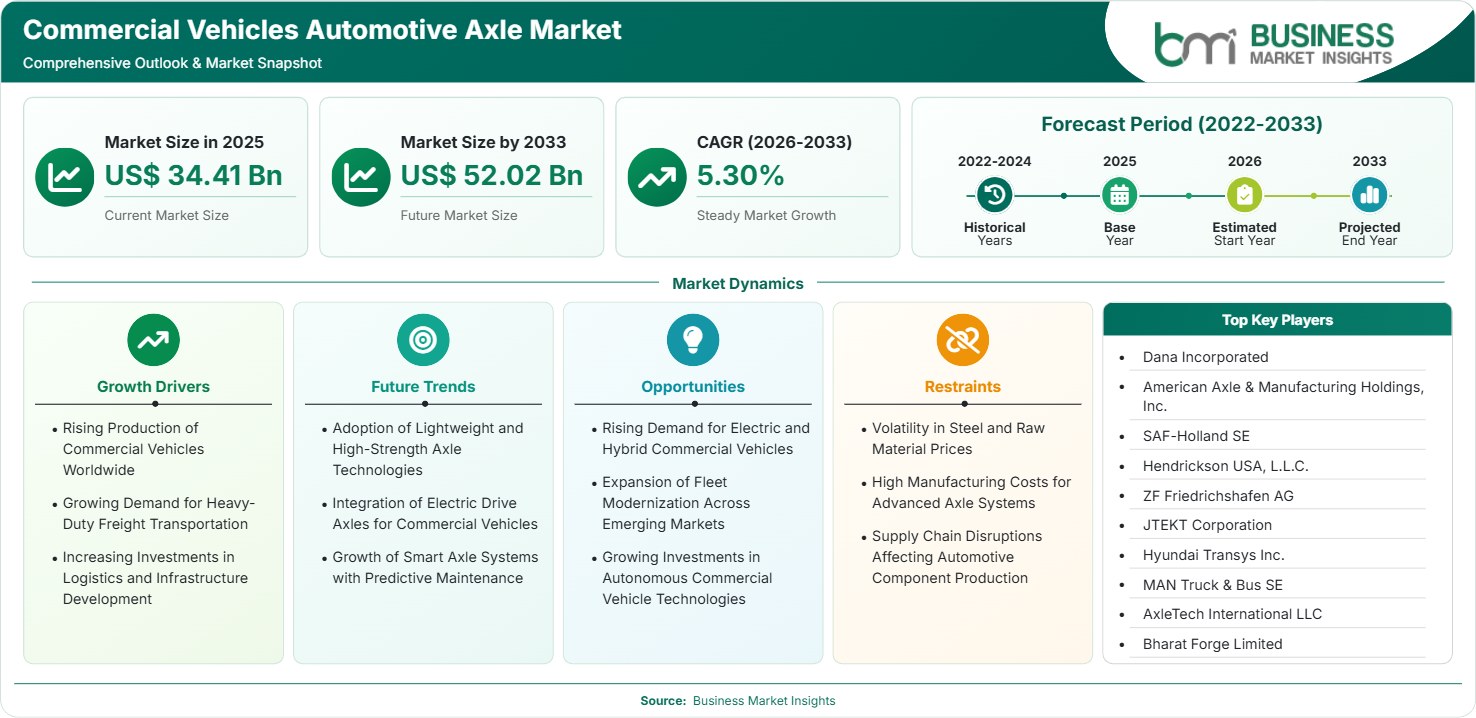
The Commercial Vehicles Automotive Axle Market Size was valued at US$ 34.41 Billion in 2025 and is projected to reach US$ 52.02 Billion by 2033, expanding at a CAGR of 5.30% during the forecast period. Growing production of commercial vehicles, rising investments in freight transportation infrastructure, increasing adoption of advanced axle technologies, and expanding logistics activities continue supporting market expansion. Manufacturers are focusing on lightweight axle materials, higher load-bearing capacity, and integrated drivetrain solutions to improve vehicle efficiency, durability, and operational performance across light, medium, and heavy commercial vehicles.

Report Coverage
  • Axle Type: Front Axle, Rear Axle, Drive Axle, Dead Axle, Lift/Tag Axle
  • Drive Type: Single Drive Axle, Tandem Drive Axle, Multidrive Axle
  • Vehicle Type: Light Commercial Vehicles , Medium Commercial Vehicles , Heavy Commercial Vehicles , Buses & Coaches
  • Axle Material: Alloy Steel Axles, Carbon Steel Axles, Lightweight/Composite Axles
US$ 34.41 Bn Market size in 2025
US$ 52.02 Bn Market Size by 2033
5.30% CAGR, 2026 - 2033
2026-2033 Forecast Period

AI Overview

Commercial Vehicles Automotive Axle Market Summary

  • North America Region: North America accounted for approximately 27%–30% of global revenue in 2025 and is projected to register a CAGR of 5.1%–5.5% through 2033. Strong demand for heavy-duty trucks, continuous fleet modernization, and growing investments in freight transportation continue supporting regional growth. The Commercial Vehicles Automotive Axle Market Share remains significant in the United States due to high commercial vehicle production and replacement demand.
  • Fastest Growing Region: Asia Pacific represented approximately 40%–43% of global revenue in 2025 and is expected to witness the fastest CAGR of 5.8%–6.2% during the forecast period. Expanding commercial vehicle manufacturing, increasing infrastructure development, and growing logistics activities continue strengthening regional demand.
  • Leading Segment: Rear Axle accounted for approximately 34%–37% of global revenue in 2025 and is projected to expand at a CAGR of 5.2%–5.6% owing to its critical role in load-bearing capacity and drivetrain performance.
  • High Growth Segment: Lightweight/Composite Axles are anticipated to register the fastest CAGR of 6.3%–6.8%, supported by increasing emphasis on vehicle weight reduction, fuel efficiency, and electric commercial vehicle development.
  • Key Opportunity: Rising adoption of lightweight axle technologies and expanding commercial vehicle electrification continue creating long-term opportunities for component manufacturers.
  • Major Market Players: Dana Incorporated, American Axle & Manufacturing Holdings, Inc., SAF-Holland SE, Hendrickson USA, L.L.C., ZF Friedrichshafen AG, JTEKT Corporation, Hyundai Transys Inc., MAN Truck & Bus SE, AxleTech International LLC, and Bharat Forge Limited.
Strategic Insights

Commercial Vehicles Automotive Axle Market: Strategic Insights

Commercial Vehicles Automotive Axle Market Strategic Framework
FREE PDF
Request your free sample
Request free sample
Stakeholder View

Key Takeaways

  • Rear axles continue accounting for the largest revenue contribution owing to their critical function in power transmission and load distribution.
  • Lightweight and composite axle technologies are emerging as the fastest-growing segment because of increasing emphasis on fuel efficiency and vehicle weight optimization.
  • Commercial vehicle manufacturers continue integrating advanced axle systems to improve durability, vehicle stability, and operational performance.
  • Asia Pacific remains the largest regional market due to expanding commercial vehicle manufacturing, infrastructure investment, and logistics sector development.
  • Continuous innovation in lightweight materials and drivetrain integration continues strengthening product competitiveness across global markets.
  • The Commercial Vehicles Automotive Axle Market Trend indicates increasing adoption of lightweight axle materials, electrified drivetrain compatibility, intelligent axle monitoring systems, and advanced manufacturing technologies.
Geographic Outlook

Commercial Vehicles Automotive Axle Market Regional Highlights

North America Commercial Vehicles Automotive Axle Market

North America accounted for approximately 27%–30% of global revenue in 2025 and is projected to expand at a CAGR of 5.1%–5.5% through 2033. Strong commercial trucking activity, replacement demand for heavy-duty vehicles, and continued investments in logistics infrastructure continue supporting regional commercial vehicles automotive axle market expansion. Fleet modernization programs, stricter fuel efficiency standards, and growing adoption of connected commercial vehicles are encouraging manufacturers to introduce advanced axle technologies with improved performance and durability.

  • Strong freight transportation activity continues supporting demand for durable axle systems across heavy-duty truck fleets.
  • Fleet modernization initiatives encourage replacement of conventional axle assemblies with lightweight and high-strength alternatives.
  • Commercial vehicle manufacturers continue integrating advanced axle technologies to improve fuel efficiency and operational reliability.
  • Expanding warehouse, distribution, and logistics infrastructure supports increasing demand for commercial transportation equipment.
  • Rising adoption of predictive maintenance technologies strengthens demand for intelligent axle monitoring solutions.

U.S. Commercial Vehicles Automotive Axle Market

The United States represents approximately 84%–87% of North American demand and is projected to register a CAGR of 5.2%–5.6% during the forecast period. Growing freight transportation volumes, expanding e-commerce logistics, increasing commercial fleet investments, and continuous replacement of aging vehicles continue driving market expansion. Manufacturers continue investing in advanced axle systems designed for higher payload capacity, lower maintenance requirements, and compatibility with electric commercial vehicle platforms. The Commercial Vehicles Automotive Axle Market Forecast remains positive as infrastructure investment, commercial transportation demand, and fleet electrification continue accelerating nationwide.

  • Expanding logistics and freight transportation industries continue increasing demand for commercial vehicle axle systems.
  • Heavy-duty truck replacement programs support sustained demand for advanced axle technologies.
  • Commercial fleet operators increasingly prioritize lightweight axle solutions to improve fuel economy and payload efficiency.
  • Growing electric commercial vehicle development encourages innovation in integrated axle and drivetrain technologies.
  • Domestic manufacturers continue expanding production capabilities to address rising demand across transportation, construction, and industrial sectors.

Europe Commercial Vehicles Automotive Axle Market

Europe accounted for approximately 22%–25% of global revenue in 2025 and is projected to expand at a CAGR of 5.0%–5.4% through 2033. Strong commercial vehicle manufacturing capabilities, stringent vehicle safety regulations, and increasing investments in sustainable transportation continue supporting regional demand. Manufacturers are focusing on lightweight axle assemblies, improved load-bearing capacity, and advanced drivetrain integration to enhance vehicle efficiency and reduce operating costs. Growing adoption of electric buses and commercial trucks is further accelerating innovation in axle technologies.

  • Germany continues leading regional demand through its strong commercial vehicle manufacturing base and advanced automotive engineering capabilities.
  • France supports commercial vehicles automotive axle market expansion with increasing investments in logistics infrastructure and commercial fleet modernization.
  • The United Kingdom records stable demand driven by replacement of aging commercial vehicle fleets and expanding freight transportation.
  • Italy continues witnessing growth through rising production of light and medium commercial vehicles and improving industrial transportation activities.
  • Nordic countries are increasingly adopting lightweight axle technologies to improve fuel efficiency and support sustainable transportation initiatives.

Asia Pacific Commercial Vehicles Automotive Axle Market

Asia Pacific represented approximately 40%–43% of global revenue in 2025 and is expected to register the fastest CAGR of 5.8%–6.2% through 2033. Rapid industrialization, expanding infrastructure development, increasing commercial vehicle production, and growing logistics activities continue driving regional market growth. China, India, Japan, and South Korea remain major manufacturing hubs for commercial vehicles while increasing investments in freight transportation and urban infrastructure continue strengthening demand for advanced axle systems. The Commercial Vehicles Automotive Axle Market Scope continues expanding as manufacturers develop lightweight, high-strength, and electric vehicle-compatible axle solutions to address evolving transportation requirements.

  • China remains the largest regional market owing to its extensive commercial vehicle manufacturing industry and continuous infrastructure investments.
  • India records the fastest regional growth supported by expanding logistics networks, highway development, and increasing commercial vehicle sales.
  • Japan continues strengthening demand through technological advancements in commercial vehicle engineering and precision axle manufacturing.
  • South Korea supports regional expansion through growing exports of commercial vehicles and investments in advanced drivetrain technologies.
  • Southeast Asian countries continue increasing demand as industrialization, construction activities, and cross-border logistics operations expand.

Rest of World Commercial Vehicles Automotive Axle Market

The Rest of World accounted for approximately 8%–10% of global revenue in 2025 and is projected to expand at a CAGR of 5.1%–5.5% through 2033. Growing investments in transportation infrastructure, expanding mining and construction industries, and increasing demand for commercial freight vehicles continue supporting market growth across Latin America, the Middle East, and Africa. Fleet expansion, rising industrial activities, and improving road connectivity are creating favorable opportunities for axle manufacturers.

  • Brazil continues leading Latin American demand through expanding agricultural logistics and commercial transportation activities.
  • Mexico supports regional growth with increasing commercial vehicle production and cross-border freight transportation.
  • Saudi Arabia continues investing in heavy commercial vehicles to support infrastructure and industrial development projects.
  • South Africa records steady demand driven by mining operations, freight transportation, and commercial fleet expansion.
  • Regional manufacturers continue strengthening distribution networks and aftermarket services to support growing commercial vehicle operations.
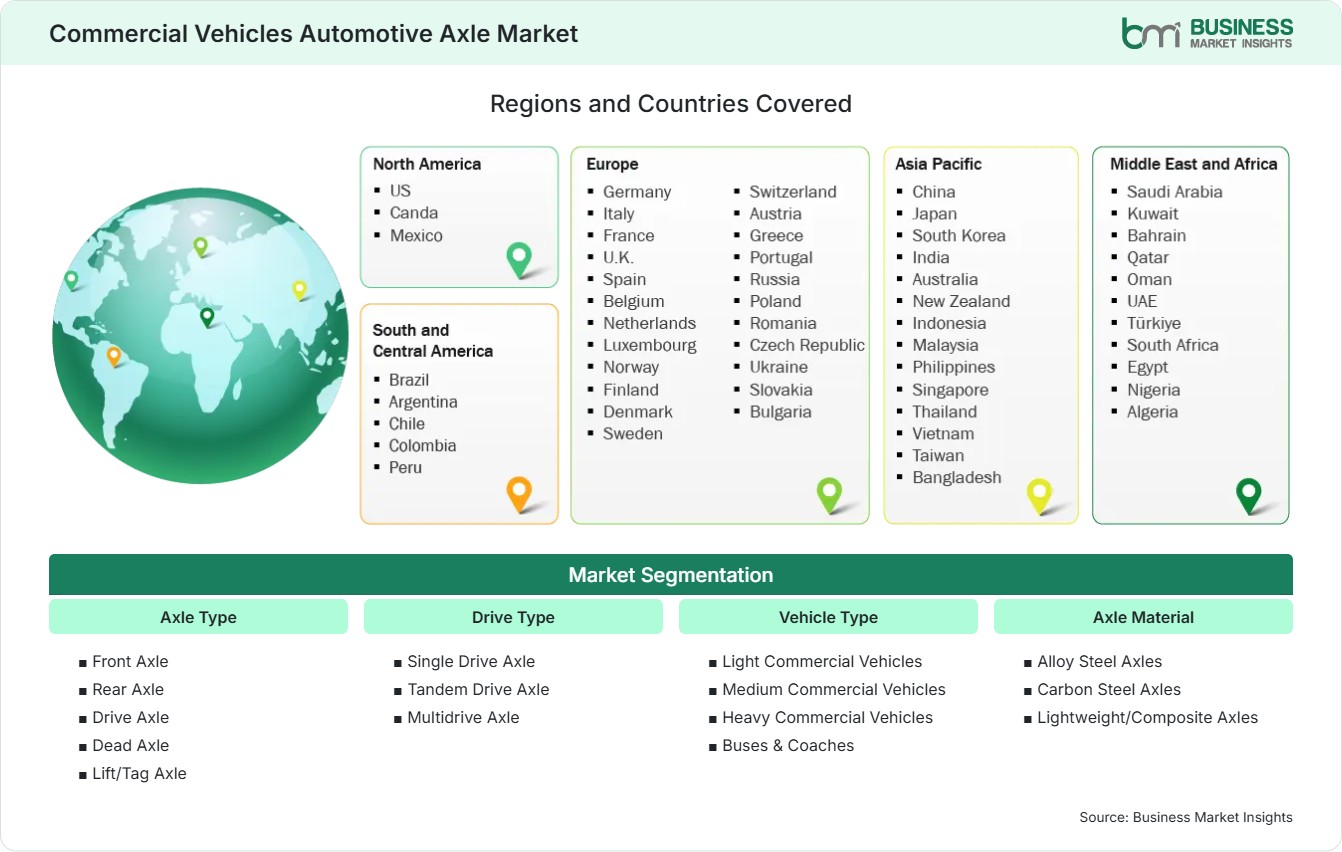
Global Market Geography
FREE PDF
Request your free sample
Request free sample
Segment Analysis

Commercial Vehicles Automotive Axle Market Segmentation

Axle Type

The Axle Type segment represents the core of the commercial vehicle automotive axle industry as different axle configurations are designed to support varying load capacities, drivetrain layouts, and operational requirements. Increasing freight movement, higher payload requirements, and continuous improvements in commercial vehicle engineering are encouraging manufacturers to develop stronger and lighter axle systems. Integration of advanced suspension technologies, improved durability, and compatibility with electric drivetrains continue supporting product innovation across this segment. The Commercial Vehicles Automotive Axle Market Analysis indicates that demand for advanced axle configurations will continue increasing as fleet operators prioritize efficiency, safety, and reduced operating costs.

  • Front Axle: Widely used to support steering functions, load distribution, and vehicle stability across light, medium, and heavy commercial vehicles.
  • Rear Axle: The leading segment owing to its critical role in transmitting engine power, supporting heavy payloads, and improving vehicle traction.
  • Drive Axle: Increasingly adopted in commercial vehicles requiring efficient torque transmission and enhanced drivetrain performance.
  • Dead Axle: Commonly utilized to support vehicle weight without transmitting power, particularly in trailers and specialized commercial vehicles.
  • Lift/Tag Axle: Growing adoption in heavy commercial vehicles improves payload capacity, reduces tire wear, and enhances operational flexibility.

Drive Type

Drive type selection plays a significant role in determining vehicle performance, load-carrying capability, and operational efficiency. Commercial vehicle manufacturers continue introducing advanced drive axle systems to meet evolving transportation requirements across logistics, mining, construction, and industrial applications.

  • Single Drive Axle: Commonly deployed in light and medium commercial vehicles where moderate payload capacity and fuel efficiency are primary operational priorities.
  • Tandem Drive Axle: Accounts for a substantial market share owing to widespread utilization in heavy-duty trucks requiring higher load distribution and improved traction.
  • Multi-drive Axle: Increasing adoption in specialized heavy-duty commercial vehicles operating under demanding terrain and extreme payload conditions.

Vehicle Type

Commercial vehicle demand continues expanding as industrialization, infrastructure development, and freight transportation activities increase globally. Different vehicle categories require axle systems specifically designed to meet unique operational, durability, and safety requirements.

  • Light Commercial Vehicles (LCV): Widely utilized in urban logistics, e-commerce deliveries, and municipal transportation requiring lightweight and fuel-efficient axle systems.
  • Medium Commercial Vehicles (MCV): Growing demand from regional freight transportation and industrial logistics supports increasing axle installations.
  • Heavy Commercial Vehicles (HCV): Represents the largest application segment owing to extensive deployment in long-haul transportation, mining, construction, and heavy industrial operations.
  • Buses & Coaches: Increasing investments in public transportation and electric bus deployment continue supporting demand for durable and lightweight axle technologies.

Axle Material

Material innovation continues improving axle durability, weight reduction, and operational efficiency across commercial vehicle applications. Manufacturers are increasingly adopting advanced materials to improve payload capacity while reducing vehicle weight and maintenance requirements.

  • Alloy Steel Axles: Dominates the market owing to superior mechanical strength, fatigue resistance, and suitability for heavy commercial vehicle applications.
  • Carbon Steel Axles: Continue witnessing steady demand because of their cost-effectiveness and extensive utilization across conventional commercial vehicles.
  • Lightweight/Composite Axles: Represent the fastest-growing material segment supported by increasing demand for fuel-efficient, electric, and low-emission commercial vehicles.
Market Forces

Commercial Vehicles Automotive Axle Market Dynamics

Key Market Drivers

Rising Production of Commercial Vehicles Worldwide

The manufacture of commercial vehicles is continuously on the rise due to the increased freight movement, construction, mining, mass transit, and industry in both developed and developing countries. Increased urbanization, increased e-commerce operations, and increased investment in transport infrastructure continue driving the demand for commercial light, medium, and heavy-duty trucks. Each new commercial vehicle produced requires axle systems that can bear increased loads, offer driveline efficiency, and ensure durability. The manufacture of axle systems is therefore being increased by manufacturers through technological advancements.

Growing Demand for Heavy-Duty Freight Transportation

The growth of logistical infrastructure both domestically and internationally continues to increase the need for heavy transport trucks with increased carrying capacity of goods. The fleets have been acquiring modern commercial trucks that are efficient in terms of fuel consumption, have high capacity, and have less maintenance needs. Advanced axles are part of the solution, helping to improve load carrying, balance, and driveline performance. There is continued growth of manufacturing, warehouses, and international business, hence an increased demand for heavy-duty axles.

Increasing Investments in Logistics and Infrastructure Development

Continued investments by the government and the private sector in construction projects involving highways, industrial zones, ports, logistics hubs, airports, and city infrastructures that need many commercial transport fleet operations have resulted in the continued growth of freight movements and, hence, increased usage of the heavy commercial trucks fitted with axle systems. This creates further prospects for the suppliers of high-quality axle systems.

Key Market Opportunities

Rising Demand for Electric and Hybrid Commercial Vehicles

Commercial vehicle electrification continues creating new opportunities for axle manufacturers as electric and hybrid platforms require lightweight, high-strength, and integrated drivetrain-compatible axle systems. Manufacturers are developing electric drive axles, e-axles, and advanced transmission-integrated axle technologies to improve energy efficiency and vehicle performance. The Commercial Vehicles Automotive Axle Market Scope continues expanding as commercial fleet operators accelerate investments in zero-emission transportation technologies.

Expansion of Fleet Modernization Across Emerging Markets

The fleet owners in developing nations are increasingly upgrading their old commercial vehicles to modern ones, which have better fuel efficiency and safety systems. The government is encouraging greener transport through financial incentives; there is legislation on emission standards from vehicles; and there are rising investments in logistics. All this makes sure that there is continued need for axle systems in light, medium, and heavy commercial vehicles.

Growing Investments in Autonomous Commercial Vehicle Technologies

Automotive manufacturers and technology companies continue investing in autonomous commercial vehicle development for freight transportation, mining operations, warehouse logistics, and industrial applications. Advanced axle systems compatible with autonomous driving technologies require improved electronic integration, higher precision, and enhanced operational reliability. Continuous research and development activities are expected to generate new growth opportunities for axle manufacturers serving next-generation commercial vehicle platforms.

Market Restraints and Challenges

Volatility in Steel and Raw Material Prices

Factor: Commercial vehicle axle manufacturing depends heavily on steel, alloy materials, and specialized metal components whose prices frequently fluctuate because of global supply chain disruptions, trade policies, and raw material availability.

Impact: Rising material costs increase manufacturing expenses, reduce profit margins, and create pricing challenges for both component suppliers and vehicle manufacturers. Companies continue focusing on supply chain diversification, long-term procurement agreements, and material optimization strategies to reduce exposure to raw material price volatility.

High Manufacturing Costs for Advanced Axle Systems

Factor: Development of lightweight composite materials, precision engineering technologies, integrated electronic systems, and electric vehicle-compatible axle assemblies requires significant investments in research, manufacturing equipment, and quality control processes.

Impact: Higher production costs may increase commercial vehicle prices and delay adoption among cost-sensitive fleet operators. Manufacturers continue investing in process automation, advanced manufacturing technologies, and economies of scale to improve production efficiency while maintaining product quality and performance.

Company Analysis

Competitive Landscape

The market is characterized by the presence of global automotive component manufacturers and commercial vehicle system suppliers competing through product innovation, lightweight material development, and advanced drivetrain integration. Companies continue investing in high-strength axle systems, electric drive axle technologies, intelligent axle monitoring solutions, and manufacturing automation to strengthen their competitive positions. Strategic partnerships with commercial vehicle OEMs, expansion of production facilities, and increasing investments in electric and autonomous commercial vehicle platforms remain key business strategies. The Commercial Vehicles Automotive Axle Market Report highlights that continuous innovation in lightweight materials, integrated axle technologies, and fleet efficiency solutions will continue shaping competitive dynamics throughout the forecast period.

Company Name

Overview

Products and Services Relevant to this Market

Dana Incorporated

Global supplier of drivetrain and power technologies serving commercial vehicle manufacturers worldwide.

Commercial vehicle axles, drive systems, e-Axles, drivetrain technologies, and thermal management solutions.

American Axle & Manufacturing Holdings, Inc.

Automotive component manufacturer specializing in driveline and metal-forming technologies for commercial and passenger vehicles.

Drive axles, differential systems, drivetrain components, axle shafts, and lightweight axle solutions.

SAF-Holland SE

Leading supplier of chassis-related systems and components for commercial vehicles and trailers.

Trailer axles, suspension systems, axle systems, coupling devices, and commercial vehicle components.

Hendrickson USA, L.L.C.

Manufacturer of suspension and axle systems for commercial trucks, trailers, buses, and specialty vehicles.

Front axles, rear axles, suspension systems, lift axles, and axle technologies for heavy-duty vehicles.

ZF Friedrichshafen AG

Global technology company providing advanced mobility systems for commercial and passenger vehicles.

Commercial vehicle axles, e-Mobility drive systems, steering systems, transmissions, and chassis technologies.

JTEKT Corporation

Automotive systems manufacturer delivering steering, driveline, and precision engineering solutions.

Drive axle components, bearings, steering systems, drivetrain technologies, and automotive mechanical systems.

Hyundai Transys Inc.

Automotive component supplier focused on drivetrain and mobility technologies for global vehicle manufacturers.

Axle systems, transmissions, electric drive components, drivetrain assemblies, and mobility technologies.

MAN Truck & Bus SE

Commercial vehicle manufacturer developing integrated heavy-duty transportation solutions.

Heavy-duty truck axles, commercial vehicle driveline systems, buses, trucks, and integrated vehicle technologies.

AxleTech International LLC

Manufacturer specializing in heavy-duty axle and drivetrain solutions for commercial and defense vehicles.

Heavy-duty axles, planetary axles, independent suspension systems, drivetrain assemblies, and specialty vehicle components.

Bharat Forge Limited

Global engineering company manufacturing forged and machined automotive components for commercial vehicle applications.

Forged axle components, commercial vehicle axles, drivetrain parts, precision engineering products, and automotive systems.

Trust & Transparency

Research Methodology

The market analysis combines proprietary research with secondary data from government agencies, company disclosures, regulatory filings, industry databases and expert interviews. Market estimates are validated through data triangulation, cross-market benchmarking and analyst review.

View Full Research Methodology

Questions Answered

Frequently Asked Questions

What does the Commercial Vehicles Automotive Axle Market Forecast indicate for future demand?

The market forecast indicates sustained growth driven by commercial fleet electrification, increasing infrastructure investments, autonomous vehicle development, and continuous innovation in lightweight axle technologies.

Which region is expected to witness the fastest growth?

Asia Pacific is projected to record the fastest growth owing to expanding commercial vehicle manufacturing, infrastructure development, logistics expansion, and industrialization.

Why are lightweight axle materials gaining popularity?

Lightweight axle materials help reduce vehicle weight, improve fuel efficiency, increase payload capacity, and support electric commercial vehicle development.

Which axle type accounts for the largest market share?

Rear axles account for the largest revenue share because they play a critical role in transmitting power, supporting heavy loads, and maintaining vehicle stability.

What factors are driving the Commercial Vehicles Automotive Axle Market?

Demand is primarily driven by rising commercial vehicle production, increasing freight transportation activities, expanding logistics infrastructure, and growing investments in fleet modernization.

Access the Full Commercial Vehicles Automotive Axle Market Report

Get segment-level forecasts, regional estimates, competitive benchmarking, company profiles and downloadable Excel datasets.

Access the full Commercial Vehicles Automotive Axle Market Report
350 pages PDF & Excel | 2026-08-20
Similar Research

Related Market Reports