
Automotive E-axle Market Outlook: Size, Share, Trends, Growth Analysis, Competitive Landscape & Forecast, 2026-2033

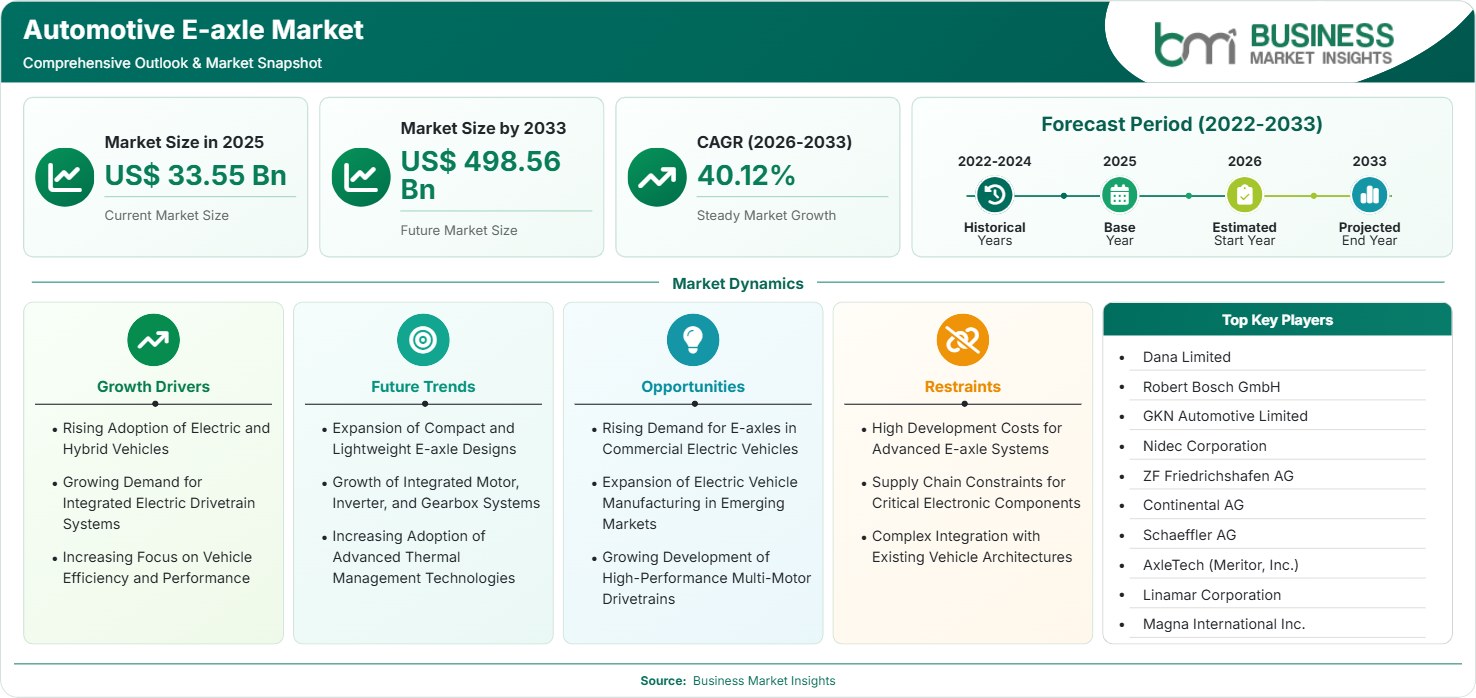
The Automotive E-axle Market size was valued at US$ 33.55 Billion in 2025 and is projected to reach US$ 498.56 Billion by 2033, growing at a CAGR of 40.12% during 2026–2033. Rising electric vehicle adoption, increasing demand for integrated electric drivetrain solutions, growing focus on vehicle efficiency and lightweight architectures, and continuous advancements in electric mobility technologies are supporting market growth globally.

Report Coverage
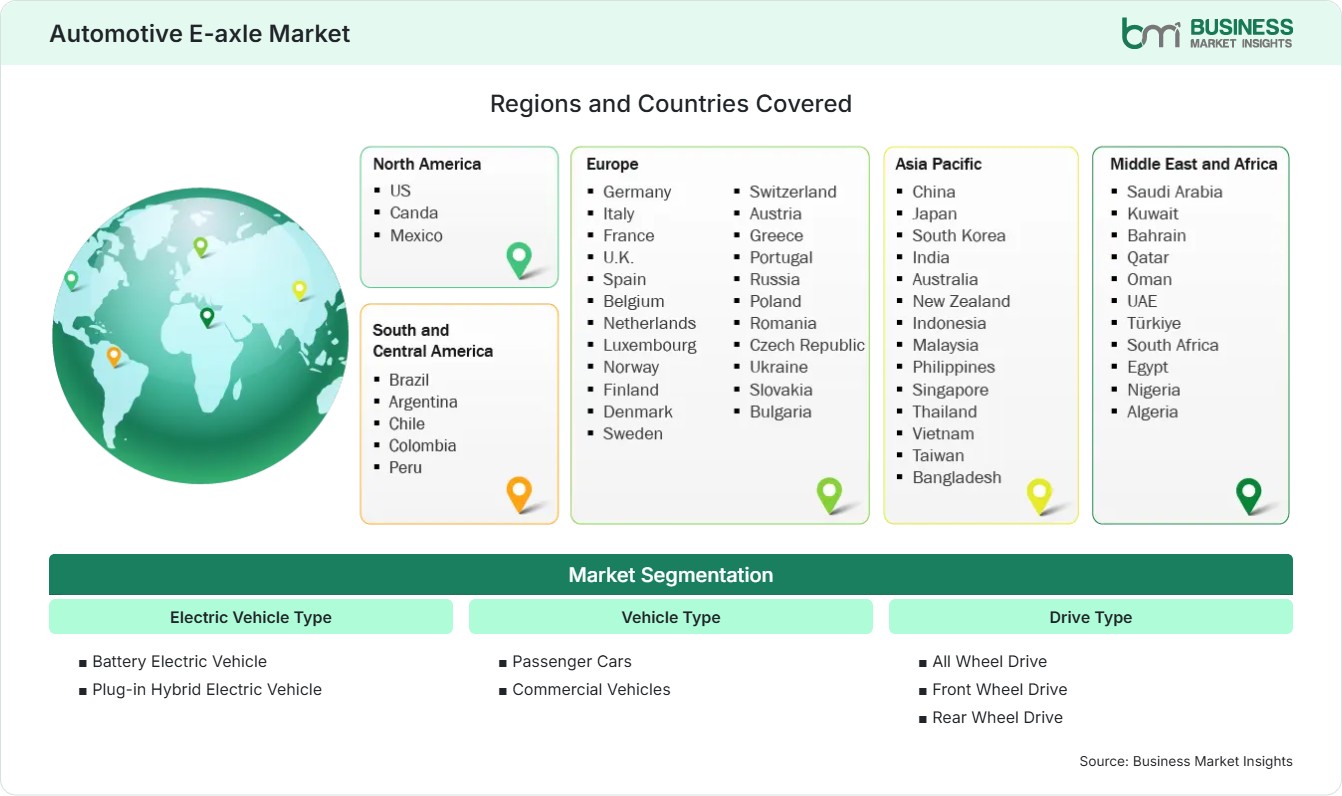
  • Electric Vehicle Type: Battery Electric Vehicle, Plug-in Hybrid Electric Vehicle
  • Vehicle Type: Passenger Cars, Commercial Vehicles
  • Drive Type: All Wheel Drive, Front Wheel Drive, Rear Wheel Drive
US$ 33.55 Bn Market size in 2025
US$ 498.56 Bn Market Size by 2033
40.12% CAGR, 2026 - 2033
2026-2033 Forecast Period

01 AI Overview

Automotive E-axle Market Summary

  • North America Region: North America holds a market share of 33%–36% in 2025, growing with a CAGR of 39.1%–39.8% during 2026–2033. Expanding EV production, supportive government incentives, and increasing investments in electric drivetrain technologies continue supporting regional leadership. The U.S. automotive E-axle market is expected to register a CAGR of 39.3%–40.0%.
  • Fastest Growing Region: Asia Pacific accounts for 35%–38% share in 2025 and is projected to grow at a CAGR of 41.0%–41.7% through 2033. Strong EV manufacturing activity, expanding battery production, and growing consumer adoption of electric vehicles continue driving regional growth.
  • Leading Segment: Battery Electric Vehicle (BEV) represents 74%–77% share in 2025 and is expected to grow at a CAGR of 40.6%–41.3% through 2033. Rapid electrification and increasing preference for fully electric mobility continue supporting segment dominance.
  • High Growth Segment: Passenger Cars account for 68%–71% share in 2025 and are forecast to grow at a CAGR of 40.8%–41.5% during 2026–2033. Rising electric passenger vehicle production and consumer adoption continue accelerating segment growth.
  • Key Market Opportunity: Expansion of electric vehicle manufacturing capacity, next-generation integrated drivetrains, lightweight e-axle systems, and high-performance electric mobility platforms is creating substantial growth opportunities.
  • Major Market Players: Dana Limited, Robert Bosch GmbH, GKN Automotive Limited, Nidec Corporation, ZF Friedrichshafen AG, Continental AG, Schaeffler AG, AxleTech (Meritor, Inc.), Linamar Corporation, and Magna International Inc.
02 Strategic Insights

Automotive E-axle Market: Strategic Insights

Automotive E-axle Market Strategic Framework
FREE PDF
Request your free sample
Request free sample
03 Stakeholder View

Key Takeaways

  • Automotive e-axles are becoming core components of next-generation electric vehicle architectures.
  • Battery electric vehicles remain the dominant platform for e-axle deployment.
  • Passenger cars account for the largest share of demand globally.
  • Integrated drivetrain solutions continue improving efficiency and vehicle performance.
  • Automakers are increasingly adopting compact and lightweight electric propulsion systems.
  • North America remains a major automotive E-axle market due to rapid EV adoption and manufacturing investments.
  • Asia Pacific is projected to witness the fastest growth owing to strong EV production capabilities.
  • Advances in electric mobility technologies are expected to create significant future opportunities.
04 Geographic Outlook

Automotive E-axle Market Regional Highlights

North America Automotive E-axle Market

North America accounts for 33%–36% Automotive E-axle Market share in 2025 and is projected to grow at a CAGR of 39.1%–39.8% through 2033. The region benefits from strong EV investments, expanding battery manufacturing capacity, and supportive electrification policies.

  • Major automotive manufacturers are increasing investment in electric vehicle platforms that require advanced e-axle integration technologies.
  • Government incentives and emission reduction programs are encouraging greater adoption of electric mobility solutions across the region.
  • Battery manufacturing expansion is strengthening the overall electric vehicle supply chain and supporting drivetrain demand.
  • Automakers are focusing on lightweight and energy-efficient propulsion systems to enhance driving range and performance.
  • Increasing consumer acceptance of electric vehicles continues creating strong opportunities for e-axle suppliers.
  • Technological innovation and strategic partnerships remain key factors supporting long-term regional market growth.

US Automotive E-axle Market

The United States contributes approximately 89%–93% of North American revenue and is expected to register a CAGR of 39.3%–40.0% through 2033. The country remains the largest market due to extensive electric vehicle production and substantial investments in electrification.

  • Major automakers are accelerating EV manufacturing programs, increasing demand for integrated electric drive systems that enhance efficiency and vehicle performance.
  • New battery and EV assembly plants are strengthening domestic supply chains and reducing reliance on imported components.
  • Growing adoption of electric pickup trucks and passenger vehicles is driving demand for advanced drivetrain technologies.
  • Federal and state incentives continue encouraging EV purchases and supporting market expansion.
  • Automotive suppliers are expanding manufacturing capacities to meet rising demand for e-axle components.
  • Significant investments in electrification-focused R&D are fostering technological advancements and supporting long-term market growth.

Europe Automotive E-axle Market

Europe represents 22%–25% of global revenue in 2025 and is anticipated to expand at a CAGR of 39.8%–40.5% through 2033. Strong regulatory support, aggressive emission reduction targets, and widespread EV adoption continue supporting regional growth. Germany remains the leading market while Poland demonstrates stronger growth momentum.

  • Germany continues to lead regional demand, supported by its strong automotive manufacturing base, established EV production capabilities, and presence of major vehicle and component manufacturers.
  • Poland is emerging as one of the fastest-growing markets, with the automotive sector benefiting from increasing EV production, manufacturing investments, and an estimated CAGR of 40.7%–41.4% during the forecast period.
  • Stringent emission reduction regulations are accelerating the transition toward electric mobility and encouraging automakers to adopt advanced electrification technologies.
  • Automotive manufacturers are increasingly integrating high-efficiency e-axle platforms to improve drivetrain performance, energy efficiency, and vehicle range.
  • Continued development of the regional battery ecosystem is strengthening EV manufacturing capabilities and supporting electric mobility expansion.
  • Growing investments in sustainable transportation infrastructure, including charging networks, are further supporting regional market growth.

Asia Pacific Automotive E-axle Market

Asia Pacific accounts for 35%–38% of global revenue in 2025 and is expected to achieve the fastest CAGR of 41.0%–41.7% through 2033. Strong EV production, extensive battery manufacturing, and rapid urban mobility electrification continue supporting robust regional growth.

  • China remains the largest regional market, supported by its extensive electric vehicle manufacturing ecosystem, established supply chains, and strong domestic demand for electrified vehicles.
  • India is projected to register a CAGR of approximately 41.9%–42.6%, driven by government incentives, expanding EV production, and increasing investments in electric mobility.
  • Automotive manufacturers are increasingly adopting integrated electric drivetrain technologies across passenger vehicles and other vehicle segments to improve efficiency and performance.
  • Expanding battery manufacturing capacity is strengthening regional supply chains and supporting the continued growth of electric vehicle production.
  • Rising consumer demand for electric passenger vehicles is encouraging automakers to expand EV portfolios and accelerate drivetrain technology adoption.
  • Increasing investments in charging infrastructure are improving EV accessibility and further accelerating electric vehicle adoption across the region.

Rest of World Automotive E-axle Market

Rest of World accounts for 8%–11% of global revenue in 2025 and is projected to expand at a CAGR of 37.6%–38.3% through 2033. Growing awareness of sustainable transportation and increasing investments in electric mobility are supporting market growth across Latin America, the Middle East, and Africa.

  • Brazil continues generating demand through the gradual expansion of electric mobility programs and vehicle electrification initiatives.
  • The UAE is witnessing increased adoption of electric transportation solutions supported by sustainability objectives.
  • Saudi Arabia is expected to achieve approximately 38.5%–39.2% CAGR through 2033, supported by transportation modernization investments.
  • Governments are increasingly encouraging adoption of low-emission vehicle technologies across urban transportation networks.
  • Automotive distributors and manufacturers are expanding electric vehicle offerings in emerging markets.
  • Infrastructure development and electrification initiatives continue creating long-term growth opportunities.
Global Market Geography
FREE PDF
Request your free sample
Request free sample
05 Segment Analysis

Automotive E-axle Market Segmentation

Electric Vehicle Type

The electric vehicle type segment represents the primary categories of electrified vehicles utilizing e-axle systems to improve drivetrain integration, energy efficiency, and vehicle performance. This segment accounts for approximately 74%–77% share in 2025 and is projected to grow at a CAGR of 40.6%–41.3% through 2033. The expanding Automotive E-axle Market Scope is supported by accelerating vehicle electrification, increasing investments in EV manufacturing, and growing demand for compact and lightweight powertrain architectures.

  • Battery Electric Vehicle (BEV): BEVs dominate the market due to their complete dependence on electric propulsion systems and widespread adoption of integrated e-axle solutions for enhanced efficiency and range.
  • Plug-in Hybrid Electric Vehicle (PHEV): PHEVs continue witnessing strong demand as automakers adopt hybrid powertrains that combine electric propulsion capabilities with extended driving flexibility.

Vehicle Type

The vehicle type segment highlights the major automotive categories adopting e-axle technologies to improve drivetrain efficiency and support electrification strategies. This segment accounts for approximately 68%–71% share in 2025 and is expected to register a CAGR of 40.8%–41.5% through 2033. Current Automotive E-axle Market Trends indicate increasing deployment across passenger vehicles, electric SUVs, delivery fleets, and commercial transportation applications.

  • Passenger Cars: Passenger cars dominate the market due to rising production of electric sedans, hatchbacks, SUVs, and premium electric vehicles globally.
  • Commercial Vehicles: Commercial vehicles are increasingly adopting e-axle technologies to support emission reduction goals, fleet electrification initiatives, and improved operating efficiency.

Drive Type

The drive type segment reflects the major drivetrain configurations utilizing e-axle technologies across electric vehicles. This segment accounts for approximately 42%–45% share in 2025 and is forecast to grow at a CAGR of 41.2%–41.9% through 2033.

  • All Wheel Drive (AWD): AWD systems are gaining popularity due to superior traction, enhanced performance, and increasing adoption in premium and high-performance electric vehicles.
  • Front Wheel Drive (FWD): FWD remains widely utilized in compact and mid-sized electric passenger vehicles because of cost efficiency and packaging advantages.
  • Rear Wheel Drive (RWD): RWD configurations continue witnessing demand in performance-oriented electric vehicles and commercial applications requiring improved load distribution.
06 Market Forces

Automotive E-axle Market Dynamics

Key Market Drivers

Rising Adoption of Electric and Hybrid Vehicles

The rapid increase in electric and hybrid vehicle sales continues to be one of the most significant factors driving demand for automotive e-axle systems worldwide. Governments are implementing stricter emission regulations and offering incentives to encourage the transition toward cleaner transportation solutions. Automotive manufacturers are expanding electric vehicle portfolios to meet changing consumer preferences and regulatory requirements. E-axle systems play a critical role in improving drivetrain efficiency while reducing vehicle complexity. As global electrification efforts continue accelerating, adoption of integrated e-axle technologies is expected to increase substantially throughout the forecast period.

Growing Demand for Integrated Electric Drivetrain Systems

Automakers are increasingly focusing on integrated electric drivetrain architectures that simplify vehicle design and enhance overall operational efficiency. E-axle systems combine motors, power electronics, and transmission components into a compact unit, reducing weight and improving packaging flexibility. These advantages help manufacturers optimize vehicle performance while lowering production complexity and costs. Growing competition within the EV industry is encouraging the adoption of highly efficient integrated solutions capable of delivering improved range and power density. This trend continues to strengthen demand for next-generation e-axle platforms across global markets.

Increasing Focus on Vehicle Efficiency and Performance

Consumers and manufacturers increasingly prioritize vehicle efficiency, driving range, acceleration, and overall performance when evaluating electric mobility solutions. E-axle systems contribute significantly to these objectives by improving power delivery, reducing drivetrain losses, and enhancing vehicle dynamics. Automakers continue investing in advanced electric propulsion technologies to differentiate products and improve customer value. Improvements in motor design, thermal management, and power electronics are further supporting performance enhancements. As expectations regarding electric vehicle capability continue rising, demand for advanced e-axle technologies is expected to remain strong.

Key Market Opportunities

Rising Demand for E-axles in Commercial Electric Vehicles

Commercial vehicle electrification is emerging as a major opportunity for automotive e-axle manufacturers. Logistics providers, public transportation operators, and fleet owners are increasingly adopting electric trucks, buses, and delivery vehicles to reduce emissions and operating costs. E-axle systems offer compact packaging and efficiency benefits that are particularly valuable in commercial vehicle applications. Governments are also promoting commercial fleet electrification through incentives and sustainability programs. As adoption of electric commercial vehicles expands globally, demand for specialized e-axle solutions is expected to grow significantly.

Expansion of Electric Vehicle Manufacturing in Emerging Markets

Emerging economies are becoming important centers for electric vehicle production due to supportive government policies, growing domestic demand, and expanding manufacturing capabilities. Automakers are establishing new production facilities and supply chain networks to serve these high-growth markets. This expansion is creating substantial opportunities for e-axle manufacturers and component suppliers. Investments in battery production, charging infrastructure, and vehicle assembly operations are further strengthening market potential. These developments are expected to drive long-term demand for integrated electric drivetrains across developing regions.

Growing Development of High-Performance Multi-Motor Drivetrains

The development of high-performance electric vehicles is increasing interest in multi-motor drivetrain architectures capable of delivering superior traction, acceleration, and vehicle control. E-axle technologies play a critical role in enabling advanced all-wheel-drive configurations and torque vectoring capabilities. Luxury and performance vehicle manufacturers are increasingly investing in sophisticated propulsion systems to enhance competitiveness. Technological advancements in software controls and power electronics are expanding the possibilities for multi-motor vehicle platforms. Long-term Automotive E-axle Market Forecast projections remain highly favorable as performance-focused electrification initiatives continue accelerating.

Market Restraints and Challenges

High Development Costs for Advanced E-axle Systems

Factor: Advanced e-axle systems require substantial investments in research and development, engineering, testing, software integration, and manufacturing capabilities. Achieving high levels of performance, efficiency, and reliability often involves significant technological complexity.

Impact: High development expenses may restrict market participation for smaller manufacturers and increase commercialization timelines. These costs can also influence vehicle pricing and investment decisions throughout the automotive supply chain.

Supply Chain Constraints for Critical Electronic Components

Factor: Automotive e-axles depend heavily on semiconductors, power electronics, rare earth materials, advanced motors, and other specialized components that can experience supply constraints and sourcing challenges.

Impact: Supply chain disruptions may affect production schedules, increase procurement costs, and limit manufacturing scalability. Companies may need to diversify suppliers and strengthen inventory management strategies to mitigate operational risks.

07 Company Analysis

Competitive Landscape

The Automotive E-axle Market Analysis is characterized by intense competition among drivetrain manufacturers, electric propulsion system developers, automotive component suppliers, and mobility technology companies. Market participants are focusing on integrated electric drive units, lightweight drivetrain architectures, high-efficiency motors, advanced power electronics, and next-generation e-axle platforms to strengthen their market positions. Rising electric vehicle adoption, increasing investments in EV manufacturing, and growing demand for compact propulsion systems continue driving innovation across the market. Companies are investing in scalable e-axle platforms, advanced software controls, and high-performance electric drivetrain technologies to address evolving automotive industry requirements.

Company Name

Overview

Products and Services relevant to this market

Dana Limited

Global supplier of drivetrain and electrification solutions for automotive applications.

E-axle systems, electric drive units, drivetrain technologies, and vehicle electrification solutions.

Robert Bosch GmbH

Automotive technology company specializing in mobility and electrification systems.

Integrated e-axles, electric motors, power electronics, and electric drivetrain solutions.

GKN Automotive Limited

Automotive driveline and electric propulsion technology provider.

E-drive systems, e-axles, all-wheel-drive technologies, and electric mobility solutions.

Nidec Corporation

Electric motor and mobility technology manufacturer.

E-axle platforms, traction motors, electric drive systems, and EV propulsion technologies.

ZF Friedrichshafen AG

Global automotive supplier focused on vehicle electrification and mobility solutions.

Electric axle drives, integrated e-drive systems, transmissions, and EV technologies.

Continental AG

Automotive technology company serving electric mobility markets.

E-axle components, power electronics, vehicle control systems, and electric drivetrain solutions.

Schaeffler AG

Motion technology company specializing in automotive and industrial applications.

Electric axle systems, hybrid drive solutions, electric motors, and drivetrain components.

AxleTech (Meritor, Inc.)

Provider of axle and drivetrain technologies for commercial vehicles.

Electric axle systems, integrated drivetrains, commercial vehicle e-mobility solutions, and propulsion technologies.

Linamar Corporation

Diversified manufacturing company serving automotive markets.

E-axle systems, drivetrain assemblies, electric propulsion components, and precision engineering solutions.

Magna International Inc.

Global automotive supplier with extensive electrification capabilities.

E-drive systems, electric axles, powertrain technologies, and vehicle electrification solutions.

10 Trust & Transparency

Research Methodology

The market analysis combines proprietary research with secondary data from government agencies, company disclosures, regulatory filings, industry databases and expert interviews. Market estimates are validated through data triangulation, cross-market benchmarking and analyst review.

View Full Research Methodology

11 Questions Answered

Frequently Asked Questions

How are integrated drivetrain systems influencing the automotive e-axle industry?

Integrated drivetrain systems are improving efficiency, reducing vehicle weight, simplifying manufacturing processes, and enhancing overall electric vehicle performance, thereby accelerating e-axle adoption.

What does this Automotive E-axle Market Report cover?

This report covers electric vehicle type analysis, vehicle type assessment, drive type evaluation, regional trends, competitive landscape analysis, market drivers, opportunities, restraints, challenges, and future growth prospects through 2033.

Why do Passenger Cars lead the market?

Passenger cars lead the market because electric passenger vehicle production is expanding rapidly, supported by increasing consumer demand, government incentives, and broader EV adoption.

Which electric vehicle type dominates the market?

Battery Electric Vehicles (BEVs) dominate the market due to their complete reliance on electric propulsion systems and widespread adoption of integrated e-axle technologies.

What is driving growth in the Automotive E-axle market?

Rising adoption of electric and hybrid vehicles, growing demand for integrated electric drivetrain systems, increasing focus on vehicle efficiency and performance, and expanding EV production capacities are major factors driving market growth.

Access the Full Automotive E-axle Market Report

Get segment-level forecasts, regional estimates, competitive benchmarking, company profiles and downloadable Excel datasets.

Access the full Automotive E-axle Market Report
350 pages PDF & Excel | 2026-08-20