
Road Transport Refrigeration Equipment Market Outlook: Size, Share, Trends, Growth Analysis, Competitive Landscape & Forecast, 2026-2033

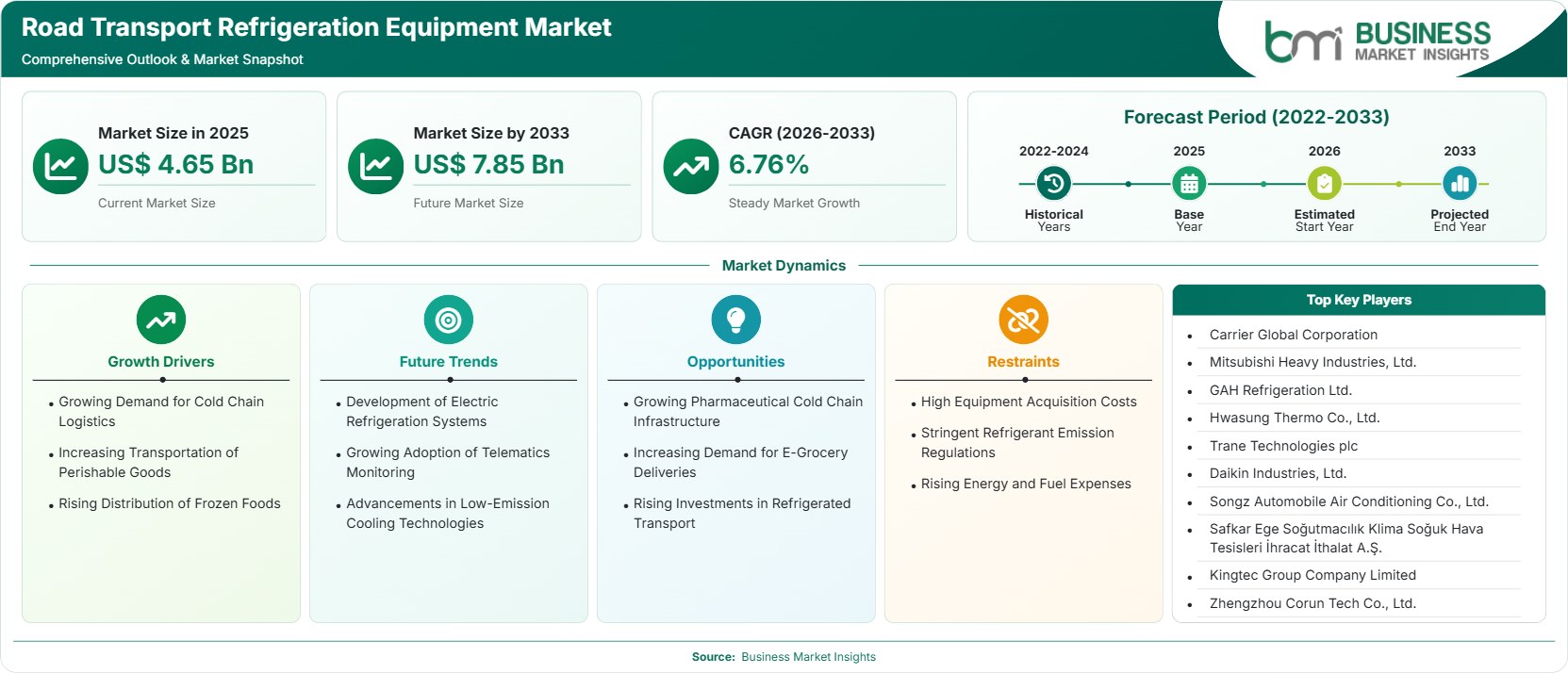
The Road Transport Refrigeration Equipment Market size was valued at US$ 4.65 Billion in 2025 and is projected to reach US$ 7.85 Billion by 2033, growing at a CAGR of 6.76% during 2026–2033. Market expansion is supported by increasing cold chain logistics demand, rising transportation of temperature-sensitive food and pharmaceuticals, stricter food safety regulations, and growing investments in energy-efficient refrigeration technologies and connected fleet management solutions.

Report Coverage
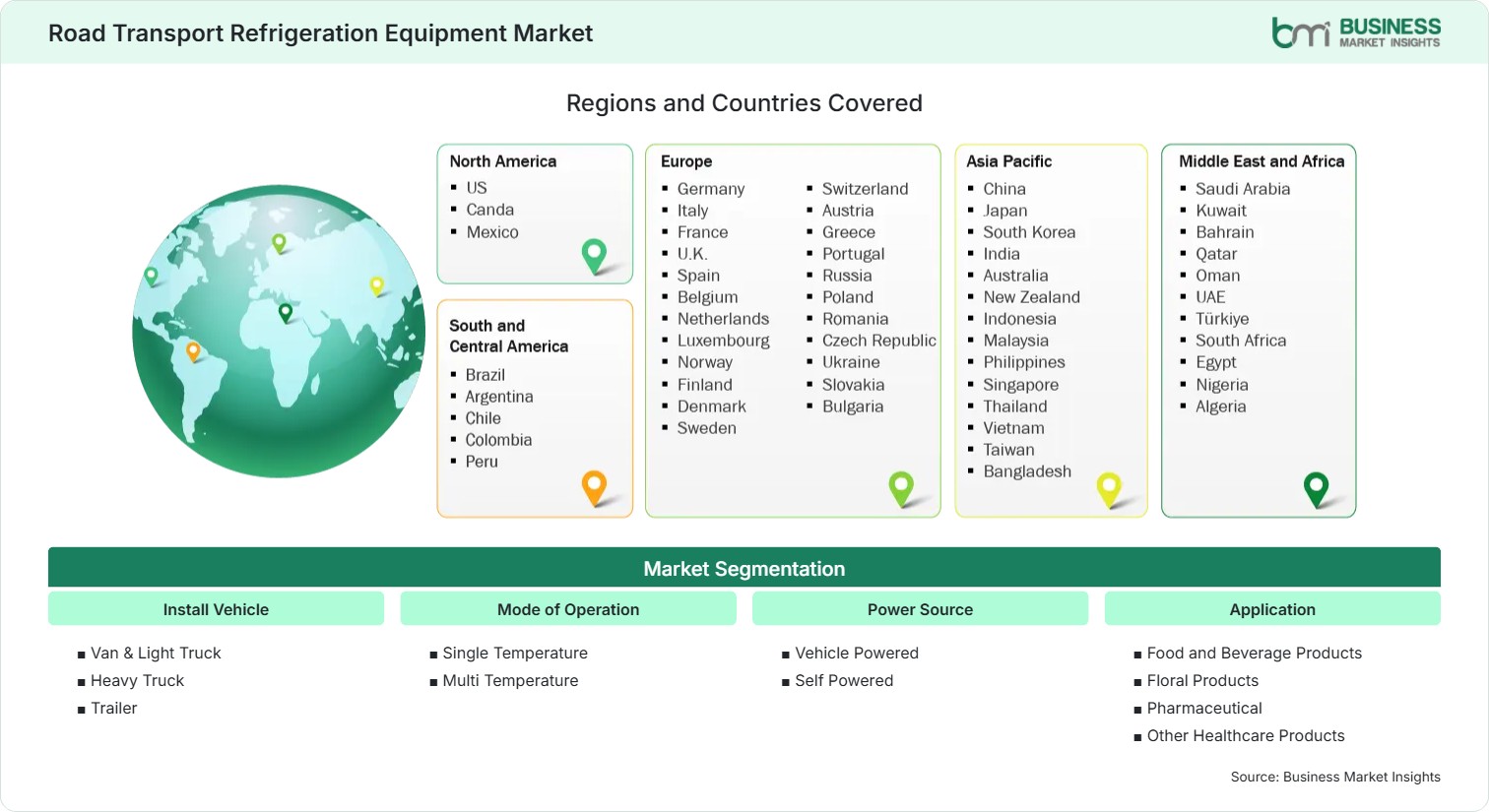
  • Install Vehicle: Van & Light Truck, Heavy Truck, Trailer
  • Mode of Operation: Single Temperature, Multi Temperature
  • Power Source: Vehicle Powered, Self Powered
  • Application: Food and Beverage Products, Floral Products, Pharmaceutical, Other Healthcare Products
US$ 4.65 Bn Market size in 2025
US$ 7.85 Bn Market Size by 2033
6.76% CAGR, 2026 - 2033
2026-2033 Forecast Period

AI Overview

Road Transport Refrigeration Equipment Market Summary

  • North America Region: North America holds 34%–37% market share in 2025 and is expected to grow at a 6.1%–6.5% CAGR during 2026–2033. Growth is supported by mature cold chain infrastructure, pharmaceutical logistics expansion, fleet modernization, and adoption of connected refrigeration technologies across commercial transportation networks. The U.S. benefits from strong refrigerated freight demand, digital fleet management adoption, and a projected 6.2%–6.6% CAGR through 2033.
  • Fastest Growing Region: Asia Pacific accounts for 28%–31% market share in 2025 while expanding at a 7.8%–8.3% CAGR through 2033. Urbanization, organized retail expansion, pharmaceutical manufacturing growth, and rising exports of perishable products continue strengthening refrigerated transportation investments.
  • Leading Segment: Food and Beverage Products represents 52%–55% market share in 2025 and advances at a 6.6%–7.0% CAGR through 2033. Expanding frozen food consumption, fresh produce distribution, and stricter temperature compliance continue driving sustained equipment deployment worldwide.
  • High Growth Segment: Multi Temperature systems account for 27%–30% market share in 2025 while recording a 7.9%–8.4% CAGR through 2033. Retail distribution efficiency, mixed-load transportation, and growing supermarket delivery operations encourage wider adoption of advanced compartment refrigeration technologies.
  • Key Market Opportunity: Expanding pharmaceutical cold chain investments encourage demand for intelligent refrigeration systems featuring real-time monitoring, predictive maintenance, lower emissions, improved energy efficiency, and reliable temperature control throughout long-distance transportation operations.
  • Major Market Players: Carrier Global Corporation, Mitsubishi Heavy Industries, Ltd., GAH Refrigeration Ltd., Hwasung Thermo Co., Ltd., Trane Technologies plc, Daikin Industries, Ltd., Songz Automobile Air Conditioning Co., Ltd., Safkar Ege Soğutmacılık Klima Soğuk Hava Tesisleri İhracat İthalat A.Ş., Kingtec Group Company Limited, Zhengzhou Corun Tech Co., Ltd.
Strategic Insights

Road Transport Refrigeration Equipment Market: Strategic Insights

Road Transport Refrigeration Equipment Market Strategic Framework
FREE PDF
Request your free sample
Request free sample
Stakeholder View

Key Takeaways

  • The value chain is rapidly shifting toward integrated cold chain ecosystems where refrigeration equipment manufacturers, fleet operators, telematics providers, and logistics companies collaborate to improve temperature visibility, operational efficiency, and regulatory compliance across transportation networks.
  • Pharmaceutical logistics and multi-temperature distribution present the strongest long-term investment opportunities as stricter temperature control standards and expanding biologics distribution require highly reliable and intelligent refrigerated transport solutions.
  • Product innovation is focusing on electric refrigeration units, natural refrigerants, IoT-enabled monitoring, predictive maintenance, and lightweight insulation materials that reduce fuel consumption while improving cargo protection and equipment lifecycle performance.
  • Asia Pacific offers the most attractive regional expansion opportunity due to increasing food processing capacity, organized retail growth, expanding pharmaceutical manufacturing, and government investments supporting modern cold chain infrastructure development.
  • Strategic partnerships, acquisitions, and technology collaborations are increasing as manufacturers strengthen digital capabilities, broaden regional distribution networks, and develop environmentally compliant refrigeration systems aligned with evolving emission regulations and customer sustainability objectives.
Geographic Outlook

Road Transport Refrigeration Equipment Market Regional Highlights

North America Road Transport Refrigeration Equipment Market

North America accounts for 34%–37% of the market share in 2025 and is projected to register a 6.1%–6.5% CAGR during 2026–2033. Strong cold chain infrastructure, stringent food safety regulations, and expanding pharmaceutical distribution continue supporting equipment demand. Fleet operators increasingly invest in connected refrigeration technologies, energy-efficient transport systems, and predictive maintenance solutions to improve operational performance while reducing maintenance costs and product losses. The Road Transport Refrigeration Equipment Market share remains the largest globally due to advanced logistics capabilities.

  • Strong supermarket distribution networks continue increasing demand for reliable refrigerated fleets capable of transporting fresh food, frozen products, dairy, meat, and pharmaceutical products while maintaining regulatory temperature compliance throughout extended delivery routes.
  • Fleet modernization initiatives encourage replacement of aging refrigeration units with fuel-efficient systems incorporating telematics, intelligent diagnostics, and environmentally compliant refrigerants that reduce operating expenses while improving cargo safety.
  • Pharmaceutical manufacturers continue expanding temperature-controlled distribution capacity, creating sustained demand for precise refrigeration equipment capable of maintaining narrow temperature ranges during domestic and international transportation.
  • Growing investments in electric commercial vehicles encourage manufacturers to develop battery-compatible refrigeration systems that improve sustainability without compromising cooling performance or delivery reliability.

US Road Transport Refrigeration Equipment Market

The United States contributes 74%–77% of the North American market and is expected to expand at a 6.2%–6.6% CAGR through 2033. Road Transport Refrigeration Equipment Market Growth is supported by rising grocery deliveries, pharmaceutical transportation, frozen food consumption, and widespread adoption of intelligent fleet monitoring technologies across commercial logistics operations.

  • Food retail expansion continues supporting refrigerated transportation investments for regional and interstate distribution of fresh produce, dairy products, seafood, and processed foods under stringent temperature requirements.
  • Pharmaceutical logistics providers increasingly deploy connected refrigeration systems that deliver continuous temperature monitoring, automated reporting, and compliance with healthcare transportation standards.
  • Logistics companies invest in predictive maintenance platforms that reduce unexpected equipment failures, improve fleet availability, and enhance transportation efficiency across nationwide refrigerated supply chains.
  • Sustainability initiatives encourage wider deployment of lower-emission refrigeration technologies that reduce fuel consumption while supporting corporate environmental performance objectives.

Europe Road Transport Refrigeration Equipment Market

Europe represents 24%–27% of the Road Transport Refrigeration Equipment market share in 2025 and is forecast to grow at a 6.4%–6.8% CAGR during 2026–2033. Demand is supported by stringent food transportation regulations, sustainable refrigeration initiatives, and an established cross-border cold chain network. Germany remains the leading market, while Poland records the fastest regional growth due to expanding logistics infrastructure.

  • Germany maintains regional leadership through its advanced food processing industry, extensive refrigerated freight operations, and continuous investments in intelligent transport technologies that improve fleet productivity and regulatory compliance.
  • France and Italy continue strengthening demand through growing dairy, meat, and frozen food transportation, encouraging logistics providers to modernize refrigeration fleets with energy-efficient cooling technologies.
  • Poland is projected to register the fastest regional expansion as warehousing investments, export-oriented food production, and logistics corridor development accelerate demand for refrigerated commercial vehicles.
  • Environmental regulations continue encouraging manufacturers to develop refrigeration units using low-global-warming-potential refrigerants, improved insulation materials, and energy-efficient compressors that reduce lifecycle operating costs.

Asia Pacific Road Transport Refrigeration Equipment Market

Asia Pacific accounts for 28%–31% of the market share in 2025 and is anticipated to expand at a 7.8%–8.3% CAGR during 2026–2033. Rapid urbanization, expanding organized retail, increasing pharmaceutical manufacturing, and growing cold chain investments continue supporting equipment demand. Rising exports of seafood, processed foods, fresh produce, and healthcare products are encouraging logistics providers to modernize refrigerated transportation fleets with advanced monitoring technologies. China leads the regional market, while India records the fastest growth.

  • China remains the largest regional market due to its extensive food manufacturing sector, expanding e-commerce grocery distribution, and continuous investments in modern cold chain transportation infrastructure.
  • India is expected to witness the highest regional CAGR as government support for cold storage, pharmaceutical production, and agricultural supply chain modernization increases refrigerated vehicle deployment.
  • Japan and South Korea continue investing in intelligent refrigeration technologies, fleet automation, and energy-efficient cooling systems to improve operational efficiency and reduce transportation emissions.
  • Rising exports of seafood, fruits, vegetables, and temperature-sensitive pharmaceutical products continue encouraging logistics companies to deploy technologically advanced refrigerated transport equipment across regional trade corridors.

Rest of World Road Transport Refrigeration Equipment Market

The Rest of World region accounts for 11%–13% market share in 2025 and is projected to expand at a 6.7%–7.2% CAGR during 2026–2033. South & Central America benefit from expanding food exports and refrigerated logistics investments, while the Middle East and Africa are strengthening pharmaceutical distribution and food security initiatives through modern cold chain infrastructure development. Brazil leads South & Central America, whereas the UAE demonstrates the fastest growth across the Middle East.

  • Brazil continues investing in refrigerated transportation to strengthen exports of meat, poultry, fruits, and processed foods while improving domestic cold chain efficiency.
  • The UAE is witnessing strong adoption of advanced refrigeration technologies supported by healthcare expansion, food imports, and smart logistics infrastructure investments.
  • Gulf countries continue expanding pharmaceutical distribution capabilities, creating demand for high-performance refrigeration equipment capable of maintaining strict temperature requirements throughout transportation.
  • Increasing public and private investment in logistics parks, refrigerated warehouses, and integrated cold chain facilities continues supporting long-term adoption of modern refrigerated transport systems.
Global Market Geography
FREE PDF
Request your free sample
Request free sample
Segment Analysis

Road Transport Refrigeration Equipment Market Segmentation

Install Vehicle

The Install Vehicle segment accounted for 44%–47% market share in 2025 and is projected to expand at a 6.5%–6.9% CAGR through 2033. Vehicle selection depends on cargo volume, transportation distance, and delivery frequency. The Road Transport Refrigeration Equipment Market scope continues expanding as logistics providers optimize fleets for food distribution, pharmaceutical transportation, and multi-stop delivery operations requiring reliable refrigeration performance and improved operational efficiency.

  • Van & Light Truck: Widely used for urban food distribution, grocery deliveries, pharmaceutical transport, and quick commerce applications due to operational flexibility, lower operating costs, and efficient last-mile temperature-controlled deliveries.
  • Heavy Truck: Supports medium and long-distance transportation of refrigerated cargo, offering larger payload capacity, dependable cooling performance, and improved logistics efficiency across regional distribution networks.
  • Trailer: Preferred for high-volume freight transportation across long distances, enabling logistics operators to transport bulk frozen foods, fresh produce, dairy products, and pharmaceutical goods efficiently.

Mode of Operation

The Mode of Operation segment represented 36%–39% market share in 2025 and is anticipated to register a 7.1%–7.5% CAGR through 2033. Demand is increasing in Road Transport Refrigeration Equipment Market as logistics companies improve distribution flexibility while maintaining precise temperature control across diverse cargo categories.

  • Single Temperature: Commonly deployed for transporting uniform cargo requiring consistent cooling conditions, including frozen foods, dairy products, seafood, and pharmaceutical shipments across dedicated distribution routes.
  • Multi Temperature: Increasingly adopted for mixed-load transportation where multiple temperature zones improve vehicle utilization, delivery flexibility, and operational efficiency across retail and supermarket distribution networks.

Power Source

The Power Source segment captured 31%–34% market share in 2025 and is expected to grow at a 6.8%–7.2% CAGR during the forecast period. Technological innovation is encouraging adoption of efficient refrigeration systems that reduce emissions, improve fuel economy, and support sustainability objectives while maintaining reliable cooling performance during transportation.

  • Vehicle Powered: Frequently selected for light commercial vehicles due to compact design, lower installation costs, and compatibility with urban refrigerated transportation serving grocery, foodservice, and healthcare logistics.
  • Self Powered: Suitable for heavy-duty transportation requiring independent refrigeration performance during extended deliveries, ensuring uninterrupted cooling regardless of vehicle engine operating conditions.

Application

The Application segment accounted for 52%–55% market share in 2025 and is forecast to expand at a 6.9%–7.3% CAGR through 2033. Rising cold chain investments, expanding organized retail, and stronger pharmaceutical distribution networks continue driving adoption of advanced refrigerated transportation systems capable of preserving product quality across diverse temperature-sensitive applications.

  • Food and Beverage Products: Represents the largest application owing to rising transportation of fresh produce, dairy products, meat, seafood, beverages, frozen foods, and processed food products requiring continuous temperature control.
  • Floral Products: Refrigerated transportation helps preserve freshness, minimize spoilage, and extend shelf life during domestic distribution and international exports of flowers and ornamental plants.
  • Pharmaceutical and Other Healthcare Products: Growing biologics production, vaccine distribution, and specialty medicine transportation continue increasing demand for highly reliable refrigeration systems with real-time monitoring and regulatory compliance.
Market Forces

Road Transport Refrigeration Equipment Market Dynamics

Key Market Drivers

Growing Demand for Cold Chain Logistics

Growing trends towards the adoption of temperature-controlled logistics are leading to an increasing need for high-end refrigeration transportation solutions in food, pharmaceuticals, and chemicals sectors. Increased spending on interconnected cold storage and distribution centers is leading to an increase in shipment of temperature-controlled cargo across greater distances. The Road Transport Refrigeration Equipment Market trends are showing the shift towards developing connected cold chain solutions, which will ensure the delivery of cargo visibility, compliance with regulations, and cost efficiency.

Increasing Transportation of Perishable Goods

The rising demand for transporting fresh fruits and vegetables, seafood, dairy, meat, and ready-to-eat foods drives the need for more dependable refrigerated transport services. Year-round delivery of high-quality perishable products is expected by customers, which pushes retailers and food producers to invest in additional capacities for refrigerated logistics. Global food trade and organized retail drive the rise in refrigerated transport. Road Transport Refrigeration Equipment Market growth will continue to be driven by increasing demand for refrigeration systems that can maintain stable temperatures during transportation, prevent product degradation, and improve supply chain efficiency.

Rising Distribution of Frozen Foods

Growing consumption of frozen meals, frozen seafood, frozen bakery products, and processed foods is driving continuous investment in refrigerated transportation fleets. Expanding supermarket chains, convenience stores, and online grocery platforms require dependable cold chain distribution to ensure product quality from manufacturers to retail outlets. Logistics providers are adopting refrigeration systems with enhanced insulation, improved cooling capacity, and digital temperature monitoring to support efficient frozen food transportation. Continuous product innovation in refrigeration technology enables operators to reduce fuel consumption, improve equipment reliability, and comply with increasingly stringent food safety regulations across domestic and international distribution networks.

Key Market Opportunities

Growing Pharmaceutical Cold Chain Infrastructure

Rapid growth in pharmaceutical production and distribution of biologicals is generating consistent demand for next generation refrigerated transport equipment. Vaccines, specialty drugs, blood plasma, and heat sensitive drugs need uninterrupted cold chain management right from the production unit to the end-user. Leading logistics firms are adopting intelligent refrigeration equipment fitted with live tracking, alert mechanisms, and loggers in compliance with increasing regulatory requirements. The Road Transport Refrigeration Equipment Market Forecasts, growing expenditure on pharmaceutical logistics infrastructure along with improving health care supply chains in developing nations will fuel the uptake of efficient refrigeration technology in the forecast period.

Increasing Demand for E-Grocery Deliveries

Rapid expansion of online grocery platforms is creating significant opportunities for refrigerated transportation providers serving urban and suburban delivery networks. Consumers increasingly expect same-day delivery of fresh produce, dairy products, frozen foods, and ready-to-cook meals while maintaining product quality. Logistics operators are expanding fleets of refrigerated vans and light commercial vehicles equipped with compact, energy-efficient cooling systems that support frequent delivery schedules. Integration of route optimization software, telematics, and remote temperature monitoring further improves delivery efficiency while reducing spoilage and operating expenses, making refrigerated transportation an essential component of modern e-commerce supply chains.

Rising Investments in Refrigerated Transport

Public and private investments in cold chain modernization are encouraging replacement of aging refrigeration equipment with technologically advanced systems offering greater efficiency and lower environmental impact. Governments are supporting food security initiatives, pharmaceutical distribution infrastructure, and agricultural logistics improvements through policies that strengthen refrigerated transportation capabilities. Manufacturers are responding by introducing lightweight refrigeration units, natural refrigerants, electric-powered systems, and predictive maintenance technologies that reduce operating costs while improving fleet productivity.

Market Restraints and Challenges

High Equipment Acquisition Costs

The primary Factor affecting market expansion is the substantial capital investment required for advanced refrigeration units, intelligent monitoring systems, and insulated transport vehicles. Impact: High acquisition and installation costs discourage small and medium-sized logistics providers from upgrading fleets, extending replacement cycles and slowing technology adoption. Additional expenses related to maintenance, spare parts, technician training, and compliance further increase total ownership costs.

Stringent Refrigerant Emission Regulations

The major Factor restraining industry expansion is the implementation of increasingly stringent environmental regulations governing refrigerants with high global warming potential. Impact: Manufacturers must invest heavily in research, product redesign, certification, and production upgrades to comply with evolving environmental standards. Fleet operators also face additional expenses when replacing older refrigeration systems with compliant technologies.

Company Analysis

Competitive Landscape

The competitive environment is characterized by continuous product innovation, digital fleet connectivity, sustainability initiatives, and expansion into emerging cold chain markets. The Road Transport Refrigeration Equipment Market analysis indicates that manufacturers are prioritizing energy-efficient refrigeration systems, low-emission refrigerants, predictive maintenance capabilities, and intelligent monitoring technologies to strengthen their competitive positions.

Company Name

Overview

Products and Services Relevant to this Market

Carrier Global Corporation

Global provider of transport refrigeration technologies with a strong presence across food, retail, and pharmaceutical cold chain logistics.

Trailer refrigeration units, truck refrigeration systems, telematics platforms, aftermarket services, maintenance solutions, and fleet performance monitoring.

Mitsubishi Heavy Industries, Ltd.

Diversified industrial manufacturer offering advanced cooling technologies with emphasis on efficiency, reliability, and environmental compliance.

Refrigeration systems, transport cooling equipment, energy-efficient compressors, industrial cooling technologies, and engineering support services.

GAH Refrigeration Ltd.

Specialist manufacturer focused on commercial vehicle refrigeration solutions for temperature-controlled transportation applications.

Van refrigeration units, truck refrigeration systems, service support, installation, maintenance, and customized cooling solutions.

Hwasung Thermo Co., Ltd.

Refrigeration equipment manufacturer serving commercial transportation markets with technologically advanced cooling systems.

Vehicle refrigeration units, transport cooling equipment, refrigeration accessories, service solutions, and fleet support technologies.

Trane Technologies plc

Global climate technology company delivering sustainable refrigeration and transport cooling innovations.

Transport refrigeration technologies, fleet connectivity solutions, maintenance services, energy-efficient cooling systems, and sustainability-focused products.

Daikin Industries, Ltd.

Leading HVAC and refrigeration manufacturer with strong expertise in environmentally responsible cooling technologies.

Refrigeration systems, compressors, cooling technologies, transport refrigeration components, and energy-efficient climate solutions.

Songz Automobile Air Conditioning Co., Ltd.

Manufacturer specializing in thermal management systems for commercial transportation and refrigerated vehicle applications.

Vehicle refrigeration equipment, transport cooling systems, thermal management products, engineering solutions, and aftermarket services.

Safkar Ege Soğutmacılık Klima Soğuk Hava Tesisleri İhracat İthalat A.Ş.

Turkish refrigeration manufacturer supplying commercial cooling systems for refrigerated transport and cold chain logistics.

Refrigerated vehicle equipment, transport cooling systems, installation services, maintenance support, and refrigeration components.

Kingtec Group Company Limited

Supplier of transport refrigeration technologies serving commercial vehicle manufacturers and logistics companies globally.

Truck refrigeration units, trailer refrigeration systems, vehicle cooling technologies, digital monitoring, and aftermarket services.

Zhengzhou Corun Tech Co., Ltd.

Manufacturer providing refrigerated transport equipment for commercial logistics, food distribution, and healthcare transportation.

Refrigeration units, insulated transport solutions, intelligent control systems, fleet refrigeration products, and technical support.

Trust & Transparency

Research Methodology

The market analysis combines proprietary research with secondary data from government agencies, company disclosures, regulatory filings, industry databases and expert interviews. Market estimates are validated through data triangulation, cross-market benchmarking and analyst review.

View Full Research Methodology

Questions Answered

Frequently Asked Questions

What is driving demand for road transport refrigeration equipment market?

Demand is primarily driven by expanding cold chain logistics, higher transportation of perishable foods, increasing pharmaceutical distribution, stricter food safety regulations, and greater investment in energy-efficient refrigerated transportation technologies.

What does the Road Transport Refrigeration Equipment Market Report help stakeholders understand?

The report provides insights into regional opportunities, competitive positioning, technological developments, segmentation trends, investment priorities, and strategic factors influencing long-term industry expansion.

How is technology transforming refrigerated transportation?

Manufacturers are integrating IoT connectivity, telematics, predictive maintenance, intelligent temperature monitoring, and energy-efficient refrigeration systems to improve fleet performance, reduce operating costs, and enhance cargo protection.

Which region is expected to grow the fastest?

Asia Pacific is projected to record the highest growth during the forecast period due to expanding organized retail, increasing pharmaceutical production, rising food exports, and continued investments in modern cold chain infrastructure.

Which application dominates the market?

Food and Beverage Products remain the leading application because refrigerated transportation is essential for maintaining quality and safety during the distribution of fresh produce, dairy products, frozen foods, meat, seafood, and beverages.

Access the Full Road Transport Refrigeration Equipment Market Report

Get segment-level forecasts, regional estimates, competitive benchmarking, company profiles and downloadable Excel datasets.

Access the full Road Transport Refrigeration Equipment Market Report
350 pages PDF & Excel | 2026-08-10
Similar Research

Related Market Reports