Market Summary
Executive Summary and Global Market Analysis
Refrigerated transport refers to temperature-controlled logistics systems designed to preserve perishable goods across supply chains. These systems maintain specific thermal conditions during transit to prevent spoilage, quality degradation, and safety risks. They are essential for handling food, pharmaceuticals, and chemicals requiring strict thermal compliance.
Rising utilization of cold chain infrastructure aligns with expanding global trade in perishable commodities. Urban consumption shifts toward fresh and ready-to-eat products reinforce reliance on temperature-controlled logistics. Regulatory enforcement regarding food safety and pharmaceutical handling further strengthens structured deployment across transport networks.
Segmentation reveals distinct operational preferences depending on cargo sensitivity and transit duration. Frozen and deep-frozen segments align with long-haul freight requiring extended preservation cycles. Road transport maintains prominence due to flexibility, while sea freight supports bulk international movement. Air transport addresses time-critical shipments with high-value cargo requirements.
Technological transitions emphasize energy efficiency, emission reduction, and real-time monitoring capabilities. Electrified systems and hybrid configurations illustrate movement toward sustainable transport frameworks. Advanced evaporator solutions improve airflow consistency, supporting uniform cooling throughout cargo compartments while reducing operational inefficiencies.
Competitive dynamics reflect ongoing investment in fleet modernization and digital logistics integration. Market participants prioritize infrastructure upgrades, route optimization technologies, and compliance-driven innovations. Strategic expansion into emerging trade corridors shapes competitive positioning within this evolving industry landscape.
Segment Analysis
Refrigerated Transport Market Segmentation
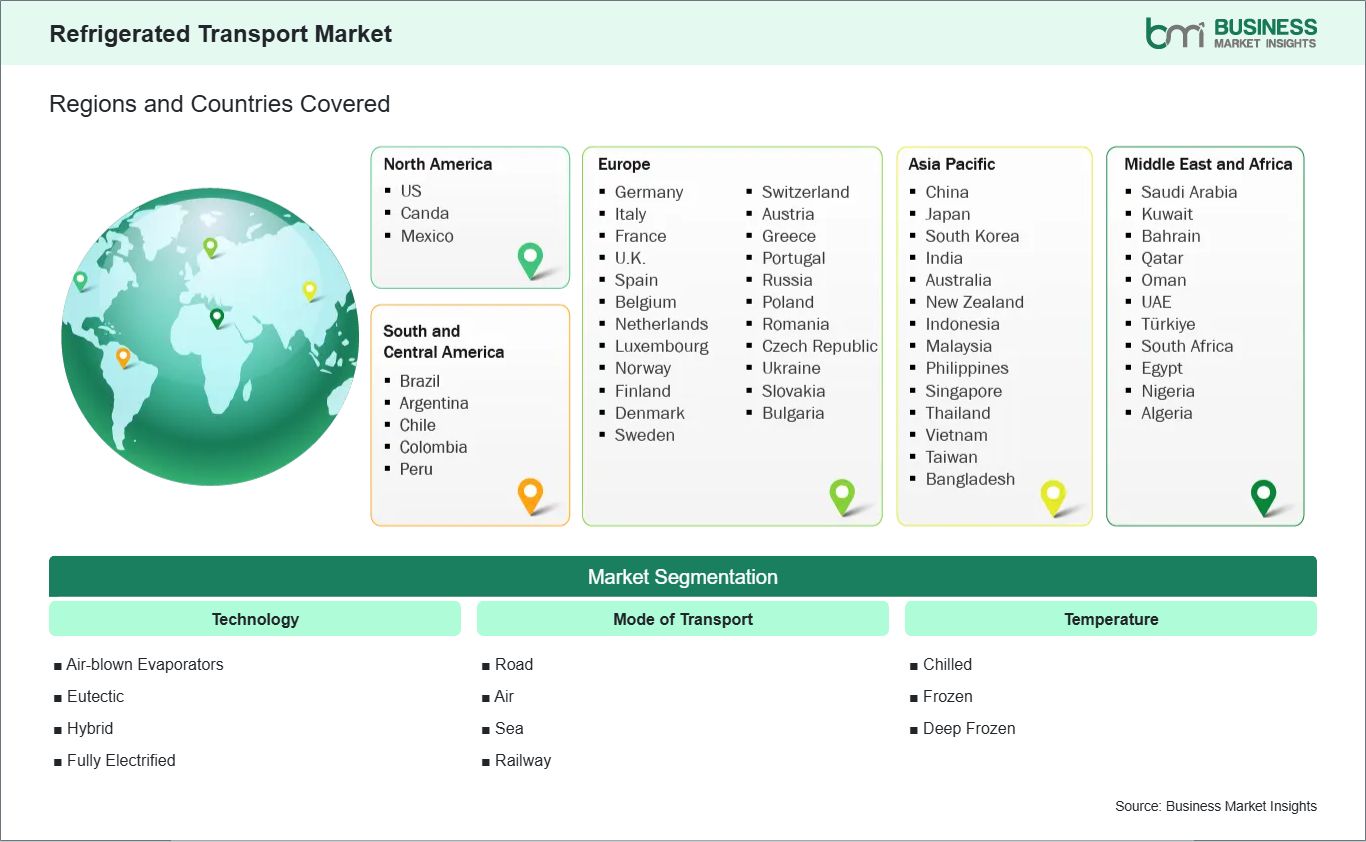
The refrigerated transport market is segmented based on temperature, technology, and mode of transport.
By Temperature
- Chilled: Supports short-distance fresh food distribution requiring mild thermal regulation
- Frozen: Ensures extended storage stability for processed food products
- Deep Frozen: Maintains ultra-low temperatures for sensitive biological and specialty goods
By Technology
- Air-blown Evaporators: Enhances uniform airflow within cargo spaces
- Eutectic: Maintains temperature stability using phase-change materials
- Hybrid: Combines fuel and electric systems for operational efficiency
- Fully Electrified: Enables low-emission cold chain transport solutions
By Mode of Transport
- Road: Offers route flexibility and cost-efficient regional delivery
- Air: Facilitates rapid transit for high-value and urgent shipments
- Sea: Supports large-volume global trade movement
- Railway: Provides stable long-distance inland transportation
Market Forces
Refrigerated Transport Market Drivers and Opportunities
Expansion of Global Cold Chain Logistics
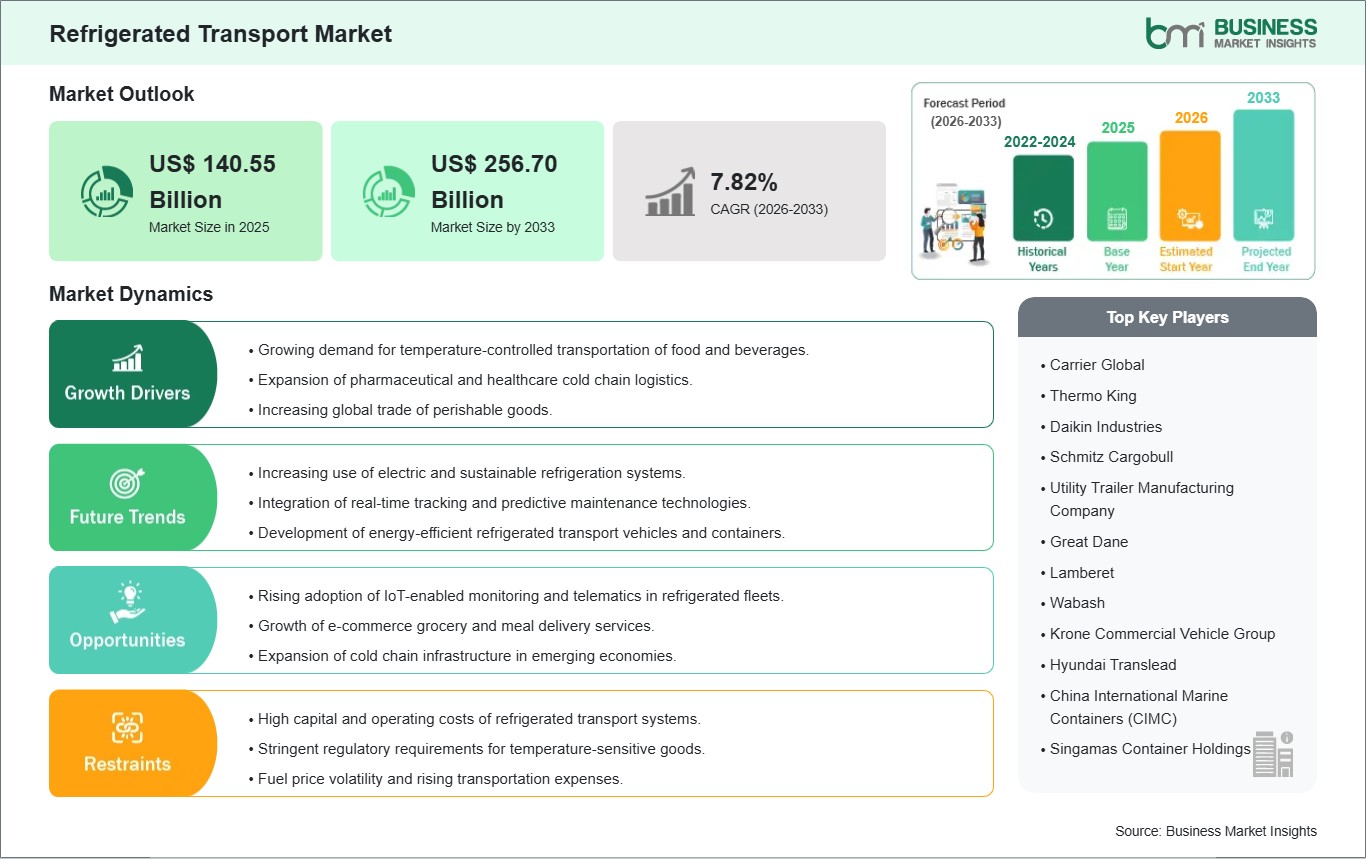
Escalating cross-border trade of perishable goods necessitates robust temperature-controlled transport solutions. Food exports, pharmaceutical supply chains, and specialty chemicals depend on reliable cold logistics systems. This need accelerates infrastructure development, fleet modernization, and adoption of advanced temperature monitoring technologies.
Enhanced cold chain integration strengthens supply continuity and minimizes spoilage risks across transportation stages. Logistics networks increasingly incorporate standardized refrigeration systems, optimizing operational consistency. The relevance of efficient refrigerated transport rises alongside stricter product integrity requirements and global distribution complexities.
Electrification and Sustainable Transport Innovation
Advancements in electrification introduce environmentally efficient solutions within refrigerated transport systems. Fully electrified units and hybrid configurations reduce dependency on conventional fuel sources while supporting emission compliance standards. These innovations enhance temperature control precision while lowering operational noise and energy consumption.
Future expansion of sustainable logistics frameworks supports broader deployment of electric refrigerated fleets. Integration with renewable energy systems and smart tracking technologies enhances operational visibility. This transition contributes to long-term efficiency improvements while aligning with evolving environmental regulations and sustainability targets.
Size and Share Analysis
Refrigerated Transport Market Size and Share Analysis
The Refrigerated Transport Market was valued at USD 140.55 Billion in 2025 and is projected to reach USD 256.70 Billion by 2033, growing at a CAGR of 7.82% during 2026–2033. This growth reflects systematic expansion of global cold chain networks and rising utilization across multiple industries requiring thermal precision.
Technology adoption increasingly favors electrified and hybrid systems, reflecting alignment with sustainability standards and operational efficiency priorities.
Application-wise, food supply chains account for the largest share due to widespread consumption of perishable goods. Pharmaceutical logistics also demonstrate significant contribution due to stringent temperature compliance requirements in medical product transportation.
Report Coverage
Refrigerated Transport Market Report Coverage and Deliverables
The Refrigerated Transport report provides a detailed analysis of the market covering the below areas:
- Market size and forecast at global, regional, and country levels for all the key market segments covered under the scope
- Market trends, as well as market dynamics such as drivers, restraints, and key opportunities
- Market analysis covering key market trends, global and regional framework, major players, regulations, and recent market developments
- Industry landscape and competition analysis covering market concentration, heat map analysis, prominent players, and recent developments for the market
- Detailed company profiles, including SWOT analysis
Geographic Insights
Refrigerated Transport Market Geographic Insights
The Refrigerated Transport market shows diverse regional adoption patterns influenced by trade flows, infrastructure maturity, and regulatory frameworks. Developed regions exhibit structured cold chain systems, while emerging markets focus on capacity expansion. Differences in consumption patterns and supply chain sophistication shape regional deployment intensity and operational priorities.
North America demonstrates consistent implementation of advanced refrigeration technologies across road and rail networks. Strong regulatory oversight ensures adherence to temperature compliance standards. Infrastructure readiness and integration of digital tracking systems support efficient cargo management across domestic and international routes.
Asia Pacific reflects accelerating deployment driven by expanding urban consumption and export-oriented industries. Investments in cold storage facilities and refrigerated logistics networks strengthen distribution efficiency. Regional governments emphasize cold chain development to reduce food wastage and enhance pharmaceutical distribution reliability.
Europe maintains a balanced market structure with emphasis on sustainable transport and emission reduction strategies. Electrified refrigeration systems gain traction within regional logistics networks. Emerging markets in other regions demonstrate gradual integration, supported by infrastructure upgrades and rising awareness of cold chain benefits.
Industry Activity
Recent Developments
The Refrigerated Transport market is evaluated by gathering qualitative and quantitative data post primary and secondary research, which includes important corporate publications, association data, and databases. Recent developments and news in the market include:
- In May 2025, Australian refrigerated logistics operator Tailored Freight entered voluntary administration.
- In December 2025, Marten Transport continues to expand its temperature-controlled trucking operations across North America.
Trust & Transparency
Research Methodology
The market analysis combines proprietary research with secondary data from government agencies, company disclosures, regulatory filings, industry databases and expert interviews. Market estimates are validated through data triangulation, cross-market benchmarking and analyst
review.
View Full Research Methodology
Key Sources Referred:
Industry logistics and cold chain reports Government transportation and trade data Refrigeration and thermal systems journals Company annual reports and filings Academic research on cold chain management Supply chain and logistics whitepapers Trade association publications