
Welded Spiral Heat Exchangers Market Outlook: Size, Share, Trends, Growth Analysis, Competitive Landscape & Forecast, 2026-2033

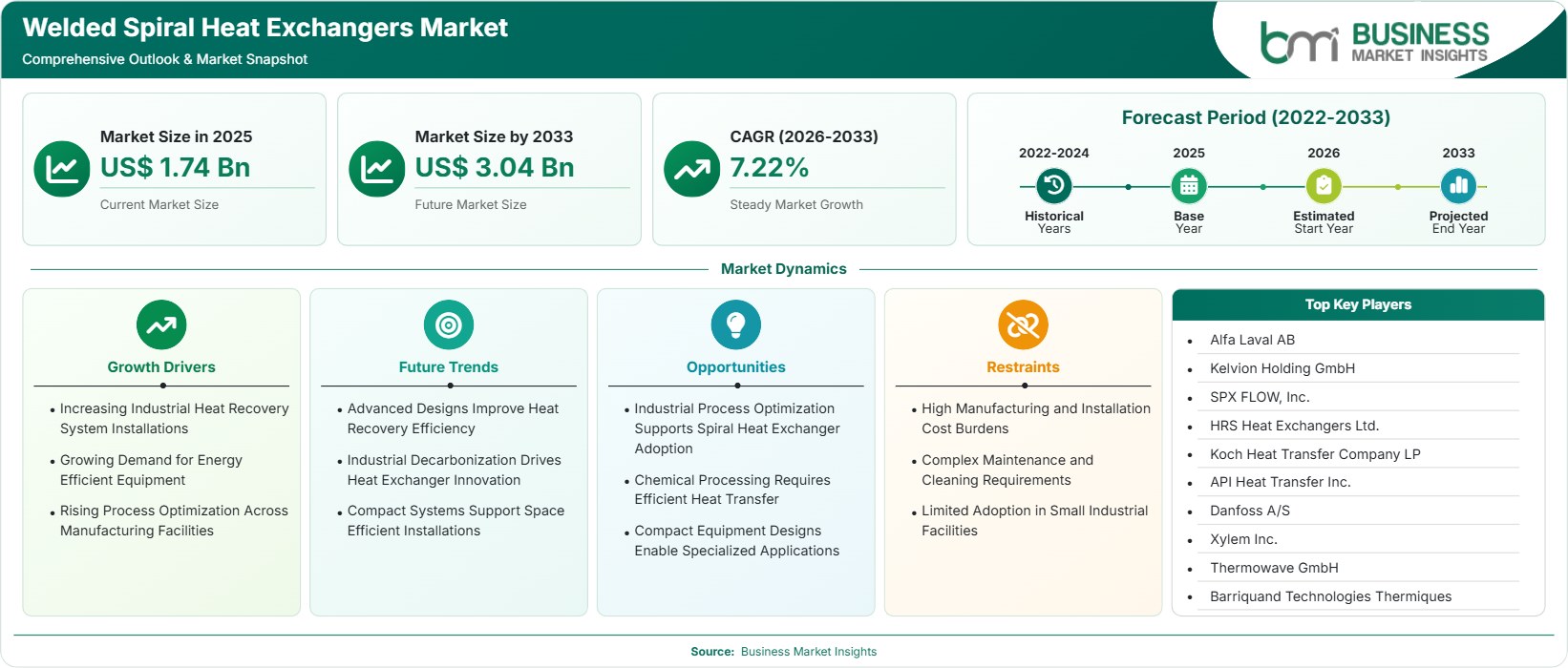
The Welded Spiral Heat Exchangers Market size was valued at US$ 1.74 Billion in 2025 and is projected to reach US$ 3.04 Billion by 2033, growing at a CAGR of 7.22% during 2026–2033. Expansion of chemical processing capacity, refinery modernization, energy-efficiency mandates, wastewater heat recovery adoption, and demand for compact anti-fouling thermal systems are creating strong opportunities across industrial end-use sectors.

Report Coverage
  • Type: Fully Welded Spiral Heat Exchangers, Semi-Welded Spiral Heat Exchangers
  • Material Type: Carbon Steel, Stainless Steel, Duplex & Super Duplex Steel, Titanium / Specialty Alloys
  • Application: Chemical & Petrochemical, Oil & Gas, Pulp & Paper, Power Generation, Others
US$ 1.74 Bn Market size in 2025
US$ 3.04 Bn Market Size by 2033
7.22% CAGR, 2026 - 2033
2026-2033 Forecast Period

AI Overview

Welded Spiral Heat Exchangers Market Summary

  • North America Region: Holds a 34%–37% share in 2025, growing at a 6.1%–6.8% CAGR during 2026–2033. Growth is supported by refinery upgrades, chemical capacity expansion, wastewater heat recovery, industrial decarbonization initiatives, asset reliability requirements, energy optimization projects, maintenance cost reduction efforts, and process efficiency investments.
    US market benefits from petrochemical investments, industrial modernization, and thermal efficiency programs, advancing at 6.3%–7.0% CAGR.
  • Fastest Growing Region: Asia Pacific holds a 27%–30% share in 2025 and advances at an 8.5%–9.2% CAGR. Rapid industrialization, chemical manufacturing expansion, power generation investments, environmental compliance programs, process optimization initiatives, and infrastructure development support sustained equipment deployment across multiple industries.
  • Leading Segment: Chemical & Petrochemical accounts for 33%–36% share of the Welded Spiral Heat Exchangers Market in 2025 and grows at 7.0%–7.8% CAGR. Strong heat recovery requirements, corrosive fluid processing needs, compact equipment preference, operational efficiency targets, and maintenance reduction objectives continue supporting broad demand worldwide.
  • High Growth Segment: Duplex & Super Duplex Steel represents 16%–19% share in 2025 and achieves 8.3%–9.0% CAGR. Rising corrosion resistance requirements, offshore applications, aggressive media handling, lifecycle cost advantages, and reliability improvements increase adoption across demanding operating environments.
  • Key Market Opportunity: Increasing deployment of industrial heat recovery systems, circular manufacturing initiatives, and carbon reduction programs creates significant opportunities for advanced thermal equipment supporting energy savings, emissions reduction, and process optimization.
  • Major Market Players: Alfa Laval AB, Kelvion Holding GmbH, SPX FLOW, Inc., HRS Heat Exchangers Ltd., Koch Heat Transfer Company LP, API Heat Transfer Inc., Danfoss A/S, Xylem Inc., Thermowave GmbH, and Barriquand Technologies Thermiques.
Strategic Insights

Welded Spiral Heat Exchangers Market: Strategic Insights

Welded Spiral Heat Exchangers Market Strategic Framework
FREE PDF
Request your free sample
Request free sample
Stakeholder View

Key Takeaways

  • Supply chains increasingly emphasize specialized metal fabrication, precision welding, engineered alloys, and aftermarket maintenance services, creating a value chain where technical expertise and lifecycle support influence purchasing decisions.
  • Chemical processing, refinery heat recovery, and advanced wastewater treatment applications present the highest revenue upside due to increasing requirements for efficient thermal management under challenging operating conditions.
  • Product innovation is focused on enhanced anti-fouling geometries, higher pressure tolerance, improved corrosion resistance, digital condition monitoring, and modular configurations supporting reduced lifecycle costs.
  • Asia-Pacific offers the strongest investment case because of expanding industrial production capacity, rising process automation adoption, and increasing implementation of energy management initiatives.
  • Industry participants continue pursuing partnerships, regional manufacturing expansion, and technology-led acquisitions to strengthen engineering capabilities and access high-growth industrial markets.
  • Sustainability-driven procurement strategies are elevating demand for systems capable of recovering process heat and improving energy utilization across continuous manufacturing operations.
Geographic Outlook

Welded Spiral Heat Exchangers Market Regional Highlights

North America Welded Spiral Heat Exchangers Market

North America accounts for 34%–37% of global revenue in 2025 and is expected to expand at a 6.1%–6.8% CAGR through 2033. The region benefits from mature refining assets, extensive chemical production infrastructure, growing industrial decarbonization investments, and modernization of water treatment facilities. The Welded Spiral Heat Exchangers Market share remains strongest in the United States due to advanced process industries and large-scale heat recovery projects. Strong aftermarket service networks and emphasis on energy optimization further support demand across multiple industrial sectors.

  • Petrochemical complexes along the Gulf Coast continue upgrading thermal systems to enhance efficiency, improve reliability, and reduce operational costs associated with fouling-intensive process streams.
  • Energy-transition investments encourage deployment of heat recovery equipment supporting carbon reduction objectives and improved asset utilization across manufacturing operations.
  • Industrial operators increasingly prioritize lifecycle economics, driving replacement demand for higher-efficiency compact thermal technologies.
  • Wastewater treatment modernization supports adoption of durable heat exchange systems capable of handling solids-rich and contaminated fluids.

US Welded Spiral Heat Exchangers Market

The United States represents 74%–78% of North American revenue and advances at a 6.3%–7.0% CAGR. Demand is concentrated within specialty chemicals, refining, pulp processing, and municipal infrastructure markets. Federal and state-level efficiency programs continue promoting recovery of wasted thermal energy and optimization of industrial processes.

  • Gulf Coast petrochemical investments support procurement of corrosion-resistant thermal equipment for continuous process operations.
  • Water infrastructure upgrades create sustained demand for systems designed to operate efficiently under challenging fluid conditions.
  • Industrial digitalization encourages integration of monitoring and predictive maintenance capabilities with thermal management assets.

Europe Welded Spiral Heat Exchangers Market

Europe holds 28%–31% market share in 2025 and is projected to grow at a 6.5%–7.2% CAGR in the Welded Spiral Heat Exchangers Market. Energy efficiency legislation, circular economy objectives, and industrial emission reduction targets support technology adoption. Germany remains the leading country, while Eastern European manufacturing locations exhibit higher growth rates. Industrial users emphasize energy recovery, operational sustainability, and lifecycle cost optimization.

  • EU decarbonization initiatives encourage broader deployment of heat recovery technologies in manufacturing facilities.
  • Chemical and pharmaceutical production hubs maintain steady demand for high-performance corrosion-resistant equipment.
  • Germany leads regional revenues, while Poland records one of the fastest industrial equipment adoption rates.
  • High energy prices continue strengthening the economic case for efficient thermal management solutions.

Asia Pacific Welded Spiral Heat Exchangers Market

Asia Pacific captures 27%–30% share of worldwide revenue in 2025 and records the fastest expansion at 8.5%–9.2% CAGR. China leads regional demand due to extensive manufacturing capacity, while India demonstrates the highest growth momentum. Large-scale investments in chemicals, power generation, industrial infrastructure, and water treatment projects underpin sustained equipment deployment.

  • China remains the dominant market through continuous investments in industrial processing and energy infrastructure.
  • India experiences accelerated adoption driven by manufacturing growth and environmental compliance initiatives.
  • Expanding chemical clusters increase requirements for reliable compact heat recovery equipment.
  • Rising electricity consumption supports deployment across thermal power and industrial utility facilities.

Rest of World Welded Spiral Heat Exchangers Market

Rest of World contributes 9%–12% share and grows at a 7.3%–8.0% CAGR. South and Central America benefit from mining, pulp, and industrial modernization investments. The Middle East and Africa region gains momentum from petrochemical diversification programs and significant process industry developments.

  • Brazil leads South American demand through pulp processing, industrial heat recovery, and wastewater management projects.
  • Saudi Arabia emerges as the fastest-growing market supported by downstream petrochemical expansion initiatives.
  • Industrial diversification programs increase procurement of advanced thermal equipment across Gulf economies.
  • Growing environmental standards encourage wider adoption of energy-efficient process technologies.
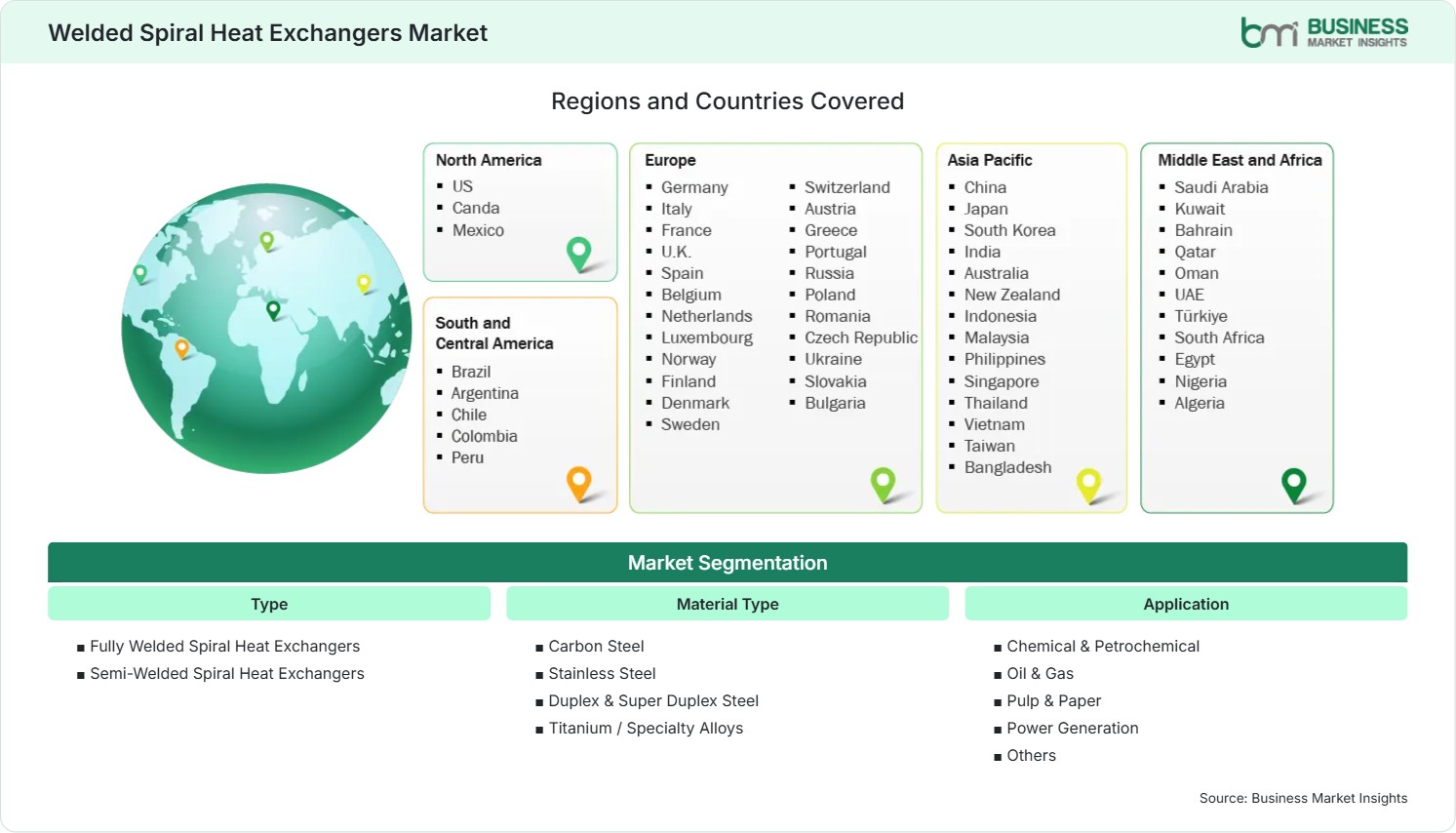
Global Market Geography
FREE PDF
Request your free sample
Request free sample
Segment Analysis

Welded Spiral Heat Exchangers Market Segmentation

Type

This category is a very important product categorization, where the market share of Fully Welded is estimated to be 58%–62% by 2025, and expansion rates are expected to be at 7.4%–8.0% CAGR. The Welded Spiral Heat Exchangers Market continues to grow as more industries demand designs with improved sealing performance, corrosion resistance, and long-term operational reliability across demanding applications.

  • Fully Welded Spiral Heat Exchangers: Preferred for aggressive process media, high-pressure conditions, and applications requiring maximum containment reliability with minimal maintenance intervention over extended operating periods.
  • Semi-Welded Spiral Heat Exchangers: Adopted where maintenance accessibility and operating flexibility remain priorities, supporting balanced performance across industrial processing and utility environments.

Material Type

Material Selection is a direct determinant of lifecycle performance. The leading materials in the market include stainless steel at 42%–46%, followed by Duplex & Super Duplex Steel, with a CAGR of 8.3%–9.0%, owing to their superior corrosion resistance in demanding operating environments.

  • Carbon Steel: Remains cost-effective for less corrosive services and is extensively deployed in standard industrial heat transfer applications.
  • Stainless Steel: Widely used because of durability, hygiene benefits, corrosion resistance, and suitability across numerous processing industries.
  • Duplex & Super Duplex Steel: Gains preference in offshore, petrochemical, and chemical operations requiring enhanced resistance to corrosion and mechanical stress.
  • Titanium/Specialty Alloys: Targeted toward highly corrosive environments where reliability and extended service life justify higher capital expenditure.

Application

Application diversification drives widespread industry adoption. Chemical & Petrochemicals is the largest market, with a 33%-36% share by 2025 and a 7.0%-7.8% CAGR, driven by high process heating, cooling, and recovery requirements. The Welded Spiral Heat Exchangers Market trends continue to center on energy efficiency and process integration initiatives.

  • Chemical & Petrochemical: Strong demand stems from heat recovery, reactor temperature control, and handling of challenging process streams.
  • Oil & Gas: Utilized across refining and upstream facilities requiring compact solutions capable of withstanding demanding operating conditions.
  • Pulp & Paper: Adoption is supported by fiber-rich fluid handling requirements and continuous process efficiency objectives.
  • Power Generation: Growth is linked to condensate management, heat recovery applications, and operational efficiency initiatives within generating facilities.
Market Forces

Welded Spiral Heat Exchangers Market Dynamics

Key Market Drivers

Industrial Energy Efficiency and Heat Recovery Investments

Energy usage in industrial processes remains a major contributor to high operational costs in the chemical, refining, and processing industries. Increased use of energy-efficiency measures results in greater demand for systems that recover waste heat and improve heat efficiency. Plants are constantly replacing their shell-and-tube equipment with more efficient spiral heat exchangers to achieve greater efficiency and minimal maintenance. Programs on industrial energy efficiency from the International Energy Agency continue to inspire upgrades to heat exchangers. Growing focus on emissions reduction and productivity improvement creates a favorable environment for advanced heat recovery solutions throughout global manufacturing networks.

Expansion of Chemical and Petrochemical Processing Capacity

There is an increasing number of chemical manufacturing investments in Asia, North America, and the Middle East, which are contributing to demand for thermal management equipment that can withstand the corrosive and fouling nature of the media involved in these processes. Reliability is a crucial attribute of equipment used in processes, as it must maintain efficiency under difficult conditions. Capacity expansion will be seen in the specialty chemicals, polymers, fertilizers, and refinery industries, driving consistent demand. Advanced process integration approaches further promote the use of compact heat-transfer equipment. These developments reinforce long-term demand across large industrial facilities seeking higher operational efficiency and reliability.

Growing Focus on Reliability in Harsh Operating Conditions

There are many industries in which the processing of viscous fluids, slurries, fibrous materials, and contaminated fluids poses serious fouling problems. Spiral designs help minimize the risk of blockage and ensure uniform equipment performance. It becomes an important feature for operators seeking to enhance productivity. It is also demanded as old industrial equipment is replaced by robust new technology, delivering operational resilience. These factors collectively support sustained adoption across multiple industrial sectors.

Key Market Opportunities

Deployment Across Industrial Decarbonization Projects

Governments and corporations are focusing more on decarbonization through energy efficiency and minimizing waste. State-of-the-art thermal technology may enable significant process heat recovery while reducing energy use. Low-carbon manufacturing, sustainable processes, and industrial modernization contribute to the expansion of the target market. The Welded Spiral Heat Exchangers Market forecasts is positive, as heat recovery projects usually result in tangible operational savings and contribute to environmental performance. Suppliers capable of demonstrating quantifiable efficiency improvements are well-positioned to benefit.

Growth of Water and Wastewater Infrastructure

Modern municipal and industrial wastewater treatment plants are adopting more advanced thermal systems to treat sludge, recover energy, and optimize processes. The growth of urbanization, increasing environmental regulations, and the need to ensure water sustainability have led to increased investments in water and wastewater infrastructure in both developed and developing countries. Spiral heat exchangers offer certain benefits for processing liquids that may be highly viscous, dirty, or prone to fouling. With the expanding capacities of water treatment facilities worldwide, technology manufacturers are presented with promising growth prospects and innovation in this evolving market.

Advanced Materials and High-Corrosion Applications

The increasing use of harsh chemicals and operation under difficult process conditions has made it necessary for industry players to adopt high-technology materials such as duplex, super duplex, and other exotic grades. The end-user is showing a preference for materials that offer good performance and low maintenance costs throughout the life cycle, rather than low upfront cost. It has provided a great opportunity for material manufacturers to supply engineered products. There will be healthy demand from offshore oil and gas, specialty chemical manufacturing, mining, desalination plants, and water treatment plants, where corrosion resistance is critical.

Market Restraints and Challenges

High Initial Capital Cost Compared with Conventional Alternatives

Advanced heat exchange systems often face implementation difficulties due to the relatively higher initial capital requirements compared with conventional systems. Advanced construction technology, specialized welding technology, and the use of high-quality materials lead to higher equipment costs. Thus, frugal industrial managers may put off equipment upgrades or stick to conventional heat exchangers despite the advantages advanced systems offer. This problem is especially acute in developing countries, where approval of expenses is usually quite frugal. Although advanced heat exchange systems are usually profitable in the long run, initial costs may hinder their adoption, particularly among small and medium-sized facilities and cost-sensitive industries.

Volatility in Raw Material and Specialty Alloy Pricing

The prices of stainless steel, alloys of nickel, titanium, and other special metals fluctuate frequently due to changes in the global commodity market, geopolitical events, disruptions in logistics, energy costs, and changes in demand in the major industries. Price instability causes margin pressures on manufacturing businesses and makes the project’s feasibility challenging for purchasers. The sudden increase in the cost of raw materials may delay purchasing and contracting. Additionally, the unpredictable availability of materials may adversely affect project execution and operational efficiency across multiple industrial sectors.

Company Analysis

Competitive Landscape

The Welded Spiral Heat Exchangers Market analysis indicates competition is centered on thermal efficiency, metallurgy expertise, customized engineering, service capabilities, and project execution experience.

Company Name

Overview

Products and Services relevant to this market

Alfa Laval AB

Global heat transfer specialist with extensive experience in spiral heat exchanger technologies and industrial process optimization.

Welded spiral heat exchangers, heat recovery systems, maintenance services and thermal engineering solutions.

Kelvion Holding GmbH

International provider of thermal solutions serving energy, chemical and industrial processing sectors.

Spiral exchangers, process cooling systems, engineered heat transfer solutions and aftermarket support.

SPX FLOW, Inc.

Industrial process technology supplier with strong presence in fluid handling and thermal systems.

Process heat exchangers, engineered systems, industrial services and thermal management technologies.

HRS Heat Exchangers Ltd.

Specialist manufacturer focused on efficient heat transfer solutions across industrial applications.

Heat recovery equipment, process exchangers, customized thermal systems and technical support.

Koch Heat Transfer Company LP

Experienced provider of thermal engineering technologies for demanding industrial operations.

Heat exchangers, process optimization solutions, engineering services and plant efficiency products.

API Heat Transfer Inc.

Thermal management company serving industrial, energy and process manufacturing markets.

Custom heat exchangers, industrial cooling solutions and thermal system design services.

Danfoss A/S

Diversified technology group emphasizing energy efficiency and industrial thermal performance.

Industrial heat transfer equipment, energy optimization technologies and control systems.

Xylem Inc.

Water technology provider supporting municipal and industrial infrastructure applications.

Thermal treatment solutions, water process equipment and energy recovery technologies.

Thermowave GmbH

German heat exchanger specialist with strong engineering and manufacturing capabilities.

Welded heat exchangers, industrial thermal systems and process efficiency solutions.

Barriquand Technologies Thermiques

Established thermal equipment supplier serving process industries worldwide.

Engineered heat exchangers, customized thermal units and industrial process solutions.

Trust & Transparency

Research Methodology

The market analysis combines proprietary research with secondary data from government agencies, company disclosures, regulatory filings, industry databases and expert interviews. Market estimates are validated through data triangulation, cross-market benchmarking and analyst review.

View Full Research Methodology

Questions Answered

Frequently Asked Questions

Why is this Welded Spiral Heat Exchangers Market Report useful for stakeholders?

It provides insights into regional demand patterns, competitive positioning, segment opportunities, technology developments, investment trends, and strategic factors influencing long-term market performance.

How are sustainability goals influencing purchasing decisions?

Industrial operators increasingly prioritize technologies that recover waste heat, reduce energy consumption, lower emissions, and improve resource efficiency while maintaining operational reliability.

Which region offers the highest future growth potential?

Asia Pacific presents the most attractive growth outlook, supported by industrial expansion, manufacturing investments, environmental compliance initiatives, and significant infrastructure development programs.

What makes spiral heat exchangers different from conventional designs?

Their continuous spiral flow path reduces fouling risk, improves thermal efficiency, lowers maintenance frequency, and offers a compact footprint compared with many traditional alternatives.

What industries generate the strongest demand for welded spiral heat exchangers?

Chemical processing, petrochemicals, oil refining, pulp and paper, wastewater treatment, and power generation remain the major demand centers because they regularly manage challenging fluids and require efficient heat recovery.

Access the Full Welded Spiral Heat Exchangers Market Report

Get segment-level forecasts, regional estimates, competitive benchmarking, company profiles and downloadable Excel datasets.

Access the full Welded Spiral Heat Exchangers Market Report
350 pages PDF & Excel | 2026-09-04