
Microchannel Heat Exchanger Market Outlook: Size, Share, Trends, Growth Analysis, Competitive Landscape & Forecast, 2026-2033

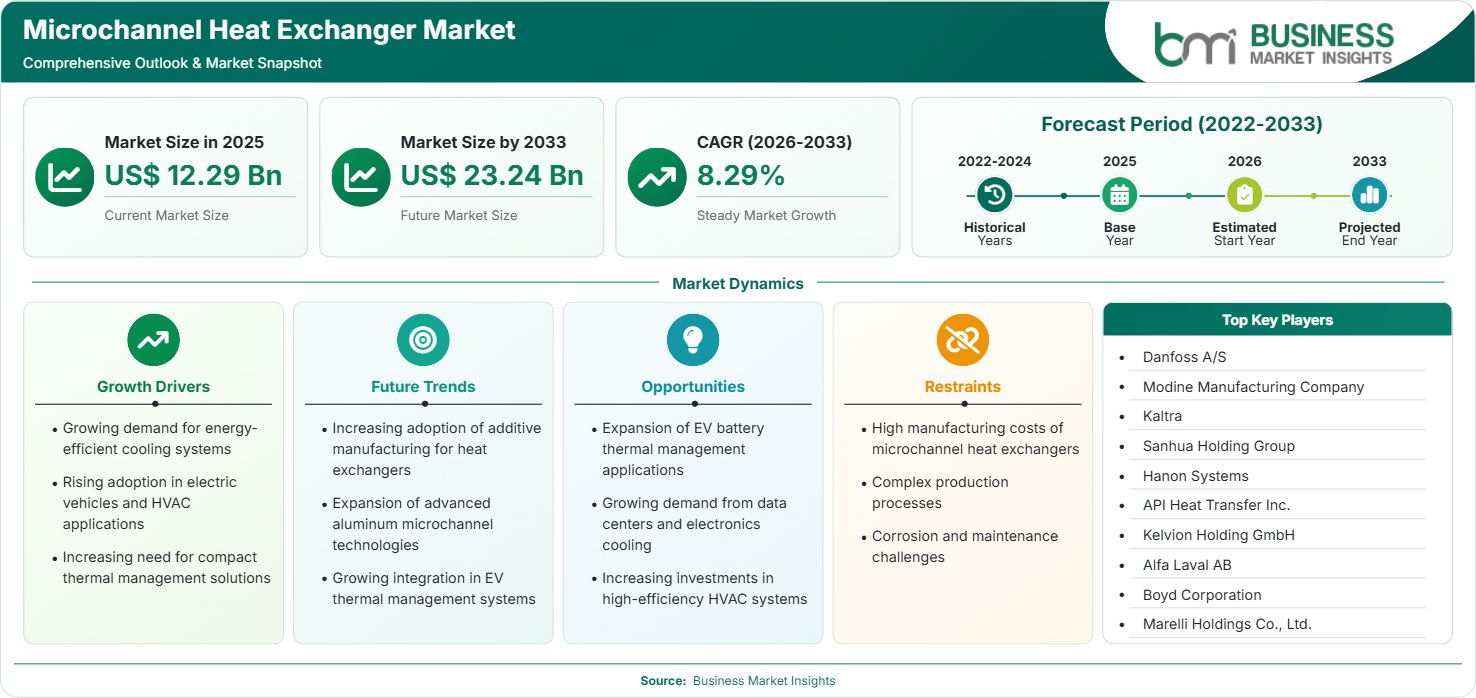
The Microchannel Heat Exchanger Market size was valued at US$ 12.29 Billion in 2025 and is projected to reach US$ 23.24 Billion by 2033, growing at a CAGR of 8.29% from 2026 to 2033. Market growth is driven by rising demand for energy-efficient thermal management solutions, increasing adoption in HVAC systems, expanding electric vehicle applications, and growing requirements for compact heat transfer technologies across industrial sectors.

Report Coverage
  • Type: Evaporator, Condenser, Water Coil
  • Application: HVAC Automotive, Refrigeration, Others
US$ 12.29 Bn Market size in 2025
US$ 23.24 Bn Market Size by 2033
8.29% CAGR, 2026 - 2033
2026-2033 Forecast Period

01 AI Overview

Microchannel Heat Exchanger Market Summary

  • North America Region: North America holds a market share of 28%–32% in 2025, growing with a CAGR of 7.80%–8.30% influenced by HVAC modernization, electric vehicle adoption, energy efficiency initiatives, and advanced cooling system demand. The U.S. market analysis indicates a CAGR of 7.90%–8.40% from 2026–2033, supported by commercial cooling requirements and automotive thermal management applications.
  • Fastest Growing Region: Asia Pacific holds a market share of 36%–40% in 2025, growing with a CAGR of 8.60%–9.10% influenced by industrial expansion, automotive production growth, infrastructure development, and increasing demand for efficient cooling technologies.
  • Leading Segment: Condenser holds a market share of 42%–46% in 2025, growing with a CAGR of 8.10%–8.60% due to extensive use in HVAC systems, refrigeration applications, and automotive cooling solutions.
  • High Growth Segment: Water Coil holds a market share of 18%–22% in 2025, growing with a CAGR of 8.70%–9.20% due to increasing adoption in efficient HVAC systems and commercial thermal management applications.
  • Key Market Opportunity: Expansion of electric vehicle battery thermal management, data center cooling demand, and high-efficiency HVAC systems is creating new opportunities for microchannel heat exchanger manufacturers.
  • Major Market Players: Danfoss A/S, Modine Manufacturing Company, Kaltra, Sanhua Holding Group, Hanon Systems, API Heat Transfer Inc., Kelvion Holding GmbH, Alfa Laval AB, Boyd Corporation, Marelli Holdings Co., Ltd.
02 Strategic Insights

Microchannel Heat Exchanger Market: Strategic Insights

Microchannel Heat Exchanger Market Strategic Framework
FREE PDF
Request your free sample
Request free sample
03 Stakeholder View

Key Takeaways

  • Energy efficiency requirements are increasing adoption of compact heat transfer technologies across HVAC, automotive, and industrial applications.
  • Condenser systems remain a major segment due to their widespread use in cooling and refrigeration applications.
  • Electric vehicle battery thermal management represents a high-growth opportunity as manufacturers focus on improving battery performance and safety.
  • Asia Pacific provides strong investment potential due to automotive production growth, industrial development, and increasing cooling demand.
  • Strategic partnerships between heat exchanger manufacturers, automotive suppliers, and HVAC companies are shaping market competition.
  • Data center expansion and sustainable cooling requirements are expected to support long-term demand for advanced thermal management solutions.
04 Geographic Outlook

Microchannel Heat Exchanger Market Regional Highlights

North America Microchannel Heat Exchanger Market

North America accounted for 28%–32% share in 2025 and is projected to expand at a CAGR of 7.80%–8.30% during 2026–2033. The region maintains strong demand due to increasing HVAC modernization, rising electric vehicle production, and growing focus on energy-efficient cooling technologies. The Microchannel Heat Exchanger Market share in North America is supported by commercial building upgrades, automotive technology development, and demand for compact thermal management systems. The United States represents the largest contributor due to advanced HVAC infrastructure, strong automotive manufacturing presence, and increasing investments in sustainable cooling solutions.

  • The United States leads regional demand through HVAC replacement activities, EV development, and adoption of efficient thermal technologies.
  • Canada is experiencing growth through energy efficiency programs, industrial cooling requirements, and sustainable infrastructure investments.
  • Automotive manufacturers are increasing adoption of microchannel technology for electric vehicle thermal management systems.
  • Commercial facilities are upgrading cooling systems to improve energy efficiency and reduce operational costs.

US Microchannel Heat Exchanger Market

The United States represented 22%–26% share within North America in 2025 and is expected to grow at a CAGR of 7.90%–8.40% between 2026–2033. The country remains a significant market due to strong demand from HVAC, automotive, refrigeration, and data center applications. Increasing focus on reducing energy consumption is encouraging adoption of advanced heat transfer technologies. The Microchannel Heat Exchanger Market analysis highlights opportunities from electric vehicle battery cooling, commercial refrigeration expansion, and high-efficiency air conditioning systems.

  • HVAC manufacturers are adopting compact heat exchangers to improve system performance and meet efficiency standards.
  • Electric vehicle producers are integrating advanced thermal management solutions for improved battery reliability.
  • Data center operators are increasing demand for efficient cooling technologies due to rising computing requirements.

Europe Microchannel Heat Exchanger Market

Europe accounted for 24%–28% share in 2025 and is forecast to grow at a CAGR of 7.60%–8.20% from 2026–2033. Germany, France, the United Kingdom, Italy, and Sweden represent key markets due to strong HVAC industries, automotive innovation, and sustainability-focused regulations. European companies are increasingly adopting energy-efficient cooling solutions to support environmental objectives and reduce operational costs. Germany represents a leading market due to automotive manufacturing capabilities and advanced engineering expertise.

  • Germany maintains strong demand through automotive thermal management innovation and industrial cooling applications.
  • France is expanding adoption through sustainable building solutions and efficient HVAC system development.
  • The United Kingdom is increasing demand through commercial cooling upgrades and energy efficiency initiatives.
  • Sweden is supporting market growth through sustainable technology adoption and industrial innovation.

Asia Pacific Microchannel Heat Exchanger Market

Asia Pacific represented 36%–40% share in 2025 and is expected to grow at a CAGR of 8.60%–9.10% during 2026–2033. The region dominates market expansion due to rapid industrialization, automotive production growth, increasing HVAC demand, and expanding data center infrastructure. China, Japan, South Korea, and India are major markets supported by manufacturing capabilities and rising demand for efficient thermal systems. The Microchannel Heat Exchanger Market trends in Asia Pacific are influenced by electric mobility growth, urbanization, and increasing adoption of advanced cooling technologies.

  • China leads regional demand through large-scale manufacturing, HVAC expansion, and electric vehicle production.
  • India is experiencing growth due to infrastructure development, rising cooling requirements, and industrial expansion.
  • Japan is adopting advanced heat exchanger technologies through automotive innovation and energy-efficient systems.
  • South Korea is increasing demand through electronics manufacturing and electric vehicle thermal management applications.

Rest of World Microchannel Heat Exchanger Market

Rest of World accounted for 8%–12% share in 2025 and is projected to grow at a CAGR of 8.20%–8.80% during 2026–2033. Latin America, Middle East, and Africa markets are gradually expanding due to increasing cooling requirements, infrastructure development, and industrial growth. Growing demand for air conditioning systems, refrigeration solutions, and energy-efficient technologies is supporting Microchannel Heat Exchanger market opportunities. Countries including Brazil, UAE, and South Africa are adopting advanced thermal management solutions across commercial and industrial sectors.

  • Brazil is increasing adoption through commercial cooling demand and industrial development.
  • UAE markets are expanding due to infrastructure growth, cooling requirements, and energy-efficient building initiatives.
  • South Africa is creating opportunities through industrial modernization and improved refrigeration systems.
  • Regional investment in sustainable infrastructure is supporting adoption of efficient thermal technologies.

Global Market Geography
FREE PDF
Request your free sample
Request free sample
05 Segment Analysis

Microchannel Heat Exchanger Market Segmentation

Type

The type segment is driven by increasing demand for compact and efficient heat transfer solutions across HVAC, automotive, and refrigeration applications. Condenser represented the leading category in Microchannel Heat Exchanger Market with 42%–46% share in 2025 and is projected to grow at a CAGR of 8.10%–8.60% during 2026–2033. Condensers are widely used due to their importance in air conditioning systems, refrigeration equipment, and vehicle cooling applications. Manufacturers are developing advanced condenser designs with improved heat transfer capability, corrosion resistance, and reduced material requirements.

  • Evaporator: Evaporators are used in cooling systems to absorb heat and improve thermal efficiency. Growing HVAC and refrigeration demand is supporting adoption.
  • Condenser: Condensers represent a major segment due to extensive application in HVAC, automotive air conditioning, and refrigeration systems.
  • Water Coil: Water coils are gaining adoption in commercial HVAC systems due to their efficient heat exchange performance and energy-saving benefits.

Application

The application segment is expanding due to increasing demand for efficient cooling solutions across HVAC, automotive, refrigeration, and industrial applications. HVAC represented the leading category with 46%–50% share in 2025 and is projected to grow at a CAGR of 8.00%–8.50% during 2026–2033. Growing urbanization, commercial construction activities, and energy efficiency requirements are increasing adoption of advanced heat exchanger technologies in air conditioning and heating systems. The Microchannel Heat Exchanger Market forecasts is also gaining momentum from automotive electrification and rising cooling requirements in electronics and data center infrastructure.

  • HVAC: HVAC applications represent a major demand area due to increasing installation of energy-efficient air conditioning systems, heat pumps, and water heating solutions. Microchannel technology enables compact designs, improved thermal performance, and reduced refrigerant requirements.
    • Air Conditioning: Air conditioning systems use microchannel heat exchangers to improve cooling efficiency, reduce system size, and support energy conservation objectives in residential, commercial, and industrial buildings.
    • Heat Pump: Heat pump applications are adopting microchannel technology due to growing demand for efficient heating and cooling systems that support lower energy consumption.
    • Heat Pump Water Heater: Heat pump water heaters benefit from compact heat transfer solutions that improve system efficiency and support sustainable water heating applications.
  • Automotive: Automotive applications are expanding due to increasing electric vehicle adoption and the need for effective battery and cabin thermal management. Microchannel heat exchangers support lightweight vehicle designs and efficient cooling performance.
  • Refrigeration: Refrigeration applications are adopting microchannel solutions due to improved heat transfer efficiency, compact structures, and reduced refrigerant requirements in commercial and industrial systems.
06 Market Forces

Microchannel Heat Exchanger Market Dynamics

Key Market Drivers

Growing demand for energy-efficient cooling systems

The growing demand for energy-efficient cooling systems is driving adoption of microchannel heat exchangers across HVAC, refrigeration, and industrial applications. Rising energy costs, environmental regulations, and sustainability goals are encouraging businesses and consumers to adopt cooling technologies that provide improved efficiency with lower power consumption. Microchannel heat exchangers offer advantages including compact designs, enhanced heat transfer performance, reduced refrigerant usage, and lower system weight. HVAC manufacturers are increasingly integrating these solutions into air conditioning systems and heat pumps to improve overall performance. The growth is supported by increasing focus on energy conservation across commercial and residential infrastructure. The Microchannel Heat Exchanger Market trends indicate stronger demand for advanced cooling systems that help reduce operational costs while maintaining high performance.

Rising adoption in electric vehicles and HVAC applications

The rising adoption in electric vehicles and HVAC applications is creating significant demand for microchannel heat exchangers due to their ability to support compact and efficient thermal management systems. Electric vehicles need sophisticated cooling systems for effective regulation of battery temperatures and ensure efficient functioning and safety. Microchannel technology is being used for cooling batteries, air conditioners of vehicles, and electronics. The same technology is being used by the HVAC industry for manufacturing compact coolers. Increased production of electric vehicles, increased charging stations, and increasing demand for energy efficient climate control systems are creating market opportunities. Developers are emphasizing the design of light weight and robust heat exchangers for future mobility and buildings.

Increasing need for compact thermal management solutions

The increasing demand for miniaturized thermal management solutions has led to the adoption of microchannel heat exchangers in automotive, electronic, HVAC, and industrial applications. There is a demand for small-sized components that offer superior performance while minimizing space and materials utilized. The efficiency of heat exchange can be enhanced through innovative microchannel-based channels and surfaces. Growing demands for thermal management have been observed due to high heat loads generated by data centers, EVs, and other electronics. Custom-made products that address the needs of applications like limited installation space and high heat loads will drive future demand for microchannel heat exchangers.

Key Market Opportunities

Expansion of EV battery thermal management applications

The expansion of EV battery thermal management applications is creating new opportunities for microchannel heat exchanger manufacturers as electric vehicle adoption increases worldwide. Battery systems require precise temperature control to maintain performance, safety, and lifespan. The microchannel technology offers heat removal capabilities and helps to reduce the weight of vehicles as well as improving packaging efficiency. Automakers and automotive parts suppliers have been developing technologies to address the challenge of larger batteries requiring more advanced heat management solutions. Increased adoption of electric cars will lead to development of specific heat exchanger design for battery packs, power electronics and even charging system. Such companies will likely gain from increased demand for EV heat management solutions.

Growing demand from data centers and electronics cooling

The growing demand from data centers and electronics cooling is creating significant opportunities for microchannel heat exchanger manufacturers as digital infrastructure expands globally. Data centers require highly efficient cooling systems to manage increasing heat generation from servers, processors, and high-performance computing equipment. Microchannel technology provides advantages such as compact size, improved thermal transfer efficiency, and reduced energy consumption, making it suitable for advanced cooling applications. The growth of cloud computing, artificial intelligence infrastructure, and digital services is increasing demand for reliable thermal management solutions. Electronics manufacturers are also adopting compact cooling technologies to improve performance and reliability of advanced devices. Increasing investments in data center infrastructure are expected to support long-term adoption of microchannel heat exchanger solutions.

Increasing investments in high-efficiency HVAC systems

The increasing investments in high-efficiency HVAC systems are creating opportunities as commercial buildings, industrial facilities, and residential projects focus on reducing energy consumption. Building efficiency standards and sustainability objectives are encouraging replacement of conventional cooling systems with advanced technologies. Microchannel heat exchangers support these goals by improving system efficiency, reducing refrigerant requirements, and enabling compact equipment designs. HVAC manufacturers are investing in innovative solutions to meet changing customer expectations and environmental requirements. Growing construction activities, urbanization, and climate control demand are strengthening opportunities for efficient heating and cooling technologies. Companies developing advanced heat transfer solutions are expected to benefit from increasing adoption of next-generation HVAC systems.

Market Restraints and Challenges

High manufacturing costs of microchannel heat exchangers

Factor: High manufacturing costs of microchannel heat exchangers create challenges due to specialized materials, precision manufacturing requirements, and advanced production equipment needed for fabrication. Impact: Higher production costs can affect pricing competitiveness and limit adoption among cost-sensitive customers and applications. Manufacturers require significant investment in technology development, quality control systems, and production optimization to maintain product performance. The use of specialized aluminum alloys and complex manufacturing processes can increase overall expenses. Companies are focusing on improving production efficiency, automation, and material utilization to reduce manufacturing costs. As technology adoption increases and production volumes expand, cost pressures are expected to gradually decrease, supporting broader market penetration.

Complex production processes

Factor: Complex production processes create challenges because microchannel heat exchangers require precise manufacturing techniques, specialized designs, and strict quality control procedures. Impact: Production complexity can increase development time, operational costs, and technical challenges for manufacturers entering the market. Maintaining consistent performance requires advanced engineering capabilities and accurate fabrication methods. Companies must invest in research, skilled workforce development, and advanced manufacturing technologies to improve production reliability. Process optimization and automation are becoming important strategies for reducing complexity and improving scalability. Although manufacturing challenges remain, ongoing technological improvements are expected to support efficient production and wider adoption across multiple industries.

07 Company Analysis

Competitive Landscape

The Microchannel Heat Exchanger Market analysis highlights a competitive environment shaped by thermal management innovation, energy efficiency requirements, electric vehicle adoption, and advanced HVAC development. Leading companies are focusing on compact designs, improved heat transfer performance, and application-specific solutions to strengthen their market positions. Manufacturers are expanding product portfolios across automotive, refrigeration, HVAC, and industrial cooling applications.

Company Name

Overview

Products and Services relevant to this market

Danfoss A/S

Global engineering company providing energy-efficient solutions for cooling, heating, and industrial applications.

Offers microchannel heat exchangers, HVAC components, and thermal management solutions.

Modine Manufacturing Company

Thermal management company specializing in advanced heat transfer technologies.

Provides heat exchangers and cooling solutions for automotive, HVAC, and industrial applications.

Kaltra

Cooling technology provider focused on advanced thermal management systems.

Offers cooling solutions, heat exchangers, and HVAC technologies for industrial applications.

Sanhua Holding Group

Manufacturer of refrigeration and HVAC components.

Provides heat exchanger products and thermal management components for cooling systems.

Hanon Systems

Automotive thermal management company serving global vehicle manufacturers.

Develops automotive heat exchangers, climate control systems, and EV thermal management solutions.

API Heat Transfer Inc.

Heat transfer technology company providing engineered thermal solutions.

Offers heat exchangers and customized thermal management systems.

Kelvion Holding GmbH

Global heat exchanger manufacturer serving industrial and energy sectors.

Provides heat transfer solutions for refrigeration, HVAC, and industrial applications.

Alfa Laval AB

Engineering company specializing in heat transfer and fluid handling technologies.

Offers heat exchangers and energy-efficient thermal solutions across industries.

Boyd Corporation

Thermal management technology company focused on advanced cooling solutions.

Provides thermal systems, heat exchangers, and cooling technologies for electronics and industrial applications.

Marelli Holdings Co., Ltd.

Automotive technology company providing mobility solutions globally.

Develops automotive thermal management systems and heat exchanger technologies.

10 Trust & Transparency

Research Methodology

The market analysis combines proprietary research with secondary data from government agencies, company disclosures, regulatory filings, industry databases and expert interviews. Market estimates are validated through data triangulation, cross-market benchmarking and analyst review.

View Full Research Methodology

11 Questions Answered

Frequently Asked Questions

What does the Microchannel Heat Exchanger Market Report provide?

The report provides insights into market size, growth trends, segmentation analysis, regional outlook, competitive landscape, market drivers, opportunities, restraints, and future industry developments.

How do microchannel heat exchangers improve energy efficiency?

Microchannel heat exchangers improve energy efficiency through enhanced heat transfer performance, compact designs, reduced refrigerant requirements, and improved system optimization compared with conventional heat exchanger technologies.

Which application segment dominates the microchannel heat exchanger market?

HVAC represents a major application segment due to increasing demand for energy-efficient air conditioning systems, heat pumps, and commercial cooling solutions. Automotive and refrigeration applications are also experiencing significant growth.

Why are microchannel heat exchangers used in electric vehicles?

Microchannel heat exchangers are used in electric vehicles because they provide efficient thermal management for battery systems, power electronics, and cabin cooling while supporting lightweight vehicle designs and improved energy performance.

What factors are driving the growth of microchannel heat exchangers?

The growth of microchannel heat exchangers is driven by increasing demand for energy-efficient cooling systems, rising electric vehicle adoption, growing HVAC applications, and the need for compact thermal management solutions across industries.

Access the Full Microchannel Heat Exchanger Market Report

Get segment-level forecasts, regional estimates, competitive benchmarking, company profiles and downloadable Excel datasets.

Access the full Microchannel Heat Exchanger Market Report
350 pages PDF & Excel | 2026-08-12