
Heat Exchangers Market Outlook: Size, Share, Trends, Growth Analysis, Competitive Landscape & Forecast, 2026-2033

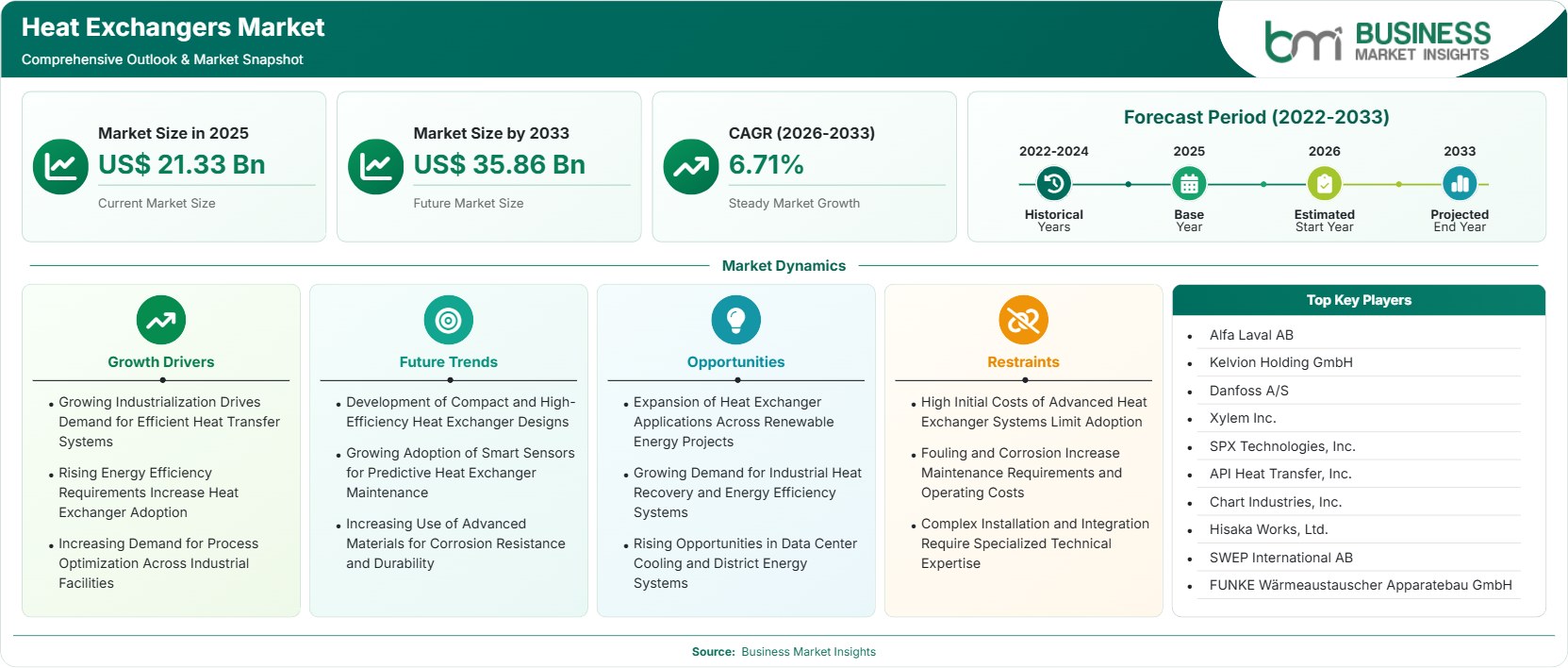
The Heat Exchangers Market size was valued at US$ 21.33 Billion in 2025 and is projected to reach US$ 35.86 Billion by 2033, growing at a CAGR of 6.71% during 2026–2033, driven by industrialization, energy-efficiency mandates, process optimization, heat recovery, renewable-energy expansion, and rising cooling requirements.

Report Coverage
  • Type: Shell & Tube, Plate & Frame, Air Coolers, Cooling Towers, Others
  • Application: Chemicals, Oil & Gas, Power Generation, HVAC, Automobile, Pharmaceuticals, Food & Beverages, Others
US$ 21.33 Bn Market size in 2025
US$ 35.86 Bn Market Size by 2033
6.71% CAGR, 2026 - 2033
2026-2033 Forecast Period

AI Overview

Heat Exchangers Market Summary

  • North America Region: North America holds a Market share of 25%–29% in 2025, growing with a CAGR of 6.2%–7.2%, supported by industrial modernization, energy efficiency investments, LNG infrastructure, power generation upgrades, and data center cooling demand. The US represents 21%–25% share, with a CAGR of 6.4%–7.4%, supported by industrial decarbonization, expanding data center capacity, and replacement of aging thermal infrastructure.
  • Fastest Growing Region: Asia Pacific holds a Market share of 39%–43% in 2025, growing with a CAGR of 7.5%–8.5%, driven by rapid industrialization, power capacity expansion, chemical manufacturing, urbanization, HVAC deployment, and investments in energy-efficient thermal management technologies.
  • Leading Segment: Shell & Tube holds a market share of 39%–43% in 2025, growing with a CAGR of 6.0%–7.0%, supported by broad use in oil and gas, chemicals, power generation, refineries, heavy industry, durability, and high-pressure process applications.
  • High Growth Segment: Data Center Cooling holds a Heat Exchangers Market share of 3%–5% in 2025, growing with a CAGR of 12.0%–14.0%, driven by AI workloads, hyperscale facilities, rising rack densities, liquid cooling adoption, and demand for energy-efficient thermal management infrastructure.
  • Key Market Opportunity: Industrial heat recovery, renewable energy integration, district energy networks, and data center cooling provide high-value opportunities as operators prioritize lower energy consumption and improved thermal efficiency.
  • Major Market Players: Alfa Laval AB, Kelvion Holding GmbH, Danfoss A/S, Xylem Inc., SPX Technologies, Inc., API Heat Transfer, Inc., Chart Industries, Inc., Hisaka Works, Ltd., SWEP International AB, and FUNKE Wärmeaustauscher Apparatebau GmbH.
Strategic Insights

Heat Exchangers Market: Strategic Insights

Heat Exchangers Market Strategic Framework
FREE PDF
Request your free sample
Request free sample
Stakeholder View

Key Takeaways

  • The value chain is shifting toward integrated thermal management, connecting equipment manufacturers, material suppliers, engineering firms, EPC contractors, technology providers, and aftermarket service companies.
  • The highest-value growth opportunities are emerging in data center cooling, industrial heat recovery, renewable energy, district energy, and applications requiring compact or highly efficient thermal systems.
  • Innovation is moving toward advanced materials, enhanced heat transfer surfaces, compact designs, digital condition monitoring, and systems compatible with low-carbon industrial processes.
  • Asia Pacific offers the strongest regional investment case due to industrial expansion, power generation requirements, urban HVAC demand, chemical production, and increasing energy efficiency investments.
  • Strategic partnerships and acquisitions are likely to focus on expanding geographic reach, strengthening specialized thermal technologies, increasing aftermarket service capabilities, and accessing high-growth applications such as data centers and clean energy.
  • Manufacturers capable of delivering customized equipment, shorter project lead times, lifecycle services, and energy performance optimization can improve customer retention in increasingly competitive industrial markets.
Geographic Outlook

Heat Exchangers Market Regional Highlights

North America Heat Exchangers Market

North America represents a Heat Exchangers Market share of 25%–29% in 2025 and records a CAGR of 6.2%–7.2% during 2026–2033. The region benefits from established oil and gas infrastructure, industrial modernization, power generation investments, and growing data center capacity. The US dominates regional demand, while Canada contributes through LNG, mining, energy, and process industries. Replacement demand remains important as operators upgrade aging equipment for better efficiency. Rising interest in industrial decarbonization is also increasing demand for waste heat recovery and advanced thermal systems.

  • The US remains the regional demand center as industrial facilities, power plants, LNG infrastructure, and data centers invest in efficient thermal management and equipment modernization.
  • Canada provides opportunities through LNG development, energy infrastructure, mining operations, and industrial projects requiring robust heat transfer systems for demanding operating environments.
  • Data center expansion is creating new demand for liquid cooling infrastructure, compact heat exchangers, and thermal systems capable of managing increasing computational densities.
  • Industrial decarbonization programs are encouraging companies to evaluate waste heat recovery and process optimization technologies that can reduce energy consumption and operating costs.

US Heat Exchangers Market

The US accounts for a Heat Exchangers Market share of 21%–25% in 2025 and records a CAGR of 6.4%–7.4% through 2033. Demand is supported by data center construction, LNG infrastructure, chemical manufacturing, power generation, HVAC modernization, and industrial replacement cycles. Manufacturers are increasingly competing through customized designs and lifecycle services.

  • Data center development is strengthening demand for advanced cooling systems as AI workloads and high-density computing increase thermal loads and cooling requirements.
  • LNG and petrochemical investments support demand for specialized heat exchangers designed to operate reliably under demanding temperature, pressure, and process conditions.
  • Industrial replacement activity creates recurring opportunities as operators modernize aging thermal equipment to improve energy performance, reliability, and maintenance efficiency.

Europe Heat Exchangers Market

Europe represents a Heat Exchangers Market share of 22%–26% in 2025 and records a CAGR of 5.8%–6.8% through 2033. Germany, Italy, France, and the UK represent leading markets, while Spain and the Netherlands offer attractive growth opportunities. The region's established manufacturing base also supports advanced heat transfer technology development. Demand is increasingly influenced by lifecycle efficiency, low-carbon processes, heat recovery, and the replacement of energy-intensive thermal equipment across industrial and commercial facilities.

  • Germany remains a leading market, supported by industrial manufacturing, chemical production, district energy infrastructure, and strong emphasis on energy efficiency and industrial decarbonization.
  • Italy offers a CAGR of 6.5%–7.5%, driven by industrial modernization, HVAC demand, food processing, pharmaceuticals, and increasing adoption of efficient thermal management equipment.
  • The Netherlands provides a CAGR of 6.8%–7.8%, supported by chemical processing, refining, energy infrastructure, data centers, and its strategic role in European industrial logistics.
  • The UK is benefiting from energy transition investments, district heating development, industrial efficiency initiatives, and modernization of thermal infrastructure across commercial and industrial applications.

Asia Pacific Heat Exchangers Market

Asia Pacific accounts for a Heat Exchangers Market share of 39%–43% in 2025 and achieves a CAGR of 7.5%–8.5% through 2033. China, Japan, South Korea, and India are leading markets, while Southeast Asia provides high-growth opportunities. Industrialization, urbanization, power generation, chemical manufacturing, refining, and HVAC deployment are supporting regional demand. Energy efficiency objectives are encouraging industrial operators to upgrade equipment, while data center development is creating additional demand for advanced cooling technologies across major technology hubs.

  • China remains the largest regional opportunity, supported by extensive industrial production, power generation, chemical processing, refining, and expanding data center infrastructure.
  • India offers a CAGR of 8.5%–9.5%, driven by industrial expansion, power generation investments, infrastructure development, HVAC deployment, and increasing demand for energy-efficient process equipment.
  • Southeast Asia provides a CAGR of 8.5%–9.5%, supported by manufacturing relocation, petrochemical investments, urbanization, data center development, and expanding industrial infrastructure.
  • Japan and South Korea remain technologically advanced markets where replacement demand, energy efficiency, semiconductor manufacturing, and specialized industrial applications support premium heat transfer technologies.

Rest of World Heat Exchangers Market

South and Central America represent approximately 7%–10% of global demand in 2025 and record a CAGR of 6.0%–7.5%. Brazil and Mexico lead regional demand, supported by oil and gas, food processing, chemicals, power generation, and industrial manufacturing. Renewable energy investments create additional opportunities. The Middle East and Africa represent approximately 8%–11% share in 2025 and achieve a CAGR of 6.5%–8.0%. Saudi Arabia and the UAE lead demand, while South Africa provides additional opportunities.

  • Brazil remains a leading market, supported by oil and gas production, biofuels, food processing, chemicals, power generation, and expanding industrial infrastructure.
  • Mexico benefits from manufacturing investment and nearshoring activity, creating demand for process cooling, HVAC systems, industrial facilities, and energy-efficient thermal equipment.
  • Saudi Arabia offers high-growth opportunities through petrochemical expansion, industrial diversification, desalination, district cooling, and large-scale infrastructure development.
  • The UAE is supported by data centers, district cooling, commercial construction, and energy infrastructure requiring efficient and reliable heat transfer technologies.
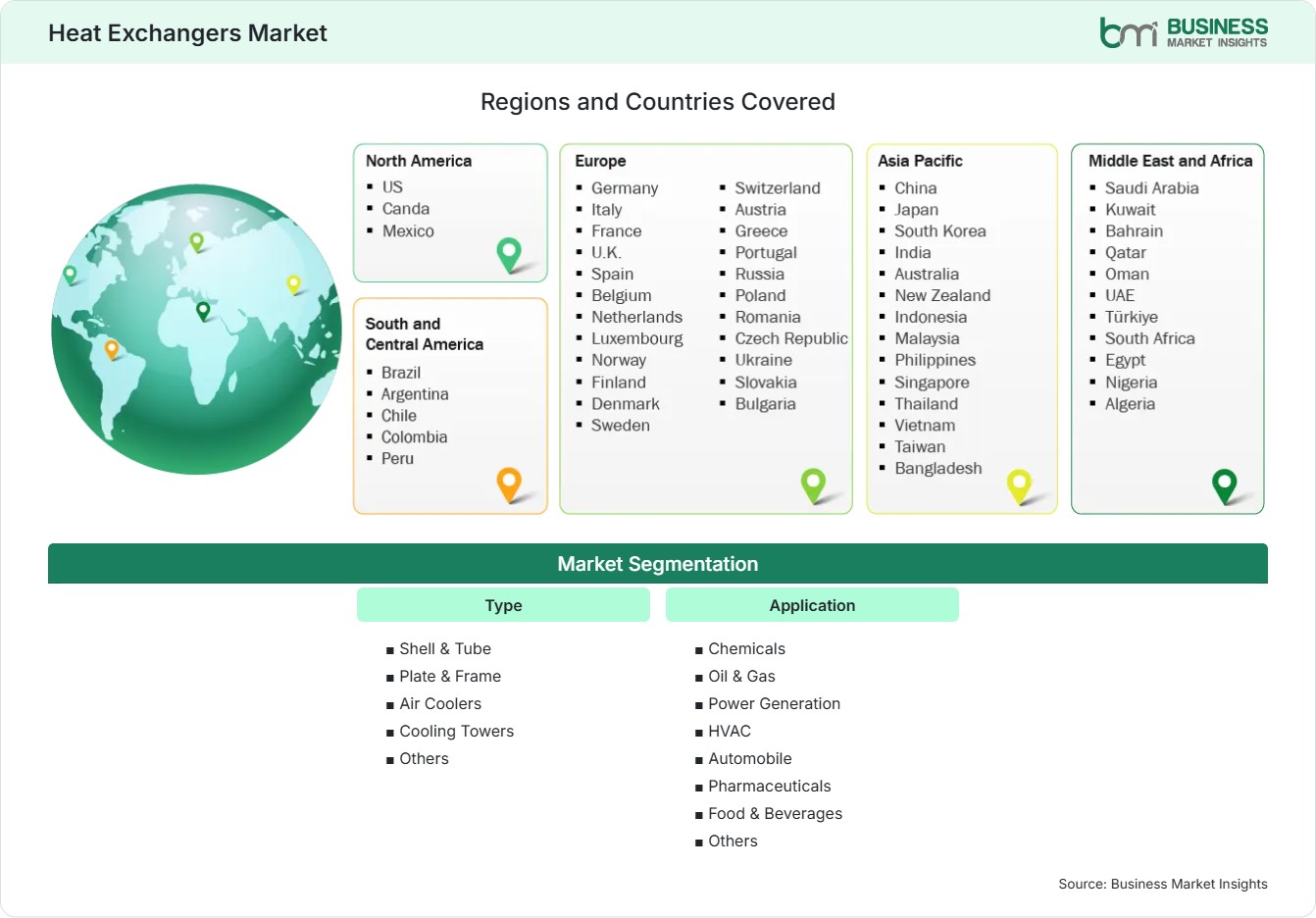
Global Market Geography
FREE PDF
Request your free sample
Request free sample
Segment Analysis

Heat Exchangers Market Segmentation

Type

Shell & Tube accounted for a Heat Exchangers Market share of 39%–43% in 2025 and is projected to grow at a CAGR of 6.0%–7.0% between 2026–2033. Its strong position reflects extensive deployment across oil and gas, chemicals, power generation, and heavy industrial processes. Plate and frame systems benefit from compact designs and high efficiency, while air coolers and cooling towers remain critical for large-scale industrial heat rejection. Manufacturers increasingly focus on materials and configurations that improve durability, thermal performance, and maintenance efficiency.

  • Shell & Tube: Widely used in high-pressure and high-temperature applications, these systems benefit from durability, flexible configurations, and established adoption across refining, chemicals, power, and industrial processing.
  • Plate & Frame: Compact designs provide efficient heat transfer and flexible capacity expansion, supporting adoption in HVAC, food processing, pharmaceuticals, district energy, and industrial applications.
  • Air Coolers: Air-cooled systems reduce dependence on water resources and support thermal management in power, oil and gas, petrochemical, and remote industrial facilities.
  • Cooling Towers: Cooling towers enable large-scale heat rejection in power generation, manufacturing, chemicals, and industrial facilities where continuous process cooling is required.

Application

Oil & Gas represented a Heat Exchangers Market share of 24%–28% in 2025 and is projected to grow at a CAGR of 6.0%–7.0% between 2026–2033. Refining, LNG, petrochemicals, and upstream processing require reliable thermal equipment capable of handling demanding operating conditions. Power generation remains a major application, while chemicals and HVAC provide broad recurring demand. Data center cooling is emerging as a specialized high-growth opportunity. Food and beverage and pharmaceutical applications benefit from strict temperature control, hygienic requirements, and increasing process efficiency priorities.

  • Chemicals: Chemical plants require reliable heat transfer for reaction control, process heating, cooling, condensation, and energy recovery across diverse production processes.
  • Oil & Gas: Refining, LNG, petrochemical, and upstream operations use heat exchangers for process heating, cooling, condensation, and thermal integration under demanding conditions.
  • Power Generation: Power plants depend on heat transfer equipment for steam systems, cooling, condensation, and auxiliary processes, with efficiency and reliability driving equipment upgrades.
  • HVAC: Commercial buildings, district energy networks, and industrial facilities use heat exchangers for efficient heating and cooling, supporting demand from urbanization and energy efficiency initiatives.
  • Automobile: Automotive manufacturing uses thermal systems for production processes, painting, engine testing, and facility HVAC, while electrification creates new cooling requirements.
  • Pharmaceuticals: Pharmaceutical facilities require precise temperature control and hygienic heat transfer systems for manufacturing, sterilization, processing, and controlled production environments.
  • Food & Beverages: Food processing relies on hygienic thermal systems for pasteurization, sterilization, evaporation, and temperature control while maintaining product quality and safety.
Market Forces

Heat Exchangers Market Dynamics

Key Market Drivers

Growing Industrialization Drives Demand for Efficient Heat Transfer Systems

Rapid industrialization in the Asia-Pacific region, the Middle East, and selected emerging economies has increased demand for dependable thermal machinery in the chemicals, oil and gas, power generation, food processing, pharmaceuticals, and manufacturing industries. The demand for equipment has increased due to new facilities requiring heating, cooling, condensing, and process integration systems, making thermal equipment a regular requirement. The heat exchangers market trend is therefore closely connected to manufacturing capacity expansion and investment in process infrastructure. Manufacturers that can deliver customized equipment benefit from industrial capacity additions.

Rising Energy Efficiency Requirements Increase Heat Exchanger Adoption

Energy efficiency is seen as an important area for investment due to energy prices and the need to reduce emissions. With the help of heat exchangers, companies can reuse their waste heat, become more energy-efficient, and optimize fuel use and heating and cooling needs. There is growing pressure from regulators and companies’ own sustainability goals to invest in efficient technology. Suppliers have started providing heat exchangers with better heat transfer, materials, design and digital capabilities. Lifecycle operating costs are consequently becoming increasingly important in purchasing decisions.

Increasing Demand for Process Optimization Across Industrial Facilities

Industries are progressively optimizing their production processes to maximize system throughput and minimize downtime and resource consumption. Heat exchangers are integral parts of thermal integration, as they help maximize heat transfer between streams and reduce dependence on external energy sources. Process optimization is highly relevant in the chemical, petroleum, pharmaceutical, and food industries, where heat management directly impacts output quality and efficiency. Manufacturers that offer engineering, monitoring, and optimization solutions, along with equipment provision, can benefit more from the asset.

Key Market Opportunities

Expansion of Heat Exchanger Applications Across Renewable Energy Projects

Renewable energy expansion is creating new applications for advanced thermal management systems across geothermal, concentrated solar power, hydrogen production, and energy storage. These projects require specialized heat transfer equipment capable of operating under variable temperatures, corrosive environments, and demanding efficiency requirements. Hydrogen production can generate additional opportunities as electrolyzers and related infrastructure require thermal management. As energy systems become more integrated, heat exchangers can also support sector coupling by connecting renewable electricity, thermal energy, industrial processes, and district heating networks.

Growing Demand for Industrial Heat Recovery and Energy Efficiency Systems

Industrial heat recovery provides a substantial opportunity as companies seek to lower energy costs and reduce emissions without compromising production. Waste heat from furnaces, compressors, exhaust streams, and process operations can be recovered and reused for preheating, steam generation, water heating, or district energy applications. Manufacturers can capture additional value by providing complete recovery systems rather than standalone equipment. Demand is particularly relevant in energy-intensive sectors where thermal losses represent a meaningful portion of operating costs. These capabilities create opportunities for both new installations and retrofit projects.

Rising Opportunities in Data Center Cooling and District Energy Systems

Rapid data center construction is creating demand for efficient cooling infrastructure as high-density computing and AI workloads increase heat generation. Liquid cooling architectures require specialized heat transfer equipment capable of managing high thermal loads within compact footprints. Manufacturers can strengthen their position by developing modular systems, digital monitoring, and solutions compatible with liquid cooling. As urban infrastructure and digital infrastructure expand, thermal equipment providers with engineering expertise and lifecycle services can capture high-value projects.

Market Restraints and Challenges

High Initial Costs of Advanced Heat Exchanger Systems Limit Adoption

Factor: Highly sophisticated heat exchangers require a considerable capital outlay due to the materials used, bespoke engineering, performance, installation, and compatibility with existing industrial setups. Impact: Excessive capital outlay may defer purchase decisions, especially among small industrial players and cost-conscious plants, even though there will be savings in operating expenses in the long run. The constraint is particularly relevant for advanced systems designed for corrosive, high-pressure, or temperature applications.

Fouling and Corrosion Increase Maintenance Requirements and Operating Costs

Factor: The effect of fouling, scaling, corrosion, and material degradation may decrease the effectiveness of heat-transfer and increase pressure drops, especially in industries where contaminants or corrosive fluids are present. Impact: Reduced heat-transfer effectiveness may lead to increased energy use, the need for cleaning and component replacement, and unexpected downtime. This is especially difficult in industries that rely on continuous processes, where any shutdown can cause significant production losses. Manufacturers that show lower maintenance costs can gain a competitive edge.

Company Analysis

Competitive Landscape

Heat Exchangers Market analysis reveals that competition within the market is marked by a number of diversified firms providing thermal management solutions, heat transfer specialists, industrial equipment makers, and engineering-focused technologists. Competitive dynamics have been influenced by equipment efficiency, ability to customize products, material knowledge, global servicing capabilities, after-market services, and experience in fast-growing markets including renewables, industrial heat recovery, data centers, and district energy.

Company Name

Overview

Products and Services relevant to this market

Alfa Laval AB

Global thermal technology company serving industrial, energy, marine, food, and wastewater applications with extensive heat transfer expertise.

Plate heat exchangers, brazed heat exchangers, shell and tube systems, air heat exchangers, heat recovery, and thermal services.

Kelvion Holding GmbH

Specialized heat transfer company providing thermal solutions across energy, industrial, HVAC, data center, and process applications.

Plate heat exchangers, shell and tube systems, air coolers, cooling towers, refrigeration solutions, and data center cooling technologies.

Danfoss A/S

Global engineering company offering energy-efficient thermal management solutions for industrial, commercial, refrigeration, and HVAC applications.

Heat exchangers, micro plate heat exchangers, HVAC thermal systems, refrigeration solutions, and energy optimization technologies.

Xylem Inc.

Water technology company providing equipment and solutions supporting water-intensive industrial, commercial, and infrastructure applications.

Heat transfer equipment, industrial cooling solutions, water management technologies, thermal systems, and related lifecycle services.

SPX Technologies, Inc.

Industrial technology company with strong capabilities in cooling infrastructure and thermal management across power and industrial markets.

Cooling towers, evaporative cooling systems, heat transfer solutions, industrial cooling technologies, and aftermarket services.

API Heat Transfer, Inc.

Heat transfer specialist serving industrial, energy, transportation, and process markets with customized thermal solutions.

Shell and tube heat exchangers, air-cooled systems, brazed plate units, radiators, and custom thermal management equipment.

Chart Industries, Inc.

Global engineering company specializing in highly engineered equipment for clean energy, industrial gases, and thermal applications.

Heat exchangers, cryogenic equipment, hydrogen-related thermal systems, LNG technologies, and engineered process solutions.

Hisaka Works, Ltd.

Japanese manufacturer specializing in heat transfer equipment for industrial processing and diverse thermal applications.

Plate heat exchangers, shell and tube systems, sterilizers, industrial thermal equipment, and process solutions.

SWEP International AB

Specialized heat exchanger manufacturer focused on compact brazed plate technology and energy-efficient thermal systems.

Brazed plate heat exchangers, HVAC solutions, refrigeration systems, district energy applications, and industrial thermal management.

FUNKE Wärmeaustauscher Apparatebau GmbH

German heat exchanger specialist providing customized thermal equipment for industrial and process applications.

Plate heat exchangers, shell and tube systems, air coolers, custom thermal equipment, and industrial heat transfer solutions.

Trust & Transparency

Research Methodology

The market analysis combines proprietary research with secondary data from government agencies, company disclosures, regulatory filings, industry databases and expert interviews. Market estimates are validated through data triangulation, cross-market benchmarking and analyst review.

View Full Research Methodology

Questions Answered

Frequently Asked Questions

What makes aftermarket services strategically important?

Maintenance, cleaning, inspection, replacement, and performance optimization can extend equipment life and reduce unplanned downtime.

Why are data centers becoming an important application in heat exchangers market report?

AI workloads and high-density computing generate greater thermal loads, increasing demand for advanced cooling infrastructure.

How is decarbonization influencing heat exchanger demand?

Decarbonization is increasing demand for heat recovery, renewable energy integration, industrial process optimization, and efficient thermal systems.

Why are compact heat exchangers gaining adoption?

Compact designs provide high heat transfer performance within smaller footprints, making them attractive where space is constrained.

What factors determine the selection of a heat exchanger?

Selection depends on operating temperature, pressure, fluid characteristics, required heat duty, available space, maintenance conditions, corrosion risk, and lifecycle cost.

Access the Full Heat Exchangers Market Report

Get segment-level forecasts, regional estimates, competitive benchmarking, company profiles and downloadable Excel datasets.

Access the full Heat Exchangers Market Report
350 pages PDF & Excel | 2026-08-07