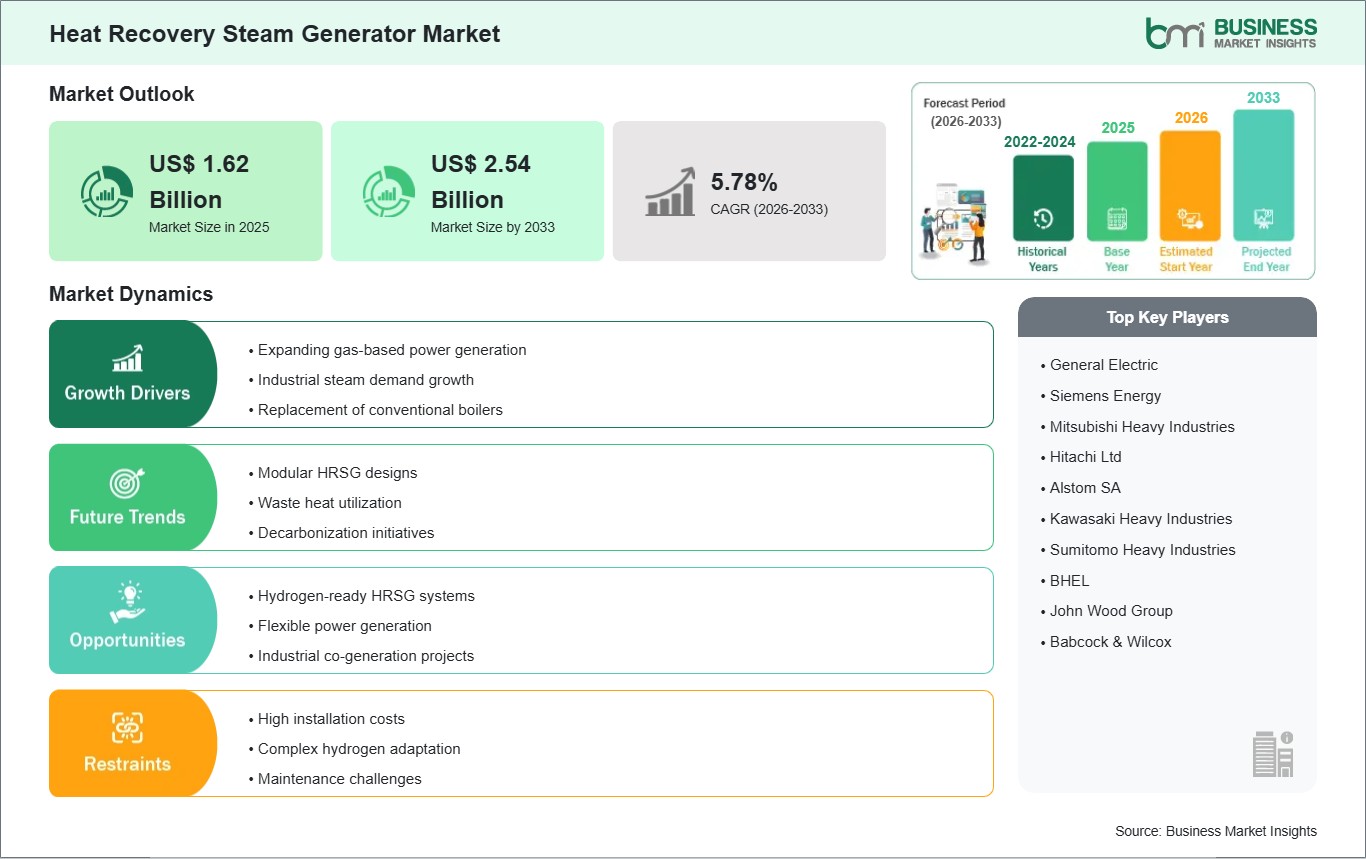
The Heat Recovery Steam Generator Market size is expected to reach US$ 2.54 Billion by 2033 from US$ 1.62 Billion in 2025.The market is estimated to record a CAGR of 5.78% from 2026 to 2033.
Heat Recovery Steam Generators refer to energy recovery heat exchangers engineered to capture waste heat from gas turbines or industrial processes and convert it into usable steam for electricity generation or process heating. By utilizing advanced heat exchange technology, these systems generate high-pressure steam that drives steam turbines in combined cycle power plants or supports cogeneration applications. This technology is fundamental to the operational architecture of modern power generation, enabling thermal efficiencies exceeding 60% compared to simple cycle plants. Market expansion is being propelled by the rapid integration of combined cycle power plants into global energy infrastructure, the rising institutional requirement for greenhouse gas emission reduction, and the increasing demand for energy efficiency across industrial sectors.
However, several factors may restrain market progression. The high capital intensity associated with advanced heat exchanger components, such as economizers, evaporators, and superheaters, remains a primary hurdle for small-scale industrial operators and emerging economies with limited financial resources. The industry also faces persistent technical challenges regarding maintenance complexity and operational reliability, as multi-pressure HRSG systems require specialized skilled personnel for installation and upkeep. Additionally, the dependence on end-use industries that generate substantial high-temperature waste heat creates a market concentration risk, as not all industrial sectors are suitable candidates for HRSG deployment. These hurdles, compounded by competition from alternative waste heat recovery technologies and the volatility of natural gas prices that affect combined cycle plant investment decisions, increase the total cost of ownership and the perceived financial risk for large-scale deployments.
Despite these hurdles, the market outlook remains highly favorable as the sector transitions toward high-efficiency, low-emission energy systems. Opportunities are emerging through the development of advanced materials such as superalloys and advanced ceramics that enable HRSGs to withstand higher temperatures and pressures, enhancing thermal efficiency and reliability. The expansion of renewable energy integration is gaining significant traction, with HRSGs being deployed in concentrated solar power (CSP) plants to extend operational hours beyond daylight periods. Furthermore, the growth of decentralized power generation and microgrids aligns with global goals for energy access and grid resilience, creating new applications for modular and small-scale HRSG systems. The adoption of cogeneration technology is playing a pivotal role as HRSGs significantly improve the economic and operational performance of combined heat and power (CHP) plants, achieving efficiency rates of 80-90%. Collectively, these innovations position the Heat Recovery Steam Generator industry for sustained long-term development as a cornerstone of the modern, efficient, and sustainable global energy landscape.

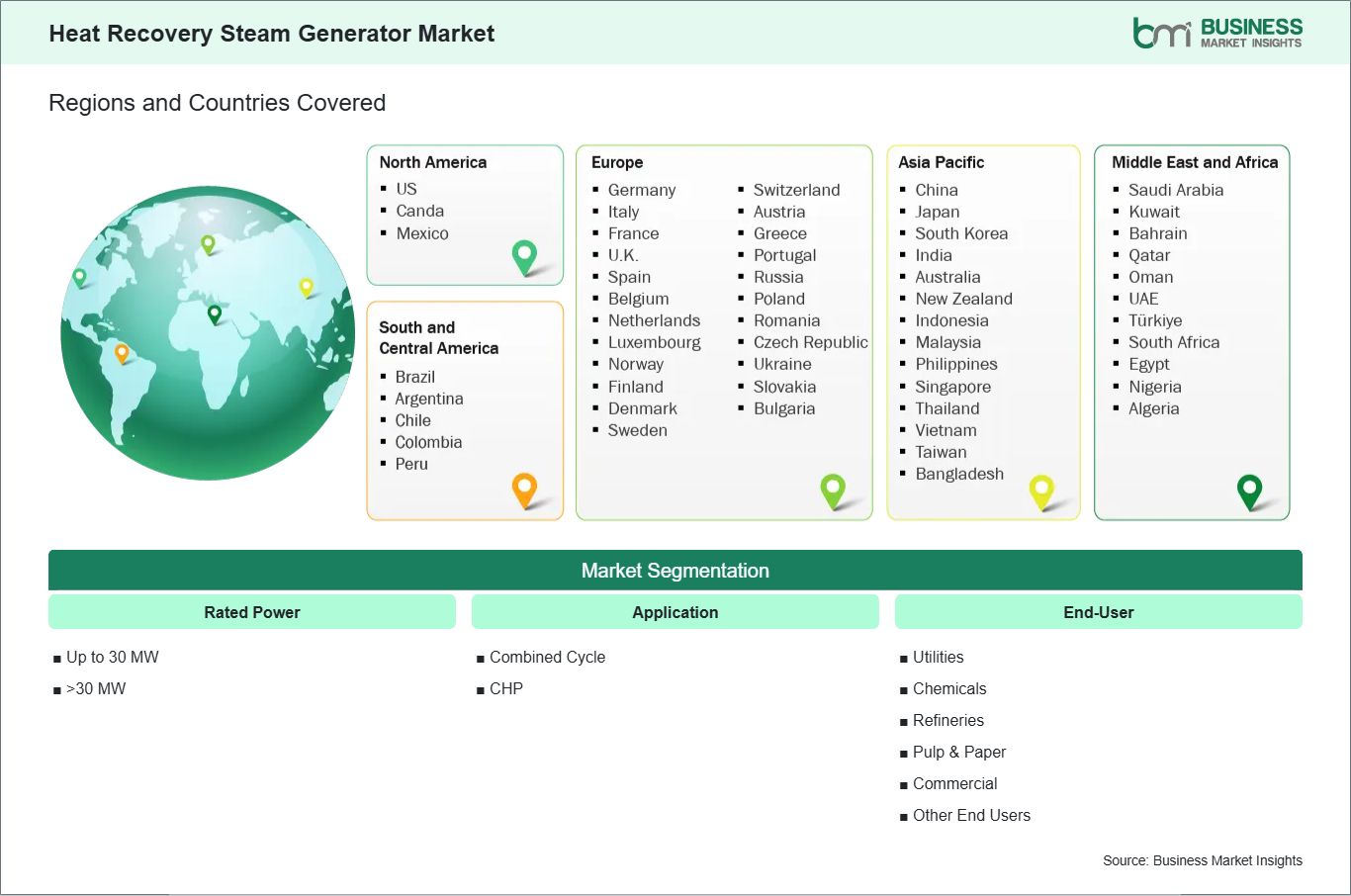
The Heat Recovery Steam Generator market is segmented based on rated power, application, and end-user, reflecting the growing demand for energy recovery solutions across power generation and industrial sectors.
The heat recovery steam generator market is being driven by the growing global focus on energy efficiency and the urgent need to reduce greenhouse gas emissions across power generation and industrial sectors. Unlike simple cycle power plants that waste substantial thermal energy, HRSG-equipped combined cycle plants capture exhaust heat from gas turbines to generate additional electricity, achieving efficiency improvements of up to 50% over conventional systems. Rising adoption of combined cycle power plants is amplifying demand, as utilities increasingly seek higher efficiency, lower emissions, and flexible power generation that can quickly respond to electricity demand fluctuations. Stringent environmental regulations, government initiatives, and massive investments have been implemented globally to reduce emissions, with combined cycle and cogeneration plants recognized as the most effective and reliable solutions for greenhouse gas elimination. Additionally, industrial sectors are turning to HRSGs to meet stricter emission standards while reducing fuel consumption and operational costs. The expansion of smart grid infrastructure and digital transformation initiatives is further propelling adoption. Collectively, energy efficiency requirements and decarbonization goals are fueling sustained growth in the global heat recovery steam generator market.
Opportunities in the heat recovery steam generator market are expanding through the integration of renewable energy systems, advanced materials development, and emerging industrial applications. HRSG deployment in concentrated solar power (CSP) plants is opening lucrative opportunities by enabling these facilities to operate effectively during non-sunny hours, significantly improving overall plant efficiency and grid reliability. The growing emphasis on decentralized power generation and microgrid deployment is fueling demand for small-scale, modular HRSG systems that provide localized energy solutions. Emerging applications in the oil and gas sector are driving innovation, as HRSGs are increasingly used for enhanced oil recovery processes and to power steam-assisted equipment, reducing reliance on separate fuel sources.
In manufacturing, HRSGs provide eco-friendly solutions for capturing and reusing waste heat in steel production, cement manufacturing, and food processing facilities, contributing to cost savings and energy conservation. The development of advanced superalloys and ceramic materials is enabling next-generation HRSG systems that withstand higher temperatures and pressures, maximizing energy recovery and minimizing downtime. Additionally, sustainability trends are encouraging deployment of high-efficiency, low-emission HRSG designs that align with global environmental goals. The expansion of cogeneration applications in chemical, petrochemical, and manufacturing plants is creating new pathways for adoption where both electricity and heat are needed simultaneously. Vendors who focus on cost-effective, technologically advanced, and modular HRSG solutions are well-positioned to capture growth. The convergence of renewable integration, advanced materials, and industrial decarbonization underscores a transformative trajectory for the global heat recovery steam generator market.
The Heat Recovery Steam Generator Market is projected to grow from US$ 1.62 Billion in 2025 to US$ 2.54 Billion by 2033 , registering a CAGR of 5.78% from 2026 to 2033.
By rated power, the greater than 30 MW segment dominates market share as large-scale HRSG systems are integral to major combined cycle power plants and heavy industrial applications requiring high power output and maximum efficiency. These systems are key to meeting growing energy demands of urban centers and industrial hubs while maintaining environmental standards. The up to 30 MW segment serves small-scale industrial applications, district heating, and renewable energy projects, offering compact energy solutions for clients with lower power demands.
By application, combined cycle represents the leading market segment due to widespread adoption of combined cycle gas turbine (CCGT) power plants globally. In these systems, HRSGs play a pivotal role by harnessing waste heat from gas turbines to produce steam for additional electricity generation, significantly enhancing overall plant efficiency often exceeding 60%. The cogeneration segment is experiencing steady growth as CHP systems achieve efficiency rates of 80-90%, making them highly attractive for industries with substantial heat and power requirements.
By end-user, utilities represent the leading segment as HRSGs are deployed in large-scale power generation plants to enhance efficiency by recovering waste heat from gas turbines and converting it into additional electrical power. The chemicals, refineries, and pulp & paper segments are significant contributors, as these energy-intensive industries benefit from HRSG integration for improved energy efficiency and reduced operational costs. The commercial segment is emerging with applications in HVAC systems for shopping malls and commercial infrastructure.
| Report Attribute | Details |
|---|---|
| Market size in 2025 | US$ 1.62 Billion |
| Market Size by 2033 | US$ 2.54 Billion |
| Global CAGR (2026 - 2033) | 5.78% |
| Historical Data | 2022-2024 |
| Forecast period | 2026-2033 |
| Segments Covered | By Rated Power
|
|
Regions and Countries Covered
| |
| North America | US, Canada, Mexico |
| Europe | Germany, Italy, France, U.K., Spain, Belgium, Netherlands, Luxembourg, Norway, Finland, Denmark, Sweden, Switzerland, Austria, Greece, Portugal, Russia, Poland, Romania, Czech Republic, Ukraine, Slovakia, Bulgaria |
| Asia-Pacific | China, Japan, South Korea, India, Australia, New Zealand, Indonesia, Malaysia, Philippines, Singapore, Thailand, Vietnam, Taiwan, Bangladesh |
| South and Central America | Brazil, Argentina, Chile, Colombia, Peru |
| Middle East and Africa | Saudi Arabia, United Arab Emirates, Kuwait, Bahrain, Qatar, Oman, Turkiye, South Africa, Egypt, Nigeria, Algeria |
| Market leaders and key company profiles |
|
The "Heat Recovery Steam Generator Market Size and Forecast (2022–2033)" report provides a detailed analysis of the market covering below areas:
The Heat Recovery Steam Generator Market shows diverse regional adoption patterns influenced by advancements in energy recovery technologies, increasing demand for efficient power generation, and rising adoption of combined cycle plants across various industries.
North America maintains a strong market position driven by the presence of key market players, growing emphasis on sustainable energy solutions, and supportive government policies promoting energy efficiency. The region comprises the United States and Canada, where investments are being made in combined cycle power plants, industrial cogeneration systems, and energy efficiency initiatives. The region focuses on enhancing thermal efficiency and reducing emissions through advanced HRSG designs and digital monitoring systems. It has well-established power generation and industrial sectors, allowing for widespread adoption of HRSGs across utility-scale combined cycle plants, industrial cogeneration facilities, and commercial applications.
Asia Pacific is growing significantly, driven by rapid industrialization, increasing focus on energy efficiency in countries like China and India, and expanding power generation infrastructure. The region comprises countries such as China, India, Japan, and South Korea, where investments are being made in combined cycle power plants, industrial cogeneration systems, and manufacturing facilities. The region focuses on improving industrial energy efficiency and supporting innovation in waste heat recovery technologies. The expansion of greenfield power projects, government initiatives for emission reduction, and increasing investments in research and development activities is also contributing to the growth of the Heat Recovery Steam Generator Market, along with rising demand for electricity and industrial process heat.
Europe demonstrates strong growth potential driven by stringent environmental regulations, the push towards renewable energy sources, and ambitious greenhouse gas reduction targets under the European Green Deal. The region focuses on decarbonization initiatives and modernization of industrial processes. The Middle East and Africa region is witnessing growth due to investments in the oil and gas sector and increasing adoption of cogeneration technologies. Latin America shows promising market potential with increasing investments in power generation infrastructure and a shift towards cleaner energy sources.
All regions are contributing significantly to the growth of the Heat Recovery Steam Generator Market, focusing on technological advancements, increasing adoption of efficient power generation solutions, and rising demand for waste heat recovery systems across various end-user industries.

The report includes qualitative and quantitative data for the Heat Recovery Steam Generator market across rated power, application, end-user, and geography.
The Heat Recovery Steam Generator market is evaluated by gathering qualitative and quantitative data post primary and secondary research, which includes important corporate publications, association data, and databases. A few of the key developments in the Heat Recovery Steam Generator market are:
The Heat Recovery Steam Generator Market is valued at US$ 1.62 Billion in 2025, it is projected to reach US$ 2.54 Billion by 2033.
As per our report Heat Recovery Steam Generator Market, the market size is valued at US$ 1.62 Billion in 2025, projecting it to reach US$ 2.54 Billion by 2033. This translates to a CAGR of approximately 5.78% during the forecast period.
The Heat Recovery Steam Generator Market report typically cover these key segments-
The historic period, base year, and forecast period can vary slightly depending on the specific market research report. However, for the Heat Recovery Steam Generator Market report:
The Heat Recovery Steam Generator Market is populated by several key players, each contributing to its growth and innovation. Some of the major players include:
The Heat Recovery Steam Generator Market report is valuable for diverse stakeholders, including:
Essentially, anyone involved in or considering involvement in the Heat Recovery Steam Generator Market value chain can benefit from the information contained in a comprehensive market report.
Please tell us your area of interest
(Market Segments/ Regions and Countries/ Companies)