
Steam Cleaners Market Outlook: Size, Share, Trends, Growth Analysis, Competitive Landscape & Forecast, 2026-2033

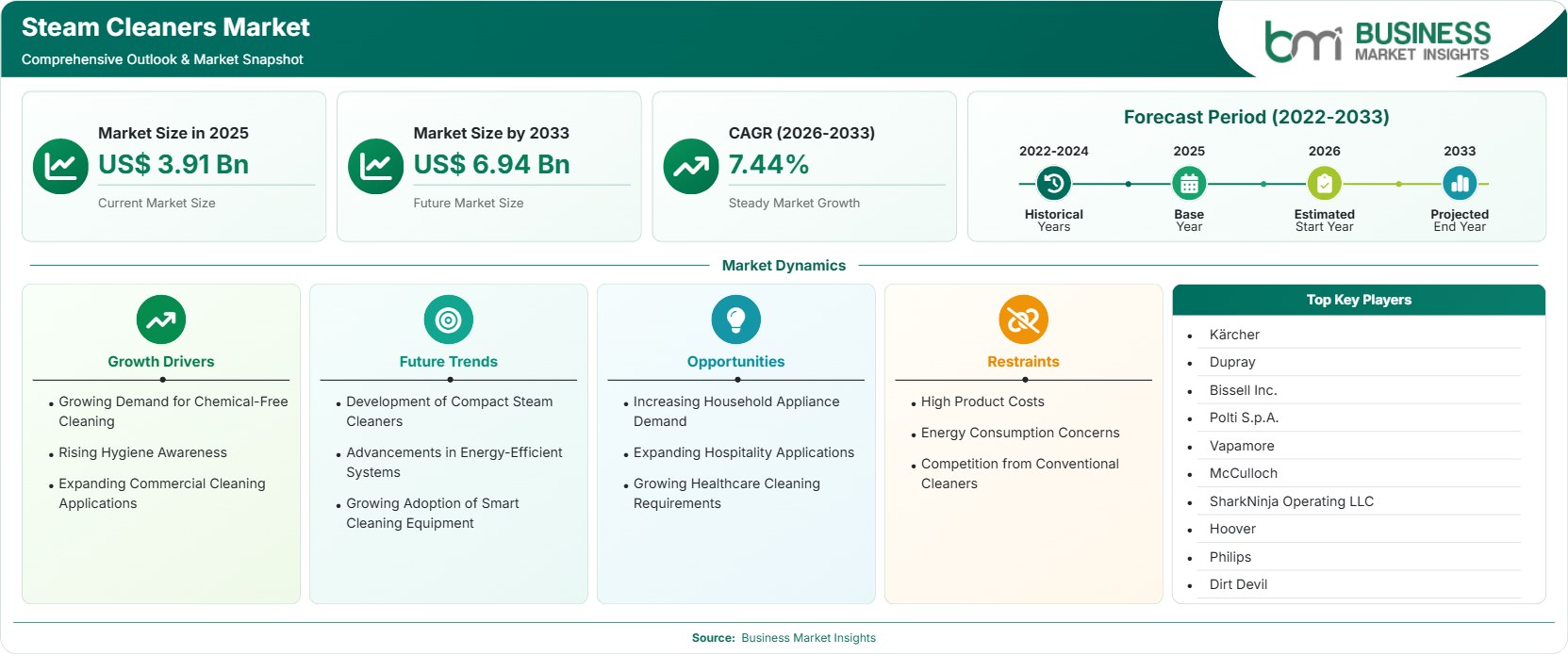
The Steam Cleaners Market size was valued at US$ 3.91 billion in 2025 and is projected to reach US$ 6.94 billion by 2033, growing at a CAGR of 7.44% during 2026–2033, supported by chemical-free cleaning demand, hygiene priorities, household appliance adoption, hospitality applications, and professional sanitation requirements.

Report Coverage
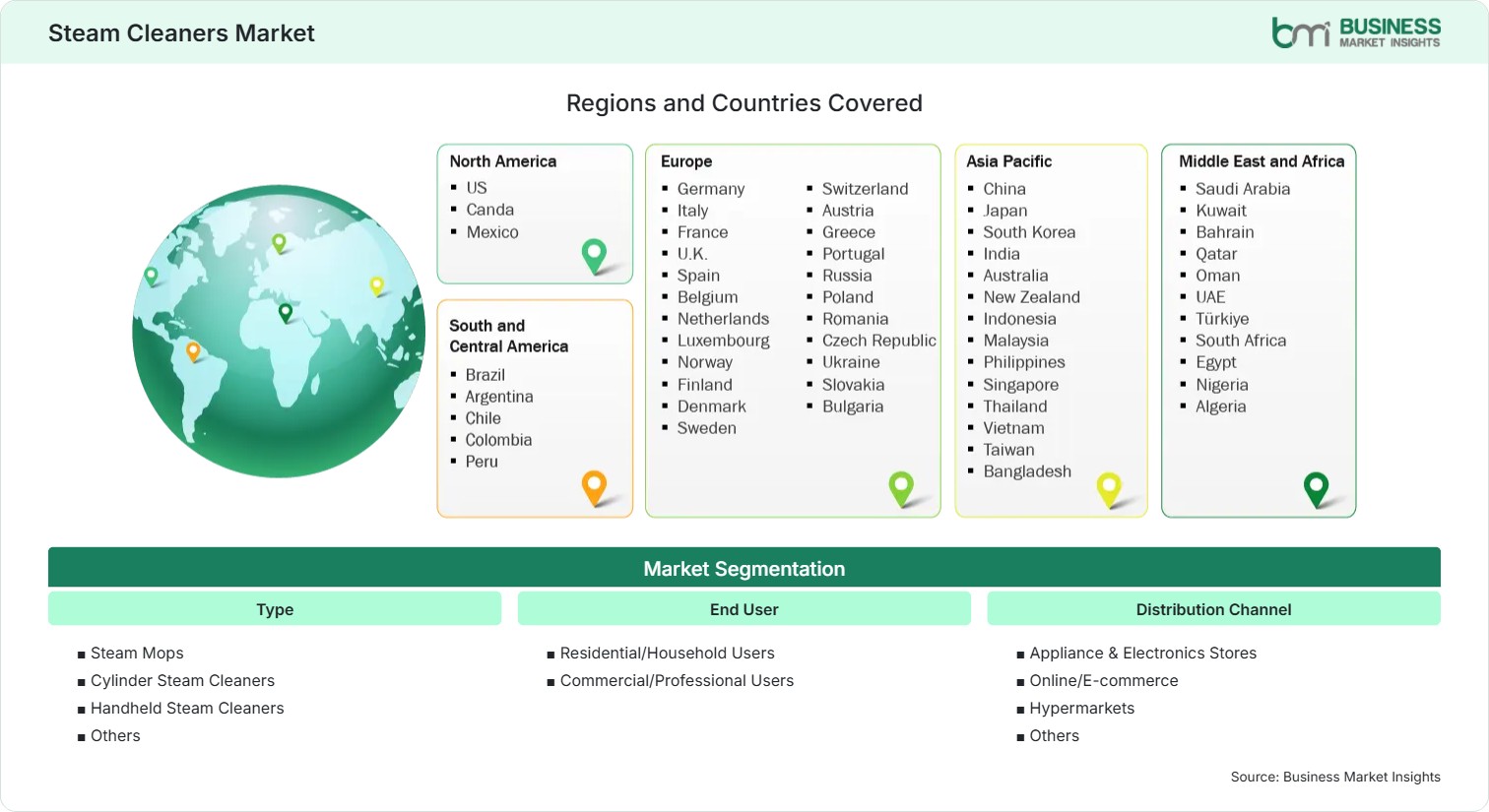
  • Type: Steam Mops, Cylinder Steam Cleaners, Handheld Steam Cleaners, Others
  • End User: Residential/Household Users, Commercial/Professional Users
  • Distribution Channel: Appliance & Electronics Stores, Online/E-commerce, Hypermarkets, Others
US$ 3.91 Bn Market size in 2025
US$ 6.94 Bn Market Size by 2033
7.44% CAGR, 2026 - 2033
2026-2033 Forecast Period

01 AI Overview

Steam Cleaners Market Summary

  • North America Region: North America holds 35%–38% share in 2025, growing at a CAGR of 6.8%–7.2% during 2026–2033, influenced by household appliance replacement, hygiene-focused cleaning practices, professional cleaning demand, premium appliance adoption, retail availability, and product innovation. The US represents the dominant regional contributor, with a CAGR of 6.9%–7.3% during 2026–2033, supported by established appliance distribution, residential adoption, commercial cleaning applications, and premium product demand.
  • Fastest Growing Region: Asia Pacific holds 24%–27% share in 2025, expanding at a CAGR of 8.0%–8.5% during 2026–2033, supported by rising household appliance penetration, expanding urban populations, stronger hygiene awareness, e-commerce accessibility, hospitality development, and professional cleaning requirements.
  • Leading Segment: Steam Mops hold 34%–37% share in 2025, expanding at a CAGR of 7.2%–7.7% during 2026–2033, supported by convenient floor cleaning, compact designs, household adoption, chemical-free cleaning preferences, easier operation, and increasing demand for multifunctional domestic appliances.
  • High Growth Segment: Online/E-commerce holds 27%–30% share in 2025, expanding at a CAGR of 9.0%–9.5% during 2026–2033, driven by product comparison, broad assortment, convenient purchasing, digital demonstrations, promotional accessibility, direct-to-consumer models, and growing consumer comfort with online appliance purchases.
  • Key Market Opportunity: Product manufacturers can expand through compact multifunctional designs, specialized professional models, digital retail channels, hospitality solutions, healthcare-oriented applications, and accessories that increase recurring revenue.
  • Major Market Players: Kärcher, Dupray, Bissell Inc., Polti S.p.A., Vapamore, McCulloch, SharkNinja Operating LLC, Hoover, Philips, and Dirt Devil.
02 Strategic Insights

Steam Cleaners Market: Strategic Insights

Steam Cleaners Market Strategic Framework
FREE PDF
Request your free sample
Request free sample
03 Stakeholder View

Key Takeaways

  • The value chain includes heating components suppliers, appliance makers, accessories designers, distributors, retailers, online platforms, professional cleaners, and after-sales services.
  • Steam mops, handheld models, professional equipment, and digital distribution products offer the highest potential upside. Manufacturers could capitalize on additional market demand through design of appliances for certain surfaces, cleaning needs, room size, and individual customer requirements.
  • Development of products is heading towards faster usability, controllable steam output, lightweight designs, multipurpose accessories, easy storage, and ergonomic features.
  • Asia Pacific provides an attractive investment case because household appliance adoption, urbanization, digital retail accessibility, hospitality development, and professional cleaning requirements create multiple demand channels rather than dependence on a single customer group.
  • Investment and consolidation options would be in the areas of product engineering differentiation, distribution expansion, accessories ecosystem development, direct-to-consumer sales and commercial applications.
04 Geographic Outlook

Steam Cleaners Market Regional Highlights

North America Steam Cleaners Market

North America holds 35%–38% Steam Cleaners Market share in 2025 and is projected to expand at a CAGR of 6.8%–7.2% during 2026–2033. The region benefits from established appliance distribution, strong household purchasing power, professional cleaning demand, and broad availability of differentiated products. The US remains the leading contributor, while Canada provides additional demand through residential and commercial applications.

  • Residential users increasingly favor convenient appliances that combine floor cleaning with steam-based sanitation, creating demand for lightweight products, larger water capacity, easier storage, and simplified controls across established household appliance categories.
  • Professional cleaning operators require dependable equipment with durable components, flexible attachments, manageable maintenance requirements, and consistent steam output, encouraging manufacturers to develop specialized models for repeated commercial usage.
  • Premium product positioning remains relevant as consumers evaluate appliance durability, functionality, warranty support, accessory availability, and ergonomic design alongside basic cleaning performance when selecting steam equipment.
  • Online retail complements physical appliance channels by providing broader product comparison, user education, accessory visibility, and convenient purchasing, helping manufacturers reach customers beyond conventional store networks.

US Steam Cleaners Market

The US represents 84%–87% of North American revenue and is projected to register a CAGR of 6.9%–7.3% during 2026–2033. Demand is supported by household appliance replacement, commercial cleaning applications, established retail infrastructure, and strong consumer familiarity with specialized cleaning equipment. The Steam Cleaners Market benefits from diversified applications across residential floors, kitchens, bathrooms, upholstery, and professional environments.

  • Household adoption is supported by demand for convenient cleaning equipment capable of handling multiple surfaces while reducing reliance on separate cleaning appliances and improving storage efficiency.
  • Professional users increasingly evaluate equipment according to operating durability, maintenance requirements, portability, water capacity, attachment flexibility, and suitability for repeated cleaning cycles.
  • E-commerce provides manufacturers with direct access to consumers and enables detailed product education through demonstrations, specifications, comparison tools, and accessory recommendations.

Europe Steam Cleaners Market

Europe accounts for 28%–31% Steam Cleaners Market share in 2025 and is projected to grow at a CAGR of 6.3%–6.8% during 2026–2033. Germany, France, Italy, and the United Kingdom represent important demand centers, while Poland and other developing European markets provide higher-growth opportunities. Market growth is supported by differentiated appliances and broader retail accessibility.

  • Germany and France provide established demand for premium cleaning appliances, with consumers evaluating durability, engineering quality, multifunctionality, energy use, and after-sales support when choosing specialized household equipment.
  • Italy remains important for compact domestic appliances, while demand for versatile cleaning products can support steam systems designed for kitchens, bathrooms, flooring, and upholstery.
  • The United Kingdom provides opportunities across residential and professional cleaning channels, particularly where compact equipment, online purchasing, and multifunctional attachments improve usability.
  • Poland and selected Central European markets offer higher-growth potential as appliance ownership expands, retail networks develop, and consumers increasingly access specialized cleaning products through digital channels.

Asia Pacific Steam Cleaners Market

Asia Pacific holds 24%–27% Steam Cleaners Market share in 2025 and is projected to record the fastest CAGR of 8.0%–8.5% during 2026–2033. China, Japan, South Korea, India, and Australia represent important markets, while India and Southeast Asian economies provide higher-growth opportunities. Urbanization, expanding household appliance ownership, e-commerce development, hospitality expansion, and increasing hygiene awareness are broadening applications.

  • China provides a broad manufacturing and consumer opportunity, combining domestic appliance demand with extensive online retail infrastructure and increasing availability of specialized household cleaning products.
  • Japan and South Korea support demand for technologically refined appliances, compact form factors, ergonomic operation, and multifunctional products suited to space-conscious residential environments.
  • India represents an attractive growth market as appliance penetration, urban household formation, organized retail, digital commerce, hospitality development, and professional cleaning services broaden potential demand.
  • Southeast Asian markets provide additional opportunities through rising urban populations, expanding hospitality facilities, increasing online purchasing, and wider consumer exposure to specialized household appliances.

Rest of World Steam Cleaners Market

Rest of World accounts for 9%–12% Steam Cleaners Market share in 2025 and is projected to grow at a CAGR of 7.0%–7.5% during 2026–2033. South and Central America provide opportunities through household appliance adoption, hospitality development, and organized cleaning services. Brazil and Mexico represent leading markets, while Colombia and Chile offer higher-growth potential. In the Middle East and Africa, the UAE, Saudi Arabia, and South Africa provide important demand centers.

  • Brazil and Mexico offer established consumer markets, while Colombia and Chile can provide additional growth as appliance distribution and digital purchasing channels broaden access to specialized cleaning equipment.
  • The UAE and Saudi Arabia provide opportunities linked to hospitality, commercial property management, premium household appliances, and professional cleaning services requiring flexible equipment.
  • South Africa remains an important African market, supported by household and professional applications and the presence of established appliance distribution structures.
  • Local distribution partnerships can reduce market-entry barriers by improving product availability, technical support, replacement-part access, and customer confidence in developing markets.
Global Market Geography
FREE PDF
Request your free sample
Request free sample
05 Segment Analysis

Steam Cleaners Market Segmentation

Type

The type segment accounted for an estimated 34%–37% share in 2025 and is projected to expand at a CAGR of 7.2%–7.7% during 2026–2034. Product selection depends on cleaning frequency, surface requirements, portability, water capacity, steam control, and attachment versatility. Steam Cleaners Market scope is broadening as manufacturers address distinct household and professional use cases.

  • Steam Mops: Steam mops support convenient floor cleaning through upright designs, targeted steam delivery, manageable operation, and compact storage, encouraging household adoption across hard-surface cleaning applications.
  • Cylinder Steam Cleaners: Cylinder systems provide higher flexibility through larger water capacity, hose-based operation, multiple attachments, and broader surface coverage, supporting users requiring comprehensive household cleaning.
  • Handheld Steam Cleaners: Handheld models emphasize portability and targeted cleaning for kitchens, bathrooms, fixtures, upholstery, and small surfaces, attracting consumers seeking compact equipment for frequent spot-cleaning tasks.

End User

The end user segment represented an estimated 63%–66% share in 2025 and is projected to grow at a CAGR of 7.0%–7.5% during 2026–2034. Residential users remain important, while professional adoption expands across hospitality, facilities, and specialized cleaning services. Steam Cleaners Market trends increasingly reflect demand for differentiated products based on cleaning intensity.

  • Residential/Household Users: Household users prioritize simple operation, compact storage, versatile attachments, manageable water filling, and reliable cleaning performance across floors, bathrooms, kitchens, upholstery, and other domestic surfaces.
  • Commercial/Professional Users: Professional users require durable equipment, longer operating cycles, flexible attachments, consistent steam output, easier maintenance, and product configurations suitable for repeated cleaning across commercial environments.

Distribution Channel

The distribution channel segment accounted for an estimated 27%–30% share in 2025 and is projected to expand at a CAGR of 8.8%–9.3% during 2026–2034. Channel selection affects product visibility, customer education, pricing, service access, and purchase convenience.

  • Appliance & Electronics Stores: Physical stores allow customers to evaluate product size, ergonomics, attachments, controls, and demonstrations, supporting purchases where tactile product assessment influences decision-making.
  • Online/E-commerce: E-commerce expands assortment visibility, enables comparison of specifications and accessories, supports direct-to-consumer selling, and provides convenient access to specialized products across geographically dispersed customers.
  • Hypermarkets: Hypermarkets provide high consumer traffic, accessible pricing, and convenient appliance purchasing, supporting mass-market steam cleaners alongside broader household cleaning and appliance categories.
06 Market Forces

Steam Cleaners Market Dynamics

Key Market Drivers

Growing Demand for Chemical-Free Cleaning

Demand for cleaning approaches that reduce dependence on conventional chemical products is strengthening the role of steam-based equipment across residential and professional settings. The Steam Cleaners Market growth is connected to equipment which relies on hot water technology for cleaning while not necessitating different chemical formulae per each task. This positioning applies especially to customers who wish to simplify their cleaning process in such places as floors, kitchens, bathrooms, fittings, and certain fabrics. Hence, the increasing trend in the market becomes equipment that is multi-functional and allows for convenient use and effective steam delivery along with mobility and wide applicability.

Rising Hygiene Awareness

Heightened attention to household and workplace cleanliness continues to encourage investment in appliances capable of supporting regular cleaning routines. The equipment using steam provides a differentiating factor since the hot vapor can be used to clean surfaces without having to use traditional cleaning chemicals. The industry is capitalizing on consumer preference for appliances that are not only functional but also easy to use repeatedly. In this case, the emphasis is on usability, steam adjustability, easy-to-hold handles, attachments, and maintenance convenience. Household consumers can take advantage of the features for the cleaning of floors, kitchen areas, bathrooms, and upholstery. Professional users can also utilize the features for repetitive cleaning tasks.

Expanding Commercial Cleaning Applications

Commercial cleaning creates a broader demand base because professional operators evaluate equipment according to productivity, durability, portability, maintenance, and task flexibility. The market could benefit advantages due to the applications related to hospitality, office, retail, facility management, and specific cleaning applications in which operators need equipment that can perform on various surfaces during one process. Equipment manufacturers are coming up with designs that give operators the flexibility to interchange attachments, regulate steam, and transport equipment from one place to another where cleaning is performed. The Steam Cleaners Market trends are therefore not confined to consumer appliances into specialized equipment strategies designed.

Key Market Opportunities

Increasing Household Appliance Demand

Household appliance expansion creates an opportunity to position steam cleaners as complementary equipment rather than occasional specialty products. Appliance suppliers can focus on consumers who upgrade their cleaning processes using small appliances, multi-functional appliances, and special appliance solutions depending on the type of rooms or surfaces. The appliance differentiation can be provided in terms of fast preparation of the appliance, flexible adjustment of steam pressure, accessory packages, easy storage, and easier maintenance of the product. Accessory systems can be used to motivate repeat purchases and increase functionalities of the appliances after its purchase.

Expanding Hospitality Applications

Hospitality facilities represent a potential commercial opportunity because cleaning teams manage diverse surfaces, frequent room turnover, public areas, kitchens, bathrooms, and furnishings. The Steam Cleaners Market Forecasts indicate that suppliers may pursue for the production of special-purpose hospitality products with an emphasis on portability, adaptability, reliability, and easy maintenance. Manufacturers can create equipment models appropriate for housekeeping departments which have to go from room to room without having to bring along different specialized devices. Mini-cylinder equipment models and handheld versions can be used for special cleaning needs, while more comprehensive systems will be suitable for more extensive cleaning routines.

Growing Healthcare Cleaning Requirements

Healthcare environments provide an application opportunity for equipment designed around controlled, repeatable surface cleaning and practical operator workflows. The market can solve specific non-essential cleaning problems where the design of the equipment, surface compatibility, operation methods, and institutional considerations are matched. Distinguishing elements in such solutions can include steam control, ergonomics, accessories, ease of maintenance, and easy-to-follow operating manuals. The challenge lies in the fact that healthcare users are operating under much more rigorous cleaning guidelines compared to regular households. Companies familiar with the process of procurement in institutions can tailor their equipment and supporting documentation to the specific applications and needs.

Market Restraints and Challenges

High Product Costs

Factor: Advanced heating assemblies, durable housings, multiple attachments, higher-capacity systems, electronic controls, and premium construction can increase acquisition costs compared with basic cleaning appliances. Impact: Increased initial costs result in delayed replacements, limit market penetration into the price-sensitive homes, and force professional customers to consider comparing the steam machines with conventional alternatives. This results in the problem of pricing for the industry in cases where features are added by the producers without providing clear gains for users. An affordable product could help with expansion of the use of the equipment, but too much cost-cutting might affect the reliability of the machine.

Energy Consumption Concerns

Factor: Steam generation requires electrical energy to heat water and maintain usable operating conditions, making power requirements an important consideration for consumers and professional operators. Impact: The issue of operational cost could be addressed by comparing the steam devices to other ways of cleaning and restricting the use of the devices when there is excess use of energy involved. Operating information can be provided by manufacturers to assist the users in identifying the steam setting for their various activities. Efficient engineering becomes important in the case of professional users who will operate the devices on a daily basis.

07 Company Analysis

Competitive Landscape

The Steam Cleaners Market analysis reflects competition among established appliance manufacturers and specialized steam-cleaning companies with different approaches to product design, distribution, functionality, and customer targeting. Competitive positioning depends on thermal performance, product ergonomics, attachment ecosystems, brand recognition, retail reach, professional applications, and after-sales support.

Company Name

Overview

Products and Services relevant to this market

Kärcher

Cleaning-equipment specialist with a broad portfolio spanning household and professional cleaning applications and differentiated equipment configurations.

Steam cleaners, steam mops, accessories, professional cleaning equipment, attachments, and supporting cleaning solutions.

Dupray

Specialized cleaning-equipment company focused on steam-based systems designed for household and professional cleaning applications.

Steam cleaners, steam mops, handheld systems, accessories, hoses, brushes, and specialized cleaning attachments.

Bissell Inc.

Household floor-care company with a strong consumer orientation and products designed around practical domestic cleaning requirements.

Steam mops, floor-cleaning systems, handheld cleaning equipment, accessories, and related household cleaning products.

Polti S.p.A.

Italian appliance company known for steam-oriented cleaning products serving household and specialized cleaning requirements.

Steam cleaners, steam mops, multifunctional systems, accessories, brushes, nozzles, and cleaning attachments.

Vapamore

Specialized steam-cleaning brand focused on portable and multifunctional equipment for household and professional users.

Steam cleaners, handheld systems, canister equipment, floor tools, brushes, hoses, and accessory kits.

McCulloch

Cleaning-appliance brand offering steam equipment designed for practical household surface-cleaning applications.

Steam mops, handheld steam cleaners, canister systems, floor accessories, brushes, and targeted cleaning tools.

SharkNinja Operating LLC

Consumer-appliance company emphasizing innovative household products, convenience, multifunctionality, and differentiated cleaning technologies.

Steam mops, floor-cleaning appliances, household cleaning systems, accessories, and related appliance technologies.

Hoover

Established floor-care brand serving residential users through appliances designed around practical cleaning performance and usability.

Steam mops, floor-cleaning products, handheld equipment, accessories, replacement components, and household cleaning appliances.

Philips

Diversified consumer technology company with appliance capabilities spanning household care and convenience-oriented product categories.

Steam-based cleaning appliances, household-care technologies, accessories, and related consumer appliance solutions.

Dirt Devil

Household cleaning brand focused on accessible cleaning appliances and convenient equipment for residential applications.

Steam cleaning products, floor-care appliances, handheld equipment, accessories, and household cleaning solutions.

10 Trust & Transparency

Research Methodology

The market analysis combines proprietary research with secondary data from government agencies, company disclosures, regulatory filings, industry databases and expert interviews. Market estimates are validated through data triangulation, cross-market benchmarking and analyst review.

View Full Research Methodology

11 Questions Answered

Frequently Asked Questions

What does the Steam Cleaners Market Report cover?

The report covers market size, growth outlook, regional dynamics, segmentation, product trends, drivers, opportunities, restraints, competitive positioning, company profiles, distribution considerations, and strategic opportunities.

Which distribution approach offers the strongest strategic potential?

Online channels provide strong potential because they enable detailed product comparisons, demonstrations, specifications, accessory recommendations, and direct customer engagement.

How can manufacturers increase recurring revenue?

Manufacturers can develop accessory ecosystems, replacement components, specialized brushes, nozzles, extension tools, service packages, and upgraded product configurations that encourage continued engagement after the initial appliance purchase.

Which product characteristics can influence purchasing decisions?

Consumers and professional users commonly evaluate operating convenience, steam control, heating readiness, ergonomics, attachment variety, water capacity, storage requirements, durability, maintenance, and warranty support before selecting equipment.

How do steam cleaners differ by application?

Steam cleaners differ mainly by portability, water capacity, steam control, attachments, operating duration, and intended surface coverage. Steam mops are suited to routine floor cleaning, handheld models address targeted surfaces, while cylinder systems provide broader multifunctional capability.

Access the Full Steam Cleaners Market Report

Get segment-level forecasts, regional estimates, competitive benchmarking, company profiles and downloadable Excel datasets.

Access the full Steam Cleaners Market Report
350 pages PDF & Excel | 2026-08-19