Market Summary
Executive Summary and Global Market Analysis
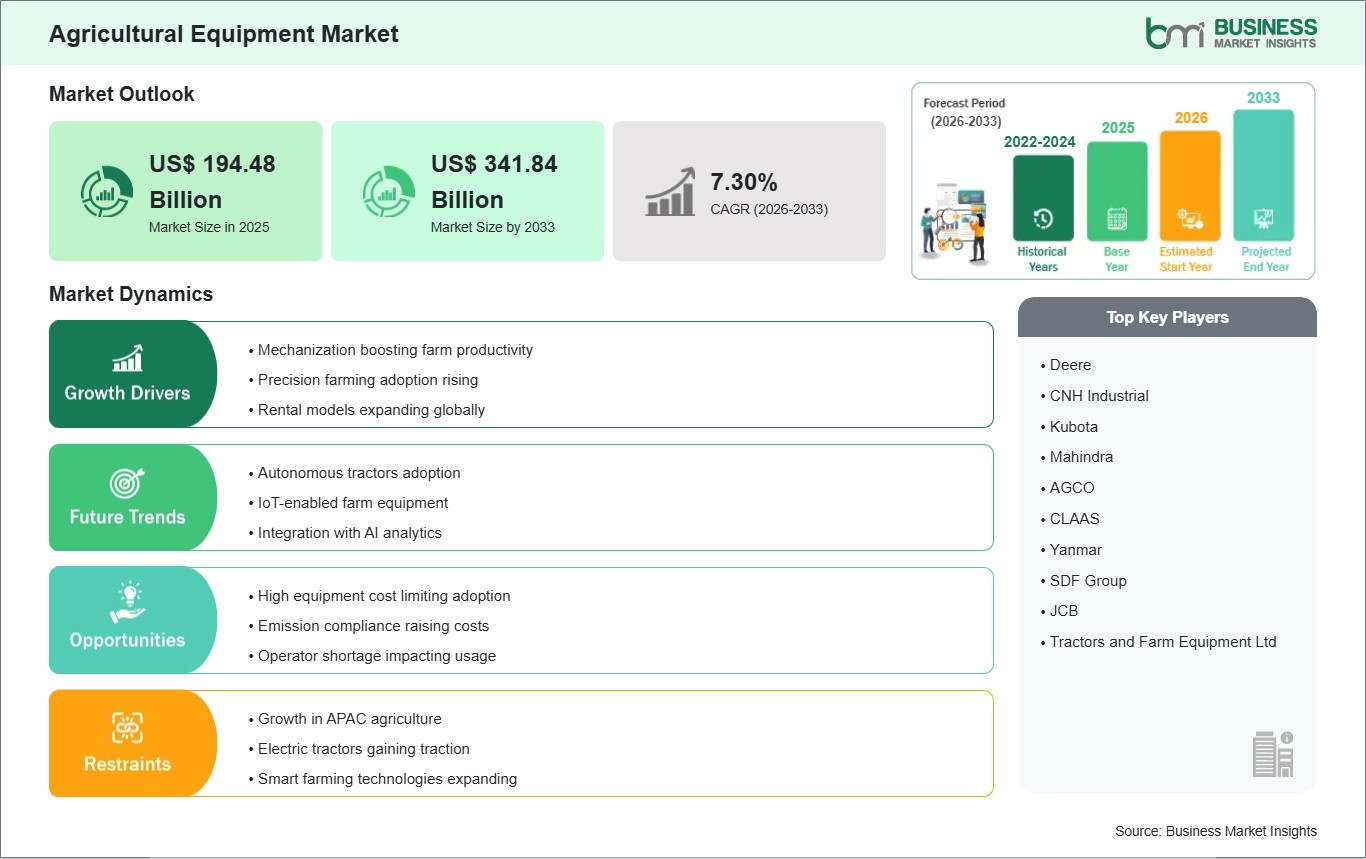
Agricultural equipment includes machinery and tools used to improve farming efficiency, crop productivity, and operational performance across agricultural activities. These systems include tractors, harvesters, irrigation systems, and planting equipment that support land preparation, crop cultivation, harvesting, and water management processes. Agricultural equipment is widely used by commercial farms, small-scale farmers, and agricultural service providers to reduce manual labor and improve farm output. Growing global food demand, rising mechanization in agriculture, and increasing labor shortages are supporting market growth. Governments and agricultural organizations are also promoting modern farming practices and precision agriculture technologies to improve productivity and resource management. Increasing adoption of smart farming solutions, automated machinery, and efficient irrigation systems is encouraging the deployment of advanced agricultural equipment across developed and developing economies.
Several factors continue to influence the development of the Agricultural Equipment market. Manufacturers are integrating GPS systems, automation technologies, telematics, and data analytics into farming machinery to improve operational efficiency and precision farming capabilities. Demand for fuel-efficient and environmentally sustainable equipment is increasing as the agriculture sector focuses on reducing emissions and operational costs. However, high equipment acquisition costs, limited financing access for small farmers, and fluctuating raw material prices can affect equipment adoption. In developing regions, inadequate infrastructure, lack of technical expertise, and inconsistent maintenance support may create operational challenges.
Despite these challenges, the market continues to benefit from long-term agricultural modernization and technological advancements. Tractors and harvesting equipment remain major contributors due to increasing mechanization across farming operations. Electric and hybrid-powered agricultural equipment are gaining attention as sustainability initiatives continue to expand. Growing investments in precision agriculture, smart irrigation, and autonomous farming technologies are expected to create future opportunities for the Agricultural Equipment market. Competitive activity is focused on product durability, automation capabilities, fuel efficiency, and long-term aftersales support services.
Segment Analysis
Agricultural Equipment Market Segmentation
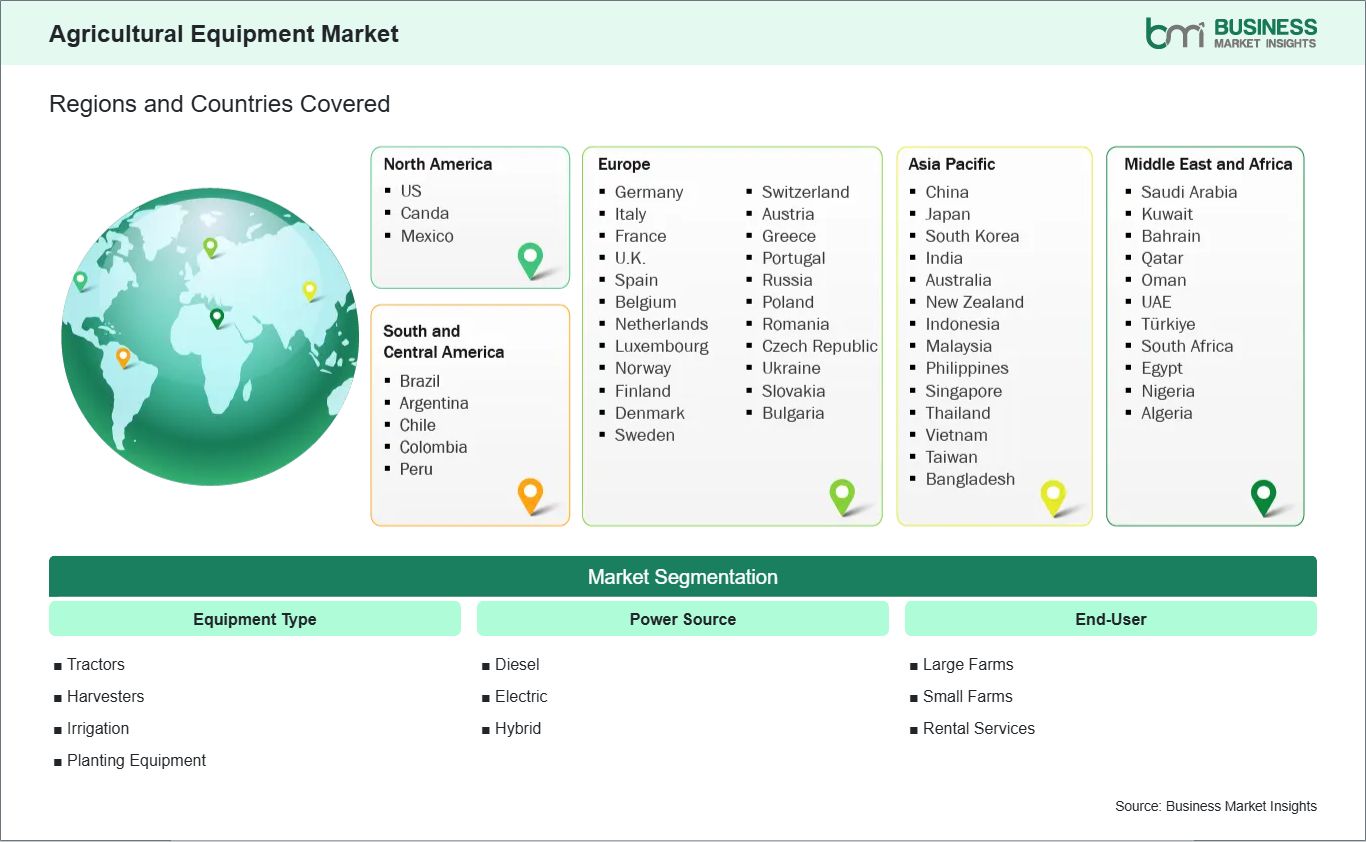
The Agricultural Equipment market is segmented based on equipment type, power source, and end-user. Rising mechanization and increasing focus on efficient farming operations are supporting demand across multiple agricultural applications.
By Equipment Type
- Tractors: Widely used for plowing, transportation, tillage, and multiple farming operations across large and small farms.
- Harvesters: Increasingly adopted to improve harvesting speed, labor efficiency, and crop management productivity.
- Irrigation: Supports efficient water distribution and resource management in modern agricultural practices.
- Planting Equipment: Used for accurate seed placement, improved crop yield, and precision farming operations.
By Power Source
- Diesel: Continues to dominate due to high power output and widespread usage in heavy farming operations.
- Electric: Gaining attention with increasing focus on sustainability and low-emission agricultural machinery.
- Hybrid: Combines fuel efficiency and operational flexibility for advanced farming applications.
By End-User
- Large Farms: Major adopters of advanced and automated agricultural machinery for high-volume operations.
- Small Farms: Gradually increasing adoption of compact and affordable farming equipment solutions.
- Rental Services: Growing demand due to cost-effective equipment access for seasonal and small-scale farming activities.
Market Forces
Agricultural Equipment Market Drivers and Opportunities
Rising Mechanization and Precision Farming Adoption
The increasing shift toward mechanized farming practices is significantly driving the Agricultural Equipment market. Farmers are adopting modern machinery to improve operational efficiency, reduce labor dependency, and increase crop productivity. Growing labor shortages in the agriculture sector are encouraging the use of tractors, harvesters, and automated planting systems across large and small farming operations. Governments in several countries are also supporting agricultural modernization through subsidies, financing programs, and rural development initiatives aimed at improving food production capabilities and farm productivity.
Precision agriculture technologies are further strengthening market demand by enabling better resource utilization and crop management. GPS-guided systems, telematics, automated steering, and smart irrigation technologies are helping farmers optimize fuel consumption, water usage, and field operations. Increasing awareness regarding sustainable farming and efficient land management is encouraging the deployment of technologically advanced equipment. Expansion of commercial farming activities and rising investments in modern agricultural infrastructure continue to create favorable conditions for long-term market development.
Expansion of Smart and Sustainable Farming Technologies
Growing interest in sustainable agriculture and digital farming technologies is creating significant opportunities for the Agricultural Equipment market. Farmers and agricultural organizations are increasingly adopting electric and hybrid-powered machinery to reduce fuel consumption and environmental impact. Smart farming technologies such as automated tractors, AI-enabled crop monitoring systems, and precision irrigation solutions are gaining popularity due to their ability to improve operational accuracy and productivity.
The development of connected farming ecosystems is also supporting market opportunities. Advanced data analytics, cloud-based farm management systems, and IoT-enabled machinery are helping farmers monitor crop conditions and optimize agricultural processes more effectively. Rental equipment services are expanding in developing regions where small-scale farmers seek affordable access to modern machinery without large capital investments. Increasing investments in autonomous agricultural vehicles and robotic farming systems are expected to support future market growth. As agricultural production requirements continue to rise globally, demand for efficient, technologically advanced, and environmentally sustainable farming equipment is expected to increase steadily.
Size and Share Analysis
Agricultural Equipment Market Size and Share Analysis
The Agricultural Equipment Market is projected to grow from US$ 194.48 Billion in 2025 to US$ 341.84 Billion by 2033 , registering a CAGR of 7.30% from 2026 to 2033.
By equipment type, tractors hold a significant share due to their wide application across plowing, tillage, transportation, and general farm operations. Harvesters are also witnessing strong demand as farmers increasingly focus on improving harvesting efficiency and reducing labor dependency. Irrigation equipment continues to gain importance with rising emphasis on water conservation and efficient agricultural resource management. Planting equipment is expanding steadily with growing adoption of precision farming techniques and automated seeding operations.
By power source, diesel-powered equipment continues to dominate the market because of its strong performance and suitability for heavy agricultural activities. Electric and hybrid equipment are gradually gaining traction due to increasing environmental awareness and advancements in sustainable farming technologies.
By end-user, large farms account for a major market share due to higher investments in mechanized farming and advanced agricultural machinery. Small farms and rental service providers are also contributing to market growth as access to affordable and compact farming equipment continues to improve. Rising investments in smart farming technologies and agricultural modernization initiatives are expected to support long-term market expansion.
Report Coverage
Agricultural Equipment Market Report Coverage and Deliverables
The "Agricultural Equipment Size and Forecast (2022-2033)" report provides a detailed analysis of the market covering below areas:
- Agricultural Equipment Market size and forecast at global, regional, and country levels for all the key market segments covered under the scope
- Agricultural Equipment Market trends, as well as market dynamics such as drivers, restraints, and key opportunities
- Agricultural Equipment Market analysis covering key market trends, global and regional framework, major players, regulations, and recent market developments
- Industry landscape and competition analysis covering market concentration, heat map analysis, prominent players, and recent developments for the market
- Detailed company profiles, including SWOT analysis
Geographic Insights
Agricultural Equipment Market Geographic Insights
The Agricultural Equipment Market shows diverse regional adoption patterns influenced by agricultural modernization programs, infrastructure development, mechanization trends, and evolving farming practices.
North America continues to represent a mature market for agricultural equipment due to large-scale commercial farming operations and strong adoption of precision agriculture technologies. The United States and Canada are focusing on automated farming machinery, GPS-enabled tractors, and advanced irrigation systems to improve productivity and reduce operational costs. Farmers across the region are increasingly integrating telematics, data analytics, and autonomous farming technologies into agricultural operations. Well-developed financing systems and strong aftersales service networks are also supporting the adoption of technologically advanced farming equipment. Increasing investments in sustainable agriculture and fuel-efficient machinery continue to strengthen market growth across the region.
Asia Pacific is witnessing strong growth in agricultural equipment adoption due to rising mechanization and government support for modern farming practices. Countries such as China and India are investing in farm modernization programs, irrigation infrastructure, and rural development initiatives to improve agricultural productivity. Demand for compact tractors, planting equipment, and harvesting machinery is increasing among small and medium-sized farms. Expanding rental service models are also improving equipment accessibility for farmers with limited capital resources. Growing population, rising food demand, and increasing awareness regarding precision farming technologies are expected to continue supporting long-term market development across the region.
Industry Activity
Recent Developments
The Agricultural Equipment Market is analyzed using a mix of primary and secondary research sources, including corporate publications, industry associations, and verified databases. This approach ensures accurate tracking of innovation trends and strategic developments influencing the market.
- In February 2024, Deere & Company introduced new autonomous farming technology solutions designed to improve precision agriculture and operational efficiency. The development included advanced automation capabilities for tractors and agricultural machinery aimed at reducing labor dependency and improving productivity across farming operations. The launch reflects growing industry focus on smart farming technologies and connected agricultural equipment.
- In November 2023, AGCO Corporation expanded its precision agriculture equipment portfolio with advanced guidance and smart farming technologies for global agricultural operations. The update focused on improving resource efficiency, crop management accuracy, and equipment connectivity across large-scale farming applications. The development highlights the increasing integration of digital technologies in agricultural machinery.
Trust & Transparency
Research Methodology
The market analysis combines proprietary research with secondary data from government agencies, company disclosures, regulatory filings, industry databases and expert interviews. Market estimates are validated through data triangulation, cross-market benchmarking and analyst
review.
View Full Research Methodology
Key Sources Referred:
World Bank - Global Trade Indicators
World Trade Organization (WTO)
International Monetary Fund (IMF)
International Trade Administration (ITA)
Company Websites
Company Annual Reports
Company Investor Presentations