Market Summary
Executive Summary and Global Market Analysis
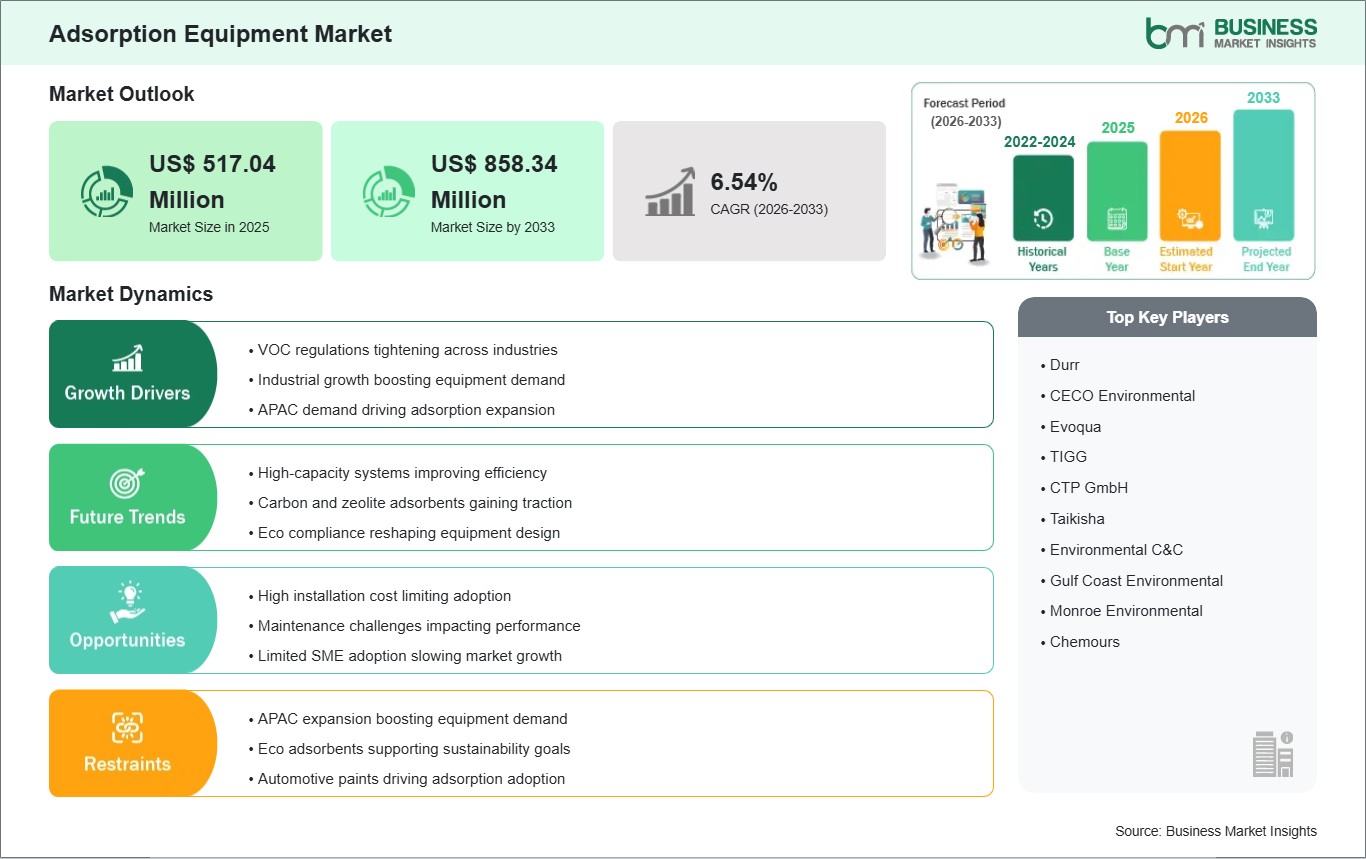
Adsorption equipment is used to remove contaminants, volatile organic compounds, moisture, and harmful gases from industrial air and process streams through adsorption technologies such as activated carbon and molecular sieves. These systems are widely used in industries including automotive paints, chemicals, semiconductors, pharmaceuticals, food and beverage, and printing to support environmental compliance, improve air quality, and maintain process efficiency. Increasing industrialization and stricter environmental regulations are supporting the demand for advanced adsorption equipment across developed and developing economies. Industries are focusing on reducing emissions, improving workplace safety, and maintaining cleaner production environments, which is encouraging wider adoption of adsorption systems.
Several trends are influencing the development of the Adsorption Equipment market. Industries are increasingly adopting energy-efficient and automated adsorption technologies to improve operational performance and reduce maintenance requirements. The demand for compact and modular systems is rising as manufacturing facilities seek flexible solutions that can be integrated into existing infrastructure. Semiconductor and pharmaceutical industries are generating strong demand for high-purity air treatment systems due to strict contamination control standards. However, fluctuations in raw material prices, high installation costs, and ongoing maintenance requirements can affect purchasing decisions, particularly among small and medium-scale industries. Regulatory compliance requirements also vary across regions, creating operational challenges for manufacturers and end users.
The market continues to benefit from expanding industrial production and increasing focus on environmental sustainability. Automotive paint facilities and chemical manufacturing plants remain major users of adsorption equipment due to high emission control requirements. Food and beverage manufacturers are also investing in advanced purification systems to maintain hygiene and product quality standards. Competitive activity in the market is centered on product efficiency, emission control performance, automation capabilities, and long-term operational reliability.
Segment Analysis
Adsorption Equipment Market Segmentation
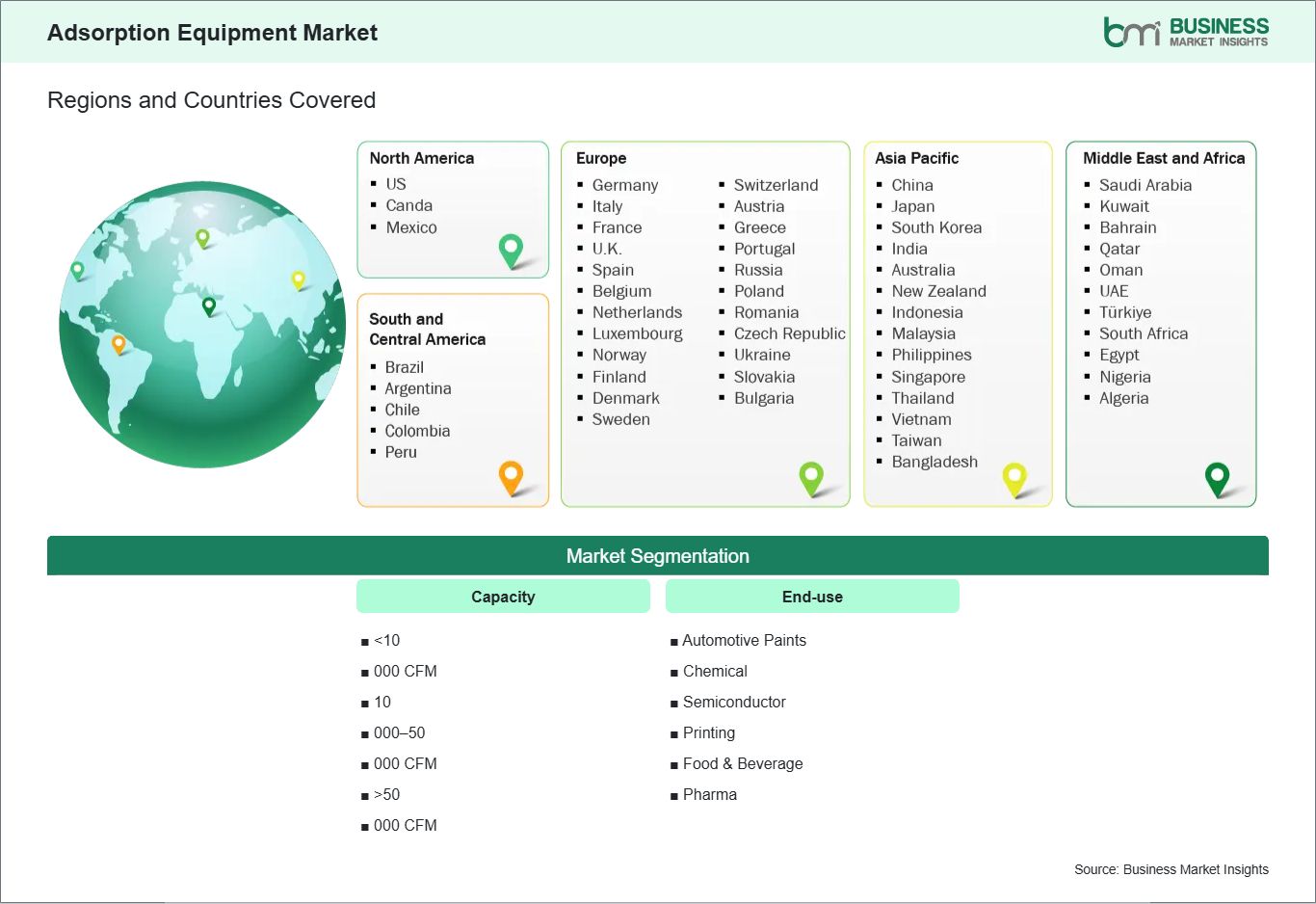
The Adsorption Equipment market is segmented based on capacity and end-use industries. Different capacity ranges and industrial applications influence equipment design, operational efficiency, and adoption trends across global markets.
By Capacity
- <10,000 CFM: These systems are commonly used in small manufacturing facilities and localized air purification applications where compact installation and lower operational requirements are important.
- 10,000-50,000 CFM: Medium-capacity systems are widely adopted across automotive, printing, and pharmaceutical industries due to balanced performance and operational flexibility.
- >50,000 CFM: Large-capacity adsorption equipment is mainly used in chemical plants, large industrial facilities, and heavy manufacturing operations requiring continuous high-volume emission control.
By End-use
- Automotive Paints: Adsorption systems are used to control volatile organic compound emissions and maintain environmental compliance during coating operations.
- Chemical: Chemical manufacturing facilities use adsorption equipment for gas purification, solvent recovery, and emission control applications.
- Semiconductor: Semiconductor production requires high-purity air treatment systems to maintain contamination-free manufacturing environments.
- Printing: Printing facilities utilize adsorption equipment to reduce solvent emissions and improve workplace air quality.
- Food & Beverage: The industry adopts adsorption technologies for odor control, air purification, and process quality management.
- Pharma: Pharmaceutical manufacturers use adsorption equipment to maintain cleanroom standards and regulatory compliance in production facilities.
Market Forces
Adsorption Equipment Market Drivers and Opportunities
Rising Environmental Regulations and Industrial Emission Control Requirements
The demand for adsorption equipment is increasing due to stricter environmental regulations and growing industrial focus on emission control. Industries such as automotive paints, chemicals, printing, and pharmaceuticals generate volatile organic compounds and hazardous air pollutants during manufacturing processes. Governments and environmental agencies are implementing stricter air quality regulations, encouraging industries to adopt advanced purification and emission control systems. Adsorption equipment helps manufacturers comply with these regulations while improving workplace safety and operational efficiency.
Industrial facilities are also focusing on sustainable manufacturing practices and energy-efficient operations. Advanced adsorption systems provide reliable contaminant removal while supporting cleaner production environments. Increasing awareness regarding employee health and environmental protection is further encouraging the installation of air purification technologies across manufacturing plants. In sectors such as semiconductors and pharmaceuticals, strict contamination control standards are creating additional demand for high-performance adsorption systems. As industrial operations continue to expand globally, the need for efficient and regulation-compliant emission control technologies is expected to support long-term growth in the Adsorption Equipment market.
Growing Demand for High-Purity Manufacturing and Smart Industrial Systems
The Adsorption Equipment market is creating new opportunities through the growing adoption of high-purity manufacturing environments and smart industrial technologies. Industries such as semiconductors, pharmaceuticals, and food processing require highly controlled production environments to maintain product quality and operational consistency. This is increasing demand for advanced adsorption systems capable of delivering precise filtration and contamination control performance.
Industrial automation and digital monitoring technologies are also supporting market growth. Manufacturers are integrating sensors, remote monitoring systems, and predictive maintenance capabilities into adsorption equipment to improve operational reliability and reduce downtime. Smart factory development and connected manufacturing systems are encouraging industries to invest in intelligent air purification and gas treatment solutions. Sustainability goals are further driving the development of energy-efficient adsorption technologies with lower operational costs and reduced environmental impact.
Size and Share Analysis
Adsorption Equipment Market Size and Share Analysis
The Adsorption Equipment Market is projected to grow from US$ 517.04 Million in 2025 to US$ 858.34 Million by 2033 , registering a CAGR of 6.54% from 2026 to 2033.
By capacity, the 10,000-50,000 CFM segment holds a significant share due to its wide adoption across medium- and large-scale manufacturing industries. These systems offer balanced operational efficiency, emission control performance, and installation flexibility for industries such as automotive paints, chemicals, and printing. Large-capacity systems above 50,000 CFM are gaining importance in heavy industrial operations and chemical processing facilities that require continuous high-volume air purification and contaminant removal. Smaller-capacity systems continue to support localized industrial applications and compact manufacturing environments.
By end-use, the chemical and automotive paints industries account for a major share of the market due to strict environmental regulations and increasing focus on emission reduction. Semiconductor and pharmaceutical industries are also generating steady demand for advanced adsorption technologies because of strict contamination control and cleanroom requirements. Food and beverage manufacturers are increasingly adopting adsorption systems to maintain product quality and improve hygiene standards. Growing industrial automation, environmental compliance initiatives, and investments in sustainable manufacturing infrastructure are expected to support long-term growth in the Adsorption Equipment market.
Report Coverage
Adsorption Equipment Market Report Coverage and Deliverables
The "Adsorption Equipment Size and Forecast (2022-2033)" report provides a detailed analysis of the market covering below areas:
- Market size and forecast at global, regional, and country levels for all the key market segments covered under the scope
- Market trends, as well as market dynamics such as drivers, restraints, and key opportunities
- Market analysis covering key market trends, global and regional framework, major players, regulations, and recent market developments
- Industry landscape and competition analysis covering market concentration, heat map analysis, prominent players, and recent developments for the market
- Detailed company profiles, including SWOT analysis
Geographic Insights
Adsorption Equipment Market Geographic Insights
The Adsorption Equipment Market shows diverse regional adoption patterns influenced by environmental regulations, industrial manufacturing growth, and increasing demand for emission control technologies.
North America, being a developed region, has a well-established industrial infrastructure and strong adoption of advanced air purification and emission control systems. The region comprises the United States and Canada, where industries are increasingly focusing on environmental compliance, workplace safety, and sustainable manufacturing operations. The chemical, pharmaceutical, automotive paints, and food processing sectors are major users of adsorption equipment across the region. Manufacturers are investing in automated and energy-efficient systems to improve operational performance and reduce environmental impact. Strong regulatory frameworks and industrial modernization initiatives continue to support the adoption of advanced adsorption technologies across different manufacturing facilities.
Asia Pacific is growing significantly, driven by rapid industrialization, expanding manufacturing activities, and increasing environmental awareness. The region comprises countries such as China, India, Japan, and South Korea, where industrial production and infrastructure development are creating strong demand for emission control equipment. Semiconductor manufacturing, chemical processing, and automotive production industries are contributing significantly to market expansion. Governments across the region are implementing stricter environmental regulations and encouraging cleaner industrial operations, which is supporting investments in adsorption technologies. Growing adoption of smart manufacturing systems and industrial automation is also creating demand for advanced air purification and contaminant control solutions.
Both regions are contributing significantly to the growth of the Adsorption Equipment Market, focusing on industrial sustainability, environmental protection, and efficient emission management technologies.
Industry Activity
Recent Developments
The Adsorption Equipment Market is analyzed using a mix of primary and secondary research sources, including corporate publications, industry associations, and verified databases. This approach ensures accurate tracking of innovation trends and strategic developments influencing the market.
- In March 2024, CECO Environmental announced advancements in its industrial air pollution control and VOC abatement technologies to support manufacturing industries facing stricter environmental compliance requirements. The development focused on improving energy efficiency and emission reduction performance across industrial processing applications. The update reflects increasing industry focus on sustainable adsorption and filtration technologies.
- In October 2023, Munters introduced expanded air treatment and industrial dehumidification solutions designed for semiconductor and pharmaceutical manufacturing environments. The company focused on improving contamination control, energy efficiency, and clean manufacturing operations through advanced adsorption technologies. The development supports growing demand for high-purity industrial processing systems.
Trust & Transparency
Research Methodology
The market analysis combines proprietary research with secondary data from government agencies, company disclosures, regulatory filings, industry databases and expert interviews. Market estimates are validated through data triangulation, cross-market benchmarking and analyst
review.
View Full Research Methodology
Key Sources Referred:
World Bank - Global Trade Indicators World Trade Organization (WTO) International Monetary Fund (IMF) International Trade Administration (ITA) Company Websites Company Annual Reports Company Investor Presentations