
3D Metrology Market Outlook: Size, Share, Trends, Growth Analysis, Competitive Landscape & Forecast, 2026-2033

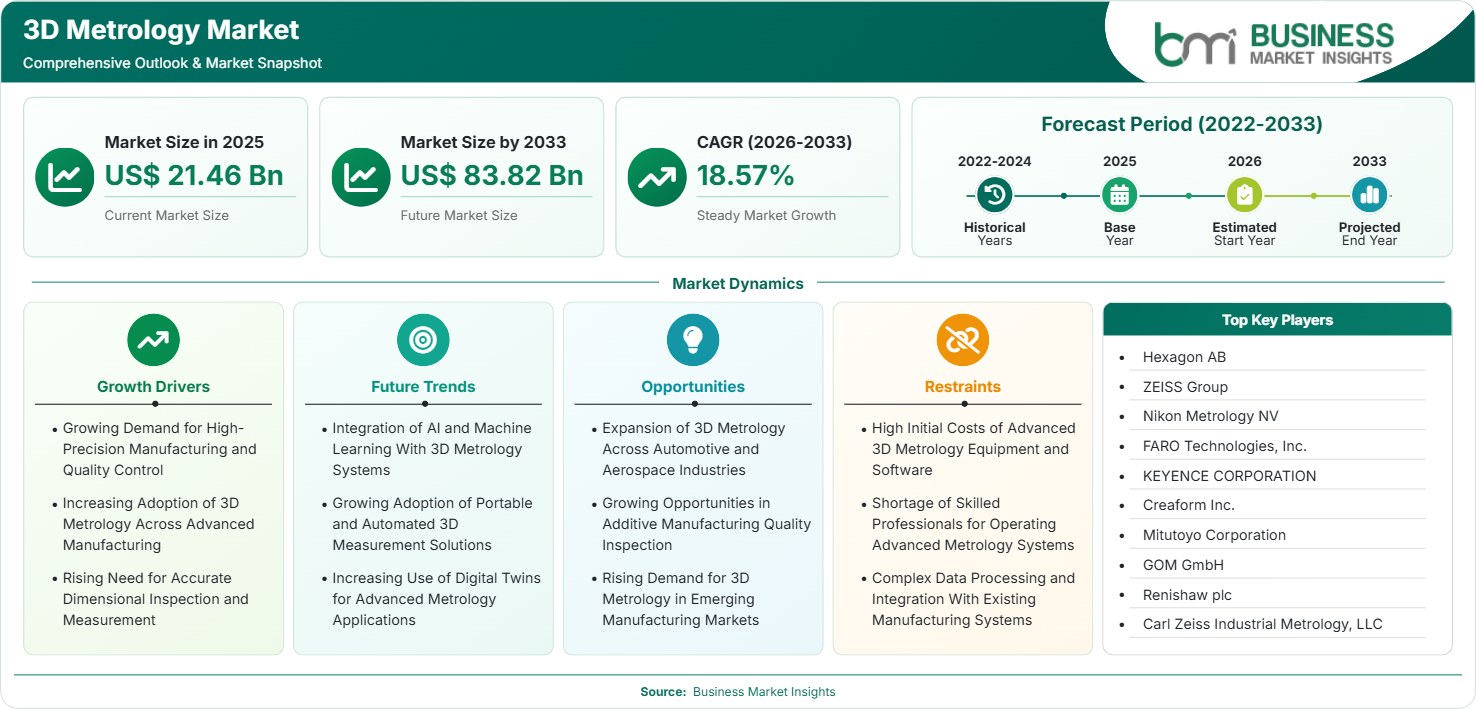
The 3D Metrology Market size was valued at US$ 21.46 Billion in 2025 and is projected to reach US$ 83.82 Billion by 2033, growing at a CAGR of 18.57% during 2026–2033, driven by precision manufacturing, automated inspection, dimensional accuracy, additive manufacturing, digital production, and quality assurance requirements.

Report Coverage
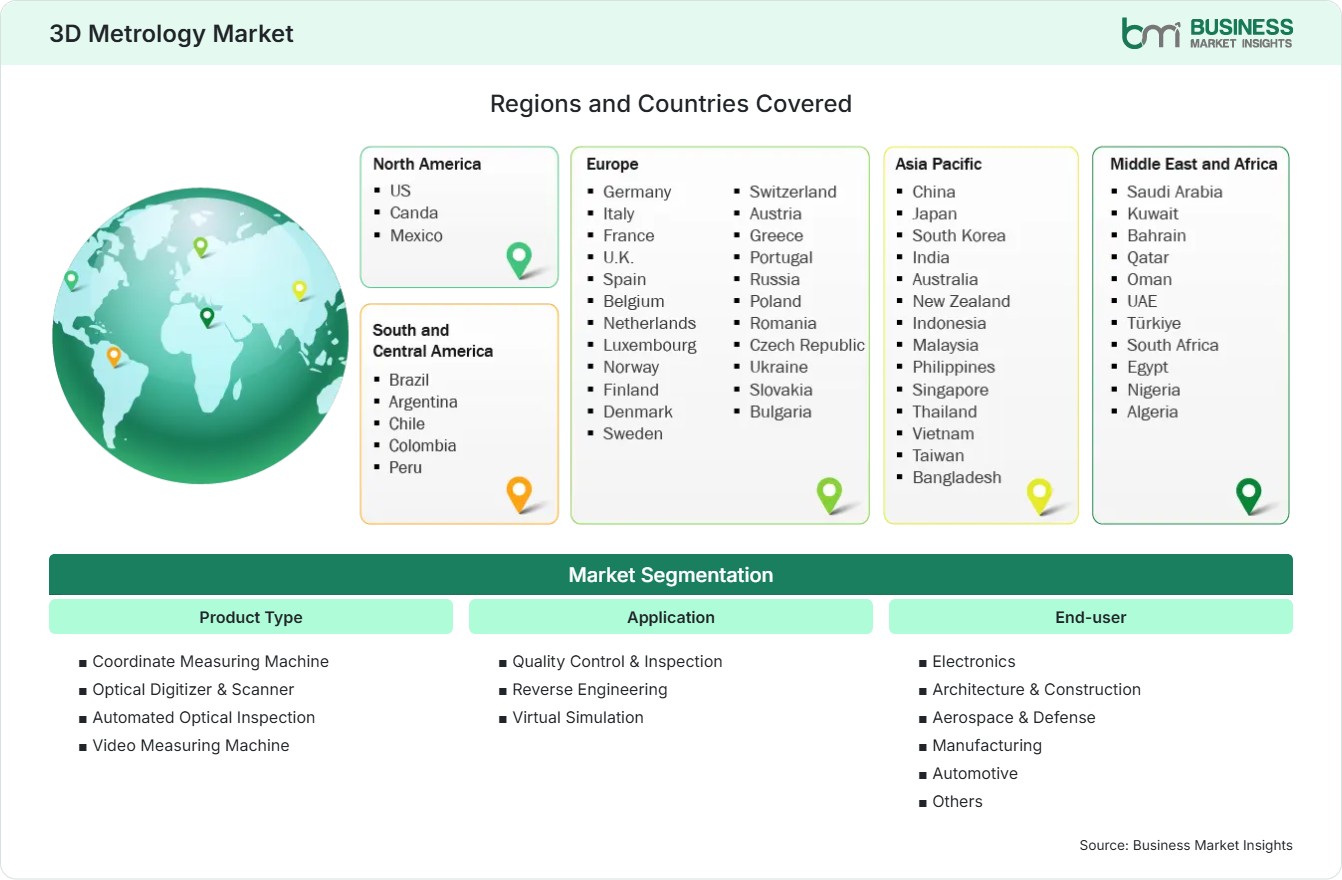
  • Product Type: Coordinate Measuring Machine, Optical Digitizer & Scanner, Automated Optical Inspection, Video Measuring Machine
  • Application: Quality Control & Inspection, Reverse Engineering, Virtual Simulation
  • End-user: Electronics, Architecture & Construction, Aerospace & Defense, Manufacturing, Automotive, Others
US$ 21.46 Bn Market size in 2025
US$ 83.82 Bn Market Size by 2033
18.57% CAGR, 2026 - 2033
2026-2033 Forecast Period

AI Overview

3D Metrology Market Summary

  • North America Region: North America held a 27%–31% share in 2025 and is projected to grow at a 17.0%–18.5% CAGR during 2026–2033, supported by aerospace, automotive, electronics, defense manufacturing, automation, and strong adoption of advanced inspection technologies. The US market is projected to grow at a 17.2%–18.7% CAGR during 2026–2033, driven by aerospace production, semiconductor manufacturing, automotive electrification, additive manufacturing, and automated quality inspection.
  • Fastest Growing Region: Asia Pacific represented a 29%–33% share in 2025 and is projected to expand at a 20.0%–22.0% CAGR through 2033, supported by industrial automation, electronics manufacturing, automotive production, semiconductor investments, aerospace development, and rapid modernization of manufacturing facilities.
  • Leading Segment: Coordinate Measuring Machine represented a 36%–40% of global 3D metrology market share in 2025 and is projected to grow at a 17.5%–18.8% CAGR through 2033, supported by high dimensional accuracy, automated inspection, aerospace quality standards, automotive manufacturing, and complex component measurement requirements.
  • High Growth Segment: Additive Manufacturing Quality Inspection represented a 14%–18% share in 2025 and is projected to grow at a 21.0%–23.0% CAGR through 2033, driven by increasing industrial 3D printing, complex geometries, layer-by-layer verification, process monitoring, and certification requirements.
  • Key Market Opportunity: Integration of 3D metrology with automated manufacturing, digital twins, artificial intelligence, additive manufacturing, robotics, and cloud analytics is creating opportunities for real-time inspection and closed-loop production control.
  • Major Market Players: Hexagon AB, ZEISS Group, Nikon Metrology NV, FARO Technologies, Inc., KEYENCE CORPORATION, Creaform Inc., Mitutoyo Corporation, GOM GmbH, Renishaw plc, and Carl Zeiss Industrial Metrology, LLC.
Strategic Insights

3D Metrology Market: Strategic Insights

3D Metrology Market Strategic Framework
FREE PDF
Request your free sample
Request free sample
Stakeholder View

Key Takeaways

  • The ecosystem increasingly connects metrology equipment manufacturers, optical technology developers, software providers, robotics companies, CAD and PLM vendors, contract manufacturers, and industrial automation suppliers, creating opportunities for integrated inspection platforms.
  • Additive manufacturing, electric vehicles, semiconductor production, and aerospace components provide high-upside applications because complex geometries and tighter tolerances increase the need for rapid three-dimensional measurement and validation.
  • The technology landscape is shifting toward non-contact optical scanning, automated robotic inspection, AI-assisted defect recognition, digital twins, and closed-loop manufacturing systems that connect measurement data directly with production processes.
  • Asia Pacific presents a compelling investment case as electronics, semiconductor, automotive, and advanced manufacturing capacity expands, particularly across China, Japan, South Korea, Taiwan, and India.
  • Strategic consolidation and partnerships are increasingly focused on combining metrology hardware with software, artificial intelligence, automation, and digital manufacturing capabilities to strengthen recurring software and services revenue.
  • Portable and flexible metrology solutions can expand adoption among small and medium-sized manufacturers by reducing dependence on dedicated inspection laboratories and enabling measurements directly on production floors.
Geographic Outlook

3D Metrology Market Regional Highlights

North America 3D Metrology Market

North America accounted for a 27%–31% share in 2025 and North America 3D Metrology Market forecast to grow at a 17.0%–18.5% CAGR through 2033. The region benefits from advanced aerospace, defense, automotive, electronics, and medical manufacturing ecosystems. The US dominates regional demand, supported by high precision requirements and Industry 4.0 investments. Canada contributes through aerospace, automotive, energy, and industrial manufacturing. Increasing adoption of automated inspection is strengthening demand for integrated metrology platforms.

  • Aerospace and defense manufacturers are expanding high-precision measurement capabilities to validate complex components, reduce production errors, and meet stringent dimensional requirements across aircraft and defense programs.
  • Automotive manufacturers are integrating 3D inspection into electric vehicle production to validate battery components, body structures, powertrain parts, and complex assemblies with greater speed and accuracy.
  • Semiconductor and electronics manufacturers are increasing demand for optical measurement and inspection technologies as miniaturization and increasingly complex component geometries raise quality-control requirements.

US 3D Metrology Market

The US North America 3D metrology market represented approximately 89%–93% of North American demand in 2025 and is projected to grow at a 17.2%–18.7% CAGR through 2033. Aerospace, defense, automotive, semiconductor, medical device, and additive manufacturing industries support strong adoption. Manufacturers are increasingly deploying portable scanners, automated inspection cells, and advanced software to improve dimensional accuracy while integrating measurement data with digital engineering and production environments.

  • Aerospace manufacturers are using high-precision metrology to validate turbine components, airframes, engine parts, and composite structures where dimensional accuracy directly influences performance and certification.
  • Automotive companies are expanding automated inspection for electric vehicles, battery systems, and lightweight components as manufacturers seek faster validation across increasingly complex production processes.
  • Additive manufacturing is increasing demand for three-dimensional inspection because printed components require geometry validation, defect identification, and dimensional verification before production-scale deployment.

Europe 3D Metrology Market

Europe 3D metrology market held a 24%–28% share in 2025 and is projected to grow at a 16.5%–18.0% CAGR through 2033. Germany, France, Italy, and the United Kingdom are leading markets, while Germany is projected to grow at a 17.0%–18.5% CAGR. Strong automotive, aerospace, machinery, and industrial automation capabilities support adoption. European manufacturers increasingly integrate metrology with digital engineering, robotics, automation, and sustainable production initiatives.

  • Germany represents a leading market due to its advanced automotive, machinery, aerospace, and industrial manufacturing base, supporting strong demand for high-accuracy dimensional inspection.
  • France and the United Kingdom provide opportunities through aerospace, defense, automotive, and advanced engineering industries requiring reliable measurement of complex components and assemblies.
  • European automotive manufacturers are expanding automated inspection capabilities to support electric vehicle production, lightweight structures, battery systems, and increasingly complex vehicle architectures.
  • Industrial digitalization is encouraging integration between metrology equipment, CAD models, production systems, and analytics platforms, enabling faster feedback and improved process control.

Asia Pacific 3D Metrology Market

Asia Pacific 3D metrology market represented a 29%–33% share in 2025 and is projected to achieve a 20.0%–22.0% CAGR through 2033, making it the fastest-growing region. China, Japan, South Korea, Taiwan, and India are leading markets, while India is projected to grow at a 22.0%–24.0% CAGR. Electronics, semiconductors, automotive, aerospace, and industrial automation investments are accelerating demand for advanced inspection and measurement.

  • China remains a major opportunity due to large-scale electronics, automotive, semiconductor, aerospace, and machinery manufacturing, alongside increasing adoption of automated quality-control systems.
  • Japan benefits from sophisticated automotive, electronics, robotics, and precision engineering industries that require high-accuracy measurement and automated inspection throughout production workflows.
  • South Korea and Taiwan offer strong opportunities through semiconductor and electronics manufacturing, where miniaturization and complex component structures require advanced optical inspection and dimensional measurement.
  • India is rapidly developing as a manufacturing and engineering hub, creating demand for metrology systems as automotive, aerospace, electronics, and industrial production capabilities expand.
  • Southeast Asian manufacturing centers are attracting investment in electronics, automotive components, and industrial production, supporting adoption of portable scanners and automated inspection systems.

Rest of World 3D Metrology Market

South and Central America 3D metrology market accounted for a 7%–9% share in 2025 and is projected to grow at a 16.0%–18.0% CAGR through 2033. Brazil and Mexico represent leading markets, supported by automotive, aerospace, electronics, and industrial manufacturing. Mexico benefits from manufacturing integration with North American supply chains, while Brazil offers opportunities through automotive, energy, aerospace, and machinery production. The Middle East and Africa represented a 6%–8% share in 2025 and is projected to grow at a 14.5%–17.0% CAGR through 2033.

  • Brazil is expanding demand through automotive, aerospace, energy, and industrial manufacturing applications where accurate dimensional inspection supports component quality and production efficiency.
  • Mexico benefits from automotive and aerospace manufacturing investments, creating opportunities for automated optical inspection, coordinate measurement, and portable three-dimensional scanning systems.
  • The UAE and Saudi Arabia are developing advanced manufacturing capabilities as part of industrial diversification initiatives, supporting opportunities for digital metrology and automated quality-control technologies.
  • South Africa represents an emerging opportunity through mining equipment, automotive manufacturing, aerospace activities, and industrial engineering applications requiring dimensional measurement and component verification.
Global Market Geography
FREE PDF
Request your free sample
Request free sample
Segment Analysis

3D Metrology Market Segmentation

Product Type

Coordinate Measuring Machine represented a 36%–40% share in 2025 and is projected to grow at a 17.5%–18.8% CAGR during 2026–2033. CMMs remain essential for precise dimensional inspection across automotive, aerospace, and manufacturing applications.

  • Coordinate Measuring Machine: CMMs deliver high dimensional accuracy for complex components and remain widely used in automotive, aerospace, manufacturing, and precision engineering quality-control workflows.
  • Optical Digitizer & Scanner: Optical scanners enable rapid non-contact measurement of complex geometries, supporting reverse engineering, surface inspection, additive manufacturing, and large-component quality assessment.
  • Automated Optical Inspection: AOI systems accelerate automated defect detection and dimensional verification, particularly in electronics and high-volume manufacturing where inspection speed and repeatability are critical.
  • Video Measuring Machine: Video measuring machines provide precise optical measurement for small and intricate components, supporting electronics, precision engineering, tooling, and manufacturing quality-control applications.

Application

Quality Control & Inspection represented a 58%–62% share in 2025 and is projected to grow at a 17.5%–18.7% CAGR during 2026–2033. Manufacturers increasingly deploy 3D metrology to improve dimensional verification, reduce defects, and accelerate production feedback.

  • Quality Control & Inspection: Quality inspection remains the dominant application as manufacturers use three-dimensional measurement to verify tolerances, detect defects, reduce rework, and maintain consistent production quality.
  • Reverse Engineering: Reverse engineering enables manufacturers to digitize existing components, recreate legacy parts, improve product designs, and support replacement production when original engineering documentation is unavailable.
  • Virtual Simulation: Virtual simulation combines measurement data with digital models to evaluate manufacturing processes, validate designs, optimize production workflows, and improve digital twin accuracy.

End-user

Manufacturing represented a 24%–28% share in 2025 and is projected to grow at a 18.0%–19.5% CAGR during 2026–2033. Broad adoption across industrial production, machinery, precision engineering, and automated manufacturing supports strong demand.

  • Electronics: Electronics manufacturers use high-resolution inspection to validate miniaturized components, assemblies, and production tolerances while improving defect detection across increasingly automated manufacturing environments.
  • Architecture & Construction: Three-dimensional scanning supports building documentation, structural measurement, construction verification, digital twins, and renovation planning across complex physical environments.
  • Aerospace & Defense: Aerospace and defense manufacturers require highly accurate measurement for complex components, composite structures, engines, and assemblies subject to stringent performance and certification requirements.
  • Manufacturing: Industrial manufacturers deploy metrology across quality assurance, process optimization, reverse engineering, and automated inspection to improve dimensional consistency and reduce production-related defects.
  • Automotive: Automotive companies use 3D metrology for body structures, powertrain components, battery systems, tooling, and electric vehicle production requiring accurate dimensional validation.
Market Forces

3D Metrology Market Dynamics

Key Market Drivers

Growing Demand for High-Precision Manufacturing and Quality Control

Increased product complexity, tolerance for dimensions, and quality demands have created a need to enhance measurement accuracy throughout production processes. 3D metrology systems are becoming increasingly important for checking part dimensions, detecting deviations, minimizing scrap, and ensuring production quality. Manufacturers of aerospace equipment, automobiles, electronic parts, and precision machinery are turning to CMMs, optical scanners, and automated inspection systems to validate their components against digital models. The move towards using lighter-weight and more complex parts is also increasing the importance of measurement. To minimize rework and achieve high first-pass yields, metrology is increasingly integrated into production engineering. This 3D Metrology Market trend is encouraging investment in scanning, automated inspection, and measurement software.

Increasing Adoption of 3D Metrology Across Advanced Manufacturing

Such technologies of advanced manufacturing like additive manufacturing, robots, digital twins, and automated production rely on precise measurements in three dimensions to verify the parts and processes. The implementation of metrology is becoming extended beyond traditional inspection labs into production areas and automated manufacturing cells. Metrology integration with the CAD and manufacturing software is also enhancing digital continuity. With the adoption of Industry 4.0 frameworks within factories, measurements become more frequently utilized for process optimization and predictive quality control.

Rising Need for Accurate Dimensional Inspection and Measurement

Complexity in component designs and tighter engineering specifications have led to a greater demand for reliable dimensioning across the aerospace, automotive, electronics, and industrial manufacturing industries. More manufacturers are equipping themselves with high-resolution measuring devices that can detect minor inconsistencies and make accurate comparisons with the CAD model. The use of advanced software also enables faster visualization and reporting of measurement results. The ability to measure the entire three-dimensional surface will give you more data than traditional point measurement methods.

Key Market Opportunities

Expansion of 3D Metrology Across Automotive and Aerospace Industries

The automotive and aerospace sectors present huge opportunities as manufacturers need to inspect increasingly intricate components such as lightweight parts, batteries, engines, and composites. The emergence of electric vehicles will increase demand for measurement capabilities for battery housings, electric propulsion systems, and lightweight car bodies. Vendors that integrate hardware, software, automation, and analytics can capitalize on these trends and offer integrated quality-control processes. Digital engineering and digital twins add even more value to the measurement data.

Growing Opportunities in Additive Manufacturing Quality Inspection

Additive Manufacturing has presented new possibilities in the field of 3D Metrology due to the complex nature of the geometrical shapes, internal structures, and surfaces of printed parts, which require quality verification. Dimensional analysis, defect detection, part verification, and repeatability are among the requirements of manufacturers in the additive manufacturing process; therefore, there will be increased demand for repeatable and traceable inspection as the industry moves from prototypes to production.

Rising Demand for 3D Metrology in Emerging Manufacturing Markets

Manufacturing markets in emerging regions are presenting opportunities for industrial firms as they expand into automation, electronics, automotive assembly, aerospace, and machinery. The need for internationally harmonized quality and metrology processes among manufacturers in these regions is growing due to their participation in global value chains. This makes portable scanners and modular measurement systems especially appealing in situations where dedicated metrology labs are unavailable. Technology suppliers can expand their reach through regional partnerships, services, applications, and training programs.

Market Restraints and Challenges

High Initial Costs of Advanced 3D Metrology Equipment and Software

Factor: Highly accurate CMMs, optical scanners, automated inspection systems, software, and robotics technology entail a high initial investment and ongoing maintenance and calibration costs. Impact: The initial cost of such machines will pose a barrier to their adoption by smaller companies with limited budgets and will be deployed only in factories with high-budget constraints.  Companies may also face additional costs for environmental controls, specialized infrastructure, operator training, software upgrades, and system integration.

Shortage of Skilled Professionals for Operating Advanced Metrology Systems

Factor: Metrology systems that utilize 3D metrology technology require specialists with expertise in dimensional measurement, GD&T, CAD programs, scanners, data analysis, calibration, and specific procedures. Impact: A lack of qualified specialists can reduce equipment use, prolong implementation, and lead companies to rely heavily on outside contractors. It can be hard for manufacturers to translate complex measurement results into actions that improve production without specialist help.

Company Analysis

Competitive Landscape

The 3D Metrology Market analysis reflects competition among established dimensional measurement companies, industrial technology providers, optical inspection specialists, and engineering software developers. Competitive differentiation increasingly depends on measurement accuracy, scanning speed, automation, portability, software capabilities, artificial intelligence, and integration with digital manufacturing systems.

Company Name

Overview

Products and Services relevant to this market

Hexagon AB

Global industrial technology company providing measurement, manufacturing intelligence, and digital reality solutions across diverse industries.

CMMs, laser trackers, 3D laser scanners, optical measurement, metrology software, inspection automation, and manufacturing analytics.

ZEISS Group

Technology company with strong expertise in industrial quality assurance, precision measurement, optics, and advanced manufacturing applications.

CMMs, optical 3D scanners, industrial CT, surface measurement, inspection software, and dimensional quality solutions.

Nikon Metrology NV

Metrology technology provider specializing in high-precision optical, X-ray, CT, and dimensional inspection solutions for industrial applications.

3D scanners, industrial CT, X-ray inspection, laser radar, optical measurement, and metrology software.

FARO Technologies, Inc.

Technology company focused on three-dimensional measurement, imaging, and digital reality solutions for manufacturing and industrial applications.

Portable 3D scanners, laser trackers, CMM arms, scanning software, measurement systems, and digital reality solutions.

KEYENCE CORPORATION

Industrial automation and sensing company providing high-precision measurement and inspection technologies for manufacturing environments.

3D measurement systems, optical profilers, vision systems, laser displacement sensors, and automated inspection solutions.

Creaform Inc.

Metrology specialist focused on portable and automated three-dimensional measurement solutions for industrial and engineering applications.

Portable 3D scanners, optical coordinate measurement, automated inspection systems, metrology software, and engineering services.

Mitutoyo Corporation

Precision measurement company providing comprehensive dimensional metrology equipment and quality-control solutions globally.

CMMs, vision measurement systems, surface measurement, form measurement, portable systems, and metrology software.

GOM GmbH

Industrial measurement specialist known for optical three-dimensional measurement and inspection technologies for manufacturing applications.

Structured-light scanners, 3D scanning systems, deformation measurement, inspection software, and automated measurement solutions.

Renishaw plc

Engineering technology company providing precision measurement, manufacturing, additive manufacturing, and process-control solutions.

CMM probes, optical measurement, laser scanning, additive manufacturing inspection, calibration, and metrology systems.

Carl Zeiss Industrial Metrology, LLC

Industrial metrology business delivering precision measurement and inspection solutions for advanced manufacturing applications.

CMMs, optical measurement, scanning technologies, industrial CT, inspection software, and quality-management solutions.

Trust & Transparency

Research Methodology

The market analysis combines proprietary research with secondary data from government agencies, company disclosures, regulatory filings, industry databases and expert interviews. Market estimates are validated through data triangulation, cross-market benchmarking and analyst review.

View Full Research Methodology

Questions Answered

Frequently Asked Questions

What is the key challenge for 3D metrology adoption?

High equipment costs and limited availability of skilled metrology professionals can delay implementation, particularly among smaller manufacturers with constrained budgets and limited specialized technical resources.

How is additive manufacturing affecting metrology demand?

Additive manufacturing requires detailed validation of complex geometries, dimensional accuracy, surface quality, and production consistency, increasing demand for high-resolution scanning and automated inspection systems.

Why is Asia Pacific the fastest-growing region?

Rapid expansion of electronics, semiconductor, automotive, aerospace, and industrial manufacturing is increasing investment in automated inspection and precision measurement technologies across the region.

Which industries are major users of 3D metrology?

Automotive, aerospace and defense, electronics, precision manufacturing, construction, and industrial engineering are major users, with adoption expanding in additive manufacturing and semiconductor production.

What factors driving demand in 3D metrology market report?

Demand is driven by tighter manufacturing tolerances, complex component geometries, automated quality control, additive manufacturing, and the need to reduce production defects and rework.

Access the Full 3D Metrology Market Report

Get segment-level forecasts, regional estimates, competitive benchmarking, company profiles and downloadable Excel datasets.

Access the full 3D Metrology Market Report
350 pages PDF & Excel | 2026-08-06