Market Summary
Executive Summary and Global Market Analysis
Facade systems comprise engineered exterior building envelope solutions designed to enhance structural protection, energy performance, weather resistance, and architectural appearance. Such systems comprise materials, glazing systems, insulating systems, and structures that together result in energy-efficient and long-lasting facades. The use of such systems finds relevance in the construction of both residential and non-residential buildings where issues like efficiency and aesthetic appeal dictate the choice of material for construction. Increasing focus on building architecture further enhances their importance.
Market growth is due to an increase in the adoption of sustainable building practices and increased concern for building efficiency. There is an increased demand for facades that help with regulating heat and increasing the functionality of buildings. Building regulators‘ concern for conserving energy is also impacting the choice of material and designing facade systems. The trend towards construction of performance buildings has seen inclusion of facades at the early stages of development.
However, the patterns of demand can be very different from one product category to another, or between materials and application sectors. For example, curtain walling continues to be an important construction material, while cladding is commonly employed as a means of protection and decoration. The use of glass and metal materials continues to attract much interest on account of their design versatility and technical qualities. Each sector has its own needs.
New technologies are transforming the sector through better production processes, digitized design, and intelligent facades. New developments related to energy management, sustainability, and efficient installation are opening up possibilities in terms of choice. The competitive landscape in the market focuses on differentiation, technical expertise, and compliance with changing construction requirements. Players in the market are continuing to fine-tune their products in order to cater to sustainability objectives, challenging architectural designs, and shifting consumer demands.
Segment Analysis
Facade Systems Market Segmentation
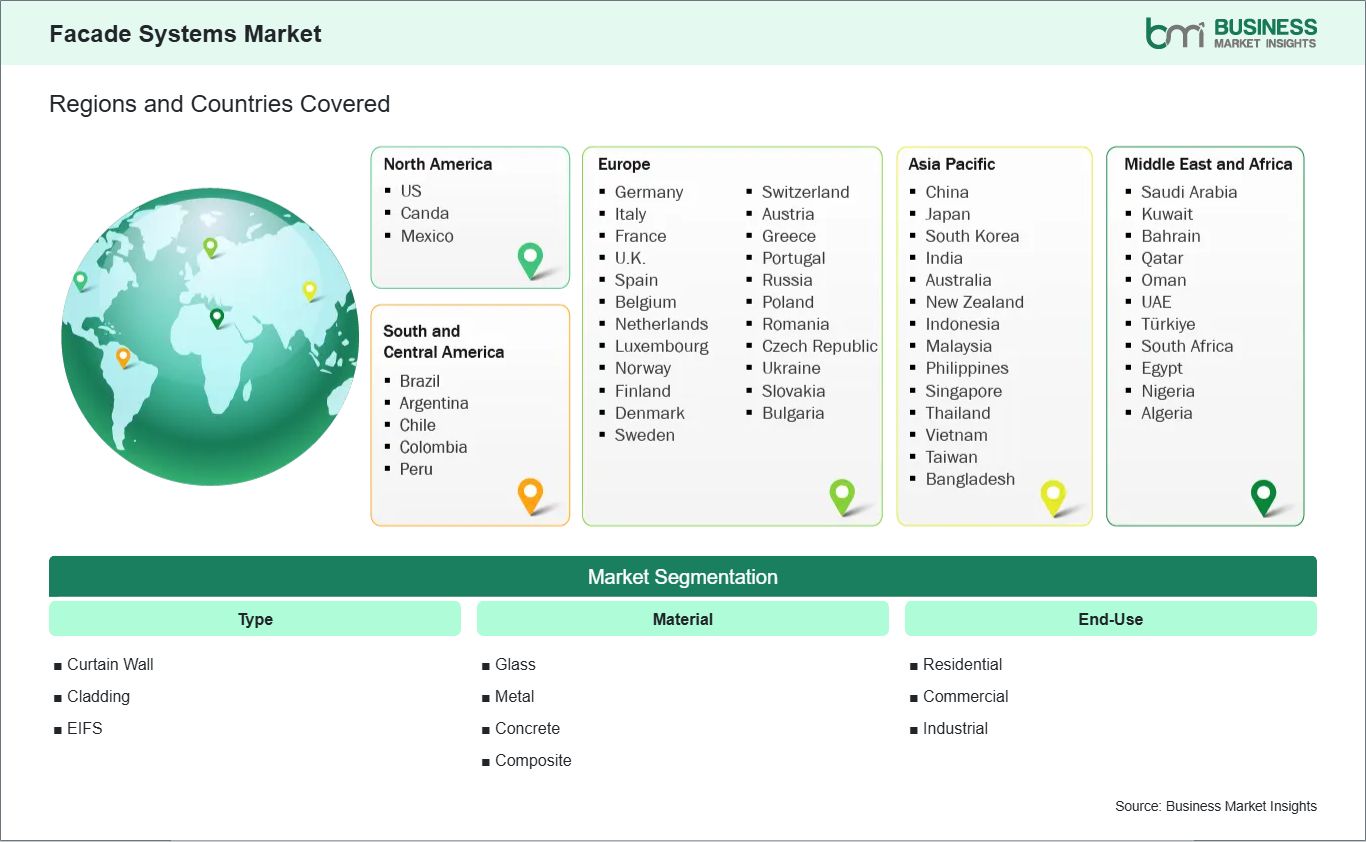
The facade systems market is segmented based on type, material, and end-use, reflecting the increasing focus on building performance, architectural aesthetics, energy efficiency, and sustainable construction practices across modern residential, commercial, and industrial developments.
By Type
- Curtain Wall - Preferred for high-rise buildings requiring extensive glazing and modern architectural designs.
- Cladding - Enhances exterior protection while supporting aesthetic customization across building structures.
- EIFS - Delivers thermal insulation benefits through lightweight and energy-efficient facade applications.
By Material
- Glass - Widely selected for daylight optimization and contemporary building appearance requirements.
- Metal - Provides structural durability and resistance to harsh environmental conditions.
- Concrete - Supports long-term performance with strong protective and load-bearing characteristics.
- Composite - Combines multiple material advantages to improve flexibility and facade efficiency.
By End-Use
- Residential - Supports energy-efficient housing construction and exterior modernization initiatives.
- Commercial - Expands deployment across offices, retail complexes, hospitality, and mixed-use developments.
- Industrial - Addresses durability, safety, and environmental protection requirements in industrial facilities.
Market Forces
Facade Systems Market Drivers and Opportunities
Rising demand for sustainable buildings
Sustainability objectives are reshaping construction specifications across public and private developments. Owners have become more concerned about developing facade systems that have the ability to minimize heat flow in order to promote energy efficiency. With environmental performance becoming a significant factor for procurement, there is greater consideration of advanced facade systems in the early stages of project planning.
The aspect of sustainability in construction impacts on choices of materials, systems, and approaches for the management of assets over time. Façade systems that will be able to boost heat resistance are in line with initiatives aimed at lowering operating costs and reducing the carbon footprint of buildings.
Smart facade systems adoption
Advancements in digital technologies are encouraging the incorporation of intelligent facade capabilities into modern buildings. Technologies such as responsive shade, automated ventilation systems, and monitor functions enabled by sensors increase efficiency and improve the experiences of those using them. They also facilitate adaptive building design that reacts to environmental changes.
Development possibilities could lie in the deeper connection between automation and building management software systems. Increased use of connected systems infrastructure could help increase their adoption rates among business institutions. With increased maturity of intelligent buildings technologies, the smart facade system will likely be able to play its part in building efficiency.
Size and Share Analysis
Facade Systems Market Size and Share Analysis
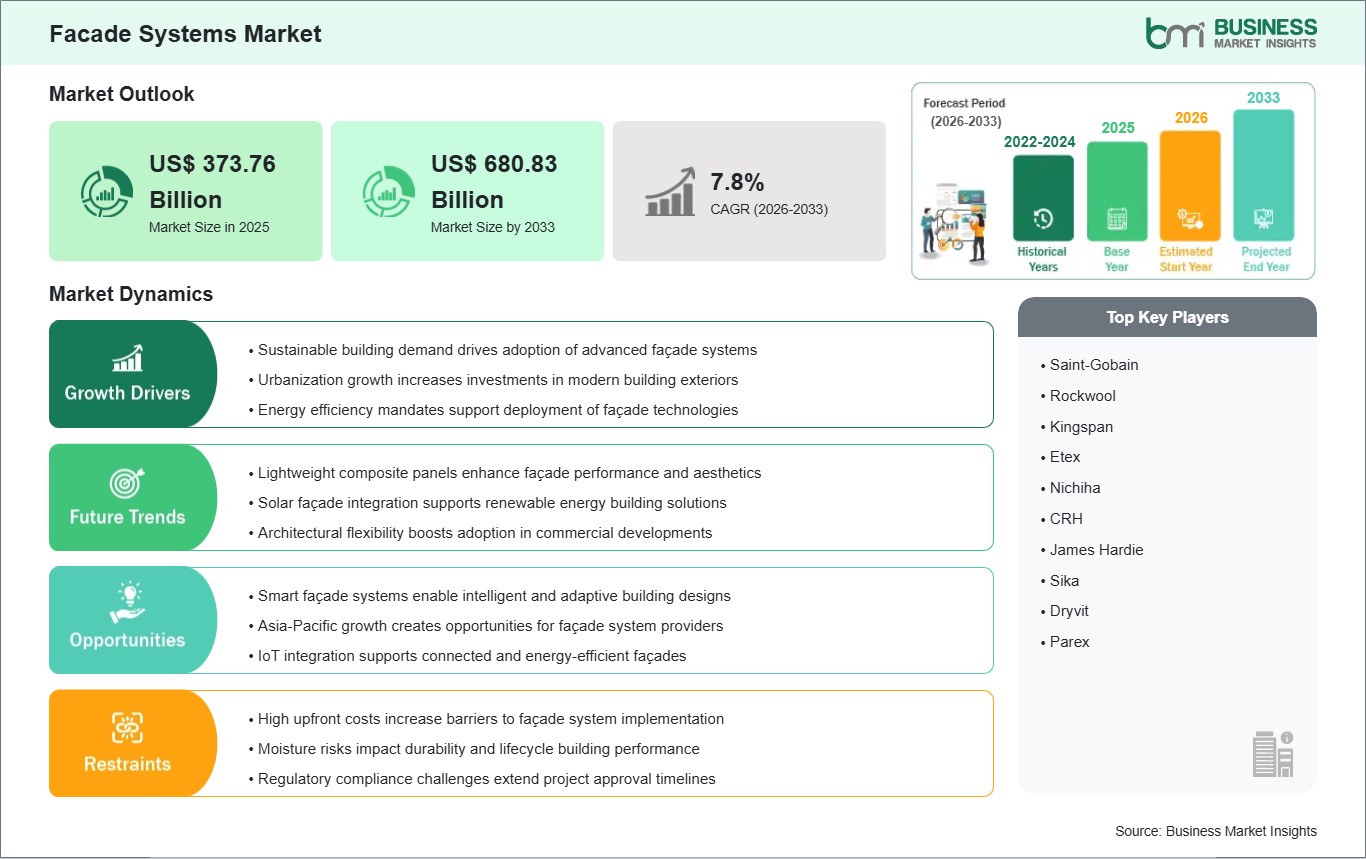
The facade systems market size is expected to reach US$ 680.83 billion by 2033 from US$ 373.76 billion in 2025. The market is estimated to record a CAGR of 7.8% during 2026 to 2033.
Market growth is supported by rising utilization of energy-efficient building designs, increasing focus on sustainable construction materials, and expanding investments in modern commercial and residential infrastructure projects. The adoption of advanced facade technologies is also strengthening demand for high-performance exterior building envelope solutions across global construction markets.
By Type, curtain wall systems account for a dominant share due to their extensive application in high-rise commercial buildings and contemporary architectural projects. Cladding systems maintain a significant presence as they provide enhanced exterior protection, design flexibility, and durability. EIFS continues to gain traction owing to its lightweight structure, insulation benefits, and suitability for energy-conscious construction requirements.
By Material, glass holds a major share supported by its widespread use in modern building designs, daylight optimization, and aesthetic appeal. Metal remains an important segment because of its strength, durability, and adaptability across diverse environmental conditions. Composite materials continue to witness broader acceptance due to their ability to combine performance advantages with design versatility, while concrete maintains relevance in applications requiring robust structural protection.
By End-Use, commercial applications dominate the market owing to continuous development of office buildings, retail centers, hospitality facilities, and mixed-use complexes. Residential applications represent a substantial portion of demand as homeowners and developers prioritize energy efficiency and modern exterior designs. Industrial applications maintain steady expansion where durability, environmental protection, and long-term operational performance remain essential construction considerations.
Report Coverage
Facade Systems Market Report Coverage and Deliverables
The "Facade Systems Market Size and Forecast (2022 - 2033)" report provides a detailed analysis of the market covering below areas:
- Market size and forecast at global, regional, and country levels for all key market segments covered under the scope
- Market trends, along with market dynamics such as drivers, restraints, and key opportunities
- Market analysis covering key trends, global and regional frameworks, major players, regulations, and recent developments
- Industry landscape and competitive analysis covering market concentration, heat map analysis, prominent players, and recent developments
- Detailed company profiles, including SWOT analysis
Geographic Insights
Facade Systems Market Geographic Insights
The facade systems market shows diverse regional adoption patterns influenced by construction priorities, regulatory frameworks, architectural preferences, and sustainability objectives. Across global markets, building owners increasingly evaluate facade solutions through the lens of energy performance, lifecycle value, and environmental compliance. This perspective is shaping procurement strategies and encouraging broader utilization of advanced exterior envelope technologies.
North America demonstrates steady demand supported by commercial redevelopment activities and modernization of existing building stock. Market participants focus on solutions that improve operational efficiency and support compliance with evolving building performance standards. Renovation projects remain particularly important as property owners seek upgrades that enhance both functionality and visual appeal.
Asia Pacific represents a dynamic environment characterized by extensive urban expansion and large-scale infrastructure development. New commercial districts, residential complexes, and mixed-use projects create sustained opportunities for facade installations. The region also exhibits rising interest in technologically advanced systems that align with contemporary architectural trends and long-term sustainability objectives.
Europe maintains a strong emphasis on energy-conscious construction and refurbishment initiatives. Demand frequently centers on facade solutions capable of improving thermal performance while preserving architectural integrity. Meanwhile, emerging markets across the Middle East, Africa, and South and Central America continue to witness expanding construction activity, creating opportunities for innovative facade applications tailored to diverse climatic and structural requirements.
Industry Activity
Recent Developments
The facade systems market is evaluated by gathering qualitative and quantitative data post primary and secondary research, which includes important corporate publications, association data, and databases. Recent developments and news in the market include:
- In June 2026, Oldcastle BuildingEnvelope (OBE) announced the launch of its Reliance-TC SS high-thermal curtain wall system, a screw-spline façade platform designed to meet stricter energy codes with U-factors as low as 0.19, enabling improved thermal performance for modern commercial façade systems while maintaining installation efficiency and flexible glazing configurations.
- In May 2026, SABIC (in coordination with SASO) announced a regulatory approval framework requiring all imported curtain wall and façade systems entering Saudi Arabia to include IoT-enabled energy performance monitoring modules compliant with SASO 2870:2026, marking a major certification shift toward real-time performance verification and digital compliance in façade systems.
Trust & Transparency
Research Methodology
The market analysis combines proprietary research with secondary data from government agencies, company disclosures, regulatory filings, industry databases and expert interviews. Market estimates are validated through data triangulation, cross-market benchmarking and analyst
review.
View Full Research Methodology
Key Sources Referred:
World Green Building Council International Code Council American Society of Heating, Refrigerating and Air-Conditioning Engineers (ASHRAE) National Institute of Building Sciences United Nations Environment Programme International Energy Agency European Commission S. Department of Energy