Market Summary
Executive Summary and Global Market Analysis
Feeding systems are agricultural equipment designed to automate and regulate livestock feed distribution across controlled farming environments. They ensure steady delivery of nutrients to the cattle, chicken, and hogs without increasing dependence on human labor. These feeding systems improve efficiency when implemented in any farm irrespective of its size. Livestock farming is now being done in an organized manner, which calls for more mechanized systems for feeding animals.
There are increased levels of acceptance of these systems as livestock farmers strive for greater efficiency in terms of food utilization. Increased labor scarcity in agricultural settings is prompting farmers to embrace more automated feeding technologies. These types of technologies make it possible to avoid food wastage, and at the same time, ensure that the food is distributed uniformly among different livestock animals. Healthy management practices for livestock are enhancing the significance of these systems among farm managers.
Demand depends on the type of system and use by different livestock industries, which depends on different farm systems and production methods. The adoption of automated systems in larger farms is becoming increasingly popular because of the benefits in scalability and accuracy offered. Self-fed and manual systems continue to be relevant in smaller farms that have not embraced technology much yet. Poultry farming is a major application area owing to high levels of feeding.
Technological advancements are reshaping feeding system capabilities through sensor-based monitoring, programmable dispensing units, and data-driven farm management integration. These innovations improve feed accuracy, reduce operational inefficiencies, and support real-time adjustments in livestock nutrition. Competitive development focuses on system durability, automation efficiency, and adaptability across varied farm sizes. As digital agriculture expands, feeding systems are increasingly integrated into connected farm ecosystems supporting enhanced decision-making and operational transparency.
Segment Analysis
Feeding System Market Segmentation
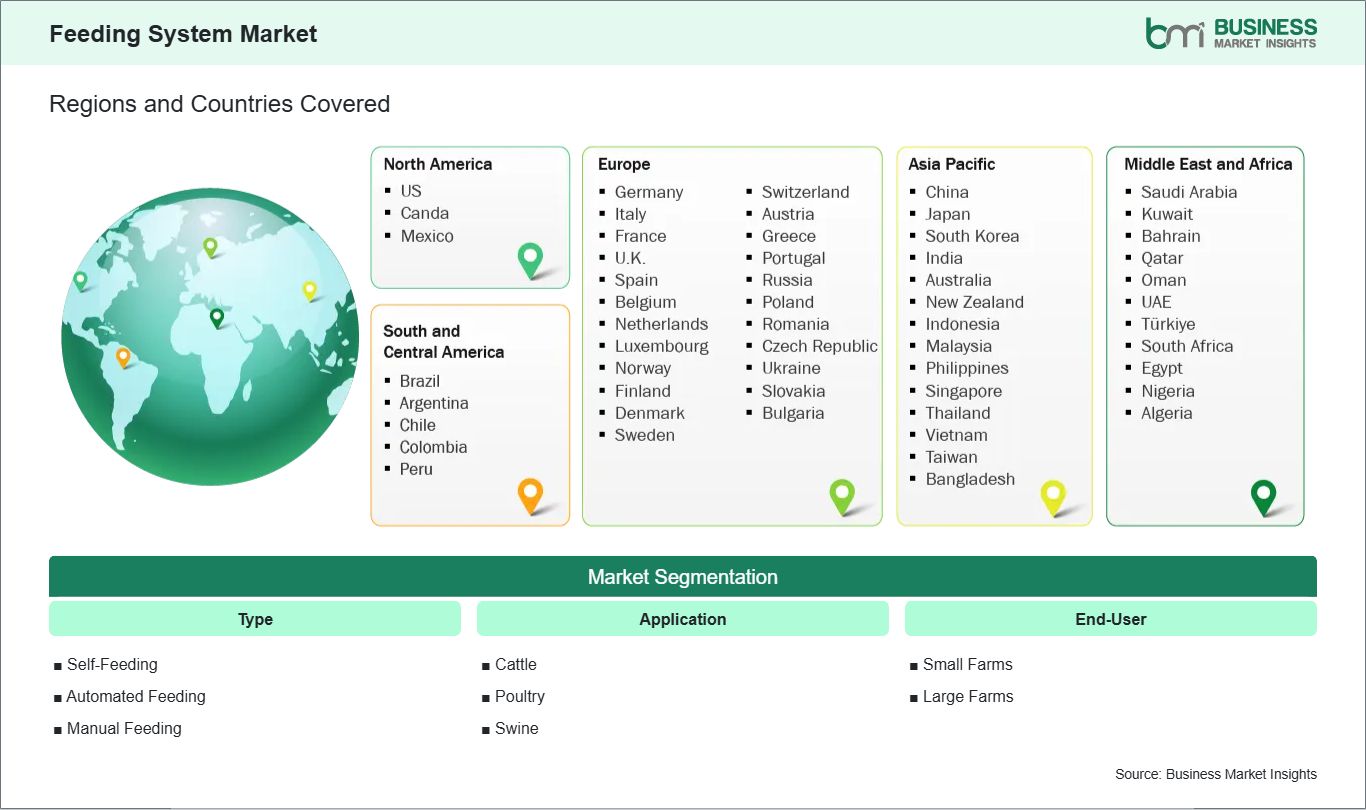
The feeding system market is segmented based on type, application, and end-user, reflecting the increasing adoption of mechanized livestock feeding solutions, improved farm productivity requirements, and growing emphasis on efficient animal nutrition management across diverse agricultural operations.
By Type
- Self-Feeding - Enables autonomous feed access for livestock with reduced human intervention requirements.
- Automated Feeding - Delivers programmed and controlled feed distribution for improved efficiency and accuracy.
- Manual Feeding - Relies on traditional human-operated feeding practices across smaller farming setups.
By Application
- Cattle - Supports structured feeding systems for dairy and beef productivity enhancement.
- Poultry - Enables high-frequency feed delivery aligned with intensive production cycles.
- Swine - Ensures controlled nutrition management for balanced growth and performance efficiency.
By End-Use
- Small Farms - Utilizes basic feeding systems for cost-effective livestock management operations.
- Large Farms - Implements advanced automated systems to support high-volume feed distribution and operational scalability.
Market Forces
Feeding System Market Drivers and Opportunities
Rising demand for automation
Livestock farming operations are increasingly shifting toward automated feeding solutions to improve efficiency and reduce dependency on manual labor. The growing operational complexity on the farms has led to the emergence of such systems as those that guarantee effective delivery of feed and reduce wastage. Automated feed delivery systems help achieve consistent nutritional delivery, which improves animal growth performance. This has been observed mostly in commercial farming operations that focus on efficiency.
The use of automation is revolutionizing livestock management through increased accuracy in feeding animals and reduced wastage of resources. Mechanization of agricultural activities is being embraced by farmers to help them gain more control over the timing and quantities of feed given to their livestock. This trend is bound to result in positive health impacts on animals as well as predictable cycles of production.
Smart agriculture adoption
Digital transformation in agriculture is enabling integration of feeding systems with smart monitoring and data analytics platforms. With the help of this technology, there is a possibility of tracking feed consumption and animal behavior at any time. The smart feed technology ensures optimum use of resources according to the needs of the animal.
More expansion will come in the future as smart agriculture becomes cheaper and more available in different farming conditions. With better compatibility with IoT technology and better farm management applications, scalability and responsiveness will increase. This will encourage the adoption of the technologies in large-scale agriculture. With increasing precision agriculture technologies, it seems inevitable for smart feeders to be an integral part of livestock management systems.
Size and Share Analysis
Feeding System Market Size and Share Analysis
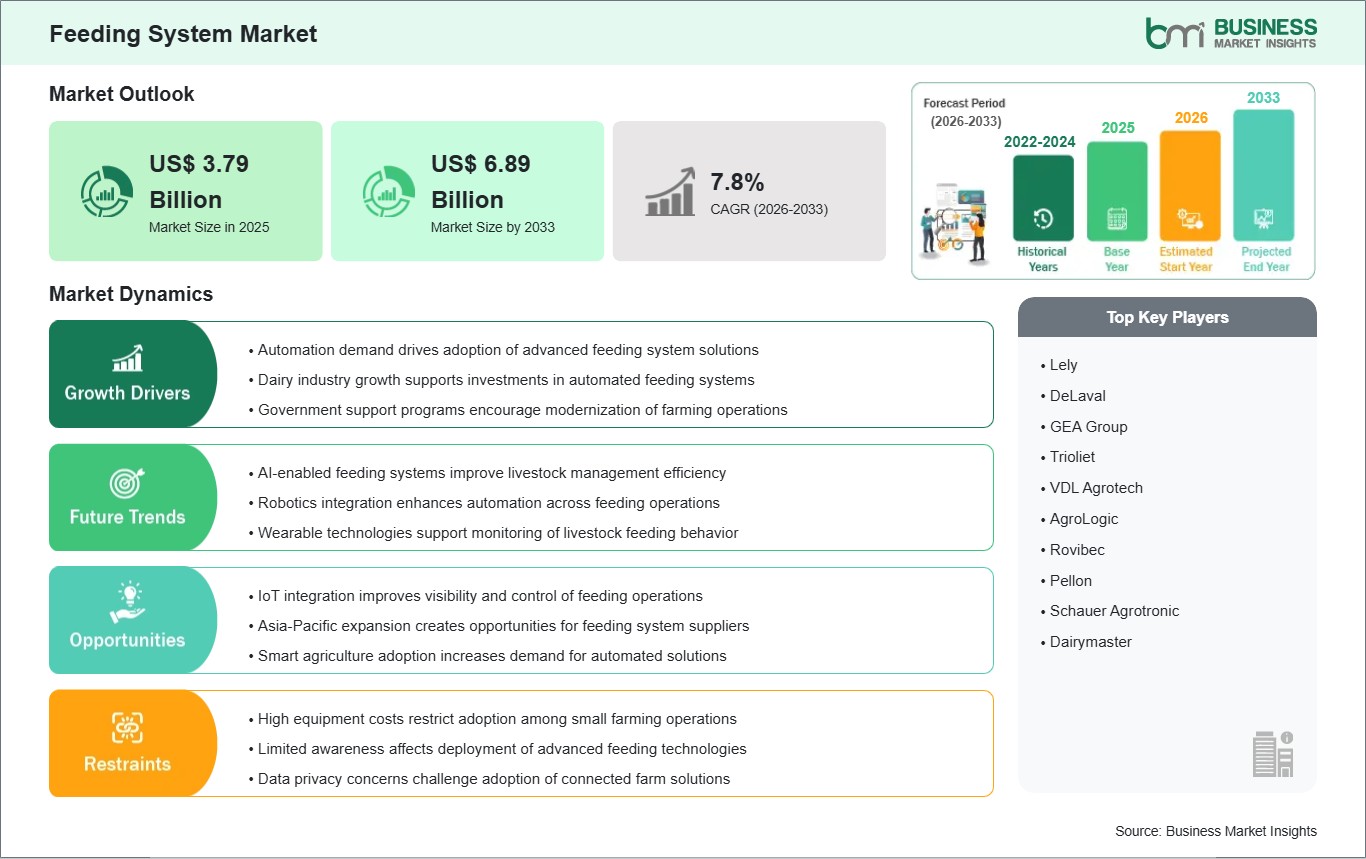
The feeding system market size is expected to reach US$ 6.89 billion by 2033 from US$ 3.79 billion in 2025. The market is estimated to record a CAGR of 7.8% during 2026 to 2033.
Market expansion is supported by increasing mechanization in livestock farming, rising focus on feed efficiency optimization, and growing adoption of automated agricultural equipment across commercial farming operations worldwide. Continuous improvements in livestock productivity management are further strengthening system deployment across diverse farming environments.
By Type, automated feeding systems account for a dominant share due to their ability to deliver precise feed distribution and reduce labor dependency in large-scale farming operations. Self-feeding systems maintain a notable position as they offer simplified feeding mechanisms suitable for semi-intensive livestock management. Manual feeding systems continue to serve small-scale farms where infrastructure limitations restrict automation adoption.
By Application, poultry represents a major share supported by high feed frequency requirements and intensive production cycles demanding consistent nutritional delivery. Cattle farming follows with steady demand driven by structured dairy and beef production systems. Swine applications continue to expand as controlled feeding practices enhance growth efficiency and herd management outcomes across commercial livestock operations.
By End-Use, large farms dominate the market due to their ability to invest in advanced automated feeding technologies that improve scalability and operational efficiency. Small farms maintain consistent participation through cost-effective feeding solutions tailored to limited operational budgets. The shift toward commercialized livestock farming continues to reinforce demand for efficient, technology-driven feeding systems across global agricultural markets.
Report Coverage
Feeding System Market Report Coverage and Deliverables
The "Feeding System Market Size and Forecast (2022 - 2033)" report provides a detailed analysis of the market covering below areas:
- Market size and forecast at global, regional, and country levels for all key market segments covered under the scope
- Market trends, along with market dynamics such as drivers, restraints, and key opportunities
- Market analysis covering key trends, global and regional frameworks, major players, regulations, and recent developments
- Industry landscape and competitive analysis covering market concentration, heat map analysis, prominent players, and recent developments
- Detailed company profiles, including SWOT analysis
Geographic Insights
Feeding System Market Geographic Insights
The Feeding System Market shows diverse regional adoption patterns influenced by agricultural modernization, livestock density variations, technological readiness, and farm mechanization trends. Across global regions, feeding practices are gradually transitioning from manual approaches toward automated and data-supported systems. This shift reflects increasing emphasis on productivity optimization and operational efficiency in livestock management environments.
North America demonstrates strong adoption supported by large-scale commercial farming operations and advanced agricultural infrastructure. Farmers in this region increasingly implement automated feeding systems to enhance efficiency and reduce labor dependency. Integration of precision agriculture tools further strengthens adoption across cattle and poultry farming segments, where consistent feed management is essential for productivity outcomes.
Asia Pacific presents significant expansion potential due to high livestock populations and growing demand for efficient food production systems. Small and large farms are gradually adopting mechanized feeding solutions to improve output consistency. Rising awareness of livestock productivity enhancement and increasing investment in agricultural modernization are contributing to broader technology penetration across the region.
Europe shows steady adoption driven by structured livestock management practices and regulatory emphasis on efficiency and sustainability. Emerging markets across Latin America, the Middle East, and Africa are gradually adopting feeding systems as agricultural mechanization expands. Infrastructure development and growing commercial farming activities are supporting gradual integration of automated and semi-automated feeding technologies across diverse farming environments.
Industry Activity
Recent Developments
The feeding system market is evaluated by gathering qualitative and quantitative data post primary and secondary research, which includes important corporate publications, association data, and databases. Recent developments and news in the market include:
- In January 2026, AGI (Ag Growth International) announced the U.S. launch of its FLEXMill™ feed processing system, a modular feeding solution designed for on-farm and commercial feed production. The system integrates grinding, batching, and micro-dosing functions in a compact footprint, enabling scalable and efficient feed manufacturing with minimal infrastructure changes.
- In July 2025, Roxell announced the launch of its upgraded iQon Multifast batch feeding system, a smart-controlled feeding solution for pig production facilities. The system integrates digital iQon control technology to improve feed precision, automation, and flexibility in livestock feeding operations.
Trust & Transparency
Research Methodology
The market analysis combines proprietary research with secondary data from government agencies, company disclosures, regulatory filings, industry databases and expert interviews. Market estimates are validated through data triangulation, cross-market benchmarking and analyst
review.
View Full Research Methodology
Key Sources Referred:
Food and Agriculture Organization (FAO) United States Department of Agriculture (USDA) European Food Safety Authority (EFSA) International Food Policy Research Institute (IFPRI) OECD Agricultural Reports Journal of Agricultural Engineering Research World Bank Agriculture and Rural Development Data National livestock and farming statistics agencies