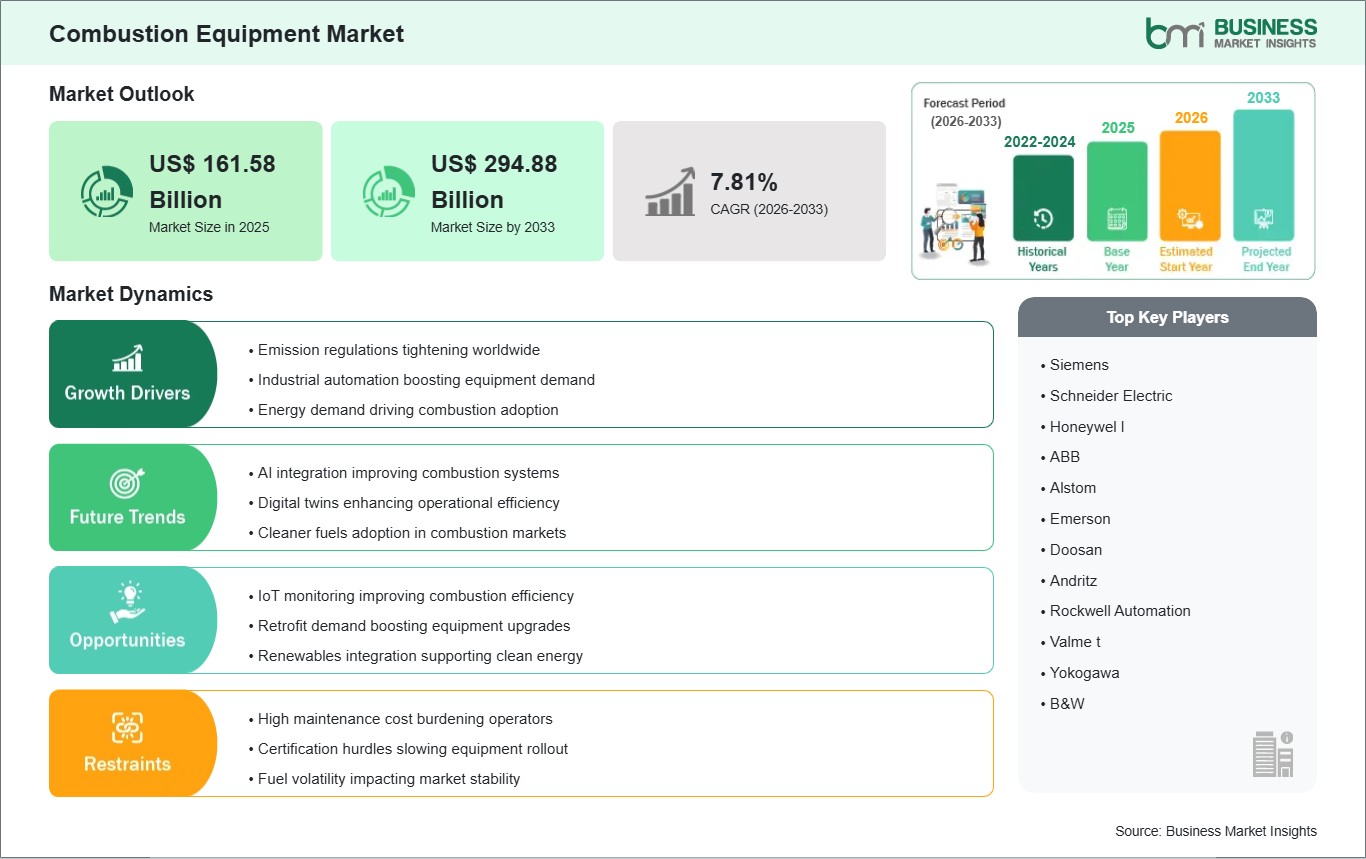
The Combustion Equipment Market size is expected to reach US$ 294.88 Billion by 2033 from US$ 161.58 Billion in 2025.The market is estimated to record a CAGR of 7.81% from 2026 to 2033.
Combustion equipment market involves industrial and commercial equipment that is used in the process of producing energy via the combustion of fuel like natural gas, oil, coal, or other alternative fuels. Combustion equipment consists of various types of equipment including burners, boilers, furnaces, incinerators, and industrial heaters that are utilized in industries related to power production, chemicals, metals and mining, food industry, cement industry, and manufacturing among others.
On a global scale, this market remains important as far as the energy sector is concerned since combustion is still the main process that produces heat. Honeywell International Inc. in 2024, the firm has developed industrial burners and combustion control systems to increase fuel efficiency and decrease emission rates for large-scale manufacturers and businesses.
The sectors such as cement and steel use combustion heaters extensively due to their extremely high temperatures which cannot be met through alternative means at the moment. Nevertheless, the industry is experiencing tough times with regard to stringent carbon emission laws, expensive fuels, and increased efforts towards decarbonizing industrial heating. This market is developing in the face of two simultaneous challenges, which are industrialization and environmental regulations.
On the one hand, increased production, construction of infrastructure in cities, and increasing consumption of energy ensure the necessity of large thermal power plants. On the other hand, tough emission standards force companies to install more effective and eco-friendly combustion equipment, such as low-NOx burners, automatic control units, waste heat recovery units, and hybrid systems with both combustion and renewable sources of energy. Besides, modernization and automation ensure improved combustion, decreased energy consumption, and proactive preventive maintenance.

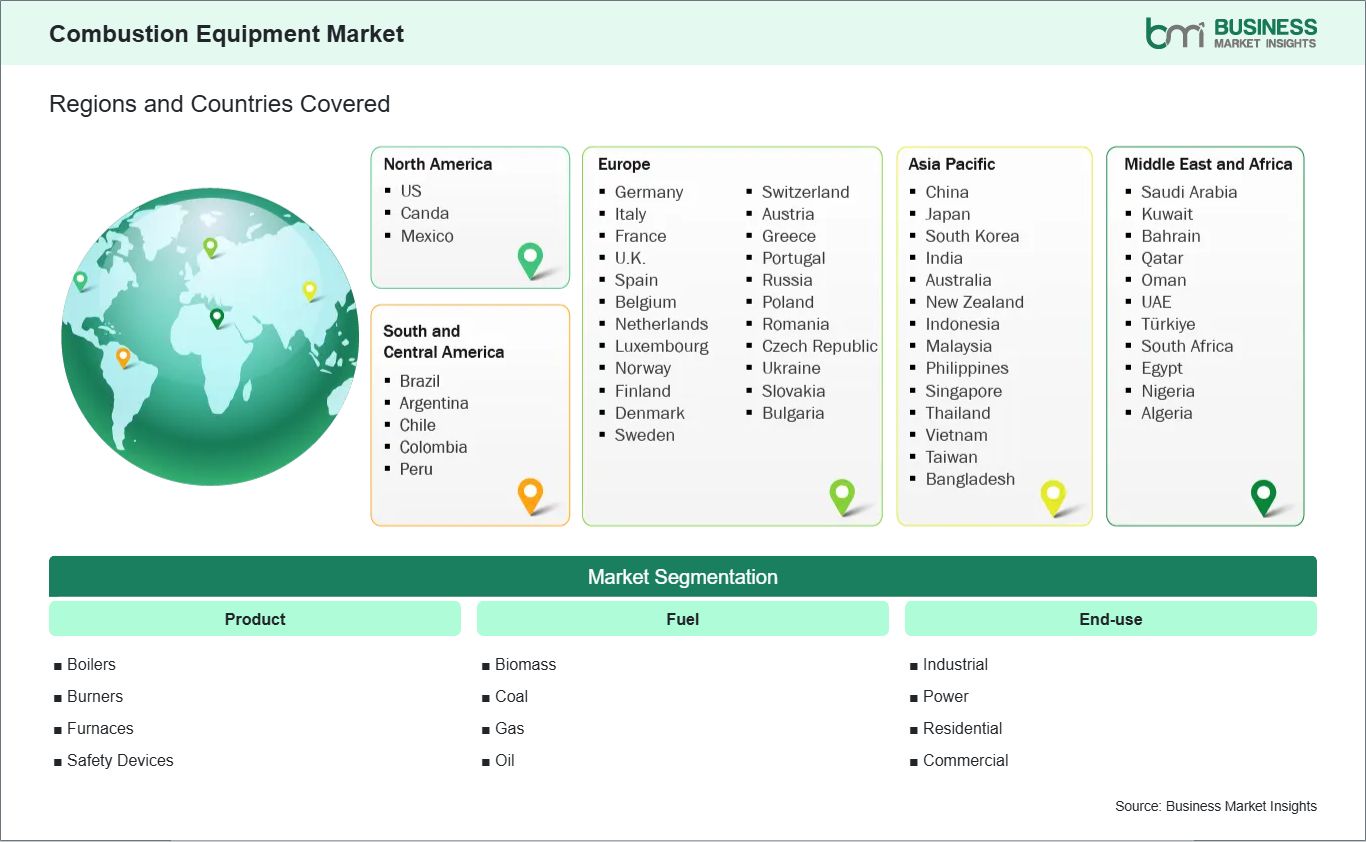
The combustion equipment market is segmented based on product, fuel, and end-use, reflecting the rising demand for efficient heat generation systems, improved energy efficiency, and stricter emission control regulations across multiple industries.
The global market for combustion equipment is witnessing strong growth driven by the need for high-efficiency propulsion and heating devices within the military modernization efforts. In today's world, military vehicles, including land and naval military craft as well as aerial equipment, rely on the use of advanced combustion equipment for efficient propulsion, auxiliary power supplies, and thermal energy management. With the ongoing modernization process, there is an increasing need for efficient combustion equipment that can function in extreme combat environments.
The other factor influencing the market growth is modernizing the fleets of both naval and land forces where engines using combustion technology form the basis for operations. Although some advancements are being witnessed where there is electrification of specific equipment, the bulk of the modern fleets continues to run on advanced diesel or gas turbine engines owing to their superior energy efficiency and reliability. Advancements in this area are geared toward increasing fuel efficiency, lowering thermal signature, and extending operating ranges.
Advancements in the field of combustion engine technologies have been driving the adoption rate among defense organizations as the next-generation combustion engines can easily work with advanced digital controls and predictive maintenance systems. It has been observed that defense bodies are upgrading their fleets with such advanced combustion engines to ensure higher operability and battlefield logistics.
A modular design of combustion equipment has been identified as providing new avenues within the international market due to their versatility, scalability, and adaptability to mission. In contemporary platforms of the military and industry, there is a need for combustion equipment that can be tailored for different levels of output and fuel types without redesigning the whole system.
In military applications, there has been a move towards using modular combustion equipment in vehicles, portable generators, and marine equipment where mission demands are often dynamic. For instance, portable energy generators and auxiliary combustion modules can be readily exchanged or updated in response to changes in operational complexity or environmental conditions. This means that even as military operations adopt modularity in their systems, they do not have to sacrifice versatility and adaptability during their operations.
Industries like manufacturing and aerospace are also playing a role in promoting the use of modular combustion equipment. This involves designing modular turbines and engines that accommodate plug-and-play modules for burners, fuel injectors, and control modules among other parts. As manufacturers continue to place emphasis on modularity and ease of upgradeability of systems, it is expected that modular combustion equipment will continue to dominate design trends.
The Combustion Equipment Market is projected to grow from US$ 161.58 Billion in 2025 to US$ 294.88 Billion by 2033 , registering a CAGR of 7.81% from 2026 to 2033.
By Product, boilers dominate the market due to their widespread use in steam generation, heating applications, and power production across industrial and utility sectors. Their high efficiency, operational reliability, and ability to support large-scale continuous processes make them the most widely deployed combustion equipment globally.
By Fuel, gas dominates the market owing to its higher efficiency, lower emissions compared to coal and oil, and strong availability through expanding gas distribution networks. Increasing regulatory pressure to reduce carbon emissions further accelerates the shift toward gas-based combustion systems.
By End-use, the industrial sector dominates the market as combustion equipment is extensively used in manufacturing, processing, and refining operations requiring consistent high-temperature heat and steam generation. Growth in heavy industries and energy-intensive production further reinforces its leading position.
| Report Attribute | Details |
|---|---|
| Market size in 2025 | US$ 161.58 Billion |
| Market Size by 2033 | US$ 294.88 Billion |
| Global CAGR (2026 - 2033) | 7.81% |
| Historical Data | 2022-2024 |
| Forecast period | 2026-2033 |
| Segments Covered | By Product
|
|
Regions and Countries Covered
| |
| North America | US, Canada, Mexico |
| Europe | Germany, Italy, France, U.K., Spain, Belgium, Netherlands, Luxembourg, Norway, Finland, Denmark, Sweden, Switzerland, Austria, Greece, Portugal, Russia, Poland, Romania, Czech Republic, Ukraine, Slovakia, Bulgaria |
| Asia-Pacific | China, Japan, South Korea, India, Australia, New Zealand, Indonesia, Malaysia, Philippines, Singapore, Thailand, Vietnam, Taiwan, Bangladesh |
| South and Central America | Brazil, Argentina, Chile, Colombia, Peru |
| Middle East and Africa | Saudi Arabia, United Arab Emirates, Kuwait, Bahrain, Qatar, Oman, Turkiye, South Africa, Egypt, Nigeria, Algeria |
| Market leaders and key company profiles |
|
The "Combustion Equipment Market Size and Forecast (2022 and 2033)" report provides a detailed analysis of the market covering below areas:
The combustion equipment industry is witnessing significant growth owing to higher energy requirements in industries, increasing importance for efficient heat generation systems, and increased attention toward reduced fuel usage and emissions. Various industries that require boilers, furnaces, kilns, incinerators, and other industrial heaters include electricity production, oil and gas, chemicals, metals, cement, and food processing, among others. This sector is also influenced by the adoption of improved combustion techniques and the use of sophisticated control systems for higher efficiency levels and minimal environmental impact.
North America is mainly influenced by the robust industrial infrastructural network, modernization of old energy networks, and stringent emission norms. Modern industries in this region are progressively using low NOX burners, highly efficient boilers, and digital control systems in their combustion systems, so as to ensure compliance with environmental rules. Meanwhile, the power generation plants and oil and gas sectors remain important end users, upgrading existing systems to increase fuel efficiencies and cut down emissions of green-house gases.
Asia-Pacific countries have witnessed strong growth due to the quick process of industrialization and high energy demands. Countries like China, India, Japan, and South Korea have made massive investments in power plants, cement production plants, steel plants, and chemical processing units that require a lot of combustion equipment. In addition, there are increasing cases of adopting energy efficient and automated combustion systems for large scale industrial processes.
The combustion equipment industry is being propelled by industrial growth, improvements in efficiency, and compliance with environmental regulations, with North America concentrating on modernization and emissions control and Asia-Pacific leading in terms of capacity enhancement and industrial deployment.

The combustion equipment market is evaluated by gathering qualitative and quantitative data post primary and secondary research, which includes important corporate publications, association data, and databases. A few of the key developments in the combustion equipment market are:
The Combustion Equipment Market is valued at US$ 161.58 Billion in 2025, it is projected to reach US$ 294.88 Billion by 2033.
As per our report Combustion Equipment Market, the market size is valued at US$ 161.58 Billion in 2025, projecting it to reach US$ 294.88 Billion by 2033. This translates to a CAGR of approximately 7.81% during the forecast period.
The Combustion Equipment Market report typically cover these key segments-
The historic period, base year, and forecast period can vary slightly depending on the specific market research report. However, for the Combustion Equipment Market report:
The Combustion Equipment Market is populated by several key players, each contributing to its growth and innovation. Some of the major players include:
The Combustion Equipment Market report is valuable for diverse stakeholders, including:
Essentially, anyone involved in or considering involvement in the Combustion Equipment Market value chain can benefit from the information contained in a comprehensive market report.
Please tell us your area of interest
(Market Segments/ Regions and Countries/ Companies)