
Agricultural Sprayer Market Outlook: Size, Share, Trends, Growth Analysis, Competitive Landscape & Forecast, 2026-2033

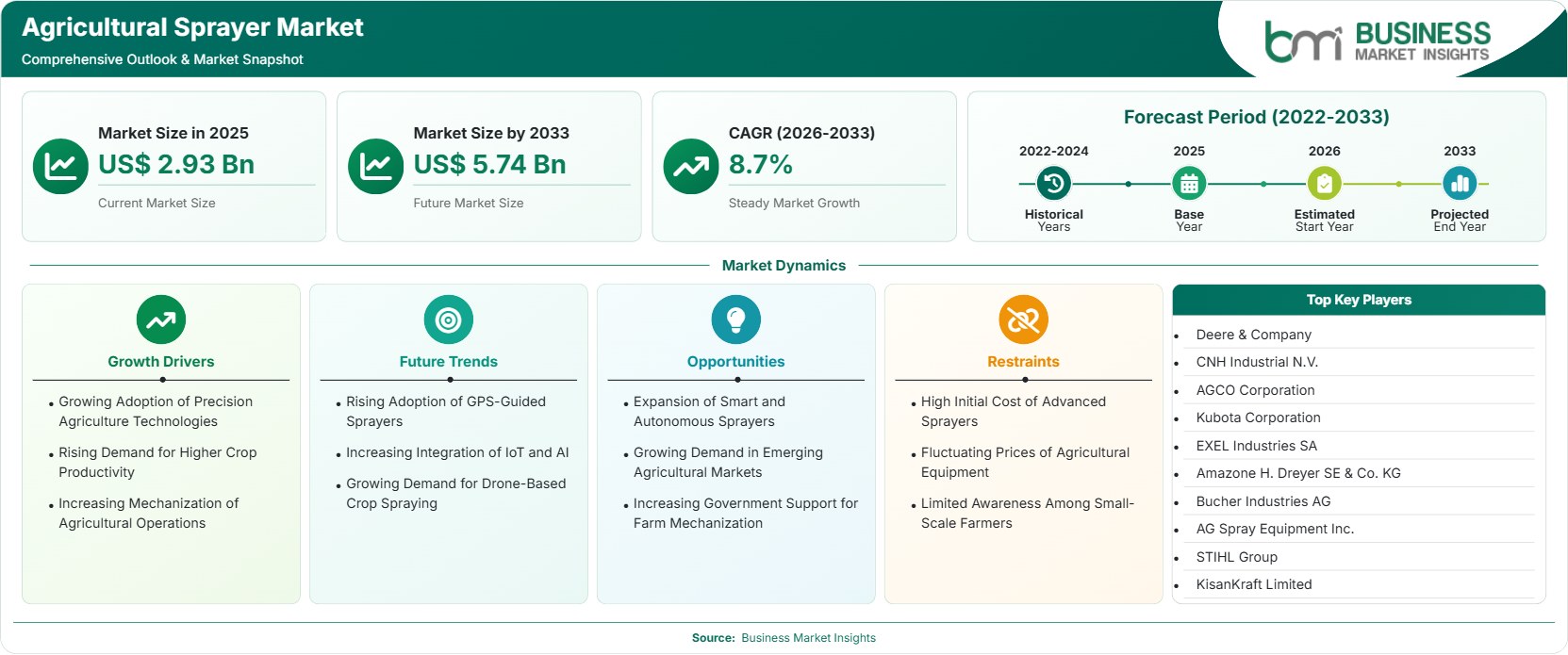
The Agricultural Sprayer Market size was valued at US$ 2.93 Billion in 2025 and is projected to reach US$ 5.74 Billion by 2033, growing at a CAGR of 8.7% during 2026–2033. Market growth is supported by rising adoption of precision agriculture technologies, increasing farm mechanization, and growing demand for higher crop productivity, while smart autonomous spraying systems and government-backed farm modernization programs continue creating new investment opportunities.

Report Coverage
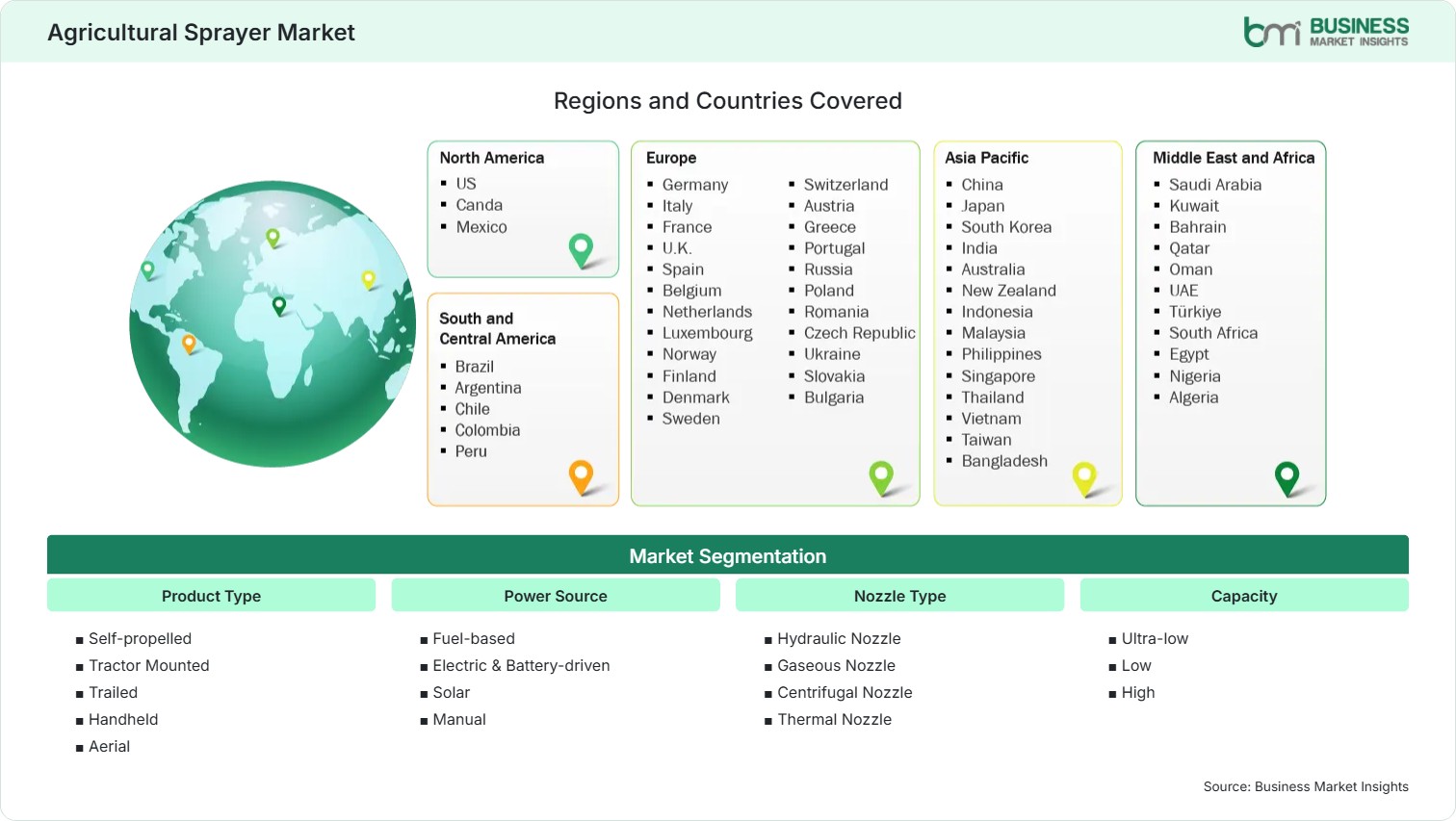
  • Product Type: Self-propelled, Tractor Mounted, Trailed, Handheld, and Aerial
  • Power Source: Fuel-based, Electric & Battery-driven, Solar, Manual
  • Nozzle Type: Hydraulic Nozzle, Gaseous Nozzle, Centrifugal Nozzle, Thermal Nozzle
  • Capacity: Ultra-low, Low, High
  • Usage: Field Sprayers, Orchards Sprayers, Garden Sprayers
US$ 2.93 Bn Market size in 2025
US$ 5.74 Bn Market Size by 2033
8.7% CAGR, 2026 - 2033
2026-2033 Forecast Period

AI Overview

Agricultural Sprayer Market Summary

  • North America Region: North America accounts for 34%–36% of the market in 2025 and is projected to grow at a CAGR of 8.2%–8.6% during 2026–2033. High mechanization levels, precision farming adoption, and strong investments in smart agricultural equipment continue to support regional demand. The United States represents 27%–29% of global revenue and is anticipated to register a CAGR of 8.1%–8.5% throughout the forecast period.
  • Fastest Growing Region: Asia Pacific holds 28%–30% of market revenue in 2025 and is expected to expand at a CAGR of 9.6%–10.1% during 2026–2033. Expanding agricultural mechanization, government subsidies, and increasing food production requirements continue accelerating equipment adoption.
  • Leading Segment: Tractor Mounted Sprayers account for 31%–34% of market revenue in 2025 and are projected to grow at a CAGR of 8.8%–9.2% through 2033. Their versatility, cost efficiency, and compatibility with medium and large farms continue supporting widespread deployment.
  • High Growth Segment: Electric & Battery-driven Sprayers represent 21%–24% of market revenue in 2025 and are forecast to register a CAGR of 10.4%–10.9% during the forecast period. Increasing sustainability initiatives and advances in battery technology continue driving adoption.
  • Key Market Opportunity: Smart autonomous spraying systems integrated with GPS guidance, artificial intelligence, variable-rate application, and precision farming technologies are creating attractive opportunities for manufacturers and technology providers.
  • Major Market Players: Deere & Company, CNH Industrial N.V., AGCO Corporation, Kubota Corporation, EXEL Industries SA, Amazone H. Dreyer SE & Co. KG, Bucher Industries AG, AG Spray Equipment Inc., STIHL Group, and KisanKraft Limited.
Strategic Insights

Agricultural Sprayer Market: Strategic Insights

Agricultural Sprayer Market Strategic Framework
FREE PDF
Request your free sample
Request free sample
Stakeholder View

Key Takeaways

  • Agricultural equipment manufacturers are increasingly integrating precision farming technologies, digital monitoring systems, and automation into spraying equipment to improve productivity and operational efficiency.
  • Smart spraying technologies, autonomous field operations, and battery-powered equipment represent the strongest long-term growth opportunities across global agricultural markets.
  • Product innovation is focused on AI-assisted spraying, GPS-guided navigation, variable-rate chemical application, telematics, and environmentally sustainable spraying technologies.
  • Asia Pacific presents the most attractive investment opportunity due to expanding mechanization programs, rising agricultural production, and increasing government financial support for farm modernization.
  • Strategic partnerships between agricultural machinery manufacturers, digital agriculture companies, and precision farming technology providers continue accelerating innovation and market expansion.
  • Companies investing in autonomous machinery, precision application systems, and energy-efficient spraying technologies are expected to strengthen their competitive positions over the forecast period.
Geographic Outlook

Agricultural Sprayer Market Regional Highlights

North America Agricultural Sprayer Market

North America accounted for 34%–36% of the Agricultural Sprayer Market share in 2025 and is projected to grow at a CAGR of 8.2%–8.6% during 2026–2033. High agricultural mechanization, precision farming adoption, and strong demand for technologically advanced spraying equipment continue supporting regional leadership. Increasing investments in digital agriculture further strengthen long-term market expansion.

  • Precision agriculture technologies continue driving replacement of conventional sprayers with GPS-enabled and variable-rate application equipment across commercial farming operations.
  • Large-scale crop production and increasing labor shortages encourage adoption of automated spraying systems capable of improving operational efficiency.
  • Farmers continue investing in connected agricultural machinery integrated with telematics, remote diagnostics, and data-driven crop management platforms.
  • Sustainability initiatives are accelerating demand for precision chemical application systems that reduce pesticide consumption and environmental impact.

US Agricultural Sprayer Market

The United States represented 27%–29% of global market revenue in 2025 and is projected to register a CAGR of 8.1%–8.5% during the forecast period. Growing precision agriculture adoption, advanced farm equipment utilization, and increasing commercial farming operations continue supporting market growth.

  • Commercial farms increasingly deploy autonomous guidance and precision spraying technologies to optimize chemical application efficiency.
  • Rising investments in digital agriculture platforms continue improving equipment connectivity and field operation management.
  • Equipment manufacturers are introducing AI-enabled spraying solutions designed to enhance productivity while minimizing operating costs.
  • Demand for electric and battery-powered sprayers continues increasing among specialty crop producers and greenhouse operators.

Europe Agricultural Sprayer Market

Europe accounted for 24%–26% of global revenue in 2025 and is expected to expand at a CAGR of 8.4%–8.8% during the forecast period. Sustainable farming regulations, precision agriculture initiatives, and modernization of agricultural equipment continue driving regional demand. Germany leads the regional market, while Poland records the fastest growth.

  • Environmental regulations continue encouraging adoption of precision spraying systems that reduce pesticide drift and chemical consumption.
  • Germany maintains regional leadership through advanced agricultural machinery manufacturing and strong technology adoption.
  • Poland continues witnessing rapid mechanization supported by agricultural modernization initiatives and expanding commercial farming.
  • Digital farm management systems increasingly integrate with spraying equipment to improve operational efficiency and regulatory compliance.

Asia Pacific Agricultural Sprayer Market

Asia Pacific represented 28%–30% of global market revenue in 2025 and is projected to expand at a CAGR of 9.6%–10.1% through 2033, making it the fastest-growing regional market. Rising food demand, expanding mechanization, and government-supported agricultural modernization continue supporting strong equipment demand.

  • China remains the largest regional market owing to large-scale agricultural production and continued investment in farm mechanization.
  • India is projected to achieve the fastest regional growth due to increasing government support for agricultural equipment adoption.
  • Japan continues investing in precision agriculture technologies addressing labor shortages and operational efficiency.
  • Australia is witnessing increasing deployment of high-capacity spraying equipment across large commercial farms.
  • Precision farming technologies continue expanding across Southeast Asia to improve agricultural productivity and resource utilization.

Rest of World Agricultural Sprayer Market

The Rest of the World accounted for 12%–14% of global revenue in 2025 and is projected to grow at a CAGR of 8.9%–9.3% during 2026–2033.

South & Central America continue expanding commercial farming activities, while the Middle East & Africa increasingly invest in agricultural modernization, irrigation efficiency, and mechanized crop production to improve food security and farming productivity.

  • Brazil leads regional demand through expanding soybean, corn, and sugarcane cultivation supported by mechanized farming.
  • Argentina continues increasing adoption of precision spraying equipment across commercial agricultural operations.
  • Saudi Arabia is investing in modern farming technologies supporting sustainable agricultural development.
  • South Africa continues expanding mechanized farming through increasing adoption of efficient crop protection equipment.
  • Government incentives across emerging economies continue improving access to modern agricultural machinery.
Global Market Geography
FREE PDF
Request your free sample
Request free sample
Segment Analysis

Agricultural Sprayer Market Segmentation

Product Type

The Product Type segment forms the core of the market as farmers increasingly adopt equipment tailored to farm size, crop type, and operational efficiency. The segment accounted for 100% of the market and is projected to grow at a CAGR of 8.7% during 2026–2033. Expanding precision agriculture adoption and farm mechanization continue broadening the agricultural sprayer market scope, encouraging manufacturers to develop highly efficient, automated, and application-specific spraying solutions.

  • Self-propelled: Self-propelled sprayers are increasingly adopted by large commercial farms due to high field capacity, superior maneuverability, advanced automation, and compatibility with precision agriculture technologies, enabling efficient large-scale crop protection.
  • Tractor Mounted: Tractor-mounted sprayers remain the most widely adopted equipment because of their affordability, operational flexibility, and compatibility with existing farm tractors across medium and large agricultural operations.
  • Trailed: Trailed sprayers offer higher tank capacities and wider boom widths, making them suitable for extensive farming operations requiring efficient pesticide, herbicide, and fertilizer application over large cultivation areas.
  • Handheld: Handheld sprayers continue serving small farms, horticulture, nurseries, and localized crop protection applications where affordability, portability, and ease of operation remain important purchasing factors.
  • Aerial: Aerial spraying platforms, including agricultural drones and aircraft, are gaining popularity for rapid crop treatment, precision chemical application, and access to difficult terrain while reducing labor requirements.

Power Source

The Power Source segment is evolving as sustainability objectives and energy-efficient farming technologies gain importance. Manufacturers are increasingly introducing alternative propulsion systems that reduce emissions, improve operational efficiency, and lower maintenance requirements while supporting precision agriculture practices.

  • Fuel-based: Fuel-powered sprayers continue dominating commercial farming because they provide high operating capacity, extended working hours, and reliable performance across large agricultural fields requiring intensive spraying operations.
  • Electric & Battery-driven: Electric and battery-powered sprayers are experiencing rapid adoption owing to lower operating costs, reduced emissions, quieter operation, and improvements in battery technology supporting extended field productivity.
  • Solar: Solar-powered sprayers are attracting increasing interest among small-scale farmers seeking environmentally sustainable and cost-effective crop protection solutions, particularly in regions with abundant solar resources.
  • Manual: Manual sprayers remain widely utilized by smallholder farmers due to their affordability, simple operation, and suitability for small agricultural plots, gardens, and horticultural applications.

Nozzle Type

Nozzle technology plays a critical role in determining spray quality, droplet size, chemical distribution, and overall application efficiency. Continuous innovation is improving precision spraying while minimizing chemical drift and environmental impact.

  • Hydraulic Nozzle: Hydraulic nozzles remain the most commonly used because they provide consistent spray distribution, versatile application capabilities, and compatibility with a broad range of agricultural spraying equipment.
  • Gaseous Nozzle: Gaseous nozzles are applied in specialized agricultural operations requiring controlled atomization and efficient chemical dispersion under specific crop protection conditions.
  • Centrifugal Nozzle: Centrifugal nozzles enable uniform droplet formation and reduced pesticide wastage, making them suitable for precision agriculture and controlled application technologies.
  • Thermal Nozzle: Thermal nozzles are utilized in specialized spraying applications requiring heat-assisted atomization for selected agricultural and pest management operations.

Capacity

Capacity selection varies according to farm size, operational intensity, crop type, and spraying frequency. Increasing commercial farming activities continue driving demand for larger-capacity equipment capable of improving productivity and reducing field downtime.

  • Ultra-low: Ultra-low capacity sprayers are designed for precision chemical application where minimal pesticide volumes and high spraying efficiency are essential for specialized crop management.
  • Low: Low-capacity sprayers remain popular among small and medium-sized farms requiring cost-effective equipment with adequate coverage for routine crop protection activities.
  • High: High-capacity sprayers support large commercial farms by reducing refill frequency, increasing operational efficiency, and enabling rapid treatment of extensive agricultural fields.

Usage

Usage patterns continue diversifying as farmers adopt specialized spraying equipment optimized for different cultivation environments and crop production systems. The Agricultural Sprayer Market share remains strongest within field crop applications due to extensive commercial farming activities. Current Market trends also indicate growing demand for specialized orchard and horticultural spraying technologies that improve crop protection efficiency while minimizing chemical waste.

  • Field Sprayers: Field sprayers dominate the market because they support large-scale cereal, oilseed, and grain cultivation through efficient pesticide, herbicide, and fertilizer application across extensive agricultural land.
  • Orchards Sprayers: Orchard sprayers are specifically designed to provide uniform chemical coverage for fruit trees and plantations while reducing spray drift and improving canopy penetration.
  • Garden Sprayers: Garden sprayers continue serving residential gardening, landscaping, nurseries, greenhouses, and small horticultural operations requiring lightweight, portable, and easy-to-operate spraying equipment.
Market Forces

Agricultural Sprayer Market Dynamics

Key Market Drivers

Growing Adoption of Precision Agriculture Technologies

The advent of precision agriculture has revolutionized modern agriculture by providing the ability to use GPS technology and variable-rate equipment for applying pesticides, herbicides, and fertilizers. The need for better sprayers that will reduce cost of inputs but increase agricultural productivity has become more prominent. As per FAO, improving resource-use efficiency is an important task to ensure increased global food demand.

Rising Demand for Higher Crop Productivity

The world’s growing population, evolving food habits, and decreasing areas of cultivable land are putting more pressure on the farming industry to boost agricultural production.  Efficient crop protection is now necessary to ensure that there is no loss of yield due to weeds, pest attacks, and plant diseases. The use of modern spray equipment makes it possible and contributing to the higher farm profit.

Increasing Mechanization of Agricultural Operations

Agricultural mechanization continues boosting across both emerging and developed economies due to rising farm sizes, labor shortages, and the requirement for greater operational efficiency. Modern spraying equipment mainly reduces manual labor while enlightening speed, consistency, and precision of crop protection activities. The Agricultural Sprayer Market trends indicate growing demand for self-propelled, automated, and tractor-mounted sprayers combined with digital farm management platforms.

Key Market Opportunities

Expansion of Smart and Autonomous Sprayers

The emergence of autonomous agricultural machinery is creating significant opportunities for sprayer manufacturers. Smart sprayers equipped with artificial intelligence, machine vision, GPS navigation, and automated boom control can identify weeds, optimize chemical application, and reduce pesticide consumption. These technologies improve operational efficiency while supporting sustainable farming practices. Agricultural Sprayer Market Forecasts indicate that increasing investments in autonomous farm equipment, robotics, and precision agriculture platforms will continue driving demand for intelligent spraying systems capable of operating with minimal human intervention across large commercial farms.

Growing Demand in Emerging Agricultural Markets

Rapid agricultural modernization across Asia Pacific, Latin America, and parts of Africa is creating substantial growth opportunities for equipment manufacturers. Expanding commercial farming, rising food demand, and increasing awareness of precision agriculture technologies are encouraging farmers to adopt mechanized spraying solutions. Governments continue introducing financial incentives, equipment subsidies, and rural development initiatives to improve agricultural productivity. Manufacturers are responding by introducing cost-effective products tailored to regional farming conditions while expanding dealer networks and after-sales service capabilities to strengthen market penetration.

Increasing Government Support for Farm Mechanization

Government initiatives promoting agricultural modernization continue encouraging investment in advanced farm equipment. Subsidies, low-interest financing programs, machinery replacement incentives, and precision agriculture development schemes are improving farmers' access to modern spraying technologies. Many countries are implementing policies focused on sustainable farming, efficient resource utilization, and improved crop productivity to strengthen food security. These supportive regulatory frameworks create favorable conditions for manufacturers introducing technologically advanced spraying equipment designed to improve agricultural efficiency while reducing environmental impact.

Market Restraints and Challenges

High Initial Cost of Advanced Sprayers

Factor: The use of technologically advanced spraying machines that integrate AI, GPS guidance systems, automation, variable rate technology, and connectivity demands complex parts, which make the cost of acquiring the equipment rise significantly. Impact: The high cost of the acquisition reduces the willingness of cost-sensitive agriculture businesses and farmers in developing nations to adopt them.

Fluctuating Prices of Agricultural Equipment

Factor: Volatile prices of aluminum, steel, hydraulic systems, electronic components batteries, and transportation services increase manufacturing costs and create uncertainty throughout agricultural equipment supply chains. Impact: increasing production costs can lead to higher equipment prices, slowing market expansion and affecting purchasing decisions. Manufacturers face pressure to keep competitive pricing while defending profit margins amid fluctuating raw material costs.

Company Analysis

Competitive Landscape

The Agricultural Sprayer Market analysis indicates that the leading players in the market are diversifying their product lines with the help of GPS-based systems, AI-driven spraying technologies, telematics, and partnerships with companies offering precision agriculture solutions. Some firms are also making investments in the development of electric machines, drones, and nozzle technologies.

Company Name

Overview (15–20 words)

Products and Services Relevant to this Market (15–20 words)

Deere & Company

Global agricultural machinery manufacturer recognized for precision farming equipment and advanced digital agriculture technologies.

Self-propelled sprayers, tractor-mounted sprayers, precision agriculture solutions, GPS guidance systems, and farm management software.

CNH Industrial N.V.

International manufacturer of agricultural equipment serving commercial farming through advanced mechanization and smart farming solutions.

Agricultural sprayers, precision application equipment, autonomous farming technologies, connected machinery, and crop management solutions.

AGCO Corporation

Leading agricultural equipment company delivering innovative machinery and digital farming technologies across global agricultural markets.

Self-propelled sprayers, precision spraying systems, variable-rate application technology, telematics, and intelligent farming platforms.

Kubota Corporation

Global manufacturer of agricultural machinery supporting efficient and sustainable farming through advanced mechanization technologies.

Tractor-mounted sprayers, compact agricultural equipment, precision farming solutions, and integrated farm machinery systems.

EXEL Industries SA

Specialized manufacturer of agricultural spraying equipment with strong expertise in precision crop protection technologies.

Agricultural sprayers, spraying components, precision application systems, boom technologies, and crop protection equipment.

Amazone H. Dreyer SE & Co. KG

German agricultural machinery manufacturer focused on intelligent crop production and precision farming equipment.

Field sprayers, mounted sprayers, trailed sprayers, precision spraying technologies, and smart farming solutions.

Bucher Industries AG

Industrial engineering company providing agricultural machinery and specialized equipment for modern farming operations.

Agricultural spraying systems, crop protection equipment, precision application technologies, and integrated farming solutions.

AG Spray Equipment Inc.

Manufacturer specializing in spraying equipment serving agricultural, industrial, and commercial applications across multiple markets.

Handheld sprayers, field sprayers, tanks, pumps, nozzles, spraying accessories, and customized application equipment.

STIHL Group

Global manufacturer of outdoor power equipment serving professional agriculture, forestry, landscaping, and horticultural sectors.

Backpack sprayers, handheld sprayers, battery-powered spraying equipment, and crop maintenance solutions.

KisanKraft Limited

Agricultural equipment company providing affordable mechanization solutions for small and medium-sized farming operations.

Manual sprayers, battery sprayers, power sprayers, agricultural implements, and farm mechanization equipment.

Industry Activity

Recent Developments

January 2026

Deere & Company announced a series of updates to its Model Year 2027 (MY27) application portfolio, delivering advancements in maneuverability, visibility, and precision agriculture.

November 2025

AGCO Corporation showcased full-line innovation and smart farming technologies at AGRITECHNICA 2025. Multiple farmers and dealers will experience the latest product launches and innovative technologies from AGCO's offerings from AGCO Power and AGCO Finance.

November 2025

Kubota Corporation unveiled the latest evolution of KFAST at Agritechnica 2025, a fully autonomous sprayer developed to transform specialty crop farming. KFAST combines precision spraying, intelligent navigation and sustainable operation to meet the evolving needs of modern agriculture.

June 2025

CNH Industrial N.V. launched next-generation smart spraying equipment featuring improved telematics connectivity, automated boom height control, and enhanced precision application capabilities.

Trust & Transparency

Research Methodology

The market analysis combines proprietary research with secondary data from government agencies, company disclosures, regulatory filings, industry databases and expert interviews. Market estimates are validated through data triangulation, cross-market benchmarking and analyst review.

View Full Research Methodology

Questions Answered

Frequently Asked Questions

What does the Agricultural Sprayer Market Report include?

The market report provides comprehensive analysis of market size, regional outlook, competitive landscape, technology trends, segmentation, growth drivers, opportunities, restraints, company profiles, and forecasts from 2026 to 2033.

Who are the leading companies operating in the market?

Major companies include Deere & Company, CNH Industrial N.V., AGCO Corporation, Kubota Corporation, EXEL Industries SA, Amazone H. Dreyer SE & Co. KG, Bucher Industries AG, AG Spray Equipment Inc., STIHL Group, and KisanKraft Limited.

Which region is expected to witness the fastest growth?

Asia Pacific is projected to register the fastest growth owing to increasing agricultural mechanization, government subsidy programs, expanding food production requirements, and rising adoption of precision farming technologies.

Which product type dominates the market?

Tractor-mounted sprayers represent the leading product segment due to their operational flexibility, affordability, compatibility with existing farm tractors, and suitability for medium and large agricultural operations.

What is driving the growth of the Agricultural Sprayer Market?

Growth is primarily driven by increasing precision agriculture adoption, rising farm mechanization, growing demand for higher crop productivity, expanding commercial farming operations, and government initiatives supporting agricultural modernization.

Access the Full Agricultural Sprayer Market Report

Get segment-level forecasts, regional estimates, competitive benchmarking, company profiles and downloadable Excel datasets.

Access the full Agricultural Sprayer Market Report
350 pages PDF & Excel | 2026-07-29