Market Summary
Executive Summary and Global Market Analysis
Mechanical ventilation systems are referred to as Energy Recovery Ventilators (ERVs). The ERV is a mechanical ventilation system that captures and transfers heat and moisture from the outgoing air to the incoming air. By capturing heat and moisture from the outgoing air, ERVs reduce the energy needed to heat or cool the incoming fresh air, thus reducing the overall demand for either heating or cooling by maintaining a balanced indoor air quality (IAQ) and ventilation rate. ERVs are now being used in many energy-efficient buildings that require good IAQ, air flow rates, and comfort for occupants.
The Energy Recovery Ventilator Market is expanding, as building owners are investigating options that meet their more stringent energy efficiency standards and current ventilation requirements. In addition to residential builders, commercial property owners, and industrial facility operators are including ERVs as a means of reducing energy waste associated with continuously bringing in fresh air. Because ERVs are being installed in buildings that are well sealed, they are relevant for maintaining healthy indoor air through controlled ventilation.
Market Demand across multiple Energy Recovery Ventilator configurations for various building types and performance characteristics. Plate Heat Exchanger Units are a popular choice as they are durable and easy to install, making them a popular choice for energy recovery. For larger commercial buildings requiring higher levels of efficiency, Rotary Wheel System technologies are utilized, and Heat Pipe technology is used for compact spaces where thermal transfer is necessary, and simplicity of operation is preferred. Different adoption patterns by type of building exist for residential, commercial and industrial buildings due to the various amounts of ventilation needed and used by occupants.
Competitive factors affecting the Energy Recovery Ventilator (ERV) industry include Smart Controls, the Energy Recovery Efficiency of the system, and system compatibility with HVAC systems. Manufacturers are bringing new ERV technologies to market that feature the latest in high-tech sensors, automated air flow adjustments, and building management platform integration capabilities. Increasingly, product development has been focused on maximum energy saving and improved indoor air quality, and simplifying the installation of ERVs, reinforcing the role of ERVs in future building infrastructure.
Segment Analysis
Energy Recovery Ventilator Market Segmentation
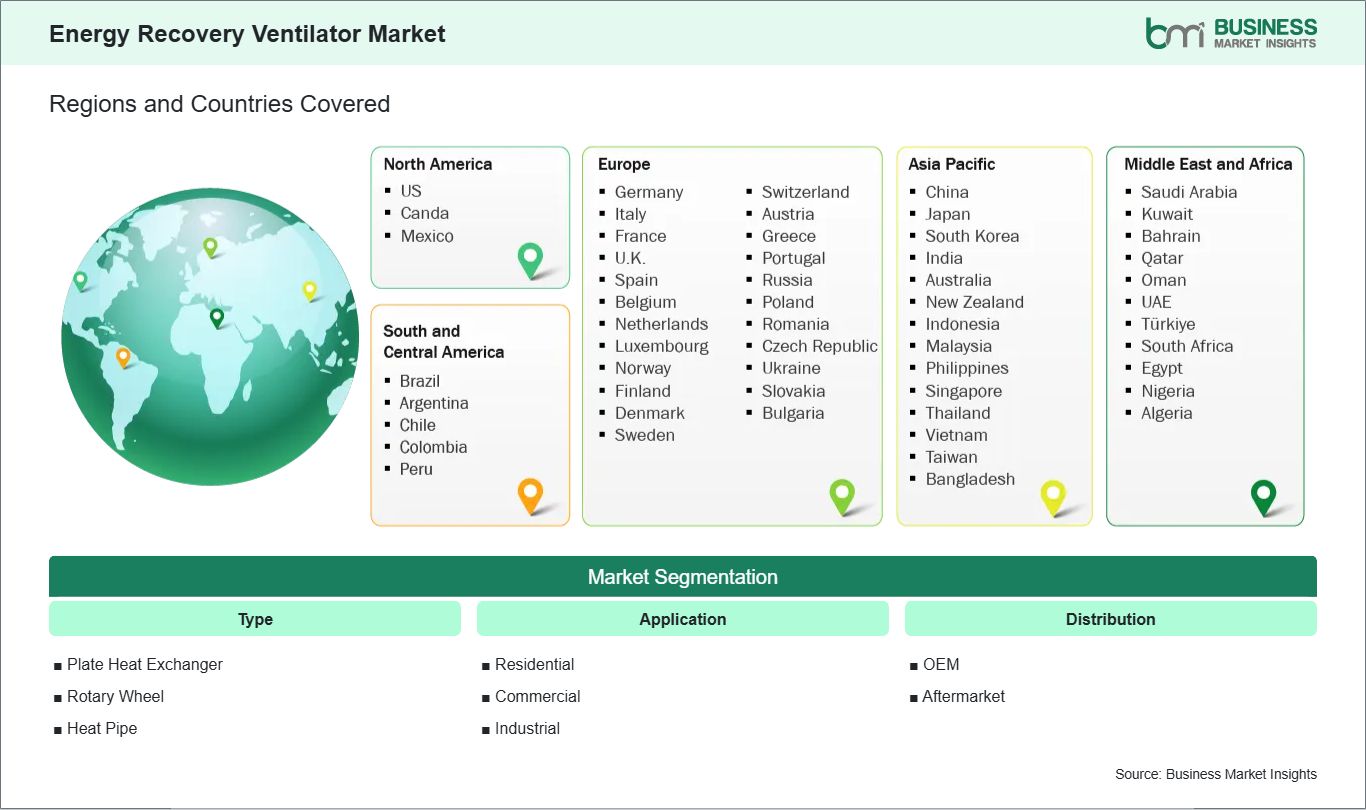
The energy recovery ventilator market is segmented by technology type, application environment, and distribution channel, reflecting diverse ventilation requirements across building categories.
By Type
- Plate Heat Exchanger - Provides reliable heat transfer through stationary exchange surfaces.
- Rotary Wheel - Achieves high recovery efficiency for large-scale ventilation systems.
- Heat Pipe - Enables passive thermal exchange with simplified mechanical operation.
By Application
- Residential - Supports healthy indoor environments in energy-conscious housing developments.
- Commercial - Addresses extensive ventilation requirements across offices and public facilities.
- Industrial - Maintains airflow quality within demanding production environments.
By Distribution
- OEM - Supplies integrated solutions directly into new HVAC installations.
- Aftermarket - Serves replacement, upgrade, and maintenance-related requirements.
Market Forces
Energy Recovery Ventilator Market Drivers and Opportunities
Rising demand for energy efficiency
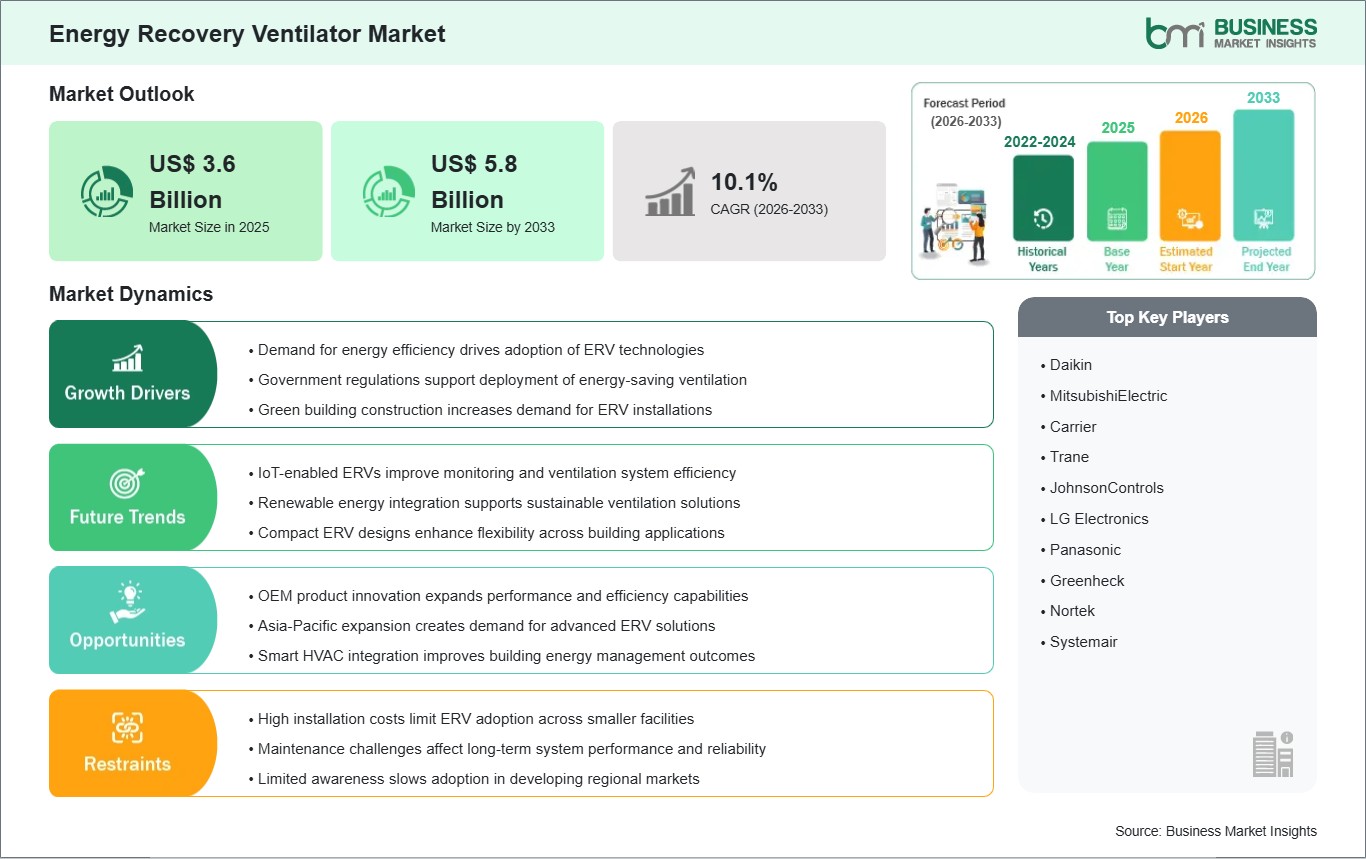
The increasing focus on energy efficiency is a major driver for the energy recovery ventilator (ERV) market. Building owners and facility managers are under growing pressure to reduce energy consumption while maintaining healthy and comfortable indoor environments. Energy recovery ventilators (ERVs) represent an innovative approach to the problem of high heating and cooling losses associated with traditional ventilation systems, in which all the pre-conditioned indoor air is exhausted to the outdoors and replaced with unconditioned outdoor air.
The heat within the stale exhaust air is recovered using the ERV and transferred into the incoming supply air, thereby minimizing heating and cooling load. As a result, ERVs have become an excellent solution for homes, businesses and factories, which are trying to reduce the consumption of heat and cooling energy. In addition to utility costs, ERVs help attain environmental goals and fulfill stringent new energy code requirements. Most building codes and green building certifications consider energy efficiency and indoor air quality to be vital to overall performance, increasing demand for ERVs. Consequently, in a world that focuses on energy conservation at various levels, facility planners and HVAC engineers are specifying ERVs in new construction and renovation projects.
OEM product innovation
The rising level of product innovation by original equipment manufacturers (OEMs) in the energy recovery ventilator (ERV) market will continue to create major opportunities for the future. The newest developments in ERV systems, which include state-of-the-art heat exchanger technology, intelligent controls, and compact designs that not only enhance performance but also make them easier to install, enable ventilation systems to be utilized in a much more efficient manner throughout various types of buildings and under a wide variety of space constraints. In addition, with many of the new ERV solutions now being able to integrate with building automation systems, facility managers are able to use data-driven controls to monitor airflow, energy use, and indoor environmental conditions, thus providing opportunities to improve the efficiency of their operations.
The ongoing evolution of smart buildings and sustainable construction practices will likely fuel the continued growth of product innovation in this market. OEMs will increasingly focus on producing ventilation systems that have greater energy recovery rates, lower maintenance requirements, and greater flexibility in application. As building owners increasingly implement integrated environmental control systems, the demand for newer ventilation technologies is expected to continue to increase. These new technologies will provide manufacturers of ERVs with opportunities in both new construction and retrofit projects, where improving energy efficiency and indoor air quality continue to be a top priority. Product innovation will therefore be a significant contributor to future growth within the energy sector.
Size and Share Analysis
Energy Recovery Ventilator Market Size and Share Analysis
The energy recovery ventilator market size is expected to reach US$ 5.8 billion by 2033 from US$ 3.6 billion in 2025. The market is estimated to record a CAGR of 10.1% during 2026 to 2033.
By type, the market is segmented into plate heat exchanger, rotary wheel, and heat pipe. Plate heat exchanger holds a dominant position due to its cost-effectiveness, reliable thermal transfer performance, and broad applicability across residential, commercial, and industrial ventilation systems. Its straightforward design and efficient energy recovery capabilities support widespread deployment in modern HVAC installations. Rotary wheel systems remain highly preferred in large-scale facilities requiring enhanced heat and moisture recovery efficiency, while heat pipe technologies are utilized in applications where passive operation, low maintenance requirements, and operational simplicity are important considerations.
By application, the market is categorized into residential, commercial, and industrial. Commercial accounts for a significant share owing to extensive ventilation requirements across offices, healthcare facilities, educational institutions, hospitality establishments, and retail buildings. Facility operators increasingly implement energy recovery ventilators to improve indoor air quality while reducing heating and cooling energy consumption. Residential represents a substantial segment as homeowners adopt energy-efficient ventilation solutions to enhance comfort and support sustainable living objectives. Industrial applications also contribute notably to market demand, with manufacturing facilities and processing plants utilizing energy recovery systems to optimize airflow management and improve overall energy performance.
By distribution, the market is segmented into OEM and aftermarket. OEM represents the leading distribution segment due to the integration of energy recovery ventilators into new HVAC systems and building construction projects. Strong collaboration between equipment manufacturers and construction stakeholders continues to support product deployment across diverse end-use environments. The aftermarket segment remains important as building owners invest in replacement units, system upgrades, and maintenance activities to improve ventilation efficiency and extend equipment lifespan.
Report Coverage
Energy Recovery Ventilator Market Report Coverage and Deliverables
The "Energy Recovery Ventilator Market Size and Forecast (2022-2033)" report provides a detailed analysis of the market covering below areas:
- Market size and forecast at global, regional, and country levels for all key market segments covered under the scope
- Market trends, along with market dynamics such as drivers, restraints, and key opportunities
- Market analysis covering key trends, global and regional frameworks, major players, regulations, and recent developments
- Industry landscape and competitive analysis covering market concentration, heat map analysis, prominent players, and recent developments
- Detailed company profiles, including SWOT analysis
Geographic Insights
Energy Recovery Ventilator Market Geographic Insights
The energy recovery ventilator market shows diverse regional adoption patterns influenced by building efficiency regulations, climate conditions, construction activity, and indoor air quality priorities. Across global markets, stakeholders increasingly recognize the value of ventilation technologies that reduce energy losses while supporting healthier indoor environments. This shift has encouraged broader incorporation of energy recovery solutions into both new developments and building modernization projects.
North America represents a significant market landscape where energy-efficient construction standards and advanced HVAC adoption support continued deployment. Commercial building owners frequently invest in ventilation upgrades that align with sustainability objectives and operational cost reduction goals. The region's emphasis on green building certifications and high-performance infrastructure further supports utilization of energy recovery technologies.
Asia Pacific demonstrates substantial growth potential as urban development, commercial construction, and residential expansion continue across major economies. Rising awareness regarding indoor environmental quality and energy management has strengthened interest in advanced ventilation systems. Rapid infrastructure development and increasing investment in modern building technologies contribute to a favorable environment for energy recovery ventilator installations.
Europe maintains a strong focus on environmental sustainability and building energy performance, encouraging widespread implementation of efficient ventilation solutions. Regulatory initiatives supporting lower energy consumption continue influencing equipment selection across residential and commercial sectors. Emerging markets in the Middle East, Africa, and South and Central America are gradually incorporating advanced HVAC technologies as construction activity expands and awareness of energy-efficient building practices increases.
Industry Activity
Recent Developments
The energy recovery ventilator market is evaluated by gathering qualitative and quantitative data post primary and secondary research, which includes important corporate publications, association data, and databases. Recent developments and news in the market include:
- In May 2026, Johnson Matthey announced that it had agreed to acquire Cormetech, a US-based emissions control technology company specializing in nitrogen oxide (NOx) reduction catalysts for power generation and industrial applications, expanding its global emission control catalyst portfolio.
- In January 2025, Greenheck announced the introduction of its new ERVi Energy Recovery Ventilator, designed for installation in space-constrained indoor environments such as basements, mezzanines, and small mechanical rooms, while supporting retrofit and decarbonization projects.
Trust & Transparency
Research Methodology
The market analysis combines proprietary research with secondary data from government agencies, company disclosures, regulatory filings, industry databases and expert interviews. Market estimates are validated through data triangulation, cross-market benchmarking and analyst
review.
View Full Research Methodology
Key Sources Referred:
HVAC industry reports and market assessments Government energy efficiency publications Building performance and ventilation standards Academic research on indoor air quality systems Company annual reports and product documentation Engineering and environmental journals Sustainable construction studies Industry association technical resources