Market Summary
Executive Summary and Global Market Analysis
Thermal recovery cores are the central mechanism for transferring energy between exhaust air having energy to waste and for adding energy to supply air from the outside without actually mixing them together. The function of thermal recovery cores is to stabilize the indoor environment and decrease the thermal impact of using heating and cooling mechanical systems. The inclusion of thermal recovery cores within ventilation designs is a trend that is becoming more common as methods of designing with a focus on efficiency and airflow management are increasing.
The thermal recovery core market is also benefiting from recent changes in the construction community's priorities towards improved operational performance over the entire lifecycle for buildings. As such, developers and building owners are beginning to look at ventilation products from the perspective of long-term energy savings and comfort to the people who will occupy the buildings. Consequently, more and more builders are specifying thermal recovery technologies on projects that have the goals of creating a balanced ventilation system and optimally controlling the temperature and humidity in the building.
The temperature information derived from the air will be used to determine how much to use. The selection of the product to build is made primarily using the air flow volume; install restrictions and the efficiency of the recovery. In addition, plate heat exchanger cores are still commonly found in applications where a compact configuration and reliable performance are required. Where a continuous transfer of energy and high ventilation rate is desired, rotary wheel systems can be recommended for use in residential, commercial and industrial applications.
Enhancements for durability, effectiveness of air flow and flexibility of integration have been the primary focus for companies developing heat exchangers. Companies are continuing to improve the core construction and material compositions to deliver better performance at different operating conditions. The way that the companies position themselves competitively in the market will depend upon the thermal efficiency of the equipment being produced. It will also depend on the compatibility with other modern ventilation systems.
Segment Analysis
Energy Recovery Ventilator Core Market Segmentation
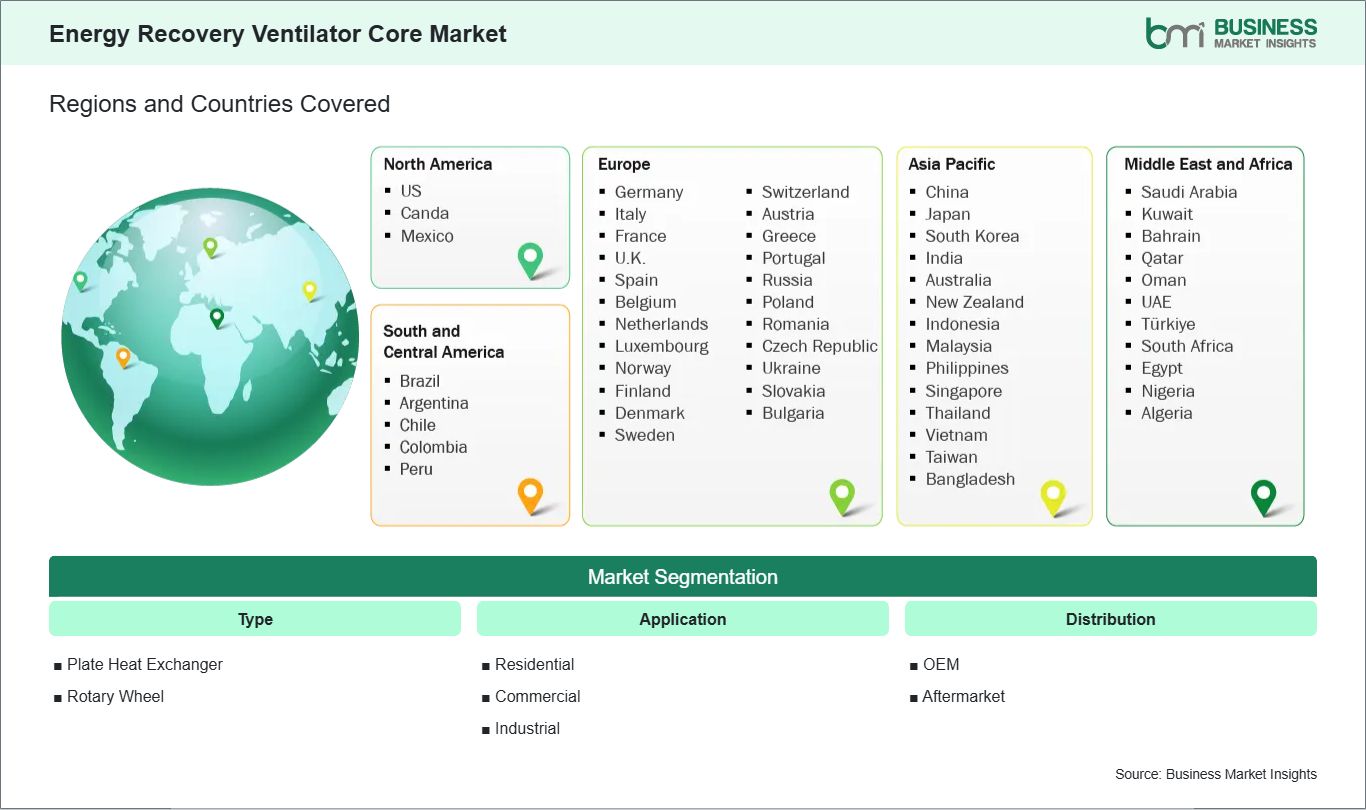
The energy recovery ventilator core market is segmented by type, application, and distribution, reflecting structural differences in ventilation system design requirements..
By Type
- Plate Heat Exchanger - Enables compact thermal transfer using layered airflow separation.
- Rotary Wheel - Delivers continuous heat exchange through rotating energy recovery media.
By Application
- Residential - Supports energy-efficient ventilation in housing systems with limited space.
- Commercial - Addresses airflow management in offices, institutions, and retail buildings.
- Industrial - Provides thermal balance in controlled manufacturing and process environments.
By Distribution
- OEM - Integrated directly into ventilation and HVAC system manufacturing lines.
- Aftermarket - Supplies replacement and upgrade components for existing installations.
Market Forces
Energy Recovery Ventilator Core Market Drivers and Opportunities
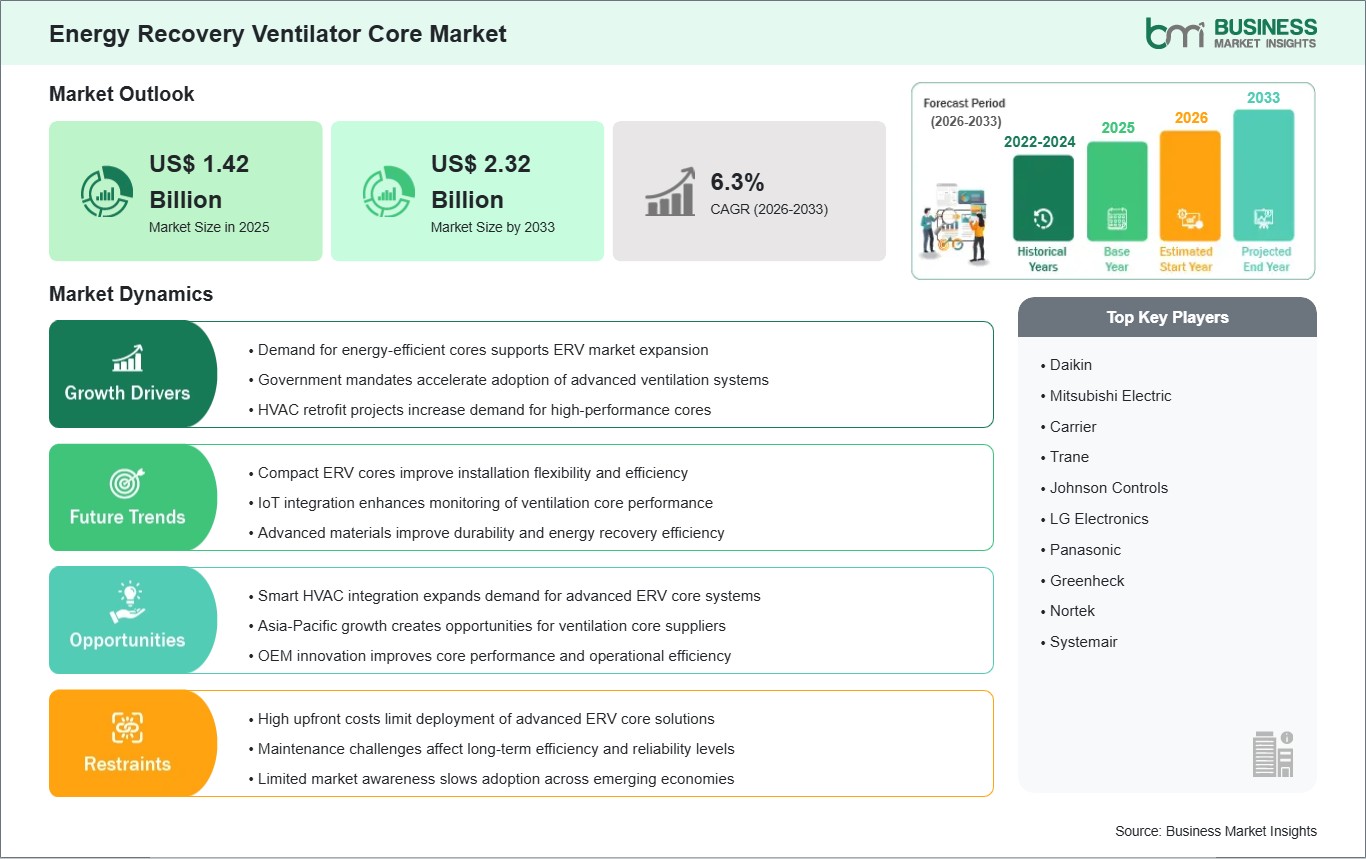
Rising demand for energy-efficient cores
The increasing focus on buildings' energy efficiency is pushing up demand for new high-performance energy recovery ventilator (ERV) cores. Facility managers and building owners want to know that while energy is being efficiently removed from buildings, they are not losing it to the outside environment, nor is energy being used unnecessarily. Basic ventilation systems simply discard the energy contained in exiting building air when they exhaust it to outside air and then use heating and cooling to prepare the incoming air for entry. ERV cores enable an energy transfer from the exiting air to the incoming air, thus reducing total energy use and improving the efficiency of heating and cooling systems. The efficiency capabilities they offer in both new and retrofit constructions are very important.
The shift toward sustainable building practices and stricter energy-performance standards is further accelerating the adoption of high-efficiency ventilation cores. Organizations are focusing on reducing operational costs and lowering environmental impact by implementing technologies that improve long-term building performance. Energy recovery cores support these goals by helping maintain indoor comfort while reducing the energy burden on heating and cooling systems. As green building initiatives and energy-conscious construction practices continue to expand globally, demand for efficient ERV core components is expected to grow across residential, commercial, and industrial sectors, creating substantial opportunities for market expansion.
Integration with smart HVAC systems
The integration of energy recovery cores with smart HVAC systems is creating significant growth opportunities for the market. Modern ventilation solutions increasingly rely on digital controls, sensors, and automated monitoring technologies to optimize airflow and thermal exchange performance. Energy recovery cores are becoming an integral part of these intelligent HVAC ecosystems, enabling systems to adjust ventilation rates based on occupancy levels, indoor air quality, and temperature conditions. This dynamic approach improves energy efficiency, enhances occupant comfort, and allows facility operators to manage building performance more effectively through real-time data insights.
The future of building management is expected to be shaped by greater automation and connectivity, further increasing the importance of smart-compatible ventilation components. As building management systems (BMS) and intelligent infrastructure become more widespread, energy recovery cores will need to support advanced control strategies and seamless system integration. Manufacturers are increasingly developing core technologies that can operate efficiently within digitally managed environments while enabling predictive maintenance and performance optimization. As demand for smart buildings continues to rise, the integration of energy recovery cores into connected HVAC systems is expected to become a key factor driving innovation and long-term market growth.
Size and Share Analysis
Energy Recovery Ventilator Core Market Size and Share Analysis
The energy recovery ventilator core market size is expected to reach US$ 2.32 billion by 2033 from US$ 1.42 billion in 2025. The market is estimated to record a CAGR of 6.3% during 2026 to 2033.
By type, the market is segmented into plate heat exchanger and rotary wheel. Plate heat exchanger holds a dominant position due to its cost-effectiveness, reliable thermal transfer performance, and broad applicability across residential, commercial, and industrial ventilation systems. Its straightforward design and efficient energy recovery capabilities support widespread deployment in modern HVAC installations. Rotary wheel systems remain highly preferred in large-scale facilities requiring enhanced heat and moisture recovery efficiency, particularly where higher ventilation capacities and improved recovery performance are essential.
By application, the market is categorized into residential, commercial, and industrial. Commercial accounts for a significant share owing to extensive ventilation requirements across offices, healthcare facilities, educational institutions, hospitality establishments, and retail buildings. Facility operators increasingly implement energy recovery ventilator cores to improve indoor air quality while reducing heating and cooling energy consumption. Residential represents a substantial segment as homeowners adopt energy-efficient ventilation solutions to enhance comfort and support sustainable living objectives. Industrial applications also contribute notably to market demand, with manufacturing facilities and processing plants utilizing energy recovery systems to optimize airflow management and improve overall energy performance.
By distribution, the market is segmented into OEM and aftermarket. OEM represents the leading distribution segment due to the integration of energy recovery ventilator cores into new HVAC systems and building construction projects. Strong collaboration between equipment manufacturers and construction stakeholders continues to support product deployment across diverse end-use environments. The aftermarket segment remains important as building owners invest in replacement units, system upgrades, and maintenance activities to improve ventilation efficiency and extend equipment lifespan.
Report Coverage
Energy Recovery Ventilator Core Market Report Coverage and Deliverables
The "Energy Recovery Ventilator Core Market Size and Forecast (2022-2033)" report provides a detailed analysis of the market covering below areas:
- Market size and forecast at global, regional, and country levels for all key market segments covered under the scope
- Market trends, along with market dynamics such as drivers, restraints, and key opportunities
- Market analysis covering key trends, global and regional frameworks, major players, regulations, and recent developments
- Industry landscape and competitive analysis covering market concentration, heat map analysis, prominent players, and recent developments
- Detailed company profiles, including SWOT analysis
Geographic Insights
Energy Recovery Ventilator Core Market Geographic Insights
The energy recovery ventilator core market shows diverse regional adoption patterns influenced by construction efficiency standards, HVAC modernization trends, climate variability, and increasing focus on building energy optimization. Across global infrastructure development, ventilation core technologies are gaining attention as essential components for reducing energy loss while maintaining indoor environmental quality across different building categories.
North America demonstrates steady adoption supported by advanced construction practices and strong emphasis on energy-efficient building systems. Commercial infrastructure and residential developments increasingly incorporate compact ventilation core technologies to improve thermal efficiency. Regulatory focus on sustainable building performance continues to reinforce demand across modern HVAC installations.
The Asia Pacific is experiencing booming deployment due to the rapid urbanization occurring in this region, which is also seeing a large amount of new residential construction and continued growth in commercial infrastructure development. Additionally, the growing importance of indoor air quality, combined with the emerging popularity of energy optimisation has enabled modern building designs to incorporate ventilation cores to a greater extent than before. Moreover, continued industrial growth is creating further demand for the utilization of these systems in controlled environment applications where there is a need for consistent management of airflow.
In Europe, sustainability-driven building regulations, as well as energy performance targets that promote the adoption of energy efficient ventilation technologies, remain paramount. Meanwhile, many emerging markets across the Middle East, Africa, and South America are slowly beginning to integrate advanced HVAC systems into their buildings as commercial construction activity increases and the need for infrastructure modernization continues to progress. Therefore, the aforementioned regions offer many developing opportunities related to energy efficient upgrades of existing buildings, as well as the changing environmental standards related to the construction industry.
Industry Activity
Recent Developments
The energy recovery ventilator core market is evaluated by gathering qualitative and quantitative data post primary and secondary research, which includes important corporate publications, association data, and databases. Recent developments and news in the market include:
- In January 2026, Panasonic Eco Systems North America announced that it would showcase its new Intelli-Balance Elite and Elite+ Energy Recovery Ventilator (ERV) series at AHR Expo 2026, highlighting improved heat exchange efficiency and high sensible recovery performance designed for modern residential and commercial ventilation applications.
- In April 2025, CORE Energy Recovery Solutions announced at ISH 2025 the launch of its next-generation F-ERV 366 and F-ERV 270 enthalpy (ERV) cores featuring a new formable membrane technology designed to improve heat and moisture transfer efficiency while reducing weight and material usage in ventilation systems.
Trust & Transparency
Research Methodology
The market analysis combines proprietary research with secondary data from government agencies, company disclosures, regulatory filings, industry databases and expert interviews. Market estimates are validated through data triangulation, cross-market benchmarking and analyst
review.
View Full Research Methodology
Key Sources Referred:
HVAC technology and ventilation system industry reports Government building energy efficiency guidelines Academic studies on heat recovery and airflow systems Engineering journals on thermal exchange materials Company annual reports and technical documentation Green building certification frameworks Construction and infrastructure development publications Industry association HVAC technical standards