Net Zero Energy Buildings Market Regional Highlights
North America Net Zero Energy Buildings Market
North America accounted for a 35%–38% share of the Net Zero Energy Buildings Market in 2025 and is projected to expand at a CAGR of 13%–15% during 2026–2033. The region benefits from advanced construction technologies, established sustainability frameworks, and strong corporate commitments toward carbon reduction. The United States and Canada are leading adoption through commercial building upgrades, renewable integration projects, and energy efficiency regulations. Increasing demand for smart energy management platforms and high-performance building materials is strengthening regional investment activity.
- Government sustainability targets and updated building energy codes are accelerating adoption of advanced efficiency solutions across commercial and institutional construction projects.
- Strong availability of green financing programs supports developers implementing renewable systems, energy-efficient envelopes, and intelligent building management technologies.
- Corporate net-zero commitments are increasing demand for energy optimization solutions in offices, industrial facilities, and mixed-use developments.
- Growing retrofit activities across aging infrastructure are creating opportunities for HVAC modernization, insulation upgrades, and renewable energy integration.
US Net Zero Energy Buildings Market
The US accounted for a 29%–32% share of the Net Zero Energy Buildings Market in North America during 2025 and is expected to grow at a CAGR of 13.5%–15% from 2026–2033. Federal sustainability initiatives, state-level energy policies, and corporate decarbonization commitments are driving adoption across commercial and institutional buildings. Demand is increasing for smart controls, efficient HVAC systems, and renewable generation technologies. Government incentives supporting clean energy deployment are encouraging building owners to invest in long-term energy performance improvements.
- Federal and state incentives are improving the economic feasibility of net-zero construction and renovation projects across multiple building categories.
- Commercial developers are adopting advanced automation systems to improve energy monitoring, reduce operational expenses, and achieve sustainability certifications.
- Increasing corporate environmental commitments are encouraging investments in renewable integration and intelligent building infrastructure.
- Growth in green-certified buildings is supporting demand for efficient materials, digital platforms, and energy management solutions.
Europe Net Zero Energy Buildings Market
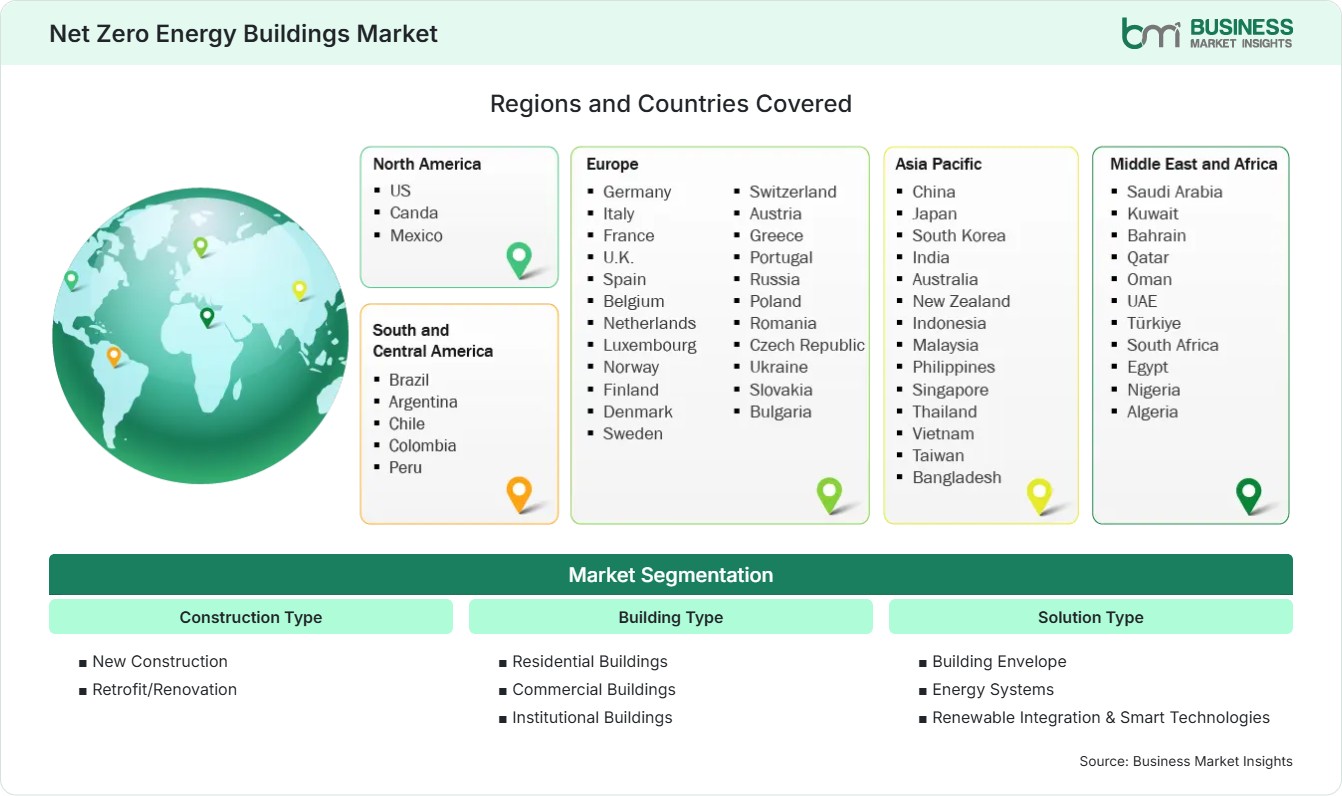
Europe represented a 30%–33% share of the Net Zero Energy Buildings Market in 2025 and is estimated to grow at a CAGR of 14%–16% during 2026–2033. The region maintains strong momentum due to ambitious climate policies, energy efficiency directives, and carbon reduction targets. Germany, the United Kingdom, France, and the Nordic countries are leading adoption, while Eastern European markets are witnessing faster investment growth. Building renovation programs and renewable energy integration initiatives are strengthening demand for sustainable construction solutions.
- European Union climate policies are encouraging member states to improve building energy performance through renovation and efficiency programs.
- Germany is advancing adoption through energy-efficient construction standards, renewable integration projects, and sustainable urban development initiatives.
- Nordic countries are demonstrating strong demand for low-energy buildings supported by advanced construction practices and renewable energy availability.
- France and the United Kingdom are expanding investments in smart building technologies and carbon-neutral infrastructure development.
- Rising demand for sustainable materials is supporting manufacturers developing advanced insulation, glazing, and building envelope solutions.
Asia Pacific Net Zero Energy Buildings Market
Asia Pacific held a 28%–31% share of the Net Zero Energy Buildings Market in 2025 and is projected to record a CAGR of 15%–17% between 2026–2033. Rapid urbanization, expanding infrastructure investment, and government-backed sustainability programs are accelerating regional adoption. China, Japan, India, South Korea, and Singapore are key markets, with developing economies providing additional growth opportunities. Increasing smart city development and renewable energy investments are supporting demand for integrated energy-efficient building solutions.
- China is expanding green building deployment through national sustainability policies, urban modernization programs, and renewable energy integration strategies.
- India is witnessing increasing demand due to smart city initiatives, energy-efficient construction regulations, and sustainable infrastructure investments.
- Japan and South Korea are adopting advanced building automation technologies to improve energy efficiency and reduce emissions.
- Singapore is promoting high-performance buildings through strict efficiency standards and green development frameworks.
- Rising urban population growth is creating demand for energy-efficient residential and commercial construction solutions.
Rest of World Net Zero Energy Buildings Market
Rest of World accounted for a 5%–8% share of the Net Zero Energy Buildings Market in 2025 and is expected to grow at a CAGR of 12%–14% during 2026–2033. South and Central America are advancing through sustainable urban projects, renewable energy availability, and green construction initiatives. The Middle East and Africa are increasingly investing in energy-efficient buildings due to climate adaptation requirements, smart city programs, and infrastructure modernization efforts.
- Brazil and Mexico are expanding sustainable construction adoption through renewable energy availability and urban development initiatives.
- Middle Eastern countries are investing in smart cities featuring energy-efficient buildings and integrated renewable technologies.
- Gulf economies are supporting green infrastructure through government-backed sustainability programs and large-scale development projects.
- Africa is experiencing rising interest in energy-efficient buildings due to urbanization and infrastructure modernization needs.
- Renewable energy potential across developing markets is creating opportunities for distributed generation and sustainable building solutions.