
Zero Turn Mowers Market Outlook: Size, Share, Trends, Growth Analysis, Competitive Landscape & Forecast, 2026-2033

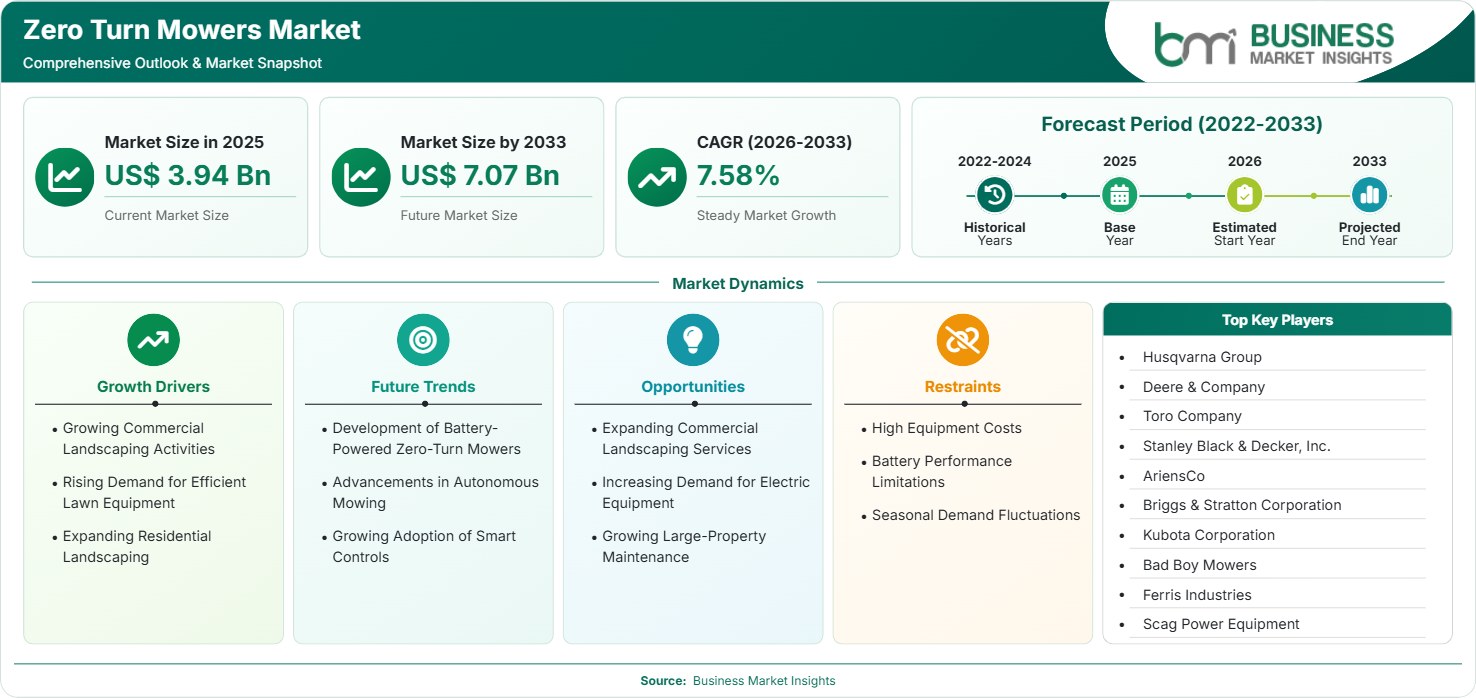
The Zero Turn Mowers Market size was valued at US$ 3.94 Billion in 2025 and is projected to reach US$ 7.07 Billion by 2033, growing at a CAGR of 7.58% during 2026–2033, driven by commercial landscaping demand, labor productivity, larger properties, equipment modernization, and electric powertrain adoption.

Report Coverage
  • Product Type: Less than 50 inches, 50-60 inches, More than 60 inches
  • Horsepower: Less than 25 HP, More than 25 HP
  • Application: Commercial, Residential
US$ 3.94 Bn Market size in 2025
US$ 7.07 Bn Market Size by 2033
7.58% CAGR, 2026 - 2033
2026-2033 Forecast Period

AI Overview

Zero Turn Mowers Market Summary

  • North America Region: North America holds a 42%–46% share in 2025, growing at a 7.10%–7.60% CAGR during 2026–2033, supported by mature landscaping services, replacement demand, mechanization, fleet upgrades, large properties, dealer networks, and increasing battery-powered equipment adoption. The US remains the principal regional market, with growth around 7.20%–7.70%, supported by professional contractors, municipalities, residential estates, and replacement cycles.
  • Fastest Growing Region: Asia Pacific accounts for a 16%–20% share in 2025, advancing at a 8.20%–9.00% CAGR during 2026–2033, as urban development, commercial landscaping, premium residential projects, mechanized grounds maintenance, and rising contractor capabilities expand equipment adoption across developing markets.
  • Leading Segment: Commercial application represents a 63%–67% share in 2025, advancing at a 7.40%–7.90% CAGR during 2026–2033, supported by contractor productivity requirements, large mowing areas, recurring maintenance contracts, operator efficiency, fleet standardization, and replacement of conventional riding equipment.
  • High Growth Segment: More than 25 HP equipment represents a 58%–62% share in 2025, growing at a 7.80%–8.30% CAGR during 2026–2033, driven by larger cutting decks, demanding commercial workloads, faster mowing cycles, improved traction, higher productivity, and increasing professional fleet adoption.
  • Key Market Opportunity: Battery-electric zero-turn platforms create opportunities for quieter operation, lower local emissions, reduced routine maintenance, fleet electrification, residential acceptance, and differentiated premium equipment offerings across urban landscaping applications.
  • Major Market Players: Husqvarna Group; Deere & Company; The Toro Company; Stanley Black & Decker, Inc.; AriensCo; Briggs & Stratton Corporation; Kubota Corporation; Bad Boy Mowers; Ferris Industries; Scag Power Equipment.
Strategic Insights

Zero Turn Mowers Market: Strategic Insights

Zero Turn Mowers Market Strategic Framework
FREE PDF
Request your free sample
Request free sample
Stakeholder View

Key Takeaways

  • Ecosystems integrating engines, transmissions, cutting decks, controls, dealer servicing, after-sales spare parts supply, financing, and fleets have become an effective way for manufacturers to distinguish themselves from their competitors.
  • Commercial landscaping is the best source of demand, since contractors appreciate high productivity of the equipment, maneuverability, reduced need for trimmings, and speedy completion of periodic landscaping jobs.
  • In terms of technology development, products are expected to feature electronic control, better suspension systems, cutting systems, diagnostics, electrified powertrains, and ergonomics.
  • Asia Pacific offers attractive expansion potential as commercial landscaping professionalizes around new commercial districts, hospitality developments, institutional properties, and premium residential construction.
  • Strategic investment is increasingly directed toward electrification, dealer coverage, product-line expansion, software-enabled equipment management, and manufacturing capabilities that improve production flexibility.
Geographic Outlook

Zero Turn Mowers Market Regional Highlights

North America Zero Turn Mowers Market

North America holds a 42%–46% of Zero Turn Mowers Market share in 2025 and is projected to expand at a 7.10%–7.60% CAGR during 2026–2033. Mature landscaping businesses, extensive dealer infrastructure, established riding-mower replacement cycles, and strong contractor familiarity support demand. The US dominates regional consumption, while Canada contributes through commercial properties, residential estates, and institutional landscaping. Market development increasingly favors higher-horsepower platforms, wider decks, comfort features, and electric alternatives.

  • Commercial contractors increasingly replace aging fleets with higher-output platforms that shorten mowing cycles and improve labor utilization across recurring maintenance routes.
  • Dealer service coverage remains a competitive advantage because professional buyers evaluate parts availability, repair response, warranty support, financing, and seasonal equipment readiness alongside purchase price.
  • Battery-powered products are gaining attention in noise-sensitive environments, although commercial adoption depends on operating duration, charging logistics, battery cost, and fleet utilization patterns.
  • Residential demand remains supported by large suburban properties where maneuverability and cutting speed provide advantages over conventional riding equipment.

US Zero Turn Mowers Market

The US represents a substantial portion of North American demand, with a 30%–34% share of the global market in 2025 and a 7.20%–7.70% CAGR during 2026–2033. Texas, Florida, California, and other landscaping-intensive states provide strong commercial and residential applications. Equipment replacement, productivity improvements, and expanding interest in electrification shape purchasing decisions.

  • Professional landscaping contractors favor machines offering durable decks, high horsepower, comfortable seating, fast ground speeds, and dependable service support.
  • Residential adoption is strongest where property sizes justify premium riding equipment and consumers prioritize reduced mowing time and maneuverability.
  • Battery-electric models are increasingly relevant for suburban, institutional, and noise-sensitive properties where operating conditions favor quieter equipment.

Europe Zero Turn Mowers Market

Europe represents a 18%–22% share in 2025, with growth estimated at 6.60%–7.20% CAGR during 2026–2033. Demand is supported by commercial grounds maintenance, municipal landscaping, sports facilities, and premium residential properties. Germany and the UK remain important markets, while France and Italy provide additional opportunities. Higher-growth countries include Spain and selected Central European markets, where professional landscaping capacity and mechanized maintenance are expanding.

  • Germany benefits from established professional landscaping operations and demand for durable equipment capable of intensive institutional and commercial use.
  • The UK supports demand through property maintenance, sports grounds, estate management, and professional landscaping services requiring maneuverability around complex landscapes.
  • France and Italy provide opportunities through hospitality properties, residential estates, municipalities, and contractors serving expanding managed green spaces.
  • Spain offers comparatively stronger growth potential as tourism infrastructure, residential developments, and commercial landscaping requirements expand.

Asia Pacific Zero Turn Mowers Market

Asia Pacific accounts for a 16%–20% share in 2025 and is projected to grow at an 8.20%–9.00% CAGR during 2026–2033, making it the fastest-growing regional Zero Turn Mowers Market. Japan and Australia provide established equipment demand, while China, India, and Southeast Asia offer expansion opportunities. Commercial landscaping, hospitality development, institutional campuses, premium residential construction, and professional contractor adoption are gradually broadening the addressable market.

  • Australia remains a strong market because extensive properties, professional landscaping businesses, and outdoor maintenance requirements support high-productivity mowing equipment.
  • Japan favors compact and efficient equipment suited to managed green spaces, institutional facilities, commercial properties, and professional landscaping environments.
  • China offers expanding opportunities as commercial property development, hospitality facilities, and landscaping professionalization increase demand for mechanized maintenance.
  • India and Southeast Asia provide longer-term upside through premium housing, resorts, commercial campuses, and organized landscaping services.

Rest of World Zero Turn Mowers Market

South and Central America represent a developing demand base, supported by commercial properties, resorts, estates, agricultural-adjacent landscaping, and professional grounds maintenance. Brazil and Mexico offer the strongest commercial potential, while Chile provides opportunities in premium property and managed landscaping applications.

The Middle East and Africa offer specialized opportunities around hospitality, golf facilities, residential compounds, institutional developments, and large landscaped properties. The combined region represents a 12%–16% share in 2025 and is projected to expand at a 7.60%–8.40% CAGR during 2026–2033, supported by premium landscaping requirements and mechanization.

  • Brazil benefits from extensive commercial properties and landscaping contractors requiring efficient equipment for large managed areas.
  • Mexico offers demand across hospitality, residential developments, commercial facilities, and professional grounds-maintenance operations.
  • Gulf markets create premium opportunities through resorts, golf facilities, compounds, and institutional landscaping requiring reliable high-productivity equipment.
  • South Africa provides opportunities in estates, sports grounds, hospitality properties, and professional landscaping services.

Global Market Geography
FREE PDF
Request your free sample
Request free sample
Segment Analysis

Zero Turn Mowers Market Segmentation

Product Type

Product Type is differentiated by deck width and operating productivity. More than 60 inches holds an estimated 35%–39% share in 2025 and is projected to grow at 7.70%–8.20% CAGR during 2026–2033, supported by commercial mowing efficiency. Zero Turn Mowers Market scope broadens as contractors balance productivity, property accessibility, transport requirements, and purchase economics.

  • Less than 50 inches: Compact decks support residential properties, narrow access areas, and landscaped spaces requiring maneuverability. Demand benefits from easier storage, transport, and operation around obstacles.
  • 50-60 inches: Mid-width decks provide a balance between productivity and maneuverability, making them suitable for residential estates, contractors, institutions, and mixed-property maintenance requirements.
  • More than 60 inches: Wide decks maximize mowing coverage for commercial properties, sports grounds, campuses, and large estates where fewer passes improve labor productivity and equipment utilization.

Horsepower

Horsepower segmentation reflects workload intensity, deck requirements, terrain, and operating duration. More than 25 HP represents an estimated 58%–62% share in 2025 and is projected to expand at 7.80%–8.30% CAGR during 2026–2033, supported by commercial fleets and larger cutting systems. Product engineering increasingly balances power with fuel efficiency and drivetrain durability.

  • Less than 25 HP: Lower-power machines target residential users and lighter commercial applications where acquisition economics, compact dimensions, and adequate cutting performance outweigh maximum productivity.
  • More than 25 HP: Higher-power platforms support wider decks, demanding terrain, extended operating hours, and commercial workloads requiring consistent speed, traction, and cutting performance.

Application

Application segmentation is led by professional users requiring dependable productivity and fleet uptime. Commercial applications account for an estimated 63%–67% share in 2025 and are projected to grow at 7.40%–7.90% CAGR during 2026–2033, while residential demand remains important across larger properties. Purchasing increasingly emphasizes lifecycle value and service availability.

  • Commercial: Contractors, municipalities, institutions, sports facilities, and property managers prioritize productivity, durability, operator comfort, serviceability, and predictable operating costs.
  • Residential: Homeowners with large properties value maneuverability, reduced mowing time, premium comfort, and simplified operation compared with conventional riding equipment.
Market Forces

Zero Turn Mowers Market Dynamics

Key Market Drivers

Growing Commercial Landscaping Activities

Commercial landscaping expansion increases demand for equipment that can complete large mowing assignments within narrow service windows. Zero Turn Mowers Market growth benefits due to the ability of contractors to increase their efficiency through high maneuverability and fast turning on the wide cutting deck. Professional customers assess machines according to the number of labor hours saved as opposed to simply considering the cost of purchasing. Standardized platform becomes important for fleet owners due to standardization of maintenance, operator training, and parts inventories.

Rising Demand for Efficient Lawn Equipment

Efficiency has become a purchasing priority as landscaping operators seek to reduce labor intensity and increase daily equipment utilization. Zero Turn Mowers Market trends include the use of larger deck sizes, more efficient blade designs, stronger transmissions, improved suspensions, and ergonomic controls. These characteristics enable users to be productive during extended time periods without experiencing much fatigue. Buyers in the commercial industry also consider factors such as fuel efficiency, service intervals, and downtime since interruptions in the equipment usage affect the work schedules. Manufacturers have thus engaged in improving their products rather than just their engines.

Expanding Residential Landscaping

Residential landscaping continues to create demand for premium riding equipment as larger properties require faster and more consistent mowing. Homeowners tend to judge machinery on basis of the size of the deck, steering response, comfort, storage requirements, and the lifetime value that it adds. The zero turn machine becomes a practical choice when mowing near trees, flower beds, fences, and oddly shaped pieces of property, where their maneuverability prevents any unnecessary repetitions. In addition, the residential market allows for the introduction of small-sized platforms, easier controls, and low-noise engines. Demonstrations from dealers still matter because buyers will assess turnability and operator comfort before buying.

Key Market Opportunities

Expanding Commercial Landscaping Services

Professional landscaping companies offer a strong opportunity because recurring contracts create predictable equipment utilization and replacement requirements. Fleet packages, financing, maintenance, telematics, operator training, and fast spare parts availability enable suppliers to generate additional value. Commercial users now look for suppliers who are able not only to provide machines but also to assist their operation throughout the machine's lifecycle. Thus, manufacturers have the opportunity to increase customer loyalty by adding dealer services, preventive maintenance, spare parts supply, and fleet management capabilities. Large contractors also create opportunities for a common platform for equipment which facilitates training and maintenance of such equipment in a wide range of geographic locations.

Increasing Demand for Electric Equipment

Electrification creates a differentiated opportunity for manufacturers developing battery-powered zero-turn platforms capable of serving noise-sensitive and emissions-conscious applications. Demand can especially be fostered near schools, hospitals, residential complexes, municipalities, hotels, and urban properties where noise operation affects the choice of equipment. The success of the product will rely on factors such as the capacity of the battery, the rate at which the battery charges, run time, thermal management, durability, and overall cost of ownership. Value can also be added by manufacturers through interoperable batteries and charging fleets. With improvements in the technology of the batteries, electric machines could move from being used in high-end applications to being used in other professional fleets.

Growing Large-Property Maintenance

Large-property maintenance creates demand for high-output equipment because operators need to cover extensive areas efficiently while maintaining consistent turf quality. Zero Turn Mowers Market Forecast suggests golf-adjacent properties, resorts, campus institutions, estate areas, sports fields, and commercial ventures can accommodate high-end machines that have more deck space and high-powered engines. Manufacturers can optimize by designing products that will work in conditions requiring long hours of operation, operator comfort, transportation, and ease of maintenance. Another area where this might prove valuable is in the standardization of products since multiple facilities can be able to share parts, attachments, training, and maintenance.

Market Restraints and Challenges

High Equipment Costs

Factor: Zero-turn equipment can require a substantial upfront investment because commercial-grade machines combine powerful engines or electric powertrains, durable transmissions, fabricated decks, suspension systems, and specialized controls. Impact: Higher acquisition costs will lead to delayed replacement especially by small landscaping firms and price-sensitive homeowners. Buyers will opt for extended equipment life or opt for less powerful machinery in times of poor financing terms. It may result in competition with regular riding lawnmowers, used machinery, and less powerful models.

Battery Performance Limitations

Factor: Battery-powered zero-turn equipment remains constrained by energy density, charging requirements, operating duration, temperature effects, battery replacement cost, and infrastructure availability. Impact: Commercial operators with long daily mowing schedules may hesitate to transition entire fleets when charging downtime can interfere with contracted service routes. Electric platforms therefore require careful matching between battery capacity, property size, shift length, charging access, and fleet scheduling. Adoption is consequently more attractive for applications where noise reduction, lower routine maintenance, and local emissions benefits justify the investment.

Company Analysis

Competitive Landscape

The Zero Turn Mowers Market analysis indicates competition is shaped by product breadth, dealer coverage, commercial durability, cutting performance, powertrain options, service support, and brand recognition. Manufacturers increasingly differentiate through ergonomics, deck engineering, electric platforms, fleet support, and lifecycle economics.

Company Name

Overview

Products and Services relevant to this market

Husqvarna Group

Global outdoor power equipment company with broad professional and consumer landscaping exposure.

Zero-turn riding mowers, commercial mowing equipment, battery equipment, accessories, replacement parts, and service support.

Deere & Company

Major agricultural and turf equipment manufacturer serving professional, commercial, and residential customers.

ZTrak zero-turn mowers, commercial turf equipment, cutting systems, financing, parts, and dealer services.

The Toro Company

Established outdoor equipment supplier with strong professional landscaping and turf-management capabilities.

Commercial and residential zero-turn mowers, turf equipment, accessories, parts, and maintenance support.

Stanley Black & Decker, Inc.

Diversified tools and outdoor equipment company with established battery-powered equipment capabilities.

Zero-turn and riding mower offerings, outdoor power equipment, battery systems, accessories, and service solutions.

AriensCo

Specialist manufacturer focused on outdoor power equipment and snow and turf applications.

Zero-turn riding mowers, commercial mowing platforms, accessories, replacement parts, and dealer support.

Briggs & Stratton Corporation

Engine and outdoor power equipment manufacturer with established lawn-care industry relationships.

Engines, zero-turn mower platforms, commercial power solutions, parts, and service support.

Kubota Corporation

Diversified machinery producer with strong presence in compact equipment and professional turf applications.

Commercial zero-turn mowers, engines, turf equipment, attachments, parts, and dealer services.

Bad Boy Mowers

Specialist mower manufacturer focused strongly on zero-turn and commercial turf equipment.

Residential and commercial zero-turn mowers, cutting decks, accessories, parts, financing, and dealer support.

Ferris Industries

Professional outdoor power equipment brand known for suspension-oriented commercial mower designs.

Commercial zero-turn mowers, suspension systems, cutting decks, accessories, parts, and service support.

Scag Power Equipment

Specialist manufacturer focused on professional turf equipment and heavy-duty mowing applications.

Commercial zero-turn mowers, wide-area mowing platforms, accessories, parts, and dealer-based service.

Trust & Transparency

Research Methodology

The market analysis combines proprietary research with secondary data from government agencies, company disclosures, regulatory filings, industry databases and expert interviews. Market estimates are validated through data triangulation, cross-market benchmarking and analyst review.

View Full Research Methodology

Questions Answered

Frequently Asked Questions

Which product characteristics are becoming more important for premium equipment?

Premium buyers increasingly evaluate cutting consistency, operator comfort, suspension, maneuverability, durability, powertrain efficiency, serviceability, and technology integration.

What role does dealer support play in equipment selection?

Dealer networks provide access to demonstrations, financing, preventive maintenance, replacement parts, warranty service, and seasonal repairs. For professional users, rapid service response can be as important as initial equipment performance because downtime can affect contracted landscaping schedules.

Why are commercial users important to manufacturers?

Commercial operators typically use equipment more intensively and replace machines according to productivity, uptime, and lifecycle economics. Their purchasing decisions can therefore influence product specifications, service networks, warranty structures, and fleet-oriented offerings.

How is electrification changing zero-turn mower design?

Electric platforms are encouraging manufacturers to redesign power management, battery placement, charging systems, controls, and maintenance strategies. The emphasis is shifting toward integrated systems rather than simply replacing combustion engines with batteries.

What factors determine the right zero-turn mower deck size?

Deck size should match property area, obstacles, transport requirements, storage capacity, and mowing frequency. The Zero Turn Mowers Market Report evaluates deck-width segmentation because product selection directly affects labor efficiency and equipment utilization.

Access the Full Zero Turn Mowers Market Report

Get segment-level forecasts, regional estimates, competitive benchmarking, company profiles and downloadable Excel datasets.

Access the full Zero Turn Mowers Market Report
350 pages PDF & Excel | 2026-08-19
Similar Research

Related Market Reports