
Zero Emission Heavy Machinery Market Outlook: Size, Share, Trends, Growth Analysis, Competitive Landscape & Forecast, 2026-2033

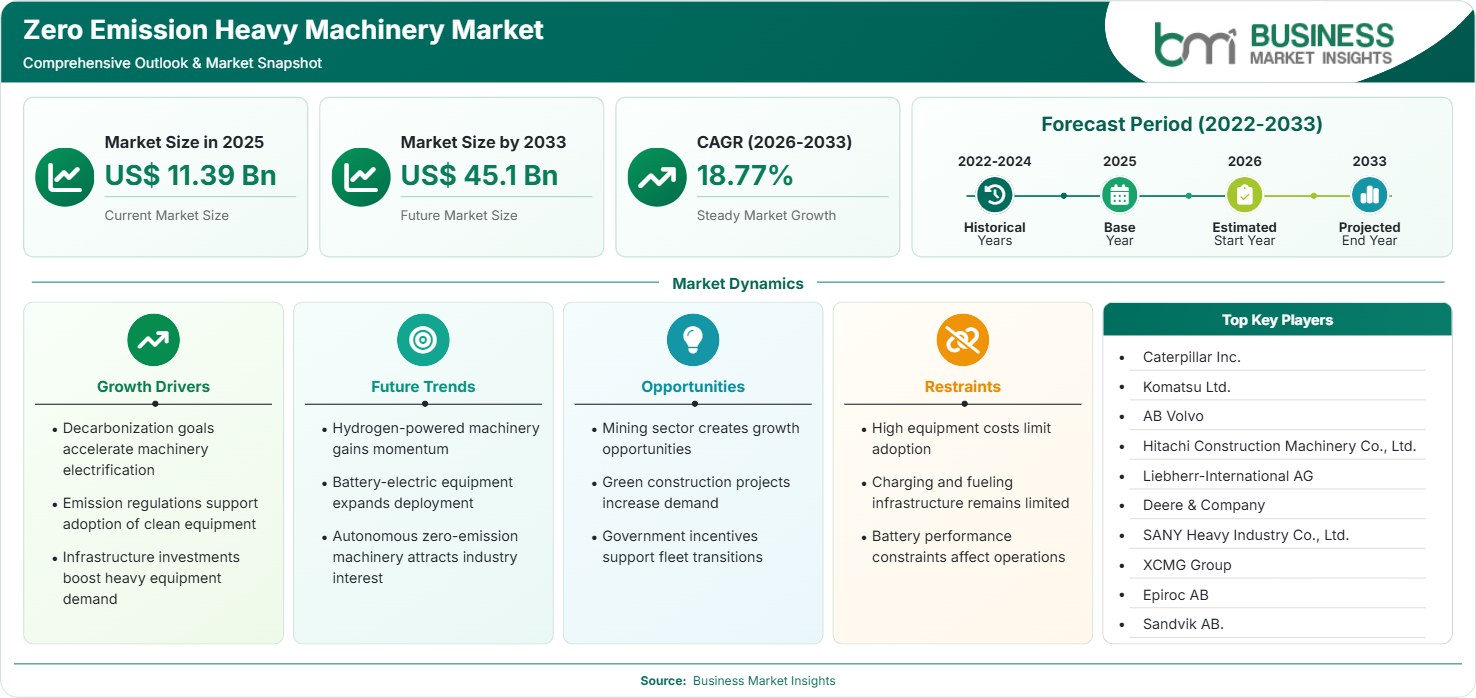
The Zero Emission Heavy Machinery Market size was valued at US$ 11.39 Billion in 2025 and is projected to reach US$ 45.1 Billion by 2033, growing at a CAGR of 18.77% during 2026–2033. Key drivers include equipment electrification, mining decarbonization targets, stringent emission regulations, battery innovation, hydrogen ecosystem expansion, and public infrastructure investments creating large-scale deployment opportunities.

Report Coverage
  • Machinery Type: Earthmoving & Excavation, Haulage & Dumping, Material Handling, Lifting & Access, Others
  • Powertrain: Battery-Electric , Hydrogen Fuel Cell Electric , Others
  • Application: Construction, Mining, Ports & Logistics Terminals, Industrial & Municipal, Others
US$ 11.39 Bn Market size in 2025
US$ 45.1 Bn Market Size by 2033
18.77% CAGR, 2026 - 2033
2026-2033 Forecast Period

AI Overview

Zero Emission Heavy Machinery Market Summary

  • North America Region: North America holds a market share of 34%–37% in 2025, growing with a CAGR of 17.5%–18.5% during 2026–2033. Key drivers include mining electrification programs, federal infrastructure spending, fleet decarbonization mandates, battery investments, equipment modernization, and demand for low-noise machinery in urban projects. The U.S. remains the regional anchor, supported by large mining operators and construction contractors, advancing at a CAGR of 17.8%–18.8%.
  • Fastest Growing Region: Asia Pacific holds a market share of 27%–30% in 2025, growing with a CAGR of 20.5%–21.8% during 2026–2033. Key drivers include urbanization, clean-energy manufacturing expansion, mining investments, government emission targets, battery localization, smart-city projects, and increasing adoption of electric equipment across industrial developments.
  • Leading Segment: Construction accounts for 41%–44% share in 2025 and advances at a CAGR of 18.0%–19.0%. Growth is supported by infrastructure spending, low-emission procurement requirements, electric equipment availability, contractor sustainability commitments, urban redevelopment projects, and stricter regulations affecting diesel-powered fleets.
  • High Growth Segment: Hydrogen Fuel Cell Electric (FCEV) represents 12%–15% share in 2025 and expands at a CAGR of 24.0%–26.0%. Growth stems from rapid refueling capability, suitability for high-duty cycles, mining adoption, hydrogen corridor development, renewable-hydrogen investments, and industrial decarbonization initiatives.
  • Key Market Opportunity: Large mining and logistics operators are pursuing net-zero pathways, creating demand for battery-electric haul trucks, hydrogen-powered machinery, charging infrastructure, energy management platforms, and integrated fleet decarbonization solutions.
  • Major Market Players: Caterpillar Inc., Komatsu Ltd., AB Volvo, Hitachi Construction Machinery Co., Ltd., Liebherr-International AG, Deere & Company, SANY Heavy Industry Co., Ltd., XCMG Group, Epiroc AB, and Sandvik AB.
Strategic Insights

Zero Emission Heavy Machinery Market: Strategic Insights

Zero Emission Heavy Machinery Market Strategic Framework
FREE PDF
Request your free sample
Request free sample
Stakeholder View

Key Takeaways

  • The value chain is evolving from equipment-centric sales toward integrated ecosystems involving battery suppliers, charging providers, software vendors, hydrogen producers, and fleet-management specialists.
  • Mining and ports offer the highest long-term revenue potential due to intensive operating cycles, fuel consumption reduction targets, and growing sustainability commitments from large asset owners.
  • Innovation is shifting toward high-capacity batteries, megawatt-scale charging systems, autonomous fleet control, predictive maintenance, and fuel-cell platforms capable of supporting continuous operations.
  • Asia-Pacific presents the strongest investment case, supported by infrastructure expansion, domestic manufacturing programs, and policy frameworks encouraging industrial electrification.
  • Strategic collaborations, technology alliances, and targeted acquisitions are increasing as OEMs seek access to battery technologies, hydrogen expertise, and software-driven fleet optimization capabilities.
  • Lifecycle emissions reporting is becoming a competitive differentiator, influencing procurement decisions among contractors, municipalities, mining firms, and logistics operators.
Geographic Outlook

Zero Emission Heavy Machinery Market Regional Highlights

North America Zero Emission Heavy Machinery Market

North America accounts for 34%–37% of global demand in 2025 and is projected to expand at a CAGR of 17.5%–18.5% through 2033. The region benefits from infrastructure modernization programs, mining electrification initiatives, and sustainability-linked procurement standards. The Zero Emission Heavy Machinery Market share remains concentrated among large contractors and mining operators adopting battery-powered excavators, loaders, and haulage systems. Equipment manufacturers are increasing local assembly and battery integration capabilities to reduce supply-chain risk while strengthening adoption across construction, aggregates, and logistics applications.

  • Federal infrastructure investments are accelerating replacement cycles for diesel-powered fleets while encouraging deployment of lower-emission equipment across transportation, utility, and public works projects.
  • Mining operators continue testing battery-electric haul trucks and hydrogen-powered machinery, supporting operational decarbonization strategies across major extraction sites.
  • Expansion of charging infrastructure and energy management systems is improving equipment utilization and reducing concerns regarding jobsite productivity.
  • OEM partnerships with utilities and technology vendors are creating integrated electrification solutions, improving customer confidence and lowering implementation complexity.

US Zero Emission Heavy Machinery Market

The U.S. represents 72%–76% of regional revenue in 2025 and records a CAGR of 17.8%–18.8% through 2033. Strong construction activity, mining modernization, and corporate carbon-reduction commitments support market expansion. Adoption is strongest among infrastructure contractors, municipal operators, and aggregate producers deploying battery-electric loaders and excavators. Domestic manufacturing investments and energy-transition funding are improving machine availability while supporting charging-network development across key industrial corridors and project locations.

  • Large contractors increasingly include sustainability metrics in procurement decisions, encouraging demand for electric and hydrogen-enabled machinery platforms.
  • Major mining companies are partnering with equipment manufacturers to evaluate battery-electric haulage and autonomous energy-management systems.
  • Utility grid upgrades are enhancing charging feasibility for large-scale construction and industrial applications.
  • Public-sector projects increasingly specify low-noise and zero-tailpipe-emission equipment for urban jobsite operations.

Europe Zero Emission Heavy Machinery Market

Europe holds 28%–31% market share in 2025 and is expected to grow at a CAGR of 18.3%–19.3% through 2033. Stringent emission regulations and climate objectives encourage early adoption across construction and municipal fleets. Germany leads regional demand, while Nordic countries and the Netherlands demonstrate strong deployment rates. The United Kingdom and Poland represent high-growth markets with CAGRs approaching regional averages. Manufacturers are investing in electric equipment platforms, charging solutions, and circular battery management capabilities.

  • Municipal procurement frameworks increasingly prioritize low-emission machinery, creating demand visibility for equipment manufacturers.
  • Urban low-emission zones are encouraging contractors to deploy quieter electric machinery in densely populated environments.
  • Renewable-energy integration supports cleaner charging infrastructure and improves lifecycle sustainability credentials.
  • Hydrogen demonstration programs are expanding applicability for heavy-duty equipment operating in demanding industrial environments.
  • European OEMs continue investing in electrified equipment portfolios and digital fleet management platforms.

Asia Pacific Zero Emission Heavy Machinery Market

Asia Pacific captures 27%–30% share in 2025 and is anticipated to achieve a CAGR of 20.5%–21.8% through 2033, making it the fastest-growing region. China remains the largest contributor, supported by manufacturing scale and electrification initiatives. India emerges as a high-growth market driven by infrastructure expansion and industrial investments. Japan, South Korea, and Australia contribute through mining innovation, advanced manufacturing capability, and energy-transition programs supporting deployment of electric and hydrogen-powered equipment.

  • Domestic battery production capacities are reducing equipment costs and improving supply-chain resilience across regional markets.
  • Urban infrastructure programs are increasing demand for electric excavators, loaders, and material-handling equipment.
  • Mining operators are investing in emission-reduction technologies to align with corporate sustainability commitments.
  • Government incentives support development of charging networks, hydrogen infrastructure, and industrial decarbonization projects.
  • Regional manufacturers are aggressively expanding electric machinery portfolios to address growing customer demand.

Rest of World Zero Emission Heavy Machinery Market

Rest of World accounts for 8%–10% of global revenue in 2025 and advances at a CAGR of 18.8%–20.0% through 2033. South and Central America benefit from mining-sector electrification projects and renewable-energy expansion. Brazil leads regional adoption, while Chile demonstrates strong mining-related demand. In the Middle East and Africa, large infrastructure developments and sustainability-focused megaprojects enhance deployment opportunities. Saudi Arabia, the UAE, and South Africa represent the most attractive growth markets for manufacturers.

  • Renewable-energy projects are enabling cleaner charging ecosystems for heavy industrial equipment.
  • Mining modernization initiatives support adoption of battery-powered haulage and excavation systems.
  • Government diversification strategies in Gulf economies encourage procurement of sustainable machinery technologies.
  • International financing institutions increasingly support low-emission infrastructure and industrial projects.
  • Port modernization programs create opportunities for electric material-handling and logistics equipment deployment.
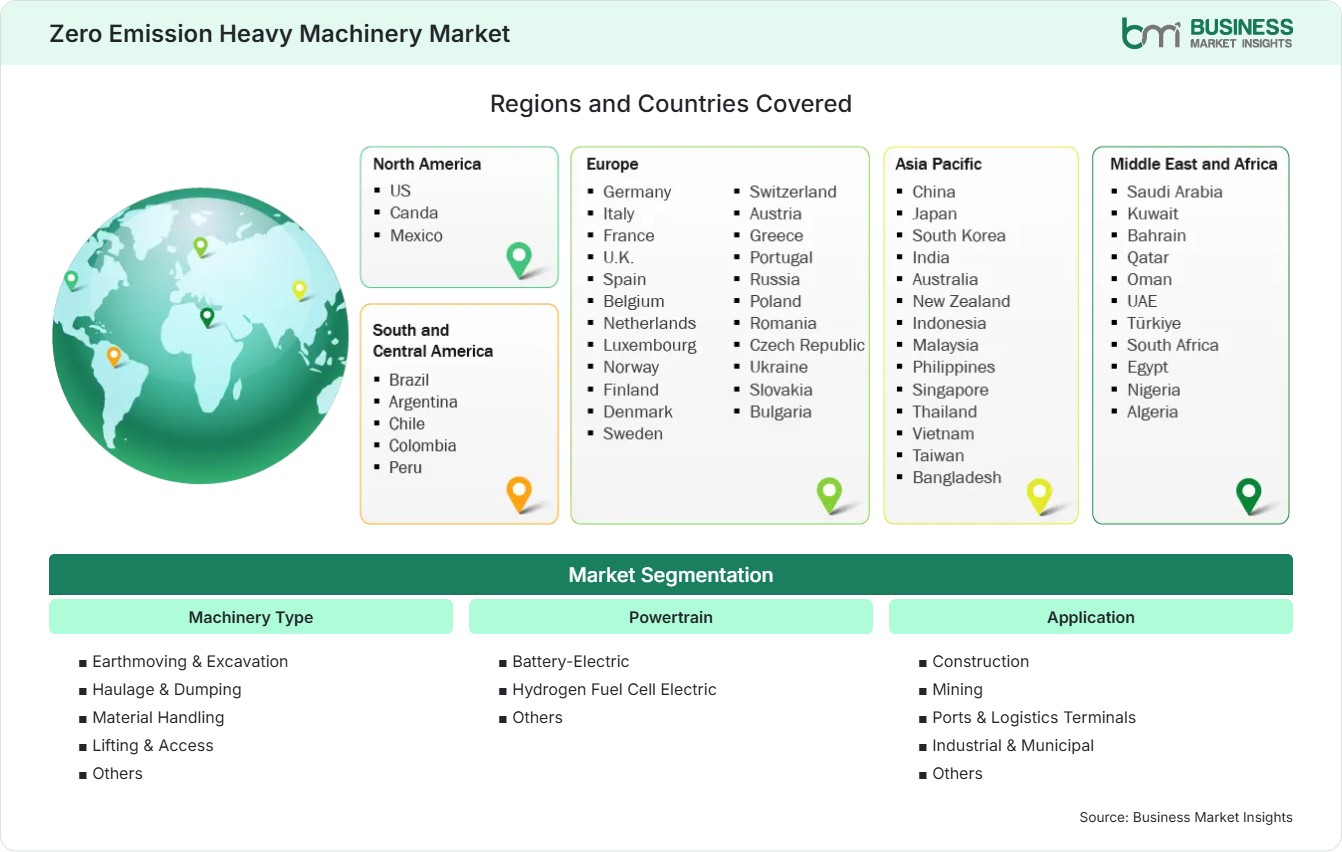
Global Market Geography
FREE PDF
Request your free sample
Request free sample
Segment Analysis

Zero Emission Heavy Machinery Market Segmentation

Machinery Type

This segment accounts for 46%–49% of industry revenue in 2025 and expands at a CAGR of 18.5%–19.5%. Demand is driven by electrification of earthmoving, material-handling, and hauling operations. The Zero Emission Heavy Machinery Market scope continues to widen as end users seek operational efficiency, emission reductions, and compliance with evolving environmental standards.

  • Earthmoving & Excavation: Electric excavators are gaining adoption across urban construction, infrastructure, and municipal applications due to lower noise output, reduced emissions, and improving battery runtime capabilities.
  • Haulage & Dumping: Mining operators increasingly deploy battery-electric and hydrogen-powered haulage equipment to reduce fuel dependency and support long-term decarbonization objectives.
  • Material Handling: Ports, warehouses, and industrial facilities are investing in electric handlers to improve air quality, lower maintenance requirements, and enhance operational efficiency.
  • Lifting & Access: Electric lifting equipment benefits from indoor suitability, lower operating costs, and compliance with noise-sensitive project requirements.

Powertrain

Powertrain technologies represent a critical competitive differentiator. The segment holds 31%–34% share in 2025 and is projected to grow at a CAGR of 19.5%–20.5%. Zero Emission Heavy Machinery Market trends indicate accelerating investment in battery systems, hydrogen fuel cells, and supporting infrastructure as users seek scalable low-carbon alternatives.

  • Battery-Electric (BEV): BEVs dominate current adoption due to established battery ecosystems, improving charging capabilities, and growing equipment availability across construction and industrial applications.
  • Hydrogen Fuel Cell Electric (FCEV): Fuel-cell solutions are increasingly attractive for heavy-duty operations that require rapid refueling, long operating hours, and reduced downtime.

Application

Applications account for 41%–44% of overall demand in 2025 and are expected to record a CAGR of 18.0%–19.0% through the forecast period. Adoption patterns vary according to operational requirements, duty cycles, sustainability targets, and regulatory pressure in different end-use industries.

  • Construction: Infrastructure development and urban renewal initiatives are driving procurement of low-emission machinery for public and private projects.
  • Mining: The sector remains a major adopter of battery-electric and hydrogen-powered platforms aimed at reducing operational emissions and fuel consumption.
  • Ports & Logistics Terminals: Electrified cargo-handling equipment supports sustainability targets while improving energy efficiency and air-quality performance.
  • Industrial & Municipal: Municipal agencies and industrial operators increasingly deploy electric fleets to meet environmental objectives and lower operating expenses.
Market Forces

Zero Emission Heavy Machinery Market Dynamics

Key Market Drivers

Global decarbonization targets accelerating equipment replacement

Governments and corporations are tightening emissions strategies across construction, mining, and industrial sectors. The International Energy Agency continues highlighting electrification as a central pathway for industrial decarbonization, while major mining companies pursue net-zero commitments. Zero Emission Heavy Machinery Market growth will be driven by replacement initiatives that will look for ways to get rid of diesel equipment. Lifecycle emissions have become more important than acquisition costs when assessing equipment purchases. Firms vying for government infrastructure contracts are incorporating electric equipment to meet the sustainability criteria. The above trends ensure a high demand scenario for battery-electric excavators, loaders, haulers, and hydrogen-powered equipment.

Rapid advances in battery technology and charging systems

Improvements in lithium-ion chemistry, thermal management, energy density, and fast-charging capability are transforming equipment economics. Manufacturers have come up with machinery that is fully equipped to operate through full shifts for certain applications. Charging infrastructure suppliers have been producing more capacity charging infrastructures that can perform well in industrial settings. Advanced digital energy management enables users to maximize their charging process and minimize any downtime. Combining long-lasting runtime and decreasing cost of batteries makes the technology commercially viable for different applications. Machinery operators see it as an approach that helps increase efficiency rather than an environmental one.

Mining sector demand for low-emission heavy equipment

Mining companies face mounting pressure from investors, regulators, and customers to reduce operational emissions. Key manufacturers have been experimenting with haul trucks, loaders, and equipment that use battery-electric and hydrogen power sources. The development of hydrogen excavators by Komatsu and hydrogen haulers, in addition to battery-electric mining by Caterpillar and Liebherr, shows increasing interest from industry players. Less need for ventilation underground and reduced dependency on fuel provide practical advantages. Moreover, the use of renewable energy sources increases the viability of such projects.

Key Market Opportunities

Expansion of hydrogen ecosystems for heavy-duty operations

Hydrogen infrastructure investment is increasing across industrial clusters, logistics corridors, and mining regions. As opposed to equipment using batteries alone, hydrogen fuel cells can provide long-term operations along with fast refueling capability. This possibility will be especially applicable to such uses as hauling, excavation, and other remote work sites. Zero Emission Heavy Machinery Market Forecasts now include hydrogen utilization prospects, since the governments provide investment into its production, transportation, and storage systems. Manufacturers that will be able to implement the hydrogen fuel cell technology into their machines will have an advantage. Cooperation between energy firms, infrastructure companies, and heavy machinery companies will facilitate the implementation process.

Electrification of ports and logistics terminals

Port authorities and logistics operators are under pressure to reduce emissions while maintaining equipment productivity. Electrified container cranes, terminal trucks, reach stackers, and material-handling equipment represent areas of high-growth opportunities. The higher volume of cargo throughput, alongside the need for sustainable development, ensures strong demand. Infrastructure is being made ready via the modernization of the grid, deployment of renewable energy sources, and integration of energy storage. Equipment suppliers benefit from subscription-based service revenues via charging solutions, software for battery efficiency, and fleet management.

Emerging-market infrastructure modernization programs

Large-scale infrastructure initiatives across Asia, the Middle East, and selected Latin American countries create opportunities for next-generation machinery deployment. New projects are increasingly designed around sustainability and energy-efficiency objectives. The implementation of green procurement practices by governments could hasten the rate of adoption. Industrial parks, transport links, renewable energy facilities, and urban development projects constitute major demand sources. Companies setting up local production facilities and services would enhance their competitive edge while reducing risks in the supply chain. Being early to the market in fast-growing countries may create lasting customer connections and fleet replacement opportunities.

Market Restraints and Challenges

High acquisition costs and financing limitations

Factor: Zero-emission machinery typically carries a higher upfront purchase price than conventional diesel alternatives due to battery systems, power electronics, and emerging technology components.

Impact: The cost sensitivity of contractors and fleet managers can affect purchasing and prolong the cycle of replacement. Small businesses are usually financially limited, even if the business case is compelling over the long run. The value retention issue is another factor influencing the purchase decision. Even as ownership costs improve, the adoption of the technology will still require more time for further development and better financing.

Charging and hydrogen infrastructure availability gaps

Factor: Many construction sites, remote mines, and industrial facilities lack adequate charging capacity or hydrogen refueling infrastructure.

Impact: Limited infrastructure increases operational complexity and may reduce confidence among prospective users. Deployment planning often requires significant investment in electrical upgrades, renewable integration, or dedicated energy systems. Equipment productivity can be affected when infrastructure expansion fails to align with fleet growth. Differences in regional standards and permitting processes create additional implementation challenges. Addressing these barriers will require coordinated action among governments, utilities, energy providers, and equipment manufacturers.

Company Analysis

Competitive Landscape

The Zero Emission Heavy Machinery Market analysis indicates competition is centered on electrification capabilities, hydrogen innovation, digital fleet management, and global service support.

Company Name

Overview

Products and Services relevant to this market

Caterpillar Inc.

Global heavy-equipment leader with significant mining and construction presence and expanding decarbonization initiatives.

Battery-electric mining solutions, electric-drive trucks, automation technologies, fleet management, and energy solutions.

Komatsu Ltd.

Major construction and mining equipment manufacturer focused on carbon-neutral equipment development.

Hydrogen excavators, electric machinery, autonomous haulage, mining equipment, and digital services.

AB Volvo

Leading provider emphasizing electrified construction machinery and sustainability-driven innovation.

Electric excavators, electric wheel loaders, charging solutions, and connected fleet services.

Hitachi Construction Machinery Co., Ltd.

International equipment manufacturer investing in next-generation low-emission technologies.

Electric excavators, mining machinery, telematics, and productivity-enhancement solutions.

Liebherr-International AG

Diversified machinery specialist with strong mining and earthmoving expertise.

Battery-electric mining trucks, electric excavators, charging technologies, and automation systems.

Deere & Company

Equipment manufacturer expanding sustainable construction equipment capabilities.

Electrified machinery, smart-jobsite systems, and machine control technologies.

SANY Heavy Industry Co., Ltd.

Major Asian manufacturer increasing electric equipment commercialization.

Electric excavators, loaders, lifting equipment, and industrial electrification products.

XCMG Group

Large-scale construction equipment producer with growing alternative-power portfolio.

Electric construction machinery, battery systems, and smart fleet platforms.

Epiroc AB

Mining and infrastructure specialist with emphasis on sustainable operations.

Battery-electric mining vehicles, underground equipment, digital platforms, and fleet optimization services.

Sandvik AB

Technology-focused supplier supporting mining productivity and sustainability.

Battery-electric underground equipment, automation, digital mining solutions, and support services.

Trust & Transparency

Research Methodology

The market analysis combines proprietary research with secondary data from government agencies, company disclosures, regulatory filings, industry databases and expert interviews. Market estimates are validated through data triangulation, cross-market benchmarking and analyst review.

View Full Research Methodology

Questions Answered

Frequently Asked Questions

Which regions provide the most attractive future opportunities?

Asia Pacific offers the strongest growth outlook due to industrialization, infrastructure development, battery manufacturing expansion, mining activity, and supportive government policies encouraging equipment electrification.

How is this Zero Emission Heavy Machinery Market Report useful for investors?

The report identifies technology trends, growth segments, regional opportunities, competitive positioning, infrastructure requirements, and commercialization pathways influencing long-term investment decisions.

What role does hydrogen technology play in market development?

Hydrogen supports heavy-duty operations requiring long runtimes and rapid refueling. It is particularly relevant for mining, haulage, and remote industrial sites where charging limitations may affect battery-only equipment.

Which application area generates the strongest demand?

Construction remains the largest application category because of public infrastructure spending, urban-development activities, environmental procurement requirements, and availability of commercially proven electric equipment options.

What factors are accelerating adoption of zero-emission machinery?

Stringent emission regulations, sustainability commitments, infrastructure modernization projects, battery improvements, and increasing customer focus on lifecycle emissions are driving adoption across construction, mining, and industrial sectors.

Access the Full Zero Emission Heavy Machinery Market Report

Get segment-level forecasts, regional estimates, competitive benchmarking, company profiles and downloadable Excel datasets.

Access the full Zero Emission Heavy Machinery Market Report
350 pages PDF & Excel | 2026-08-28