
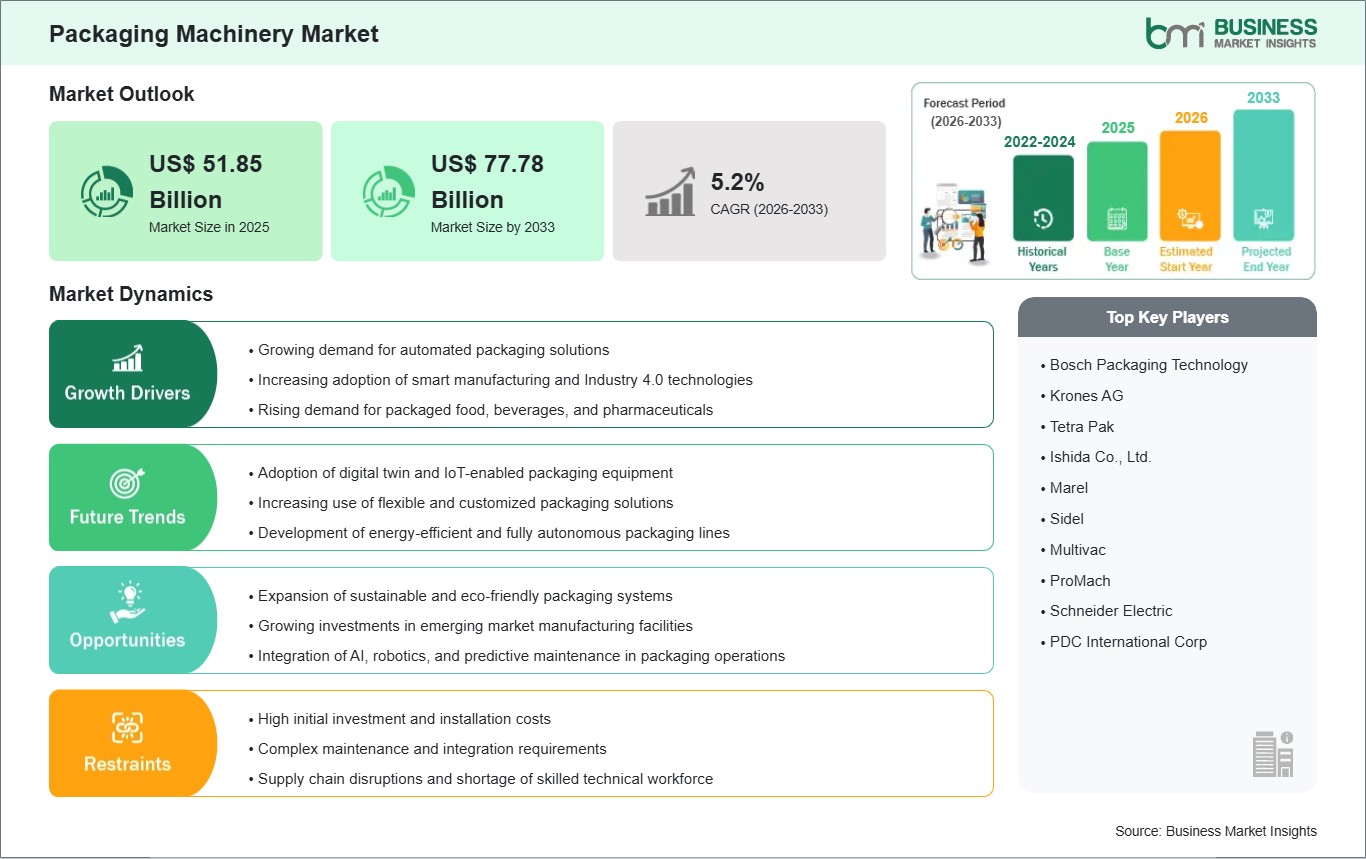
The packaging machinery market size is expected to reach US$ 77.78 billion by 2033 from US$ 51.85 billion in 2025. The market is estimated to record a CAGR of 5.2% from 2026 to 2033.
Packaging machinery comprises industrial systems that fill, seal, label, wrap, cart, and organize products for storage, transport, and retail presentation. These systems support line efficiency, product protection, pack consistency, and format control across high-volume manufacturing environments. Their role has expanded as producers seek tighter throughput management, cleaner operations, and stronger compatibility with changing packaging formats.
Investment momentum across this sector reflects the need to improve line precision while reducing manual intervention in repetitive packaging tasks. Producers in food, beverage, pharmaceutical, and personal care settings are modernizing equipment to support faster changeovers, stable output quality, and better handling of diverse pack sizes. This shift also aligns with stricter hygiene expectations and closer monitoring of operational performance.
From a segmentation perspective, filling, form-fill-seal, labeling, and cartoning equipment remain central to production workflows because they address core packaging functions. Automatic systems hold strategic importance where labor optimization and line synchronization are critical, while semi-automatic formats retain relevance for smaller batch operations. Across end-use categories, beverages, food, and pharmaceuticals sustain broad equipment demand due to volume intensity and packaging compliance needs.
Technology development is reshaping machine architecture through smarter controls, modular formats, and better integration with digital production environments. Equipment suppliers are focusing on flexible systems that can manage material variation, shorter production runs, and frequent design updates without extensive downtime. This evolution improves asset utilization and supports manufacturers pursuing more responsive packaging operations.
The competitive environment is shaped by innovation in machine efficiency, line customization, and service capability rather than scale alone. Market participants differentiate through automation depth, application engineering, retrofit support, and integration expertise. As purchasing decisions increasingly weigh adaptability and lifecycle performance, suppliers that align technical reliability with operating flexibility are strengthening their position across this industry.

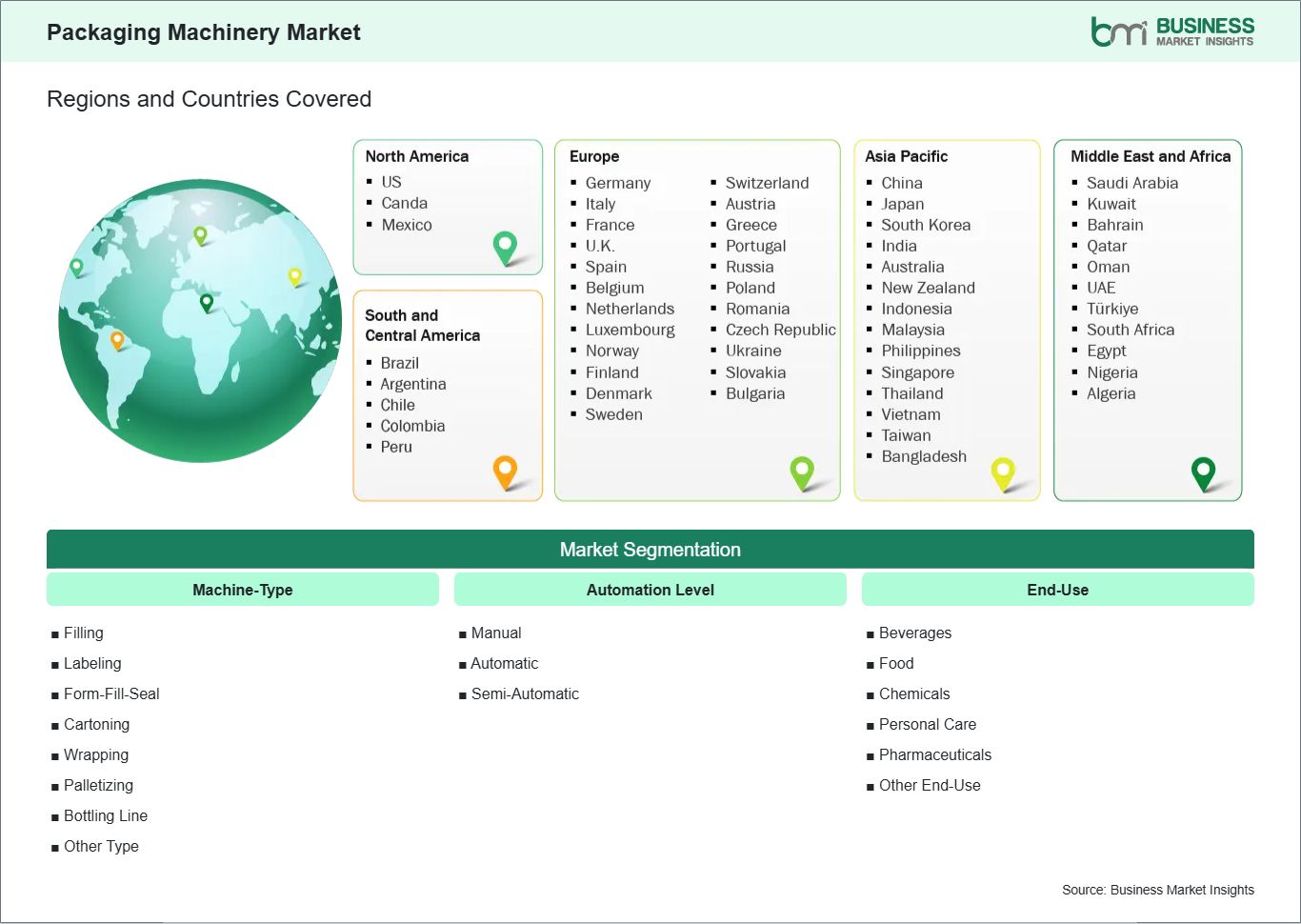
The packaging machinery market is segmented based on type, automation level, and end-use, reflecting its critical role in municipal and industrial water treatment, air purification, and pharmaceutical manufacturing.
Filling : Supports accurate dosing across liquid, powder, and viscous product applications.
Labeling : Enables traceability, branding consistency, and regulatory information placement.
Form-Fill-Seal : Combines multiple packaging stages within one compact production configuration.
Cartoning : Improves secondary packaging efficiency for retail and transport formats.
Wrapping : Protects products during handling, storage, and distribution movement.
Palletizing : Streamlines end-of-line stacking for warehouse and shipping readiness.
Bottling Line : Integrates rinsing, filling, capping, and conveying for containerized products.
Other Type : Covers specialized machinery built for niche packaging requirements..
Manual : Fits low-volume operations requiring direct operator control.
Automatic : Delivers synchronized, high-throughput performance with limited human intervention.
Semi-Automatic : Balances flexibility and efficiency for mid-scale production settings.
Beverages : Requires speed, fill integrity, and continuous line coordination.
Food : Prioritizes hygiene, portion control, and packaging versatility.
Chemicals : Demands durable handling systems for safety-sensitive formulations.
Personal Care : Supports presentation quality and frequent product variation.
Pharmaceuticals : Emphasizes accuracy, traceability, and controlled packaging conditions.
Other End-Use : Includes specialized industrial packaging applications beyond core sectors.
Manufacturers are under pressure to maintain output consistency while managing labor constraints, product variation, and stricter packaging requirements. This operating environment is pushing packaging facilities toward automated machinery that can execute repeatable tasks with tighter control. As production complexity increases, businesses are selecting systems that improve coordination across filling, sealing, labeling, and end-of-line operations.
The effect extends beyond speed because automation strengthens process discipline, supports cleaner production flows, and reduces disruption during changeovers. These advantages matter in sectors where packaging quality directly affects shelf appeal, compliance, and throughput reliability. As a result, automated equipment remains closely aligned with capital spending priorities across packaging-intensive manufacturing environments.
Packaging operations are shifting toward shorter runs, multiple stock-keeping units, and material formats that require adaptable machine settings. This trend is encouraging innovation in modular systems, digital controls, and sensor-enabled equipment that can respond to changing production inputs. Use cases are expanding where manufacturers need quick reconfiguration without sacrificing line continuity or pack precision.
Future scope is notable as connected machinery supports predictive maintenance, performance visibility, and broader integration with plant-level systems. Suppliers that offer scalable platforms can address both retrofit demand and greenfield investments across emerging and established industries. This opens room for differentiated solutions that improve operating resilience while supporting long-term packaging modernization.
The Packaging Machinery Market was valued at USD 51.85 Billion in 2025 and is projected to reach USD 77.78 Billion by 2033, expanding at a CAGR of 5.2% during 2026 - 2033. This trajectory indicates sustained capital allocation toward equipment modernization, reflecting the need for higher packaging efficiency, stronger format flexibility, and better process control across industrial production lines.
Among machine categories, filling and form-fill-seal systems hold a leading position because they address essential packaging functions across diverse manufacturing settings. Automatic equipment also commands a strong share as larger production facilities prioritize synchronized throughput, reduced manual dependence, and consistent pack quality throughout multi-stage packaging operations.
From an application perspective, food and beverages represent the most influential end-use base due to high packaging volumes, regular product turnover, and strict handling requirements. Pharmaceuticals also retain a significant position because packaging lines in this area require precision, traceability, and dependable operating performance under controlled production conditions.
| Report Attribute | Details |
|---|---|
| Market size in 2025 | US$ 51.85 Billion |
| Market Size by 2033 | US$ 77.78 Billion |
| Global CAGR (2026 - 2033) | 5.2% |
| Historical Data | 2022-2024 |
| Forecast period | 2026-2033 |
| Segments Covered | By Machine-Type
|
|
Regions and Countries Covered
| |
| North America | US, Canada, Mexico |
| Europe | Germany, Italy, France, U.K., Spain, Belgium, Netherlands, Luxembourg, Norway, Finland, Denmark, Sweden, Switzerland, Austria, Greece, Portugal, Russia, Poland, Romania, Czech Republic, Ukraine, Slovakia, Bulgaria |
| Asia-Pacific | China, Japan, South Korea, India, Australia, New Zealand, Indonesia, Malaysia, Philippines, Singapore, Thailand, Vietnam, Taiwan, Bangladesh |
| South and Central America | Brazil, Argentina, Chile, Colombia, Peru |
| Middle East and Africa | Saudi Arabia, United Arab Emirates, Kuwait, Bahrain, Qatar, Oman, Turkiye, South Africa, Egypt, Nigeria, Algeria |
| Market leaders and key company profiles |
|
The "Packaging Machinery Market Size and Forecast (2022:2033)" report provides a detailed analysis of the market covering below areas:
The Packaging Machinery market shows diverse regional adoption patterns influenced by industrial maturity, packaging standards, labor economics, and the pace of manufacturing modernization. At a global level, procurement decisions increasingly reflect the need for flexible systems that can accommodate product variety, faster turnaround requirements, and tighter control over packaging quality across different production environments.
North America maintains a technically advanced market structure shaped by replacement demand, automation upgrades, and strong emphasis on production efficiency. Buyers in this region typically prioritize integrated machinery, digital monitoring capability, and equipment that supports reliable throughput in food, beverage, and pharmaceutical packaging lines. Demand also reflects a preference for solutions that reduce downtime and simplify maintenance planning.
Asia Pacific presents a broad expansion landscape supported by manufacturing scale, industrial diversification, and the continued buildout of packaging capacity. Equipment demand is shaped by both high-volume production hubs and mid-sized processors seeking operational improvements. The region also shows strong interest in modular systems that balance cost discipline with performance, especially where product portfolios are widening and packaging formats are becoming more varied.
Europe demonstrates steady demand centered on engineering precision, material compatibility, and compliance-focused packaging operations. Investment patterns often favor systems that support advanced controls, format adaptability, and efficient use of resources. Across emerging markets in the Middle East, Africa, and South and Central America, deployment is linked to industrial development, packaged goods expansion, and the gradual shift from labor-intensive packaging formats toward more standardized machinery-led processes.

The packaging machinery market is evaluated by gathering qualitative and quantitative data post primary and secondary research, which includes important corporate publications, association data, and databases. Recent developments and news in the market include:
The Packaging Machinery Market is valued at US$ 51.85 Billion in 2025, it is projected to reach US$ 77.78 Billion by 2033.
As per our report Packaging Machinery Market, the market size is valued at US$ 51.85 Billion in 2025, projecting it to reach US$ 77.78 Billion by 2033. This translates to a CAGR of approximately 5.2% during the forecast period.
The Packaging Machinery Market report typically cover these key segments-
The historic period, base year, and forecast period can vary slightly depending on the specific market research report. However, for the Packaging Machinery Market report:
The Packaging Machinery Market is populated by several key players, each contributing to its growth and innovation. Some of the major players include:
The Packaging Machinery Market report is valuable for diverse stakeholders, including:
Essentially, anyone involved in or considering involvement in the Packaging Machinery Market value chain can benefit from the information contained in a comprehensive market report.
Please tell us your area of interest
(Market Segments/ Regions and Countries/ Companies)