
Sustainable Machinery Equipment Market Outlook: Size, Share, Trends, Growth Analysis, Competitive Landscape & Forecast, 2026-2033

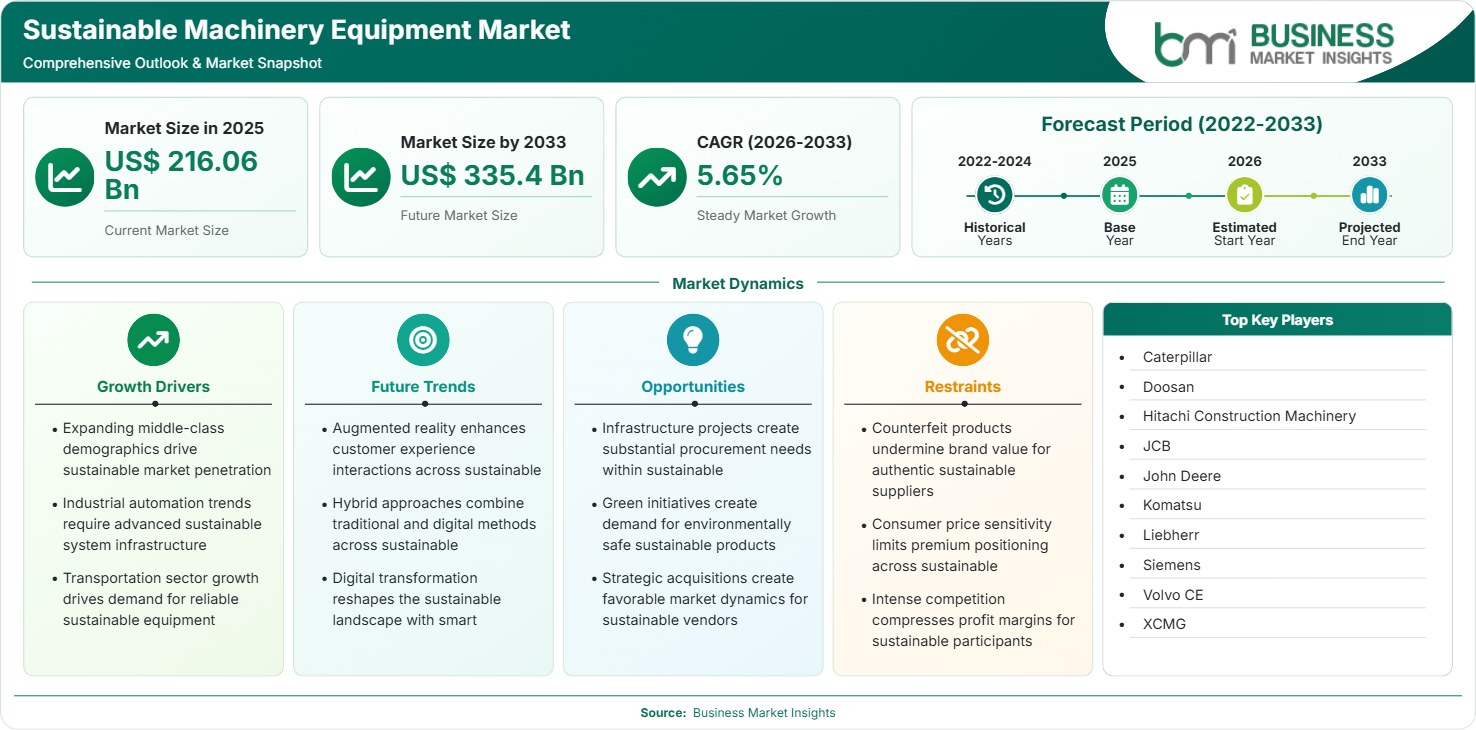
The Sustainable Machinery Equipment Market size was valued at US$ 216.06 Billion in 2025 and is projected to reach US$ 335.4 Billion by 2033, growing at a CAGR of 5.65% during 2026–2033, driven by electrification, energy efficiency, automation, circularity, emissions reduction, and investment in cleaner industrial infrastructure.

Report Coverage
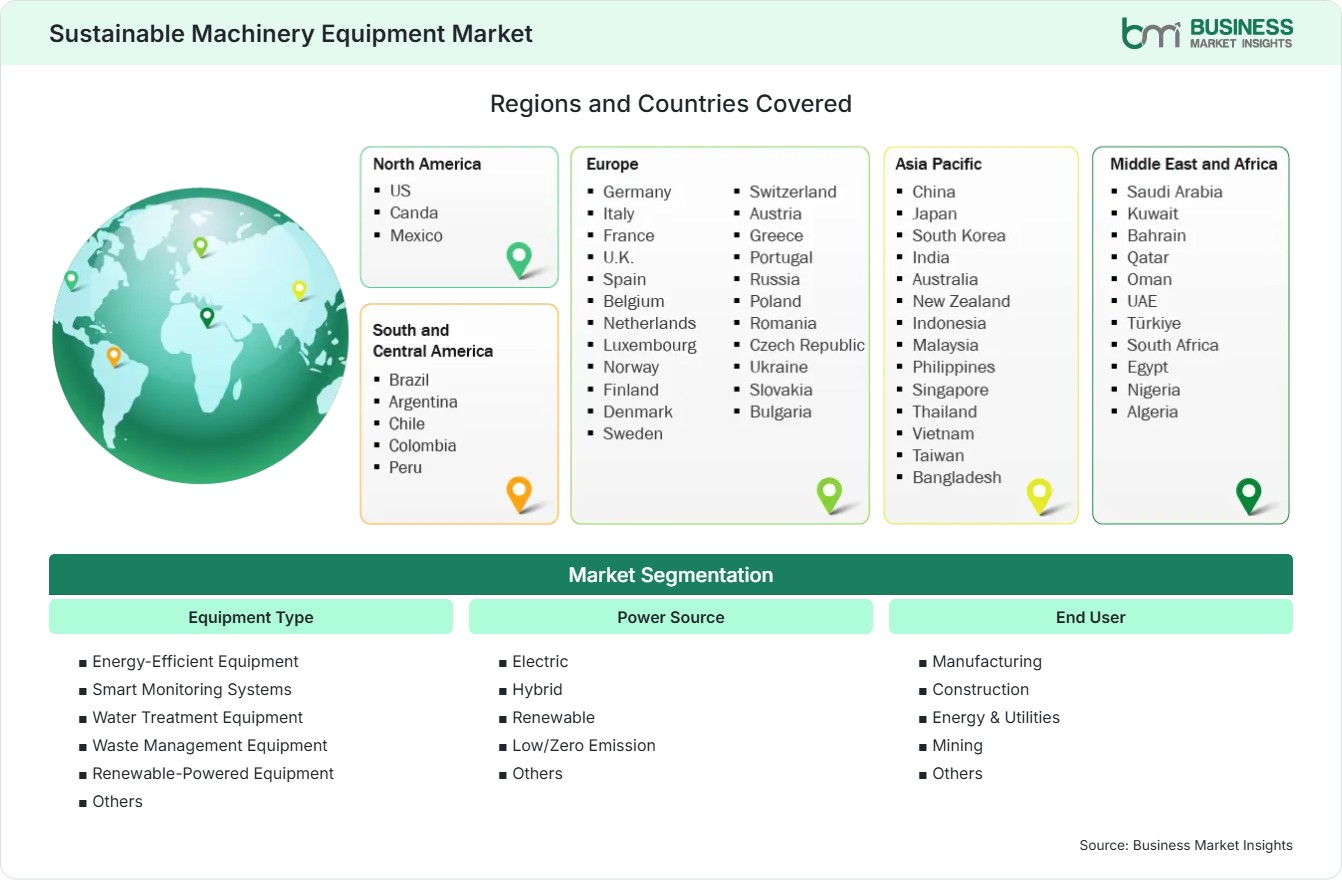
  • Equipment Type: Energy-Efficient Equipment, Smart Monitoring Systems, Water Treatment Equipment, Waste Management Equipment, Renewable-Powered Equipment, Others
  • Power Source: Electric, Hybrid, Renewable, Low/Zero Emission, Others
  • End User: Manufacturing, Construction, Energy & Utilities, Mining, Others
US$ 216.06 Bn Market size in 2025
US$ 335.4 Bn Market Size by 2033
5.65% CAGR, 2026 - 2033
2026-2033 Forecast Period

AI Overview

Sustainable Machinery Equipment Market Summary

  • North America Region: North America holds a market share of 29%–33% in 2025, growing with a CAGR of 5.2%–5.8% during 2026–2033, influenced by fleet electrification, federal infrastructure spending, industrial automation, clean-energy investment, and stricter emissions performance requirements. The U.S. market is supported by construction modernization, industrial automation, and electrification investments, with a 5.3%–5.9% CAGR during 2026–2033.
  • Fastest Growing Region: Asia Pacific holds a market share of 27%–31% in 2025, growing with a CAGR of 6.4%–7.1% during 2026–2033, supported by rapid industrialization, urban infrastructure development, renewable-power deployment, manufacturing expansion, and accelerated adoption of electric and hybrid machinery.
  • Leading Segment: Energy-Efficient Equipment holds a market share of 31%–35% in 2025, growing with a CAGR of 5.8%–6.4% during 2026–2033, driven by industrial energy optimization, operating-cost reduction, carbon reporting, equipment modernization, and demand for productive machinery with lower lifetime energy consumption.
  • High Growth Segment: Renewable-Powered Equipment holds a market share of 13%–17% in 2025, growing with a CAGR of 7.2%–8.1% during 2026–2033, supported by distributed generation, battery integration, remote operations, renewable-energy procurement, diesel displacement, and rising demand for resilient low-carbon machinery across infrastructure projects.
  • Key Market Opportunity: The strongest opportunity lies in integrated equipment ecosystems combining electrified machinery, renewable power, digital monitoring, predictive maintenance, and energy management, enabling customers to reduce operating costs while improving asset utilization and emissions visibility.
  • Major Market Players: Caterpillar Inc., Doosan Corporation, Hitachi Construction Machinery Co., Ltd., J C Bamford Excavators Ltd., Deere & Company, Komatsu Ltd., Liebherr-International AG, Siemens AG, Volvo Construction Equipment AB, and XCMG Group.
Strategic Insights

Sustainable Machinery Equipment Market: Strategic Insights

Sustainable Machinery Equipment Market Strategic Framework
FREE PDF
Request your free sample
Request free sample
Stakeholder View

Key Takeaways

  • The value chain is moving from equipment manufacturing toward integrated ecosystems involving OEMs, component suppliers, software providers, utilities, financiers, charging specialists, and aftermarket service networks. Competitive advantage increasingly depends on interoperability and lifecycle economics.
  • The highest upside is emerging in energy-efficient equipment, electrified fleets, renewable-powered machinery, smart monitoring, and water and waste systems where customers can directly connect sustainability investments with lower energy, maintenance, fuel, and resource costs.
  • Product innovation is shifting toward modular battery architectures, hybrid power management, AI-enabled predictive maintenance, autonomous operation, digital twins, remote diagnostics, and energy-aware controls that optimize equipment performance continuously rather than only at scheduled service intervals.
  • India, China, Japan, and Southeast Asian manufacturing hubs present compelling investment cases because industrial expansion, infrastructure modernization, and renewable-power deployment are increasing demand for efficient equipment across factories, construction sites, utilities, and resource-intensive operations.
  • Investment and partnership activity is increasingly focused on integrated decarbonization platforms rather than isolated hardware. Recent industry developments demonstrate growing collaboration between equipment manufacturers, energy providers, technology companies, and industrial customers to solve charging and operational integration challenges.
Geographic Outlook

Sustainable Machinery Equipment Market Regional Highlights

North America Sustainable Machinery Equipment Market

North America represented 29%–33% of Sustainable Machinery Equipment Market share in 2025 and is projected to expand at a CAGR of 5.2%–5.8% during 2026–2033. Demand is supported by construction modernization, industrial reshoring, fleet replacement, clean-energy investment, and digital asset management. The United States remains the dominant market, while Canada benefits from mining, infrastructure, utilities, and resource-efficiency investment. The regional procurement environment increasingly rewards equipment capable of demonstrating lower fuel consumption, emissions intensity, downtime, and lifecycle operating costs.

  • Federal and state infrastructure investment is supporting demand for efficient construction, utility, transport, and municipal equipment with improved productivity and lower operating emissions.
  • Industrial reshoring is increasing investment in automated production systems, energy management, efficient motors, digital monitoring, and machinery capable of supporting lower-carbon manufacturing operations.
  • Mining operators are evaluating electrification, hybridization, remote monitoring, and energy optimization to reduce diesel dependence while maintaining productivity across demanding duty cycles.
  • Canada presents opportunities in mining, utilities, hydroelectric infrastructure, and remote operations where renewable-powered and hybrid equipment can reduce fuel logistics and improve resilience.
  • The region’s aftermarket ecosystem is increasingly important as predictive maintenance, remanufacturing, component upgrades, and software subscriptions extend asset life and generate recurring revenue.

US Sustainable Machinery Equipment Market

The U.S. accounted for 24%–28% of Sustainable Machinery Equipment Market share in 2025 and is expected to grow at a CAGR of 5.3%–5.9% during 2026–2033. Industrial reshoring, infrastructure construction, data-center development, renewable-energy projects, and fleet modernization are supporting demand. Buyers increasingly evaluate total cost of ownership, energy consumption, emissions, uptime, and digital service capabilities together. Large contractors and industrial operators are also creating demonstration projects to validate electric, hybrid, and connected machinery before broader fleet deployment.

  • Construction contractors are prioritizing electric compact equipment and connected fleet systems for urban projects where noise, local emissions, and operating efficiency influence project economics.
  • Manufacturing investment is accelerating demand for automation, energy monitoring, efficient production equipment, and software-enabled maintenance that improves utilization and reduces unplanned downtime.
  • Renewable-energy and grid infrastructure development creates demand for specialized equipment capable of operating efficiently across construction, installation, maintenance, and remote service environments.
  • Mining and heavy industry remain important opportunities for hybrid powertrains, autonomous systems, electrified material handling, and advanced monitoring technologies.

Europe Sustainable Machinery Equipment Market

Europe held 22%–26% of Sustainable Machinery Equipment Market share in 2025 and is projected to grow at a CAGR of 5.6%–6.2% during 2026–2033. Germany remains a leading market because of advanced manufacturing, industrial automation, and engineering capabilities, while the Netherlands and Sweden are among high-growth markets with approximately 6.3%–7.1% CAGRs. France, Italy, and the United Kingdom also provide opportunities through infrastructure modernization, industrial efficiency programs, and low-emission equipment adoption.

  • European procurement increasingly connects machinery selection with energy performance, carbon accounting, circularity, repairability, and lifecycle environmental impact.
  • Germany combines advanced automation with strong industrial equipment capabilities, creating demand for digital twins, efficient production systems, and integrated energy management.
  • Sweden and the Netherlands are developing visible use cases for electric construction equipment, charging integration, and low-emission urban operations.
  • Construction and mining equipment manufacturers are expanding zero-emission portfolios while testing hydrogen, battery, and hybrid solutions for different duty cycles.
  • Industrial customers are increasingly seeking software-enabled performance optimization that can translate energy and emissions data into operational decisions.

Asia Pacific Sustainable Machinery Equipment Market

Asia Pacific accounted for 27%–31% of Sustainable Machinery Equipment Market share in 2025 and is projected to expand at a CAGR of 6.4%–7.1% during 2026–2033. China remains the leading market, while India, Vietnam, and Indonesia represent high-growth opportunities with approximately 7.0%–8.2% CAGRs. Manufacturing expansion, urban infrastructure, mining, renewable-power deployment, and industrial modernization are creating a broad demand base for efficient, connected, electrified, and resource-saving equipment.

  • China combines large-scale manufacturing capacity with rapid adoption of electric machinery, automation, renewable energy systems, and digitally managed industrial equipment.
  • India offers strong potential as infrastructure investment, manufacturing expansion, renewable deployment, and industrial modernization increase demand for efficient machinery.
  • Japan supports advanced opportunities in robotics, energy efficiency, precision manufacturing, construction technology, and lifecycle optimization for industrial assets.
  • Southeast Asian economies are attracting factories and infrastructure investment, creating demand for reliable equipment that reduces energy, water, fuel, and maintenance requirements.
  • Mining and heavy industrial operations are increasingly evaluating hybridization, electrification, remote monitoring, and renewable-powered systems to improve operational resilience.

Rest of World Sustainable Machinery Equipment Market

South and Central America represented 9%–12% of Sustainable Machinery Equipment Market share in 2025, with a projected CAGR of 5.8%–6.6% through 2033. Brazil leads regional demand, while Chile and Colombia offer high-growth opportunities at approximately 6.7%–7.5% CAGRs. Mining, agriculture, construction, renewable energy, and utilities are key adoption areas where efficient machinery can reduce fuel intensity and improve productivity.

The Middle East and Africa represented 8%–11% of Sustainable Machinery Equipment Market share in 2025 and is projected to grow at a CAGR of 6.0%–6.9%. Saudi Arabia, the United Arab Emirates, and South Africa provide leading opportunities, while Morocco and Egypt show strong potential through renewable energy, infrastructure, water management, and industrial diversification.

  • Latin American mining operations are evaluating electrification, renewable power, efficient processing equipment, and digital monitoring to manage energy intensity and operational costs.
  • Brazil’s industrial, agricultural, infrastructure, and energy sectors create a diversified demand base for machinery with improved efficiency and lower resource consumption.
  • Gulf economies are investing in smart infrastructure, renewable energy, water systems, and industrial diversification, creating opportunities for integrated sustainable equipment platforms.
  • Africa presents demand for solar-powered, hybrid, efficient, and remotely monitored equipment where grid limitations and fuel logistics affect project economics.
  • Water treatment, waste management, and distributed energy equipment offer particularly strong opportunities in regions facing resource constraints and rapid urban development.
Global Market Geography
FREE PDF
Request your free sample
Request free sample
Segment Analysis

Sustainable Machinery Equipment Market Segmentation

Equipment Type

Energy-Efficient Equipment led the Sustainable Machinery Equipment Market with 31%–35% share in 2025 and is projected to grow at a CAGR of 5.8%–6.4% during 2026–2033. Adoption is supported by energy costs, carbon targets, automation, and lifecycle savings. Smart monitoring, water treatment, waste management, and renewable-powered equipment are expanding as industrial customers seek measurable resource efficiency and integrated operational sustainability across assets, facilities, and infrastructure projects.

  • Energy-Efficient Equipment: High-efficiency motors, drives, compressors, pumps, and optimized machinery reduce energy intensity, supporting industrial modernization, operating-cost control, emissions reduction, and equipment replacement cycles.
  • Smart Monitoring Systems: Sensors, telemetry, analytics, and predictive maintenance improve asset visibility, reduce downtime, optimize utilization, and enable data-based sustainability reporting across distributed equipment fleets.
  • Water Treatment Equipment: Advanced filtration, recycling, desalination, and wastewater systems support industrial water security, regulatory compliance, resource recovery, and growing demand for closed-loop operations.
  • Waste Management Equipment: Sorting, compacting, recycling, recovery, and processing machinery supports circular economy models, municipal infrastructure expansion, material recovery, and lower landfill dependence.
  • Renewable-Powered Equipment: Solar, wind, battery, and other renewable energy integrations reduce diesel dependence, strengthen remote operations, and support low-emission infrastructure, agriculture, mining, and construction applications.

Power Source

Electric equipment held 28%–32% of the Sustainable Machinery Equipment Market in 2025, while the broader power-source segment is projected to expand at a CAGR of 5.9%–6.5% during 2026–2033. Electrification is strongest in suitable duty cycles, whereas hybrid, renewable, and low or zero-emission systems address heavier loads, remote operations, and infrastructure constraints. Technology selection increasingly depends on duty cycle, charging, energy availability, and lifecycle economics.

  • Electric: Battery-electric and grid-connected systems reduce local emissions, noise, and fuel consumption, supporting urban construction, manufacturing, warehouses, utilities, and compact machinery applications.
  • Hybrid: Hybrid powertrains combine engine and electric technologies to improve fuel efficiency, capture regenerative energy, and support heavy-duty applications requiring extended operating endurance.
  • Renewable: Solar, wind, and renewable-generated electricity support remote machinery, distributed operations, charging systems, and projects seeking lower lifecycle carbon intensity and reduced fuel logistics.
  • Low/Zero Emission: Hydrogen, advanced battery, fuel-cell, and other low-emission systems target demanding applications where conventional electrification requires longer range, faster refueling, or higher continuous power.
  • Others: Conventional and emerging power systems remain relevant where infrastructure, duty cycles, cost, or operational requirements limit immediate transition toward electrified and renewable alternatives.

End User

Manufacturing represented 27%–31% of the Sustainable Machinery Equipment Market in 2025 and is projected to grow at a CAGR of 5.7%–6.3% during 2026–2033. Construction, energy and utilities, mining, and other end users are adopting sustainable machinery as energy efficiency, resource productivity, emissions management, and digitalization become increasingly integrated into capital expenditure, operational planning, and asset management decisions.

  • Manufacturing: Automated, efficient, connected machinery supports production productivity, energy management, predictive maintenance, quality improvement, and lower resource intensity across factories.
  • Construction: Electric, hybrid, connected, and low-emission equipment helps contractors manage urban emissions, fuel costs, noise constraints, productivity requirements, and sustainability specifications.
  • Energy & Utilities: Efficient equipment supports generation, transmission, distribution, water infrastructure, renewable projects, grid modernization, and maintenance operations requiring high reliability.
  • Mining: Electrification, automation, remote monitoring, hybridization, and energy optimization address heavy-duty energy consumption, worker safety, productivity, and emissions reduction challenges.
Market Forces

Sustainable Machinery Equipment Market Dynamics

Key Market Drivers

Industrial Electrification and Energy Efficiency

Electrification is becoming a core procurement strategy as industrial operators seek lower energy intensity, reduced local emissions, and more predictable operating costs. Siemens reported in 2026 that 65% of surveyed industrial leaders viewed electrification as the most effective lever for net-zero targets, while 63% identified digitalization as a critical enabler of the energy transition. These signals reinforce the Sustainable Machinery Equipment Market growth opportunity for electric motors, battery systems, intelligent controls, efficient drive systems, and energy management systems. This means that the market trends have changed from mere equipment replacement to power optimization. Companies that can develop hardware and software to monitor power efficiency will realize value for themselves and their customers in retaining clients.

Connected Equipment and Predictive Maintenance

Connected machinery is expanding because industrial customers increasingly require visibility into utilization, energy consumption, component health, and downtime risk. Sensors, edge computing, cloud analytics, digital twins, and AI-based diagnostics enable operators to identify abnormal conditions before failures disrupt production. This technology shift changes the revenue model for equipment manufacturers by creating recurring opportunities in software, remote monitoring, optimization, and service contracts. The Sustainable Machinery Equipment Market growth is consequently linked to the ability to convert equipment data into operational savings rather than merely collect telemetry. Predictive maintenance also supports sustainability by extending asset life, reducing unnecessary component replacement, improving energy performance, and optimizing service visits. As digital capabilities become embedded in machinery, interoperability and cybersecurity will increasingly influence supplier selection and fleet modernization decisions.

Resource Productivity and Circular Industrial Operations

Manufacturers and infrastructure operators are increasingly evaluating machinery through the lens of material, water, energy, and waste productivity. Equipment that supports recycling, remanufacturing, water reuse, efficient processing, and lower material losses is gaining relevance as resource security becomes an operational priority. The Sustainable Machinery Equipment Market trends reflect this shift toward circularity, with customers seeking machinery that can improve resource recovery while reducing operating intensity. Circular design also helps create additional opportunities within the after-sales segment due to refurbishing, remanufacturing, modularity, and increased longevity. Manufacturers with effective capabilities in reverse logistics and lifecycle engineering will be able to enhance their margins while at the same time becoming less dependent on materials. This driver is particularly applicable for the mining, manufacturing, water treatment, waste management, and construction sectors.

Key Market Opportunities

Integrated Electrified Equipment and Energy Systems

The strongest opportunity is the development of integrated systems linking electric machinery with charging, energy storage, renewable generation, grid management, and operational software. The trend towards customers requiring a full-fledged deployment solution has risen because the electrification of equipment may face challenges in terms of the availability of electricity at a particular site, charging timing, and varied workloads. The recent demonstrations made in the industry indicate that the trend of the market is shifting towards a managed approach to energy rather than individual battery machines. Sustainable Machinery Equipment Market Forecasts indicates that there will be a growing need for integrated solutions in construction, mining, utility, logistics, and manufacturing industries where energy systems play a role in the usage of equipment. Joint efforts from OEMs, utilities, energy firms, and technology vendors will help to facilitate deployment and establish defendable ecosystems.

Low-Emission Heavy-Duty Machinery

Heavy-duty applications represent a significant opportunity because high fuel consumption and difficult operating conditions create strong economic incentives for alternative power systems. Battery electric vehicles (BEVs), hybrids, hydrogen energy, and renewable assisted systems are all technologies that can be employed for various duty cycles, particularly for applications in mining, quarrying, construction, ports, and utilities. The current product development efforts place more emphasis on matching appropriate powertrains according to their requirements. There is room for expansion beyond selling the equipment itself by providing value-added services such as charging solutions, energy management, finance, maintenance, and fleet transition services. Companies that offer transition roadmaps will be able to guide their clients in executing their pilots, investing in infrastructure, and replacing their fleets.

Water, Waste, and Resource Recovery Infrastructure

Urbanization, industrial expansion, water stress, and circular economy objectives are creating demand for machinery that improves resource recovery and reduces environmental intensity. Water treatment equipment, waste sorting systems, recycling machinery, and recovery technologies can benefit from public infrastructure investment and industrial sustainability programs. The potential will be especially promising where resource scarcity impacts the process or performance of operations. Technological companies could capitalize on this opportunity by providing automation technology, sensing sorters, efficient energy technology, modularity and remote monitoring capabilities. Integrated solutions encompassing collection, processing, recovery and data reporting would be more economical while meeting the necessary environmental regulations. There is also greater opportunity for growth within emerging economies in which newer technology can be developed without the hindrance of legacy equipment.

Market Restraints and Challenges

High Upfront Investment and Infrastructure Constraints

Factor: Sustainable equipment often requires higher initial capital expenditure because advanced batteries, power electronics, automation, charging infrastructure, sensors, and integrated energy systems add cost before operating savings are realized.

Impact: This can delay adoption among smaller contractors, manufacturers, municipalities, and resource operators with limited access to financing or uncertain utilization rates. The problem is further compounded when charging systems, grid improvements, or renewable power generation are to be installed along with the machinery. Models of total cost of ownership help in better investment choices, but technology risk, residual value, and uneven availability of infrastructure remain hurdles for consumers. Leasing of machinery, performance-based agreements, service-based business models, and phased fleet replacement plans by the manufacturers and financial institutions can help overcome this barrier.

Battery Supply, Technology Risk, and Operational Compatibility

Factor: Sustainable machinery depends on batteries, power electronics, software, charging systems, and specialized components whose supply chains remain exposed to material availability, technology changes, and regional infrastructure differences.

Impact: Equipment buyers may delay procurement when concerns arise about replacement cost, battery life, charging time, residual value, or compatibility with existing fleets. Highly demanding tasks also entail dependability under conditions of high loads, high temperatures, and lengthy operating cycles. This will make it difficult for a particular powertrain to be suitable in all uses. The solution by manufacturers may be in having modular designs, battery warranties, standard charging procedures, hybrid options, service infrastructure, and neutral technology transition plans.

Company Analysis

Competitive Landscape

The Sustainable Machinery Equipment Market analysis indicates that competition is increasingly shaped by the convergence of machinery engineering, electrification, automation, digital services, energy management, and lifecycle support. Leading companies are expanding sustainable portfolios while building partnerships that address charging, software, power systems, predictive maintenance, and operational integration.

Company Name

Overview

Products and Services relevant to this market

Caterpillar Inc.

A global heavy-equipment manufacturer with extensive construction, mining, energy, and industrial capabilities, increasingly focused on lower-emission power and connected asset performance.

Electric and hybrid machinery, battery systems, efficient engines, autonomous equipment, fleet monitoring, energy solutions, remanufacturing, and lifecycle services.

Doosan Corporation

A diversified South Korean industrial group with machinery, energy, infrastructure, and technology capabilities supporting industrial sustainability and equipment modernization.

Electric construction machinery, energy systems, industrial equipment, automation, digital solutions, and technologies supporting lower-emission operations.

Hitachi Construction Machinery Co., Ltd.

A global construction and mining equipment manufacturer advancing zero-emission machinery, digital solutions, autonomous operation, and circularity-oriented business models.

Battery-powered excavators, zero-emission machines, autonomous systems, fleet monitoring, energy management, remanufactured components, and lifecycle services.

J C Bamford Excavators Ltd.

A major British construction equipment manufacturer known for compact equipment, construction machinery innovation, and expanding electric equipment capabilities.

Electric construction equipment, efficient engines, telematics, compact machinery, charging solutions, and equipment lifecycle support.

Deere & Company

A global manufacturer serving agriculture, construction, forestry, and related industries with increasing emphasis on automation, precision, electrification, and efficiency.

Electric and hybrid machinery, precision technologies, autonomous systems, telematics, smart farming equipment, and connected fleet solutions.

Komatsu Ltd.

A leading Japanese manufacturer of construction, mining, and industrial equipment developing electrification, automation, digitalization, and low-carbon operating solutions.

Electric and hybrid machinery, autonomous haulage, smart construction platforms, fleet management, energy-efficient equipment, and remanufacturing.

Liebherr-International AG

A diversified Swiss engineering group with extensive expertise in construction machinery, mining, material handling, cranes, and industrial technologies.

Electric and battery systems, efficient construction machinery, alternative powertrains, digital monitoring, cranes, mining equipment, and lifecycle services.

Siemens AG

A global technology company providing electrification, automation, industrial software, digital twins, and energy management technologies for sustainable industrial operations.

Industrial automation, digital twins, energy management, electrification platforms, predictive analytics, industrial AI, and sustainable infrastructure technologies.

Volvo Construction Equipment AB

A major construction equipment manufacturer with a strong focus on electric machinery, zero-emission worksites, connectivity, and integrated sustainable construction solutions.

Battery-electric excavators, loaders, haulers, charging systems, fleet services, connected equipment, and zero-emission site solutions.

XCMG Group

A major Chinese construction machinery manufacturer expanding intelligent, electric, digital, and renewable-energy-related equipment across global markets.

Electric construction machinery, intelligent equipment, battery systems, digital fleet solutions, renewable-energy equipment, and advanced industrial machinery.

Trust & Transparency

Research Methodology

The market analysis combines proprietary research with secondary data from government agencies, company disclosures, regulatory filings, industry databases and expert interviews. Market estimates are validated through data triangulation, cross-market benchmarking and analyst review.

View Full Research Methodology

Questions Answered

Frequently Asked Questions

What capabilities will differentiate equipment manufacturers?

The Sustainable Machinery Equipment Market Report indicates that the strongest differentiators will include powertrain flexibility, software integration, predictive maintenance, charging partnerships, lifecycle services, component circularity, cybersecurity, and the ability to quantify measurable operational and environmental outcomes.

How can smaller companies adopt sustainable machinery?

Leasing, equipment-as-a-service, phased fleet replacement, performance contracts, and modular upgrades can reduce upfront capital requirements while allowing customers to validate operating savings before committing to larger-scale transitions.

Which applications are most suitable for early electrification?

Compact construction equipment, urban machinery, indoor industrial equipment, warehouses, municipal operations, and selected mining or quarrying applications often provide favorable conditions because duty cycles and charging requirements are more manageable.

Why are integrated energy systems becoming important for machinery?

Electric machinery can be limited by site power capacity and charging availability. Integrated systems combining charging, storage, renewable generation, energy management, and equipment improve deployment reliability and asset utilization.

What is changing the procurement criteria for sustainable machinery?

Procurement is shifting from purchase price toward total cost of ownership, energy consumption, emissions, uptime, data visibility, serviceability, and lifecycle performance. Buyers increasingly evaluate equipment and supporting infrastructure together.

Access the Full Sustainable Machinery Equipment Market Report

Get segment-level forecasts, regional estimates, competitive benchmarking, company profiles and downloadable Excel datasets.

Access the full Sustainable Machinery Equipment Market Report
350 pages PDF & Excel | 2026-08-17