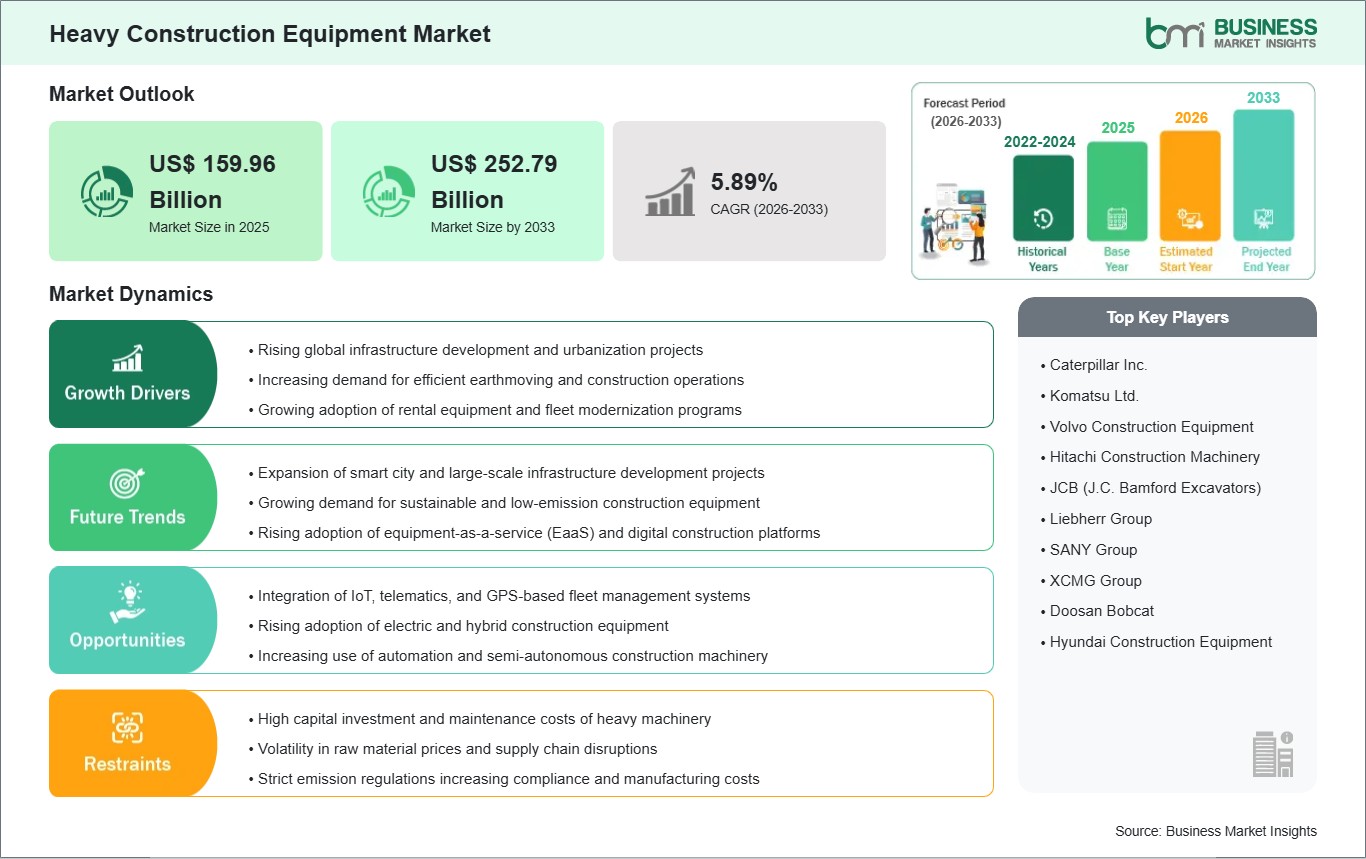
The Heavy Construction Equipment Market size is expected to reach US$ 252.79 Billion by 2033 from US$ 159.96 Billion in 2025.The market is estimated to record a CAGR of 5.89% from 2026 to 2033.
Heavy Construction Equipment Market refers to the industry encompassing large-scale machinery and equipment used in construction, mining, infrastructure development, and earthmoving operations. This includes excavators, bulldozers, loaders, cranes, motor graders, dump trucks, compactors, and backhoe loaders that are essential for executing heavy-duty construction activities. Modern heavy construction equipment increasingly integrates advanced technologies such as telematics, GPS tracking, IoT-enabled monitoring systems, AI-based predictive maintenance, and automated control systems to improve operational efficiency, fuel optimization, safety, and equipment lifecycle management. The rising global demand for infrastructure development, urbanization, smart city projects, and transportation network expansion is significantly driving market growth. Additionally, increasing investments in residential, commercial, and industrial construction projects, along with rapid industrialization in emerging economies, is accelerating equipment adoption across global markets.
However, the market faces several constraints that may impact growth. High capital investment and maintenance costs associated with heavy construction machinery remain a major barrier, particularly for small and medium-sized contractors. Fluctuations in raw material prices and supply chain disruptions also affect manufacturing and equipment availability. The market is further challenged by strict environmental regulations related to emissions, pushing manufacturers toward costly engine upgrades and electrification initiatives. Additionally, skilled operator shortages and rising operational costs, including fuel consumption and maintenance, limit efficient utilization of equipment in certain regions. Economic uncertainties and cyclical nature of the construction industry can also lead to delayed infrastructure projects, directly impacting equipment demand.
Despite these challenges, the long-term outlook for the heavy construction equipment market remains highly positive, driven by continuous infrastructure modernization and technological advancements. Significant opportunities are emerging through the electrification of construction machinery, autonomous and semi-autonomous equipment, and integration of AI-powered fleet management systems. The rapid expansion of smart city initiatives, renewable energy infrastructure projects, and large-scale transportation developments is further boosting demand. Additionally, advancements in telematics, remote monitoring, and predictive maintenance solutions are improving equipment efficiency, reducing downtime, and lowering operational costs. The growing shift toward sustainable construction practices and low-emission machinery is also encouraging innovation in electric and hybrid heavy equipment. Collectively, these factors are positioning the heavy construction equipment market for sustained long-term growth as a critical enabler of global infrastructure development and industrial expansion.

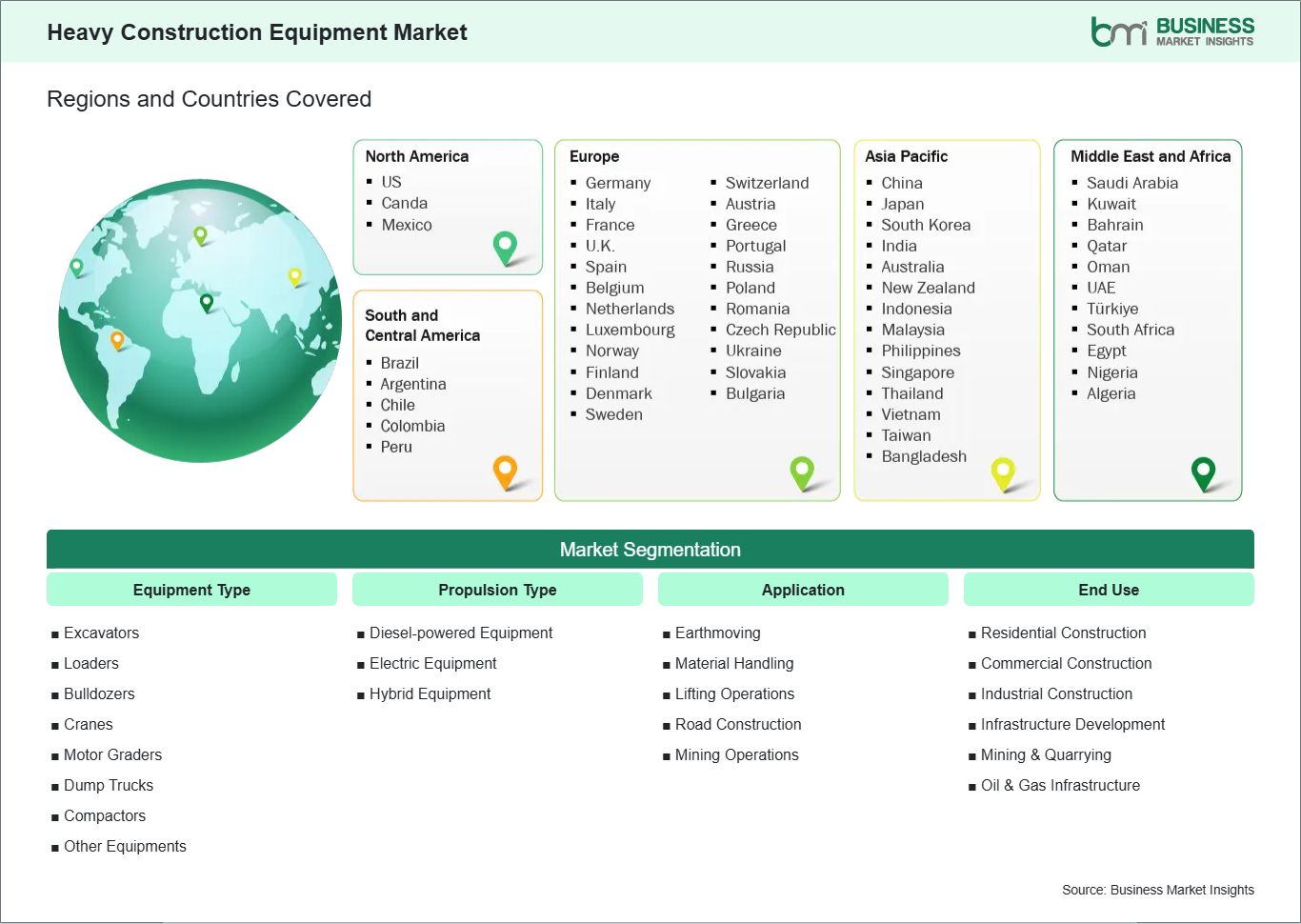
The heavy construction equipment market is segmented based on equipment type, propulsion type, application, and end use, reflecting the increasing demand for efficient earthmoving machinery, infrastructure development solutions, and technologically advanced construction equipment across global industries.
The Heavy Construction Equipment Market is primarily driven by the rapid expansion of global infrastructure development, increasing urbanization, and growing investments in residential, commercial, and industrial construction projects. Governments across developed and emerging economies are heavily investing in transportation infrastructure such as highways, railways, airports, ports, and smart city developments, significantly boosting demand for excavators, loaders, cranes, bulldozers, and other heavy machinery. The rise in population growth and urban migration is further accelerating the need for housing and commercial infrastructure, thereby increasing equipment utilization across construction sites. Unlike traditional manual construction methods, modern heavy construction equipment enhances productivity, reduces project timelines, and improves operational efficiency through advanced hydraulics, automation, and telematics systems. Additionally, rising investments in mining activities and energy infrastructure projects are further supporting market expansion globally.
The increasing adoption of advanced technologies such as IoT-enabled fleet management, GPS tracking, and AI-based predictive maintenance systems is further driving efficiency and equipment performance across construction operations. Manufacturers are increasingly integrating smart technologies into machinery to improve fuel efficiency, reduce downtime, and enhance operator safety. Furthermore, the growing trend of rental equipment services is enabling small and medium-sized contractors to access advanced machinery without significant capital investment, thereby expanding market penetration. Collectively, these factors are contributing to strong and sustained growth in the heavy construction equipment market across both developed and developing regions.
Opportunities in the Heavy Construction Equipment Market are expanding significantly due to the rising shift toward electrification, autonomous machinery, and smart construction technologies. The increasing focus on reducing carbon emissions and meeting stringent environmental regulations is accelerating the development and adoption of electric and hybrid construction equipment. Autonomous and semi-autonomous machinery equipped with AI, machine learning, and sensor fusion technologies is improving operational efficiency, safety, and precision in construction and mining operations. The emergence of smart construction sites powered by IoT connectivity and real-time data analytics is enabling better fleet coordination, resource optimization, and predictive maintenance capabilities.
Additionally, rapid growth in smart city initiatives, renewable energy infrastructure projects, and large-scale industrial developments is creating substantial opportunities for advanced construction equipment manufacturers. The integration of digital twin technology and cloud-based construction management platforms is further enhancing project planning, monitoring, and execution efficiency. Increasing investments in infrastructure modernization across Asia Pacific, the Middle East, and Africa are also opening new growth avenues for global equipment suppliers. Furthermore, the rising popularity of equipment-as-a-service (EaaS) models and rental-based construction machinery solutions is enabling wider adoption across cost-sensitive markets. Collectively, the convergence of electrification, automation, and digital construction ecosystems is positioning the heavy construction equipment market for strong long-term growth as a key enabler of global infrastructure transformation.
The Heavy Construction Equipment Market is projected to grow from US$ 159.96 Billion in 2025 to US$ 252.79 Billion by 2033 , registering a CAGR of 5.89% from 2026 to 2033.
By equipment type, excavators account for a significant share due to their extensive use in earthmoving, demolition, mining, and infrastructure development projects across residential, commercial, and industrial construction sectors. Loaders also hold a strong share as they are widely used for material handling and transportation tasks across construction sites. Cranes are witnessing steady demand driven by increasing high-rise construction activities and large-scale infrastructure projects such as bridges, ports, and industrial facilities. Bulldozers and motor graders continue to play a critical role in land clearing, grading, and road construction activities, particularly in large infrastructure and mining projects. Dump trucks and compactors are also gaining traction due to rising demand for efficient material transport and soil stabilization in road and urban development projects.
By propulsion type, diesel-powered equipment dominates the market owing to its high power output, durability, and suitability for heavy-duty construction and mining applications. However, electric and hybrid construction equipment are witnessing rapid growth due to increasing environmental regulations, emission reduction targets, and the growing adoption of sustainable construction practices. Electrification is particularly gaining momentum in urban construction projects where noise reduction and zero-emission requirements are becoming increasingly important.
| Report Attribute | Details |
|---|---|
| Market size in 2025 | US$ 159.96 Billion |
| Market Size by 2033 | US$ 252.79 Billion |
| Global CAGR (2026 - 2033) | 5.89% |
| Historical Data | 2022-2024 |
| Forecast period | 2026-2033 |
| Segments Covered | By Equipment Type
|
|
Regions and Countries Covered
| |
| North America | US, Canada, Mexico |
| Europe | Germany, Italy, France, U.K., Spain, Belgium, Netherlands, Luxembourg, Norway, Finland, Denmark, Sweden, Switzerland, Austria, Greece, Portugal, Russia, Poland, Romania, Czech Republic, Ukraine, Slovakia, Bulgaria |
| Asia-Pacific | China, Japan, South Korea, India, Australia, New Zealand, Indonesia, Malaysia, Philippines, Singapore, Thailand, Vietnam, Taiwan, Bangladesh |
| South and Central America | Brazil, Argentina, Chile, Colombia, Peru |
| Middle East and Africa | Saudi Arabia, United Arab Emirates, Kuwait, Bahrain, Qatar, Oman, Turkiye, South Africa, Egypt, Nigeria, Algeria |
| Market leaders and key company profiles |
|
The "Heavy Construction Equipment Market Size and Forecast (2022–2033)" report provides a detailed analysis of the market covering below areas:
The Heavy Construction Equipment Market demonstrates strong regional variation driven by infrastructure development spending, urbanization rates, industrial expansion, and government-led construction initiatives across major global economies..
North America holds a significant share of the heavy construction equipment market due to strong infrastructure modernization programs, advanced construction technology adoption, and high investment in commercial and residential construction projects. The United States and Canada are witnessing steady demand for excavators, loaders, cranes, and bulldozers driven by highway expansion, urban redevelopment, and large-scale industrial construction. The region is also characterized by high adoption of telematics, GPS-enabled fleet management systems, and AI-based predictive maintenance solutions that improve equipment efficiency and reduce downtime. Additionally, growing investments in renewable energy infrastructure and smart city projects are further supporting market growth across North America.
Asia Pacific is the fastest-growing region in the heavy construction equipment market, driven by rapid urbanization, large-scale infrastructure development, and expanding industrialization. Countries such as China, India, Japan, South Korea, and Southeast Asian nations are experiencing massive investments in highways, railways, airports, smart cities, and residential construction projects. The region benefits from strong manufacturing capabilities, cost-effective labor, and government-backed infrastructure development programs. Increasing mining activities and industrial expansion are also boosting demand for heavy earthmoving equipment. Additionally, the rapid adoption of rental equipment services and growing penetration of smart construction technologies are further accelerating market growth in Asia Pacific.
Overall, all major regions are contributing to the expansion of the Heavy Construction Equipment Market, with growth strongly supported by infrastructure modernization, urbanization trends, and increasing adoption of advanced construction technologies worldwide.

The heavy construction equipment market is evaluated by gathering qualitative and quantitative data post primary and secondary research, which includes important corporate publications, association data, and databases. A few of the key developments in the heavy construction equipment marketare:
The Heavy Construction Equipment Market is valued at US$ 159.96 Billion in 2025, it is projected to reach US$ 252.79 Billion by 2033.
As per our report Heavy Construction Equipment Market, the market size is valued at US$ 159.96 Billion in 2025, projecting it to reach US$ 252.79 Billion by 2033. This translates to a CAGR of approximately 5.89% during the forecast period.
The Heavy Construction Equipment Market report typically cover these key segments-
The historic period, base year, and forecast period can vary slightly depending on the specific market research report. However, for the Heavy Construction Equipment Market report:
The Heavy Construction Equipment Market is populated by several key players, each contributing to its growth and innovation. Some of the major players include:
The Heavy Construction Equipment Market report is valuable for diverse stakeholders, including:
Essentially, anyone involved in or considering involvement in the Heavy Construction Equipment Market value chain can benefit from the information contained in a comprehensive market report.
Please tell us your area of interest
(Market Segments/ Regions and Countries/ Companies)