Market Summary
Executive Summary and Global Market Analysis
Heat pumps are energy-efficient systems designed to transfer heat for residential, commercial, and industrial temperature control applications. These systems support heating and cooling operations while reducing reliance on conventional fuel-based equipment. The market continues to gain traction as building owners seek alternatives aligned with lower emission targets and improved operational efficiency. Advancements in compressor technologies and integrated control systems are also strengthening product performance across diverse climate conditions. Competitive conditions remain influenced by product innovation, distribution partnerships, and regional manufacturing strategies. Market participants continue refining product portfolios to address regulatory compliance and performance expectations.
Rising focus on energy conservation standards has influenced purchasing decisions across developed and developing economies. Regulatory frameworks supporting cleaner heating solutions have encouraged broader deployment in newly constructed buildings and renovation projects. Consumer preference for electricity-based thermal management systems is also contributing to market penetration. In addition, urban infrastructure expansion continues to support installations in residential complexes, office buildings, and institutional facilities. Technology evolution is reshaping system capabilities through enhanced automation, connectivity, and adaptive temperature management. Commercial facilities increasingly integrate smart climate systems to improve energy monitoring and operational consistency.
Segment Analysis
Heat Pump Market Segmentation
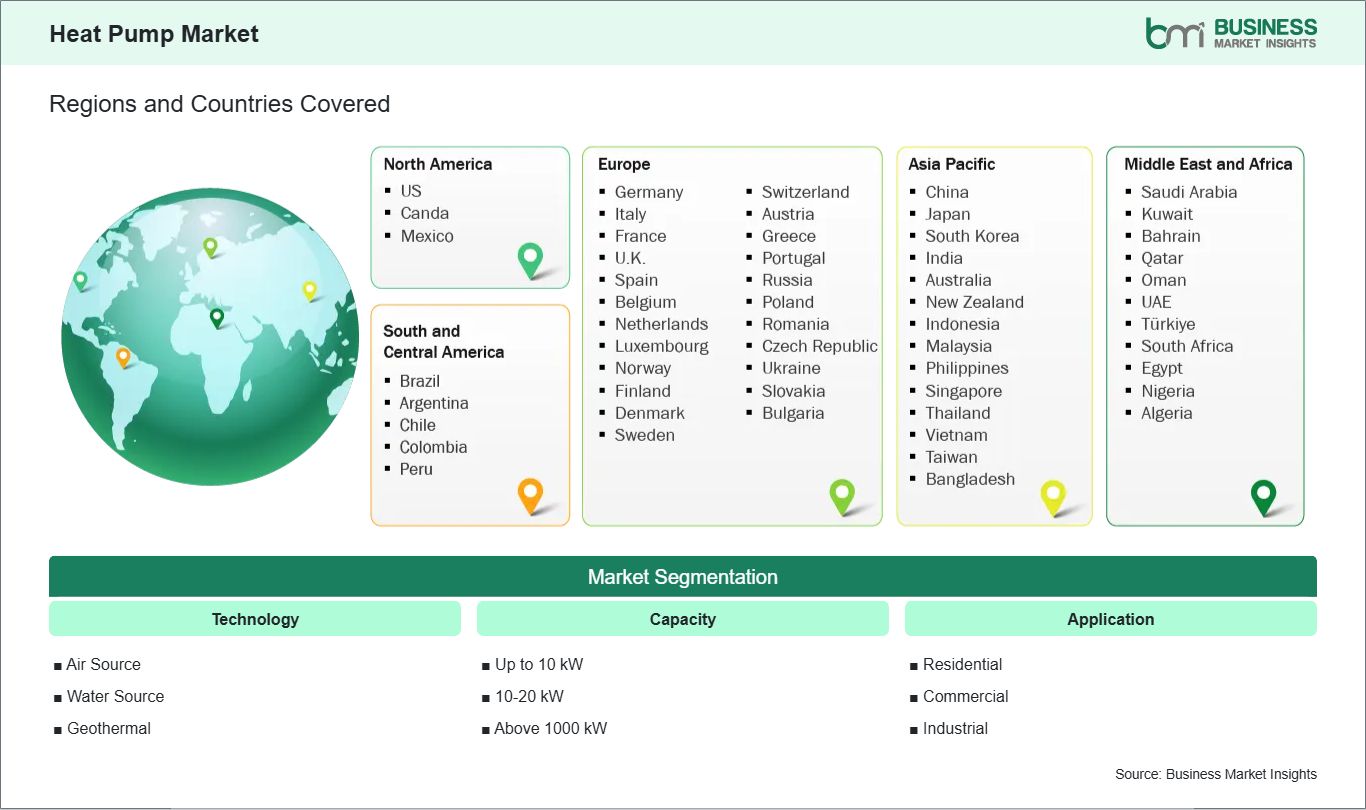
The Heat Map market is segmented based on technology, capacity, and application, reflecting the growing demand for heat pump.
By Technology
- Air Source: Dominated the market in 2025 due to cost-effective installation and strong suitability for residential and commercial buildings.
- Water Source: Gaining adoption due to higher efficiency in stable environments and use in large commercial applications.
- Geothermal: Expanding due to long-term efficiency benefits and strong alignment with renewable energy adoption.
By Capacity
- Up to 10 kW: Held the largest share in 2025 driven by strong residential and small commercial demand.
- 10–20 kW: Witnessing steady growth due to rising use in mid-sized residential and commercial spaces.
- Above 1000 kW: Expanding in industrial and district heating applications requiring large-scale capacity.
By Application
- Residential: Accounted for the largest share in 2025 due to strong adoption of energy-efficient home heating systems.
- Commercial: Growing steadily with rising deployment in offices, retail, and institutional buildings.
- Industrial: Expanding due to increasing demand for high-capacity and efficient heating solutions in large facilities.
Market Forces
Heat Pump Market Drivers and Opportunities
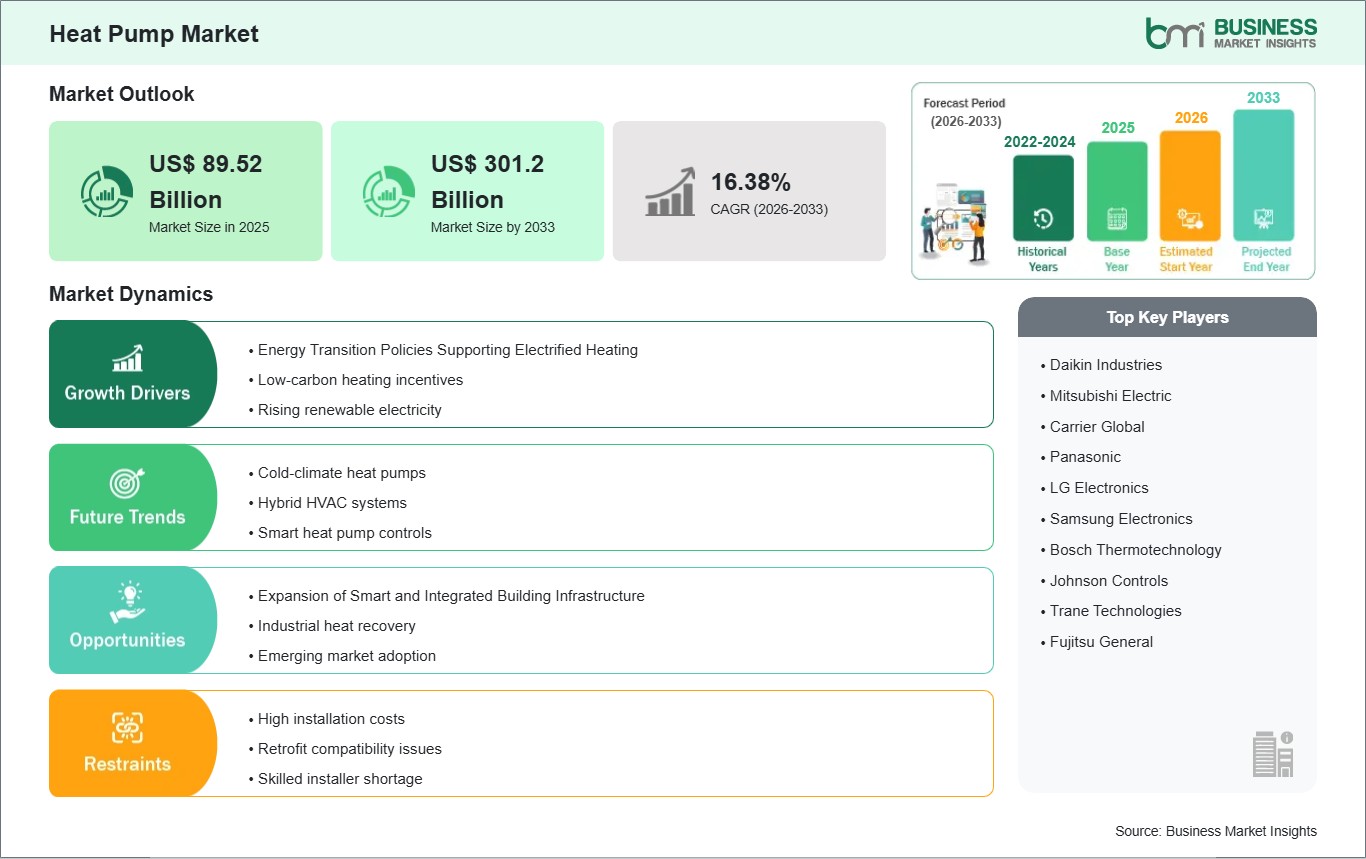
Energy Transition Policies Supporting Electrified Heating
National energy frameworks continue prioritizing low-emission heating infrastructure across residential and commercial environments. Traditional fuel-based systems face increasing replacement pressure due to stricter environmental regulations and evolving building standards. Heat pumps align with electrification goals by supporting efficient thermal management while reducing dependence on conventional combustion equipment.
Policy initiatives promoting cleaner technologies are strengthening market relevance in both mature and developing economies. Building efficiency codes and sustainability programs encourage property owners to adopt modern heating systems with lower environmental impact. Technological refinement in compressor efficiency and temperature control capabilities further supports broader acceptance across multiple applications.
Expansion of Smart and Integrated Building Infrastructure
The industry is witnessing greater integration between intelligent building systems and energy-efficient thermal technologies. Smart monitoring platforms enable improved operational management, remote diagnostics, and adaptive temperature regulation across residential and commercial facilities. This trend creates favorable conditions for advanced heat pump solutions with connected functionality and automated performance optimization.
Future expansion opportunities remain linked to urban modernization and digital infrastructure investments. Commercial buildings, educational institutions, and mixed-use developments increasingly require integrated climate control systems capable of balancing energy efficiency and occupant comfort. Continued emphasis on sustainable construction practices is expected to support long-term deployment across global markets.
Size and Share Analysis
Heat Pump Market Size and Share Analysis
The Heat Pump Market is projected to grow from US$ 89.52 Billion in 2025 to US$ 301.2 Billion by 2033 , registering a CAGR of 16.38% from 2026 to 2033.
By technology, the Heat Pump market is divided into Air Source, Water Source, and Geothermal. The Air Source segment dominated the market in 2025 due to its cost-effective installation process and suitability for residential as well as commercial buildings. Increasing adoption of energy-efficient heating systems and compatibility with existing infrastructure further supported segment expansion across multiple regions.
By capacity, the market is divided into Up to 10 kW, 10–20 kW, and Above 1000 kW. The Up to 10 kW segment held the largest share in 2025, primarily driven by strong demand from residential housing projects and small commercial establishments. Compact system design, lower operational requirements, and rising replacement of conventional heating units contributed to segment growth.
By application, the market is divided into Residential, Commercial, and Industrial. The Residential segment accounted for the largest market share in 2025 due to increasing consumer preference for efficient indoor climate control systems. Supportive government initiatives promoting low-emission household heating technologies also accelerated adoption across urban residential developments.
Report Coverage
Heat Pump Market Report Coverage and Deliverables
The "Heat Pump Market Size and Forecast (2022–2033)" report provides a detailed analysis of the market covering:
- Heat Pump market size and forecast at global, regional, and country levels for all the key market segments covered under the scope
- Heat Pump market trends, as well as market dynamics such as drivers, restraints, and key opportunities
- Industry landscape and competition analysis covering market concentration, heat map analysis, prominent players, and recent developments
- Detailed company profiles, including SWOT analysis
Geographic Insights
Heat Pump Market Geographic Insights
The Heat Pump market is divided into geographic segments, which include North America, Asia Pacific, Europe, Middle East & Africa, and South & Central America. The Asia Pacific market is anticipated to be the leading region for such substantial growth throughout the forecast period emphasizing emission reduction strategies, while emerging markets focus on efficient cooling and heating integration within expanding urban infrastructure.
North America demonstrates steady market activity supported by energy transition policies and residential replacement demand. The United States continues investing in building modernization and efficient heating technologies across commercial and household applications. Canada also contributes through cold-climate adoption initiatives and environmentally focused construction practices. Commercial property owners increasingly evaluate advanced thermal systems to improve operational efficiency and align with evolving sustainability standards.
Asia-Pacific represents a significant regional market due to rapid urbanization and infrastructure expansion. China continues integrating energy-efficient systems within residential construction and industrial facilities. Japan maintains focus on advanced heating technologies supported by technological innovation and energy conservation policies. India, South Korea, and Southeast Asian countries are also witnessing broader utilization in commercial developments and high-density urban environments.
Europe maintains strong market penetration through environmental regulations and decarbonization strategies targeting conventional heating systems. Germany, France, and the United Kingdom continue promoting cleaner building technologies through policy support and renovation programs. Emerging opportunities are also visible across South America, the Middle East, and Africa, where commercial construction and urban infrastructure development support gradual adoption of efficient thermal management solutions.
Industry Activity
Recent Developments
The Heat Pump market is evaluated by gathering qualitative and quantitative data post primary and secondary research, which includes important corporate publications, association data, and databases. A few of the key developments in the Heat Pump market are:
- In May 2026, Italian heating and cooling specialist MTA Spa has launched a module air-to-water heat pump system for commercial and industrial applications. The system is available in six versions, with heating capacities ranging from 83.7 kW to 148.5 kW and cooling capacities ranging from 83.4 kW to 147.4 kW.
- In February 2026, Daikin Europe expands its award-winning Stylish air-to-air heat pump range with five new design options that bring greater freedom for homeowners and interior designers. Known for its modern aesthetic, compact size, and impressive energy efficiency, the Stylish range now introduces a broader design palette with finishes that integrate seamlessly into diverse interior styles.
Trust & Transparency
Research Methodology
The market analysis combines proprietary research with secondary data from government agencies, company disclosures, regulatory filings, industry databases and expert interviews. Market estimates are validated through data triangulation, cross-market benchmarking and analyst
review.
View Full Research Methodology
Key Sources Referred:
Government energy efficiency publications National building and environmental policy documents Industry white papers on thermal management technologies Research publications covering tire material innovation and efficiency trends Company website Company annual reports Company investor presentations