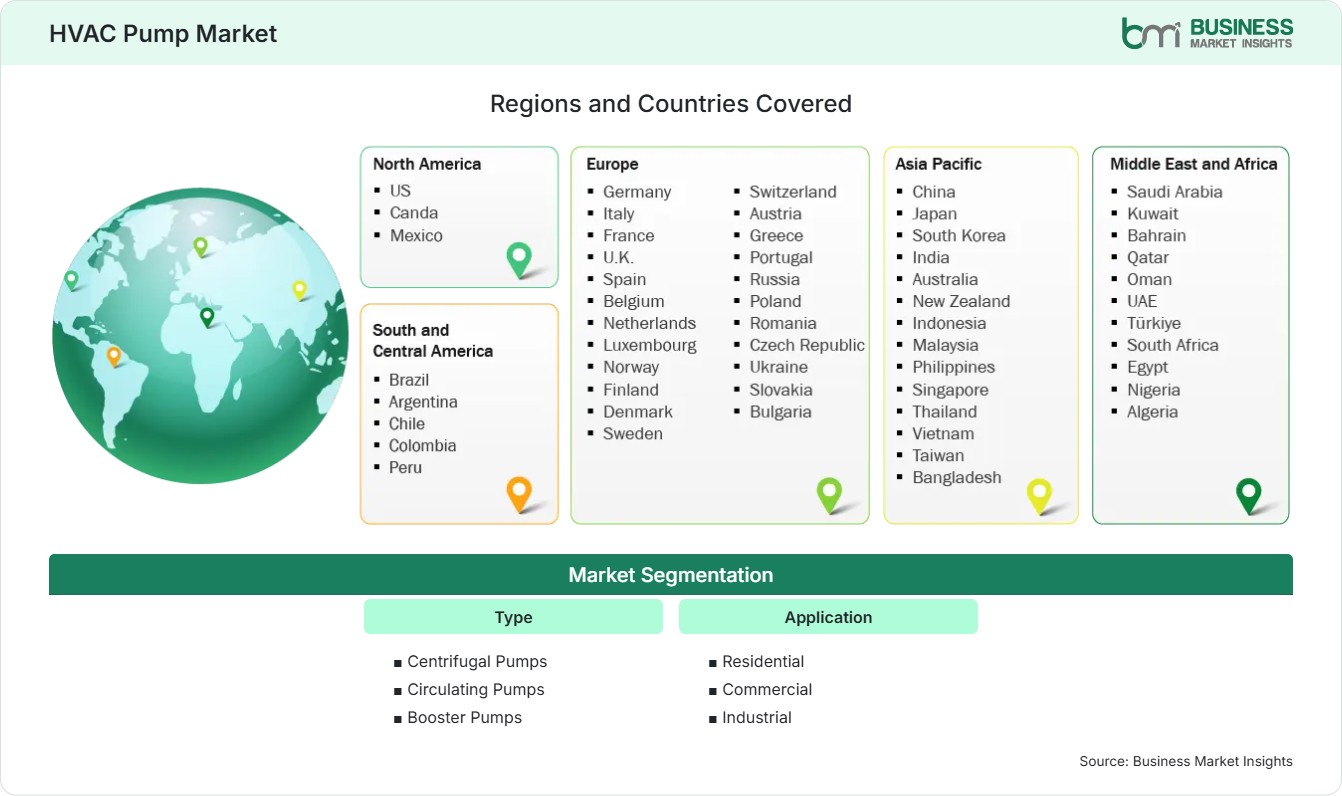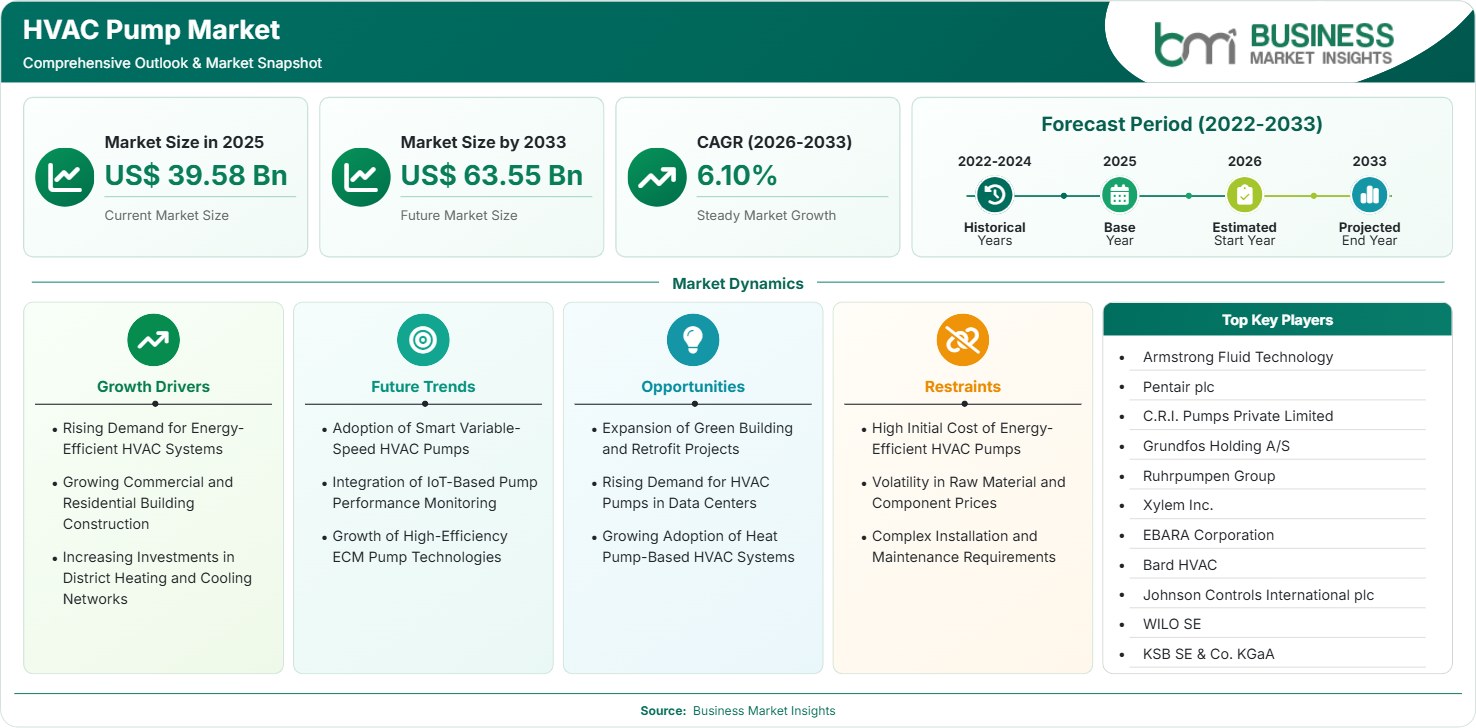
HVAC Pump Market Regional Highlights
North America HVAC Pump Market
North America accounted for approximately 34%–37% of global revenue during 2025 and is anticipated to register a CAGR of 5.5%–5.9% through 2033. The region benefits from widespread retrofit activities, replacement of aging HVAC systems, and strong regulatory emphasis on energy efficiency. The HVAC Pump Market share remains supported by commercial construction, healthcare modernization, institutional infrastructure upgrades, and rapid deployment of intelligent building automation technologies across the United States and Canada.
- Standards on energy efficiency established by national and state organizations promote the usage of premium efficiency electronically controlled pumps which are able to save money and help meet sustainability goals for commercial buildings.
- Digital monitoring of pumps used in commercial buildings to enhance heating and cooling operation as well as increase the life cycle of equipment is becoming more popular among commercial real estate managers.
- Hospitals, universities, airports, and public facilities keep modernizing their HVAC systems and need highly reliable pumping systems that will help to ensure operational continuity and indoor air quality.
- Higher interest in retrofit-friendly variable speed pump technology allows meeting carbon reduction goals and cutting maintenance costs for existing facilities..
US HVAC Pump Market
The United States represents nearly 82%–85% of the North American HVAC pump market and is projected to expand at a CAGR of 5.6%–6.0% during the forecast period. Rising investment in commercial retrofits, institutional construction, smart buildings, and industrial modernization supports sustained equipment demand. Federal efficiency initiatives and broader adoption of connected HVAC technologies continue strengthening long-term replacement cycles throughout the country.
- Data center expansion significantly increases demand for high-efficiency circulation pumps supporting precision cooling systems and uninterrupted thermal management across mission-critical digital infrastructure.
- Growth in healthcare construction, pharmaceutical manufacturing, and higher education facilities supports increasing deployment of intelligent HVAC pumping technologies emphasizing operational reliability and energy optimization.
- Building owners increasingly prioritize lifecycle cost reduction by replacing fixed-speed pumps with digitally controlled variable-speed systems capable of adapting to changing building loads automatically.
- Public infrastructure modernization programs continue creating replacement opportunities across transportation terminals, municipal buildings, and educational campuses implementing advanced HVAC technologies.
Europe HVAC Pump Market
Europe captured approximately 27%–30% market share in 2025 while expected to grow at a CAGR of 5.8%–6.2% through 2033. Stringent environmental legislation, mature building renovation markets, and strong adoption of heat pumps continue supporting demand. Germany remains the leading country, whereas Eastern European economies demonstrate faster expansion due to increasing commercial construction and industrial infrastructure development.
- European Green Deal objectives continue encouraging adoption of highly efficient pumping systems supporting lower building emissions, improved operational efficiency, and sustainable heating and cooling infrastructure.
- Germany leads regional demand through advanced manufacturing capabilities, extensive commercial building renovations, and widespread implementation of intelligent building management technologies.
- Poland demonstrates one of the strongest growth trajectories, supported by industrial investments, logistics infrastructure expansion, and modernization of commercial real estate across major urban centers.
- Integration of renewable heating technologies, district energy systems, and electrified building infrastructure increases demand for sophisticated circulation pumps capable of handling variable operating conditions.
Asia Pacific HVAC Pump Market
Asia Pacific represented around 29%–32% of total revenue during 2025 and is forecast to achieve a CAGR of 7.0%–7.5% through 2033, making it the fastest-growing regional HVAC pump market. Rapid urbanization, expanding manufacturing capacity, increasing commercial construction, and government-backed smart infrastructure initiatives continue driving adoption. China dominates regional demand, while India records the fastest expansion supported by large-scale infrastructure investment.
- China maintains regional leadership through large commercial developments, manufacturing expansion, and continuous investment in sustainable building technologies and district cooling infrastructure.
- India records the fastest regional growth owing to smart city initiatives, rapid commercial real estate development, healthcare expansion, and increasing implementation of green building standards.
- Southeast Asian economies continue investing in hospitality, mixed-use developments, airports, and industrial facilities requiring advanced HVAC circulation technologies with improved energy performance.
- Rising industrial automation and digital building management adoption strengthen demand for connected pumping systems offering predictive maintenance and optimized energy utilization across manufacturing facilities.
Rest of World HVAC Pump Market
The Rest of World region accounted for approximately 8%–10% HVAC pump market share during 2025 and is expected to expand at a CAGR of 6.2%–6.6% through 2033. South & Central America benefit from commercial infrastructure investments, while the Middle East and Africa experience increasing adoption driven by urban development, hospitality projects, and district cooling systems. Brazil leads Latin America, whereas Saudi Arabia demonstrates the fastest regional expansion.
- Brazil benefits from increasing commercial construction, healthcare infrastructure development, and modernization of industrial facilities requiring energy-efficient HVAC circulation equipment.
- Saudi Arabia experiences accelerated demand through mega infrastructure developments, smart cities, hospitality investments, and district cooling networks supporting large-scale urban expansion.
- Gulf Cooperation Council countries increasingly deploy digitally managed pumping systems integrated with advanced building automation to reduce electricity consumption and improve sustainability performance.