
Cleanroom HVAC Market Outlook: Size, Share, Trends, Growth Analysis, Competitive Landscape & Forecast, 2026-2033

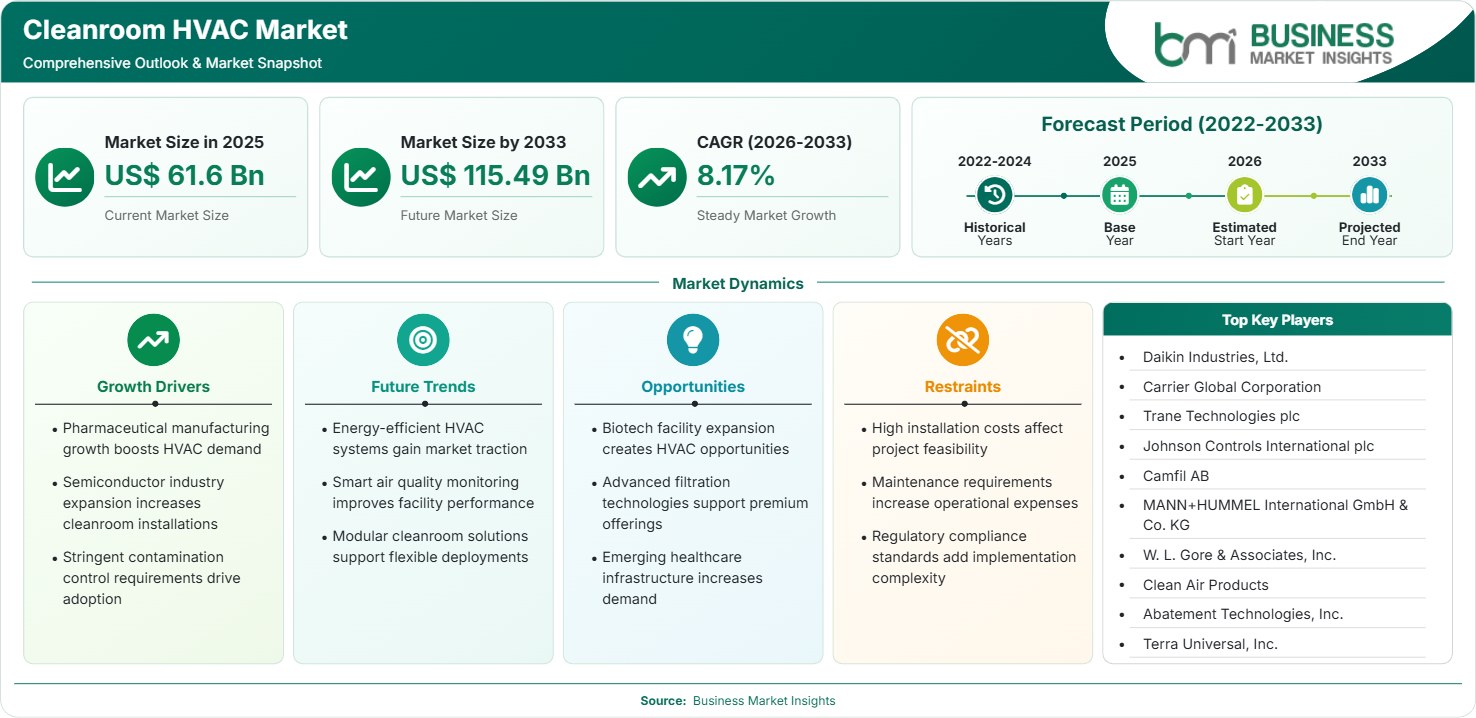
The Cleanroom HVAC Market size was valued at US$ 61.6 Billion in 2025 and is projected to reach US$ 115.49 Billion by 2033, growing at a CAGR of 8.17% during 2026–2033. Growth is supported by pharmaceutical manufacturing expansion, semiconductor capacity additions, stricter contamination-control regulations, energy-efficient filtration adoption, and increasing investments in advanced healthcare, biotechnology, and research infrastructure.

Report Coverage
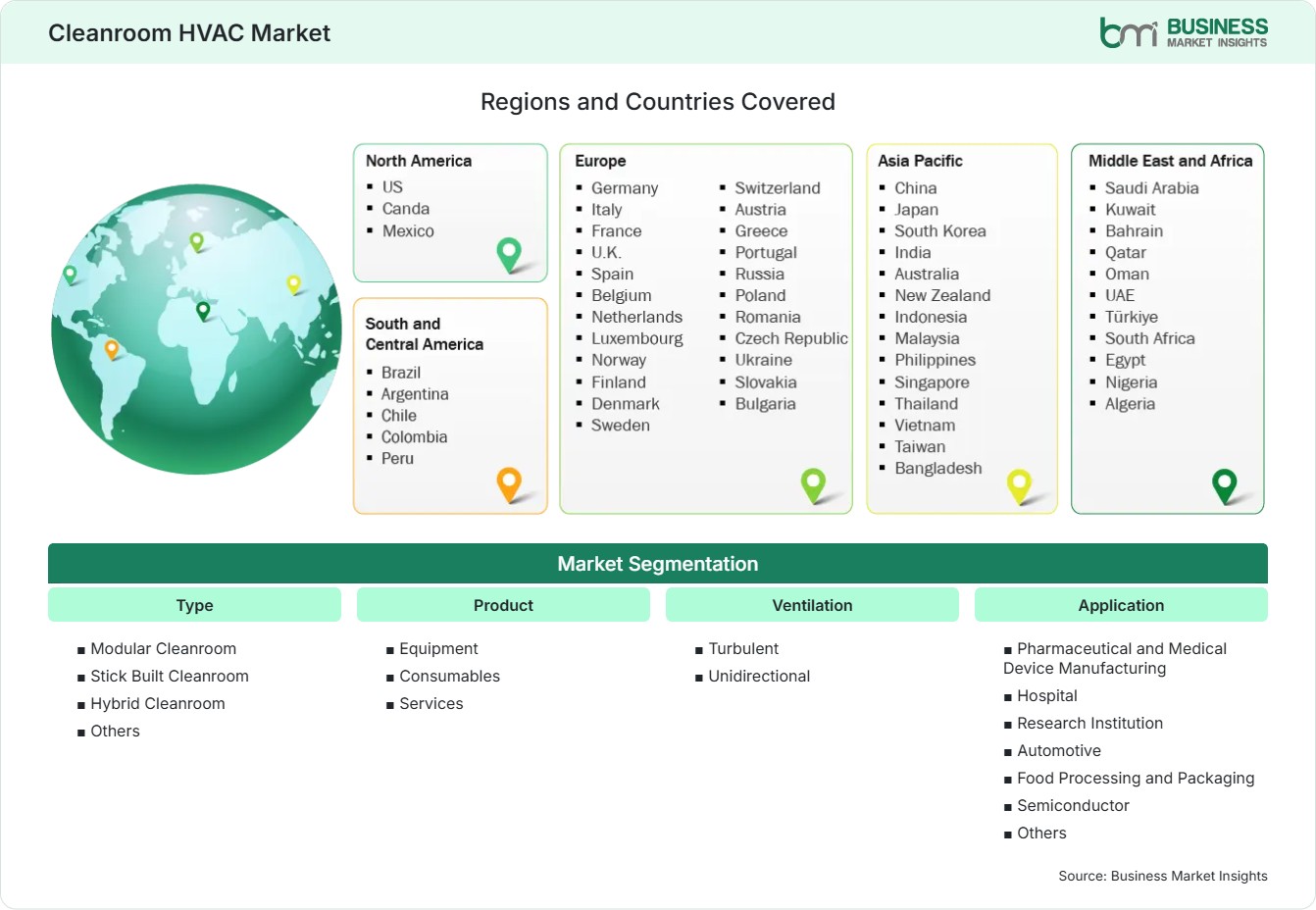
  • Type: Modular Cleanroom, Stick Built Cleanroom, Hybrid Cleanroom, Others
  • Product: Equipment, Consumables, Services
  • Ventilation: Turbulent, Unidirectional
  • Application: Pharmaceutical and Medical Device Manufacturing, Hospital, Research Institution, Automotive, Food Processing and Packaging, Semiconductor, Others
US$ 61.6 Bn Market size in 2025
US$ 115.49 Bn Market Size by 2033
8.17% CAGR, 2026 - 2033
2026-2033 Forecast Period

AI Overview

Cleanroom HVAC Market Summary

  • North America Region: North America holds a market share of 34%–37% in 2025, growing with a CAGR of 7.2%–7.8%. Demand is driven by biopharmaceutical investments, semiconductor reshoring, GMP compliance requirements, advanced filtration upgrades, healthcare infrastructure modernization, energy-efficient airflow systems, contamination control regulations, and growing clean manufacturing capacity worldwide.
    US market benefits from pharmaceutical capacity expansion and semiconductor fabs, advancing at roughly 7.4%–8.0% CAGR through 2033.
  • Fastest Growing Region: Asia Pacific holds 28%–31% share in 2025 and expands at 9.4%–10.0% CAGR. Growth stems from electronics manufacturing expansion, vaccine production facilities, government industrial policies, contract manufacturing investments, data-driven facility monitoring, and increasing controlled-environment requirements across emerging economies.
  • Leading Segment: Equipment accounts for 48%–52% share in 2025 with 7.8%–8.4% CAGR. Adoption is strengthened by HEPA and ULPA filtration demand, air handling unit modernization, lifecycle efficiency upgrades, intelligent controls integration, regulatory compliance needs, and industrial contamination reduction requirements globally.
  • High Growth Segment: Semiconductor represents 18%–22% share in 2025 and advances at 10.2%–10.8% CAGR. Growth arises from wafer fabrication investments, advanced chip manufacturing nodes, precision airflow requirements, government incentives, AI infrastructure expansion, clean production standards, and contamination-sensitive process environments.
  • Key Market Opportunity: Retrofitting aging pharmaceutical, healthcare, and electronics facilities with smart filtration, predictive monitoring, energy-efficient air handling systems, and digital environmental controls creates strong long-term revenue opportunities globally.
  • Major Market Players: Daikin Industries, Ltd.; Carrier Global Corporation; Trane Technologies plc; Johnson Controls International plc; Camfil AB; MANN+HUMMEL International GmbH & Co. KG; W. L. Gore & Associates, Inc.; Clean Air Products; Abatement Technologies, Inc.; Terra Universal, Inc.
Strategic Insights

Cleanroom HVAC Market: Strategic Insights

Cleanroom HVAC Market Strategic Framework
FREE PDF
Request your free sample
Request free sample
Stakeholder View

Key Takeaways

  • Supply chains are increasingly integrating filtration manufacturers, automation providers, HVAC specialists, and validation service companies to deliver turnkey contamination-control ecosystems.
  • Semiconductor fabrication and biologics manufacturing present the strongest long-term revenue opportunities due to stringent air purity and process reliability requirements.
  • Innovation is shifting toward AI-enabled environmental monitoring, low-energy filtration media, variable-air-volume systems, and predictive facility management platforms.
  • India, Vietnam, and Malaysia offer compelling investment cases as electronics and pharmaceutical production shifts toward diversified manufacturing hubs.
  • Strategic acquisitions continue to strengthen portfolios in filtration technologies, contamination monitoring, and energy-efficient airflow management solutions.
  • Sustainability targets are accelerating adoption of low-pressure-drop filters and advanced control systems that reduce energy consumption without compromising cleanliness standards.
Geographic Outlook

Cleanroom HVAC Market Regional Highlights

North America Cleanroom HVAC Market

North America generated 34%–37% of total revenues in 2025 and is projected to achieve a CAGR of 7.2%–7.2% from 2025 to 2033. Demand in North America is influenced by growth in pharmaceutical production, biotech research and development, and semiconductor manufacturing. The Cleanroom HVAC market share is held by the US due to compliance norms and significant investment.

  • Semiconductor reshoring programs support construction of contamination-controlled facilities requiring advanced filtration and airflow systems.
  • Biologics production capacity expansion continues driving demand for validated environmental control infrastructure.
  • Hospital modernization projects increase adoption of energy-efficient air handling systems and clean-environment technologies.
  • Growing automation and digital monitoring integration improve facility reliability and compliance outcomes.

US Cleanroom HVAC Market

The United States represents approximately 76%–80% share within the North America market and records a CAGR of 7.4%–8.0%. Strong pharmaceutical manufacturing, biotechnology research activity, and major semiconductor investments support robust procurement of filtration, ventilation, and environmental monitoring systems.

  • FDA-driven compliance requirements encourage systematic upgrades of controlled production environments.
  • Domestic chip manufacturing incentives create substantial demand for advanced contamination-control infrastructure.
  • Research institutions increasingly deploy intelligent environmental management platforms.
  • Sustainability targets accelerate replacement of legacy HVAC systems with energy-efficient alternatives.

Europe Cleanroom HVAC Market

Europe captures a market share of 24%–27% in 2025 and has a growth rate of 7.5%–8.1% CAGR. Germany ranks as the market leader among all countries, while Ireland and Poland show greater growth owing to the presence of the pharmaceutical and electronics sectors. Regional adoption is supported by rigorous environmental standards and advanced industrial manufacturing ecosystems.

  • Germany leads through pharmaceutical engineering expertise and industrial automation capabilities.
  • Ireland records high facility investments linked to multinational life-science manufacturers.
  • Food processing compliance requirements stimulate demand for contamination-controlled production.
  • Sustainability regulations encourage adoption of efficient filtration and ventilation technologies.

Asia Pacific Cleanroom HVAC Market

The Asia Pacific accounts for 28% to 31% of the market share in 2025 and is the fastest-growing region with a CAGR of 9.4% to 10.0%. China is the dominant country in terms of regional demand, while India and Vietnam record high growth rates. Strong electronics manufacturing ecosystems and increasing healthcare investments support continued expansion.

  • Semiconductor capacity additions remain a major source of regional Cleanroom HVAC Market growth.
  • India benefits from pharmaceutical production expansion and industrial policy support.
  • Southeast Asia attracts multinational manufacturing relocation initiatives.
  • Healthcare infrastructure development increases controlled-environment installations.
  • Local production capabilities improve supply-chain responsiveness and project execution.

Rest of World Cleanroom HVAC Market

Rest of World accounts for 10%–13% share and advances at 8.3%–8.9% CAGR. South and Central America benefit from healthcare and food-processing investments. The Middle East and Africa gain momentum through pharmaceutical localization strategies and specialized healthcare infrastructure projects.

  • Saudi Arabia and UAE lead regional healthcare manufacturing investments.
  • Brazil remains the largest Latin American market for controlled-environment solutions.
  • Industrial diversification programs stimulate clean manufacturing capacity.
  • Growing regulatory oversight supports adoption of advanced filtration technologies.
Global Market Geography
FREE PDF
Request your free sample
Request free sample
Segment Analysis

Cleanroom HVAC Market Segmentation

Type

This segment accounts for roughly a 29%–33% share and grows at 8.0%–8.6% CAGR. The Cleanroom HVAC Market scope across facility designs is expanding as manufacturers balance flexibility, compliance, and scalability for pharmaceutical, electronics, and research applications.

  • Modular Cleanroom: Rapid installation, scalability, and lower disruption make modular systems preferred for expanding pharmaceutical and electronics production environments.
  • Stick Built Cleanroom: Permanent infrastructure remains important for large-scale facilities requiring customized airflow management and long-term operational stability.
  • Hybrid Cleanroom: Combines flexibility and customization, supporting phased expansion projects while maintaining stringent contamination-control performance.

Product

Product demand remains led by equipment, holding a 48%–52% share with 7.8%–8.4% CAGR driven by filtration upgrades and energy-efficiency initiatives.

  • Equipment: Includes air handling units, filters, monitoring devices, and environmental controls supporting core cleanroom operations.
  • Consumables: Recurring demand comes from replacement filters, cleaning supplies, and contamination-control materials.
  • Services: Validation, maintenance, testing, and certification activities gain importance as regulatory expectations increase.

Ventilation

Ventilation solutions represent a 14%–18% share and expand at 8.1%–8.7% CAGR as operators optimize cleanliness and energy performance.

  • Turbulent: Suitable for less-critical environments requiring balanced cost and cleanliness performance.
  • Unidirectional: Preferred in high-specification semiconductor and pharmaceutical applications needing precise particulate control.

Application

Application demand is diversified, with pharmaceutical manufacturing leading revenue generation. The Cleanroom HVAC Market trends increasingly reflect semiconductor and biotechnology investment patterns. Segment CAGR ranges between 8.4%–10.8%.

  • Pharmaceutical and Medical Device Manufacturing: Strong compliance and quality requirements support continuous investment.
  • Hospital: Infection prevention initiatives drive environmental control upgrades.
  • Research Institution: Advanced laboratories require stable contamination-controlled environments.
  • Automotive: EV battery development increases clean manufacturing requirements.
  • Food Processing and Packaging: Food safety regulations encourage facility modernization.
  • Semiconductor: Highest growth supported by wafer fabrication and advanced-node investments.
Market Forces

Cleanroom HVAC Market Dynamics

Key Market Drivers

Expansion of Global Pharmaceutical Manufacturing Capacity

Pharmaceutical companies are making more investments in biologics, cell therapy, vaccine development, and aseptic manufacturing capabilities. The WHO quality standards and GMP compliance require more advanced contamination control strategies. This is directly driving demand for filtration, airflow control, and environmental monitoring technologies. With greater manufacturing complexity, facility owners prefer a validated cleanroom environment. Strong demand is evident in North America, Europe, India, and the growing Asian pharmaceutical markets where capacity additions continue accelerating.

Growth in Semiconductor Fabrication Investments

Semiconductor manufacturing requires extremely strict control of airborne particles and environmental conditions to maintain product quality and process efficiency. Growing global investments in wafer fabrication plants, advanced packaging facilities, and AI chip manufacturing are driving sustained demand for sophisticated environmental management systems. Because even minor contamination can reduce production yields, manufacturers require precise airflow control, pressure management, and ultra-high-efficiency filtration solutions. Increasing electronics demand, along with government-supported semiconductor expansion programs, continues to strengthen long-term infrastructure spending and cleanroom technology adoption worldwide.

Energy-Efficient Facility Operations and Sustainability Goals

Energy consumption remains one of the most expensive cost factors for a facility under control, and therefore, facility managers are encouraged to use energy-efficient products. Many facilities have adopted advanced low-pressure-drop filtration systems, intelligent building management systems, and ventilation systems to improve efficiency and reduce energy consumption. The rising need for sustainability and environmental laws have also been contributing to the replacement of obsolete equipment with more efficient products. These upgrades help maintain regulatory compliance, lower operational expenses, enhance lifecycle value, and support long-term sustainability objectives, encouraging broader adoption across healthcare, pharmaceutical, industrial, and commercial sectors.

Key Market Opportunities

Smart Monitoring and Predictive Facility Management

With the use of sensors, analytical models, artificial intelligence, and digital twins, many possibilities have emerged for companies seeking to navigate intelligent cleanroom HVAC market forecasts. Real-time monitoring helps improve contamination control, enables predictive maintenance, prevents downtime, and increases efficiency. With growing adoption of connected infrastructure, service providers will be able to earn recurring income via subscription-based software, analytics, monitoring, and maintenance services while helping customers optimize environmental conditions and regulatory compliance.

Retrofit Demand from Aging Industrial Facilities

Many medical laboratories, manufacturing plants, hospitals, and research institutes still depend on outdated airflow, filtration, and environmental control systems. There is high demand for upgrades to increase energy efficiency, enhance regulatory compliance, and improve system reliability. The projects yield tangible benefits and positive returns on investments that speed up the procurement process and create opportunities for equipment suppliers and validation service providers.

Emerging Manufacturing Hubs Across Asia and the Middle East

The fast-growing industries in Asia and the Middle East, the localization of healthcare initiatives, and the diversification of economies have created a growing demand for cleanroom facilities. There is an increase in government promotion of the manufacture of medicines, electronic goods, semiconductors, and other devices, thereby increasing demand for HVAC and contamination control systems. Such developments present excellent market potential for cleanroom providers worldwide.

Market Restraints and Challenges

High Capital Costs and Complex Validation Requirements

Factor: Installation of advanced filtration systems, air handling units, environmental monitoring platforms, automation controls, and validation services requires significant capital expenditure, particularly for facilities operating under stringent ISO, GMP, and regulatory standards. Impact: Small and medium-sized manufacturers often postpone upgrades or new cleanroom projects due to budget limitations, slowing technology adoption in price-sensitive markets. In addition, lengthy implementation schedules, specialized engineering expertise, equipment qualification processes, performance testing, and recurring certification requirements increase total ownership costs. These challenges can extend project payback periods, create entry barriers for new market participants, and reduce investment flexibility for smaller operators

Skilled Workforce and Maintenance Constraints

Factor: The operation of highly controlled environments depends on a skilled workforce with expertise in airflow management, filtration system maintenance, equipment calibration, and regulatory compliance. Impact: A shortage of trained personnel can significantly reduce operational efficiency, increase the likelihood of compliance violations, and raise the risk of system failures. In developing markets, limited technical expertise often leads to higher maintenance costs, delayed repairs, and extended downtime. These challenges can adversely affect facility reliability, productivity, and long-term operational performance, making workforce development and training essential priorities.

Company Analysis

Competitive Landscape

The competitive environment is characterized by strong engineering capabilities, filtration expertise, and integrated service offerings. Current Cleanroom HVAC Market analysis indicates growing emphasis on energy efficiency, smart monitoring, and turnkey project delivery.

Company Name

Overview

Products and Services relevant to this market

Daikin Industries, Ltd.

Global HVAC leader with extensive industrial climate-control expertise.

Air handling systems, ventilation solutions, controls, clean-environment HVAC platforms.

Carrier Global Corporation

Major provider of building and industrial environmental solutions.

HVAC equipment, monitoring systems, controls, energy optimization services.

Trane Technologies plc

Focuses on sustainable climate technologies worldwide.

Chillers, air management systems, cleanroom environmental controls.

Johnson Controls International plc

Building technology and facility management specialist.

Integrated controls, building automation, ventilation systems.

Camfil AB

Leading air filtration and contamination-control company.

HEPA filters, ULPA filters, filtration management services.

MANN+HUMMEL International GmbH & Co. KG

Filtration technology provider serving industrial sectors.

Industrial air filtration and clean manufacturing solutions.

W. L. Gore & Associates, Inc.

Materials and filtration technology specialist.

Advanced filtration products and contamination-control technologies.

Clean Air Products

Dedicated cleanroom systems provider.

Modular cleanrooms, air systems, accessories, validation support.

Abatement Technologies, Inc.

Indoor air quality and containment solutions company.

Containment equipment, filtration systems, environmental controls.

Terra Universal, Inc.

Cleanroom infrastructure and equipment supplier.

Modular cleanrooms, laminar flow units, monitoring solutions.

Trust & Transparency

Research Methodology

The market analysis combines proprietary research with secondary data from government agencies, company disclosures, regulatory filings, industry databases and expert interviews. Market estimates are validated through data triangulation, cross-market benchmarking and analyst review.

View Full Research Methodology

Questions Answered

Frequently Asked Questions

What does this Cleanroom HVAC Market Report help stakeholders evaluate?

The report supports assessment of regional opportunities, demand trends, technology shifts, competitive positioning, investment priorities, and long-term growth potential across major end-use sectors.

What makes Asia Pacific the fastest-growing region?

Rapid electronics manufacturing growth, pharmaceutical investments, industrial policy support, and expanding healthcare infrastructure continue creating significant demand for controlled-environment facilities.

How does unidirectional airflow differ from turbulent airflow?

Unidirectional airflow moves filtered air in a consistent direction for superior contamination control, while turbulent airflow uses mixed circulation suitable for less critical applications.

What factors most influence cleanroom operating costs?

Energy consumption, filter replacement schedules, validation requirements, maintenance programs, and airflow management efficiency are the primary cost drivers across facilities.

What industries generate the highest demand for advanced cleanroom HVAC systems?

Pharmaceutical manufacturing, semiconductor fabrication, biotechnology research, healthcare facilities, and food processing operations account for the greatest demand because they require tightly controlled contamination environments.

Access the Full Cleanroom HVAC Market Report

Get segment-level forecasts, regional estimates, competitive benchmarking, company profiles and downloadable Excel datasets.

Access the full Cleanroom HVAC Market Report
350 pages PDF & Excel | 2026-08-31