
Heating Ventilation and Cooling (HVAC) System Market Outlook: Size, Share, Trends, Growth Analysis, Competitive Landscape & Forecast, 2026-2033

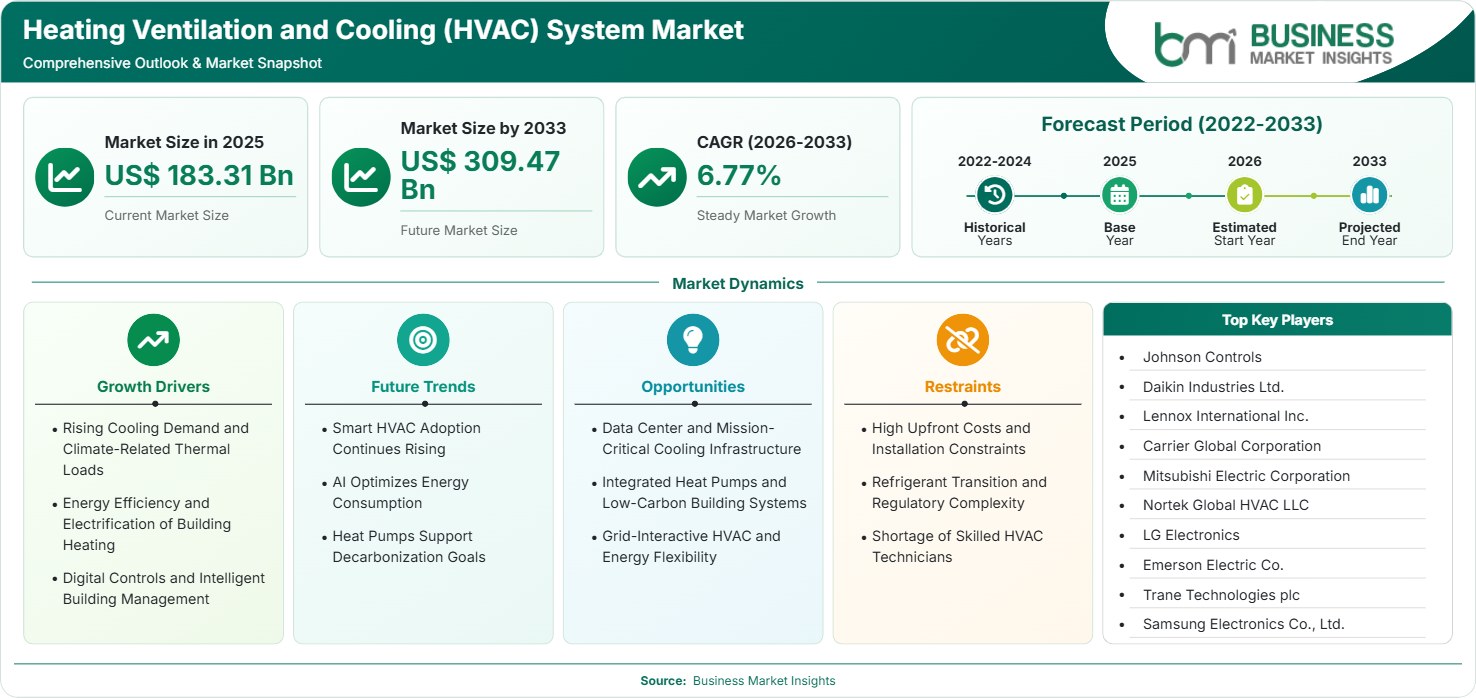
The Heating Ventilation and Cooling (HVAC) System Market size was valued at US$ 183.31 Billion in 2025 and is projected to reach US$ 309.47 Billion by 2033, growing at a CAGR of 6.77% during 2026–2033, driven by electrification, energy efficiency, smart controls, heat pumps, urbanization, and cooling demand.

Report Coverage
  • Application: Residential, Commercial, Industrial
  • Product Type: Heating Equipment, Cooling Equipment, Ventilation Equipment
US$ 183.31 Bn Market size in 2025
US$ 309.47 Bn Market Size by 2033
6.77% CAGR, 2026 - 2033
2026-2033 Forecast Period

AI Overview

Heating Ventilation and Cooling (HVAC) System Market Summary

  • North America Region: North America holds a 24%–27% Heating Ventilation and Cooling System Market share in 2025, growing at a 6.0%–6.6% CAGR, influenced by commercial construction, data centers, replacement demand, efficiency standards, heat pumps, and connected controls. The US market remains technology-led, with a 5.8%–6.4% CAGR supported by retrofit activity and resilient commercial demand.
  • Fastest Growing Region: Asia Pacific holds a 38%–42% share of the market in 2025, advancing at a 7.4%–8.1% CAGR as urbanization, rising cooling penetration, industrialization, infrastructure investment, and hot-weather exposure accelerate equipment adoption across China, India, Japan, and Southeast Asia.
  • Leading Segment: Cooling Equipment holds a 43%–47% share of the Heating Ventilation and Cooling System market in 2025, expanding at a 6.9%–7.4% CAGR as rising cooling loads, replacement cycles, energy efficiency mandates, inverter adoption, refrigerant transitions, and commercial cooling requirements strengthen equipment demand globally.
  • High Growth Segment: Commercial applications represent the high-growth segment, expanding at a 7.2%–7.9% CAGR as data centers, healthcare facilities, logistics hubs, offices, retail properties, and energy-efficient building retrofits require integrated thermal management and automation solutions.
  • Key Market Opportunity: Decarbonized heating, intelligent controls, heat pumps, and thermal optimization create investment opportunities by combining equipment sales with software, monitoring, maintenance, energy services, and recurring lifecycle revenues.
  • Major Market Players: Johnson Controls, Daikin Industries Ltd., Lennox International Inc., Carrier Global Corporation, Mitsubishi Electric Corporation, Nortek Global HVAC LLC, LG Electronics, Emerson Electric Co., Trane Technologies plc, and Samsung Electronics Co., Ltd.
Strategic Insights

Heating Ventilation and Cooling (HVAC) System Market: Strategic Insights

Heating Ventilation and Cooling (HVAC) System Market Strategic Framework
FREE PDF
Request your free sample
Request free sample
Stakeholder View

Key Takeaways

  • Equipment manufacturers are increasingly integrating compressors, controls, sensors, software, analytics, maintenance, and energy-management capabilities, shifting competition from standalone hardware toward complete thermal-management ecosystems.
  • Commercial facilities offer an attractive growth pool because data centers, hospitals, warehouses, retail buildings, and offices require higher reliability, redundancy, air-quality management, and continuous optimization than conventional installations.
  • Variable-speed operation, heat pumps, low-GWP refrigerants, predictive controls, thermal storage, and AI-assisted optimization are becoming central development priorities as customers seek lower operating costs without compromising comfort.
  • India, Southeast Asia, China, and selected Middle Eastern economies combine increasing cooling penetration with construction activity, making them important markets for localized manufacturing, distribution, service networks, and efficient equipment.
  • Recent transactions and partnerships demonstrate increasing strategic interest in digital controls, data-center cooling, energy management, and integrated climate platforms rather than traditional equipment categories alone.
  • Recurring maintenance, remote monitoring, controls upgrades, replacement compressors, refrigerant servicing, and performance contracts can create more stable revenue streams as installed equipment bases expand.
Geographic Outlook

Heating Ventilation and Cooling (HVAC) System Market Regional Highlights

North America Heating Ventilation and Cooling System Market

North America accounts for a 24%–27% share in 2025 and is projected to grow at a 6.0%–6.6% CAGR through 2033. The regional outlook reflects replacement demand, commercial construction, data-center investment, and stricter efficiency requirements. The United States represents the dominant national Heating Ventilation and Cooling System Market, while Canada contributes through cold-climate heating modernization. Connected equipment, heat pumps, variable-speed systems, and building automation are gaining importance as owners prioritize energy performance, resilience, and lifecycle costs. Regional demand is also influenced by refrigerant transitions and the growing requirement for advanced controls in large commercial facilities.

  • Data centers are increasing demand for precision cooling, redundant systems, liquid-assisted thermal management, and intelligent controls as computing infrastructure expands across major technology clusters.
  • Replacement activity remains important because aging residential and commercial equipment creates opportunities for higher-efficiency systems, heat pumps, variable-speed compressors, and connected thermostats.
  • Federal and state efficiency requirements are encouraging manufacturers to redesign equipment around lower energy consumption and evolving refrigerant safety requirements.
  • Building owners increasingly combine HVAC upgrades with automation, energy monitoring, demand response, and predictive maintenance to improve total operating economics.

US Heating Ventilation and Cooling System Market

The United States represents the principal North American market, with a 5.8%–6.4% CAGR through 2033 and a 72%–78% share of regional demand in 2025. Demand is supported by replacement cycles, commercial construction, data-center capacity additions, and building-efficiency investments. The IEA reports that US heat-pump sales declined around 13% in 2025, yet heat pumps still outsold gas boilers for a fourth consecutive year. This illustrates a structural electrification trend despite short-term market volatility.

  • Commercial HVAC demand is supported by data centers, healthcare, logistics, education, and large office properties requiring reliable temperature and humidity management.
  • Refrigerant transition requirements are accelerating product updates, installer training, leak-management practices, and safety-focused system designs across residential and commercial applications.
  • Connected controls and home energy-management platforms are expanding the addressable market beyond equipment replacement by linking HVAC operation with electricity pricing and grid flexibility.

Europe Heating Ventilation and Cooling System Market

Europe holds a 22%–25% share in 2025 and is projected to advance at a 6.4%–7.0% CAGR in the Heating Ventilation and Cooling System Market. Germany remains a leading market, while France, Italy, the United Kingdom, Spain, and the Nordic countries provide substantial opportunities. Germany recorded a 55% increase in first-half heat-pump sales in 2025, helping European heat-pump sales rise 11% for the year. Decarbonization policies, building renovation, heat-pump adoption, and refrigerant requirements are influencing product selection and investment.

  • Germany combines strong heat-pump adoption with building modernization, creating demand for high-efficiency heating equipment, hybrid systems, controls, and professional installation services.
  • France remains a major heat-pump market, although 2025 sales declined moderately, demonstrating the importance of policy stability and household economics.
  • The United Kingdom is positioned for expansion through building-efficiency initiatives, heat-pump deployment, and modernization of older heating systems.
  • Nordic markets emphasize efficient heating, heat recovery, and integrated controls because long heating seasons increase the economic value of energy performance.

Asia Pacific Heating Ventilation and Cooling System Market

The Asia Pacific region holds a market share of 38% to 42% and is the fastest-growing market, with a CAGR of 7.4% to 8.1%. China continues to be the biggest producer and consumer of equipment, while India, Japan, Indonesia, Vietnam, and other parts of Southeast Asia offer considerable incremental demand. According to figures from the IEA, there has been a 25% increase in global air conditioner shipments over the last five years, mainly from developing economies. Urbanization, rising incomes, industrial facilities, and extreme heat exposure reinforce regional demand.

  • China combines extensive manufacturing capacity with great domestic demand, supporting rapid deployment of inverter air conditioners, heat pumps, commercial systems, and smart controls.
  • India represents a compelling growth market as household cooling penetration rises alongside urban construction, commercial development, manufacturing investment, and rising summer temperatures.
  • Japan maintains a mature but technologically advanced market focused on efficient equipment, heat-pump water heating, controls, and replacement of installed systems.
  • Southeast Asia is gaining attention because expanding urban populations, tropical climates, tourism infrastructure, and industrial facilities require reliable cooling throughout the year.

Rest of World Heating Ventilation and Cooling System Market

Rest of World represents a 10%–14% share in 2025 and is expected to grow at a 7.0%–7.8% CAGR of the Heating Ventilation and Cooling System Market. South and Central America benefit from expanding commercial construction, residential cooling penetration, and industrial investment, while Brazil and Mexico remain important regional markets. Middle Eastern and African demand is shaped by high cooling requirements, urban development, hospitality, healthcare, and infrastructure projects. Saudi Arabia and the United Arab Emirates are especially relevant for high-performance cooling and large centralized systems.

Across these markets, energy efficiency is becoming more important because cooling can represent a substantial operating expense in hot climates. Efficient chillers, variable-speed systems, district cooling, heat recovery, and building automation provide opportunities for manufacturers and service providers.

  • Brazil and Mexico offer opportunities through residential penetration, commercial development, industrial facilities, and modernization of inefficient installed equipment.
  • Gulf markets prioritize high-capacity cooling, district systems, advanced controls, and resilient equipment because extreme temperatures create substantial thermal loads.
  • South Africa and selected African economies offer longer-term potential as urbanization, healthcare infrastructure, retail development, and electrification improve equipment accessibility.
  • Energy-performance requirements are increasingly encouraging developers to evaluate lifecycle costs instead of selecting systems solely on initial purchase price.
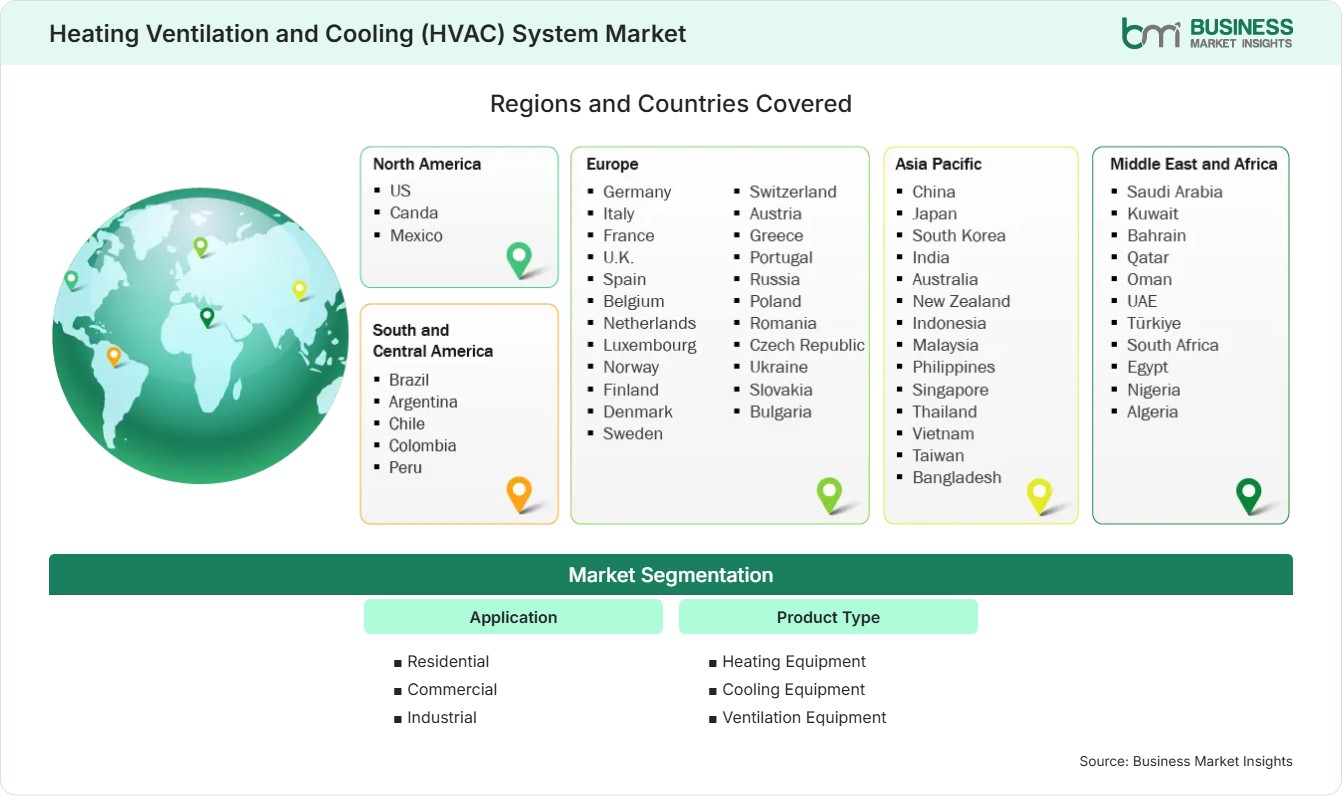
Global Market Geography
FREE PDF
Request your free sample
Request free sample
Segment Analysis

Heating Ventilation and Cooling (HVAC) System Market Segmentation

Application

The Application demand is driven by the installation of Heating Ventilation and Cooling System Market in the residential sector, whereas the commercial sector provides the highest growth potential. Segmentation depends on building construction, replacement cycles, energy costs, and automation needs. The advantage of commercial applications includes data centers and healthcare facilities. Demand for residential applications will be driven by increased cooling penetration and heat pump usage. Temperature control and ventilation will be required in industrial facilities.

  • Residential: Demand centers on split systems, heat pumps, packaged equipment, and smart thermostats. Replacement cycles and rising cooling penetration encourage higher-efficiency equipment and connected energy management.
  • Commercial: Offices, hospitals, retail properties, hotels, logistics centers, and data centers require scalable systems, redundancy, advanced controls, and continuous monitoring, supporting premium equipment adoption.
  • Industrial: Manufacturing facilities require process cooling, ventilation, humidity control, and thermal stability. Specialized systems support production quality, worker environments, and energy optimization across industrial operations.

Product Type

The demand for Product Type is driven by the need for cooling equipment, which accounts for the largest share due to the growing adoption of cooling in developing nations and commercial spaces. Heating equipment benefits from electrification and heat pumps, while ventilation equipment becomes relevant due to demands on indoor air quality. The proportion of segments will be affected by energy-efficiency standards, refrigerant regulations, intelligent control systems, and integrated building management systems.

  • Heating Equipment: Heat pumps, boilers, furnaces, and hybrid systems address residential, commercial, and industrial heating needs. Electrification and efficiency targets are increasing interest in low-carbon heating technologies.
  • Cooling Equipment: Air conditioners, chillers, rooftop units, VRF systems, and precision cooling equipment support residential and commercial demand. Inverter technology and efficiency improvements are strengthening product differentiation.
  • Ventilation Equipment: Air-handling units, exhaust systems, heat-recovery ventilators, and filtration technologies support indoor-air-quality objectives. Demand is strengthened by healthcare, commercial buildings, industrial applications, and tighter ventilation practices.
Market Forces

Heating Ventilation and Cooling (HVAC) System Market Dynamics

Key Market Drivers

Rising Cooling Demand and Climate-Related Thermal Loads

Demand for cooling is driven by rising temperatures, urbanization, and the increasing prevalence of appliances. According to the International Energy Agency, space cooling has grown by more than 4% per year since 2000, exceeding all other building end uses. Global air conditioner shipments have hit about 200 million units in 2024, up 25% from shipments five years ago. These trends help drive the Heating Ventilation and Cooling System Market across both residential and commercial applications. Emerging markets remain critical to the market, with air conditioning ownership expanding from a fairly low base. The impact of heatwaves and seasonality changes has also led companies to focus on capacity and resilience.

Energy Efficiency and Electrification of Building Heating

Energy efficiency is shifting HVAC procurement toward equipment that lowers lifetime electricity or fuel consumption rather than simply meeting capacity requirements. Heat pumps are central to this transition because they can provide heating and cooling through a single electrically driven system. According to IEA data, Sales of heat pumps grew by 11% in Europe in 2025, with a 55% increase in Germany in the first half of the year, and heat pumps sold ahead of gas boilers for the first time. These developments align with Heating Ventilation and Cooling System Market trends such as electrification, inverters, heat storage, and energy management. Heat pump sales were down by about 13% in the US in 2025, yet beat gas boiler sales for the fourth year in a row.

Digital Controls and Intelligent Building Management

The future of connected HVAC systems is shifting from remotely monitored devices to intelligent building systems that operate based on occupancy, weather conditions, energy rates, and equipment performance. Autonomous controls using artificial intelligence will enable optimal functioning of all systems simultaneously, with minimal runtime and enhanced comfort. According to a report by Trane Technologies, using BrainBox AI technology can help reduce energy use by up to 25% and greenhouse gas emissions by up to 40% in buildings. Digital transformation has thus emerged as a key factor in the Heating Ventilation and Cooling System market growth, especially in commercial buildings where there is high energy demand. Building owners can combine sensors, controls, predictive maintenance, and analytics to generate measurable efficiency improvements without replacing every installed component.

Key Market Opportunities

Data Center and Mission-Critical Cooling Infrastructure

Data centers are a value-added proposition because, as computing density increases, the need for proper thermal management will grow. Increased computing density will lead to higher heat loads for AI workloads at the rack level, necessitating precision air conditioning, redundancy, liquid cooling, heat-rejection devices, and intelligent control systems. Daikin showcased its offerings in data center and commercial cooling at the 2026 AHR Expo. The Carrier company has recognized data centers as one of the commercial HVAC growth areas. Investors can target suppliers with expertise in high-availability cooling, controls, service, and thermal optimization rather than commodity equipment alone.

Integrated Heat Pumps and Low-Carbon Building Systems

The shift towards electric heating systems from fossil-fuel-based systems presents opportunities across all fronts, including hardware, installation, controls, and servicing. The example of heat pump recovery in Europe shows how this combination of policy, energy economics, and building renovation can increase demand. In December 2025, Daikin and Copeland expanded their collaboration in Europe on inverter compressors, power electronics, and controls for residential heat pumps. These kinds of collaborations present an opportunity for companies to develop whole systems customized to local grids, refrigerants, and buildings. Thus, the Heating Ventilation and Cooling System Market Forecasts favor firms capable of integrating hardware, installation, and controls.

Grid-Interactive HVAC and Energy Flexibility

HVAC systems can be turned into distributed energy resources through the use of batteries, smart control systems, time-of-use pricing, and demand-response schemes by utilities. Carrier initiated pilot studies starting in 2025 involving HVAC systems that use batteries in combination with variable-speed heat pumps to shift energy use away from peak times. The company concluded that its total installed base of residential systems in North America was more than 100 GW of potential flexible load. The result is a new business opportunity where HVAC manufacturers, utilities, software vendors, and consumers create value from grid services.

Market Restraints and Challenges

High Upfront Costs and Installation Constraints

Factor: Higher costs are associated with implementing advanced HVAC systems, as they require efficient compressors, heat pumps, sensors, controls, electrical work, and specialized installation services.

Impact: Higher costs can affect the decision to replace systems for those households, small businesses, and building owners with small budgets. This problem is exacerbated by the need to upgrade electrical systems, ductwork, and insulation to enable new systems to meet their efficiency targets. A shortage of skilled laborers to implement the project can also drive up costs. This can pose a problem for the adoption of such products in the price-sensitive residential market. The manufacturers and their channel partners can address this barrier by offering products with modular designs, financing options, and service contracts.

Refrigerant Transition and Regulatory Complexity

Factor: Regulations concerning refrigerants are requiring manufacturers and contractors to transition to lower-global-warming-potential refrigerants while meeting criteria for flammability, equipment design, service, and transportation.

Impact: The need to comply adds complexity to redesigning, certification, training, stocking, and installation throughout the entire value chain. ASHRAE standards increasingly focus on refrigerant classification and proper system functioning, and recent changes indicate evolving regulations regarding the use of A2L refrigerants. Coordination of products across different national regulations is required of manufacturers and will not be performed at the same pace. Contractors need new equipment and training, and distributors need to handle different refrigerant types during transitional phases. This could lead to temporary supply chain friction and increased implementation costs.

Company Analysis

Competitive Landscape

The Heating Ventilation and Cooling System Market analysis indicates that competition increasingly centers on energy efficiency, digital controls, heat pumps, commercial HVAC, data-center cooling, and lifecycle services. Leading participants are using product innovation, acquisitions, partnerships, geographic expansion, and digital platforms to strengthen their positions.

Company Name

Overview

Products and Services relevant to this market

Johnson Controls International plc

Global building-technology company focused on intelligent, efficient, and sustainable building systems across commercial and institutional environments.

HVAC equipment, building automation, controls, service, energy optimization, and integrated building-management solutions for commercial customers.

Daikin Industries, Ltd.

Japanese climate-technology leader with extensive global expertise in air conditioning, heat pumps, refrigerants, and commercial thermal systems.

Residential and commercial air conditioners, heat pumps, VRV systems, chillers, controls, compressors, and refrigerant technologies.

Lennox International Inc.

US-based climate-solutions provider serving residential and commercial customers through equipment, controls, and service channels.

Furnaces, heat pumps, air conditioners, rooftop equipment, indoor-air-quality products, thermostats, controls, and commercial HVAC systems.

Carrier Global Corporation

Global intelligent climate and energy solutions provider with strong residential, commercial, controls, and data-center capabilities.

Air conditioning, heating, heat pumps, chillers, building automation, controls, energy management, and aftermarket services.

Mitsubishi Electric Corporation

Japanese technology company with advanced inverter and variable-refrigerant-flow HVAC capabilities across residential and commercial applications.

Split systems, VRF equipment, heat pumps, ventilation products, controls, air-handling solutions, and building-management technologies.

Nortek Global HVAC LLC

HVAC manufacturer focused on residential and commercial equipment and specialized indoor climate solutions.

Heating and cooling equipment, air handlers, packaged systems, ventilation solutions, and commercial HVAC products.

LG Electronics Inc.

Korean technology company offering connected residential and commercial climate systems supported by advanced controls and digital platforms.

Air conditioners, heat pumps, VRF systems, air-handling solutions, controls, building-management technologies, and commercial HVAC equipment.

Emerson Electric Co.

Industrial technology company supplying automation and thermal-management technologies used across HVAC and building applications.

Compressors, controls, sensors, valves, refrigeration components, automation technologies, and climate-management solutions.

Trane Technologies plc

Global climate innovator focused on efficient building systems, intelligent controls, sustainability, and advanced commercial HVAC services.

Chillers, heat pumps, air handlers, rooftop systems, controls, building analytics, digital optimization, and lifecycle services.

Samsung Electronics Co., Ltd.

Technology manufacturer with connected residential and commercial air-conditioning systems integrated with broader smart-building ecosystems.

Residential air conditioners, VRF systems, heat pumps, controls, connected HVAC products, and smart-building integration solutions.

Trust & Transparency

Research Methodology

The market analysis combines proprietary research with secondary data from government agencies, company disclosures, regulatory filings, industry databases and expert interviews. Market estimates are validated through data triangulation, cross-market benchmarking and analyst review.

View Full Research Methodology

Questions Answered

Frequently Asked Questions

What distinguishes the Heating Ventilation and Cooling System Market Report from a conventional equipment study?

The analysis evaluates equipment demand together with application requirements, digital controls, electrification, refrigerant transitions, commercial infrastructure, lifecycle services, and regional investment conditions. This approach captures how HVAC is evolving from equipment procurement toward integrated thermal and energy-management platforms.

How can HVAC systems participate in electricity-grid management?

Connected HVAC systems can respond to electricity prices, demand-response signals, weather conditions, and building occupancy. Battery-enabled systems can shift consumption away from peak periods. Carrier's 2025 trials demonstrate how HVAC equipment can function as flexible distributed energy resources rather than simply consuming electricity.

Why are refrigerants becoming a strategic issue for HVAC manufacturers?

Refrigerant transitions influence product design, safety certification, installer training, supply chains, and after-sales servicing. Companies must manage different regulatory timelines across countries while ensuring technicians can safely install and maintain newer refrigerants. This makes regulatory capability and service infrastructure increasingly important competitive assets.

How are data centers changing commercial HVAC requirements?

Data centers require continuous cooling, redundancy, precise temperature and humidity control, rapid response, and increasingly sophisticated thermal-management architectures. AI computing is raising equipment density, encouraging manufacturers to develop precision cooling, liquid-assisted systems, advanced controls, and high-availability service models tailored to mission-critical environments.

What technologies will have the greatest influence on HVAC system development through 2033?

Heat pumps, variable-speed compressors, low-GWP refrigerants, AI-enabled controls, thermal storage, connected sensors, and building-management platforms are likely to shape product development. The strongest systems will increasingly integrate multiple technologies rather than treating heating, cooling, ventilation, and energy management as separate functions.

Access the Full Heating Ventilation and Cooling (HVAC) System Market Report

Get segment-level forecasts, regional estimates, competitive benchmarking, company profiles and downloadable Excel datasets.

Access the full Heating Ventilation and Cooling (HVAC) System Market Report
350 pages PDF & Excel | 2026-09-23
Similar Research

Related Market Reports