
District Cooling Market Outlook: Size, Share, Trends, Growth Analysis, Competitive Landscape & Forecast, 2026-2033

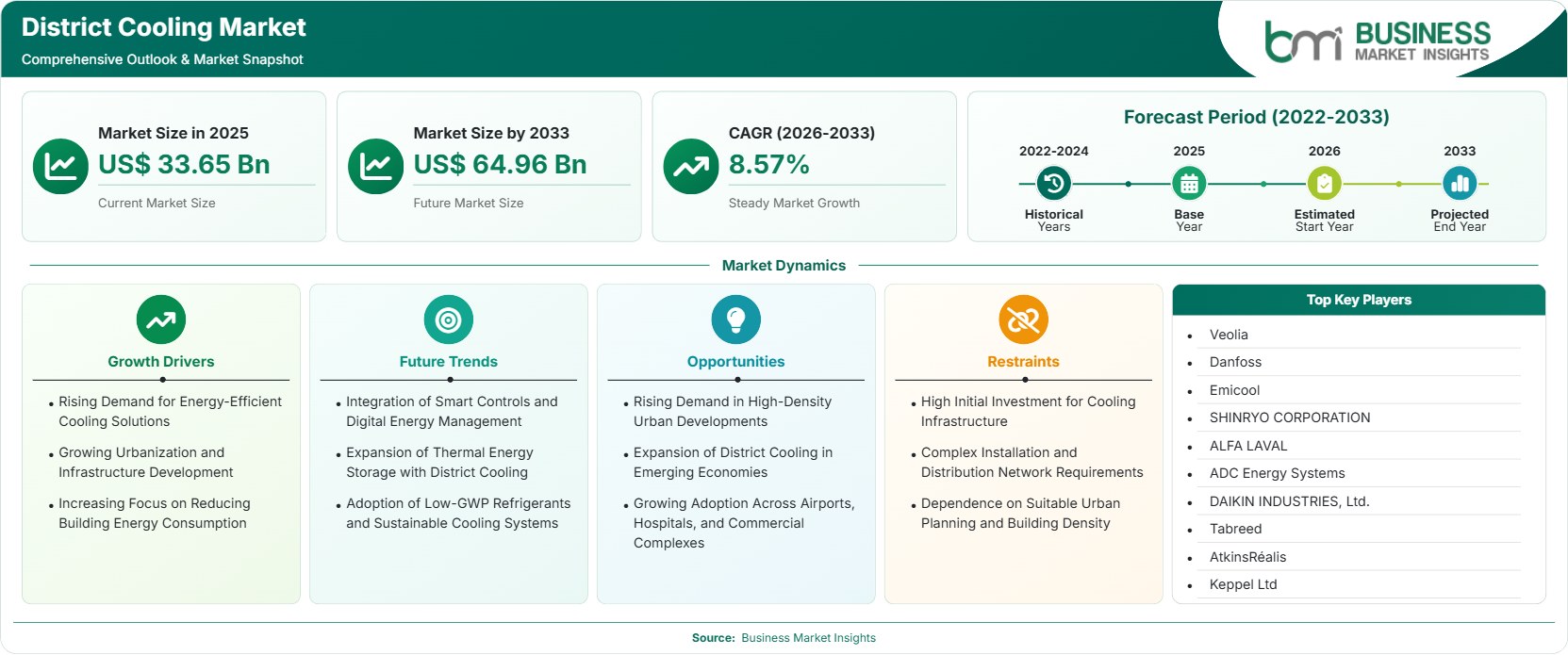
The District Cooling Market size was valued at US$ 33.65 Billion in 2025 and is projected to reach US$ 64.96 Billion by 2033, growing at a CAGR of 8.57% during 2026–2033. Rising urbanization, growing demand for energy-efficient cooling infrastructure, increasing investments in smart city projects, and expanding adoption of sustainable cooling technologies are supporting market growth globally.

Report Coverage
  • Technology: Electric Chillers, Absorption Chillers, Others
  • End-User: Residential, Industrial, Commercial
US$ 33.65 Bn Market size in 2025
US$ 64.96 Bn Market Size by 2033
8.57% CAGR, 2026 - 2033
2026-2033 Forecast Period

01 AI Overview

District Cooling Market Summary

  • North America Region: North America holds a market share of 34%–37% in 2025, growing with a CAGR of 8.1%–8.8% during 2026–2033. Increasing adoption of energy-efficient cooling systems, commercial infrastructure expansion, and sustainability initiatives continue supporting regional leadership. The U.S. market is expected to register a CAGR of 8.3%–9.0%.
  • Fastest Growing Region: Asia Pacific accounts for 30%–33% share in 2025 and is projected to grow at a CAGR of 9.0%–9.7% through 2033. Rapid urbanization, infrastructure development, and rising energy demand continue driving regional growth.
  • Leading Segment: Electric Chillers represent 56%–59% share in 2025 and are expected to grow at a CAGR of 8.4%–9.1% through 2033. High operational efficiency and widespread deployment across district cooling networks continue supporting segment dominance.
  • High Growth Segment: Commercial accounts for 47%–50% share in 2025 and is forecast to grow at a CAGR of 8.9%–9.6% during 2026–2033. Growing construction of airports, shopping malls, office complexes, hospitals, and mixed-use developments continues accelerating segment growth.
  • Key Market Opportunity: Expansion of smart cities, green building projects, sustainable urban infrastructure, and centralized cooling networks is creating substantial growth opportunities.
  • Major Market Players: Veolia, Danfoss, Emicool, SHINRYO CORPORATION, ALFA LAVAL, ADC Energy Systems, DAIKIN INDUSTRIES, Ltd., Tabreed, AtkinsRéalis, and Keppel Ltd.
02 Strategic Insights

District Cooling Market: Strategic Insights

District Cooling Market Strategic Framework
FREE PDF
Request your free sample
Request free sample
03 Stakeholder View

Key Takeaways

  • District cooling systems are becoming critical components of sustainable urban infrastructure.
  • Electric chillers continue dominating due to efficiency and operational reliability.
  • Commercial applications account for the largest share of market demand.
  • Smart city initiatives are supporting centralized cooling adoption.
  • Energy efficiency and carbon reduction targets remain key market drivers.
  • North America remains the leading market due to infrastructure modernization and sustainability programs.
  • Asia Pacific is projected to witness the fastest growth owing to urbanization and city development projects.
  • Green buildings and district energy systems are expected to create significant future opportunities.
04 Geographic Outlook

District Cooling Market Regional Highlights

North America District Cooling Market

North America accounts for 34%–37% District Cooling Market share in 2025 and is projected to grow at a CAGR of 8.1%–8.8% through 2033. The region benefits from growing investments in sustainable infrastructure, increasing commercial construction activity, and rising demand for energy-efficient cooling technologies.

  • Smart city initiatives are supporting district cooling adoption by integrating centralized, energy-efficient cooling systems into modern urban infrastructure.
  • Commercial buildings are increasingly adopting centralized cooling solutions to improve energy management, reduce operating costs, and enhance occupant comfort.
  • Corporate sustainability targets are encouraging investments in lower-emission cooling infrastructure and environmentally responsible building systems.
  • Energy-efficient technologies, including advanced chillers, thermal energy storage, and smart controls, are gaining wider acceptance across commercial developments.
  • Healthcare, educational, and institutional facilities are expanding district cooling utilization due to reliable and consistent cooling requirements.
  • Infrastructure modernization projects are creating additional demand as cities upgrade aging cooling networks and develop sustainable urban facilities.

US District Cooling Market

The United States contributes approximately 89%–93% of North American revenue and is expected to register a CAGR of 8.3%–9.0% through 2033. The country remains the largest market due to extensive commercial infrastructure, growing sustainability initiatives, and increasing focus on energy optimization.

  • Commercial buildings continue driving investments in district cooling infrastructure, particularly across large office complexes, retail centers, hotels, and mixed-use developments.
  • Universities and healthcare campuses remain major adopters due to their high and consistent cooling requirements and centralized facility management needs.
  • Urban redevelopment projects are supporting market expansion by incorporating centralized cooling networks into modern residential, commercial, and mixed-use districts.
  • Advanced energy management solutions are improving system performance through intelligent monitoring, automated controls, load optimization, and predictive maintenance.
  • Green building standards are encouraging adoption by promoting energy efficiency, lower emissions, sustainable infrastructure, and improved overall building performance.

Europe District Cooling Market

Europe represents 22%–25% of global revenue in 2025 and is anticipated to expand at a CAGR of 8.5%–9.2% through 2033. Strong environmental regulations, energy-efficiency targets, and urban sustainability initiatives continue supporting regional growth. Germany remains the leading market while Poland demonstrates stronger growth momentum.

  • Germany continues leading regional demand, supported by strong investments in sustainable infrastructure, energy efficiency, and low-carbon urban development.
  • Poland is among the fastest-growing markets, with the district cooling market estimated to register a CAGR of 9.4%–10.1% during the forecast period.
  • Carbon reduction initiatives are encouraging adoption of centralized cooling systems that can improve energy efficiency and reduce emissions.
  • District energy systems are expanding across urban areas, supporting reliable and efficient cooling for large-scale developments.
  • Green building projects continue creating opportunities through energy-performance requirements and sustainability-focused construction practices.
  • Municipal authorities are investing in efficient cooling infrastructure to modernize urban energy networks and support long-term sustainability goals.

Asia Pacific District Cooling Market

Asia Pacific accounts for 30%–33% of global revenue in 2025 and is expected to achieve the fastest CAGR of 9.0%–9.7% through 2033. Rapid urbanization, large-scale infrastructure development, expanding commercial real estate projects, and smart city initiatives continue supporting strong regional growth.

  • China remains the largest regional market, supported by extensive urban infrastructure development, rapid construction activity, and growing demand for centralized cooling solutions.
  • India is projected to achieve a CAGR of approximately 9.9%–10.6%, driven by smart city initiatives, commercial construction, urbanization, and infrastructure modernization.
  • District cooling systems are expanding across mixed-use developments, including residential, commercial, hospitality, and retail complexes.
  • Commercial infrastructure projects remain major demand generators as developers prioritize efficient and reliable centralized cooling systems.
  • Sustainability objectives are encouraging adoption of energy-efficient cooling technologies and lower-emission district energy solutions.
  • Government infrastructure investments are creating new opportunities through urban development programs, public facilities, and large-scale infrastructure projects.

Rest of World District Cooling Market

Rest of World accounts for 8%–11% of global revenue in 2025 and is projected to expand at a CAGR of 7.5%–8.2% through 2033. Infrastructure investments, urban development initiatives, and increasing focus on sustainable cooling technologies are supporting market growth across Latin America, the Middle East, and Africa.

  • Brazil continues generating district cooling demand through urban development, commercial construction, and modernization of large-scale infrastructure.
  • The UAE is witnessing significant deployment of district cooling systems, particularly across smart cities, commercial hubs, residential communities, and large mixed-use developments.
  • Saudi Arabia is expected to achieve a CAGR of approximately 8.4%–9.1% through 2033, supported by major smart city programs and large-scale infrastructure investments.
  • Commercial developments remain important growth contributors as new projects increasingly prioritize efficient centralized cooling solutions.
  • Energy-efficiency initiatives are encouraging adoption of advanced cooling systems that reduce energy consumption and operating costs.
  • Centralized cooling infrastructure continues creating long-term opportunities across rapidly urbanizing cities and large-scale development projects.
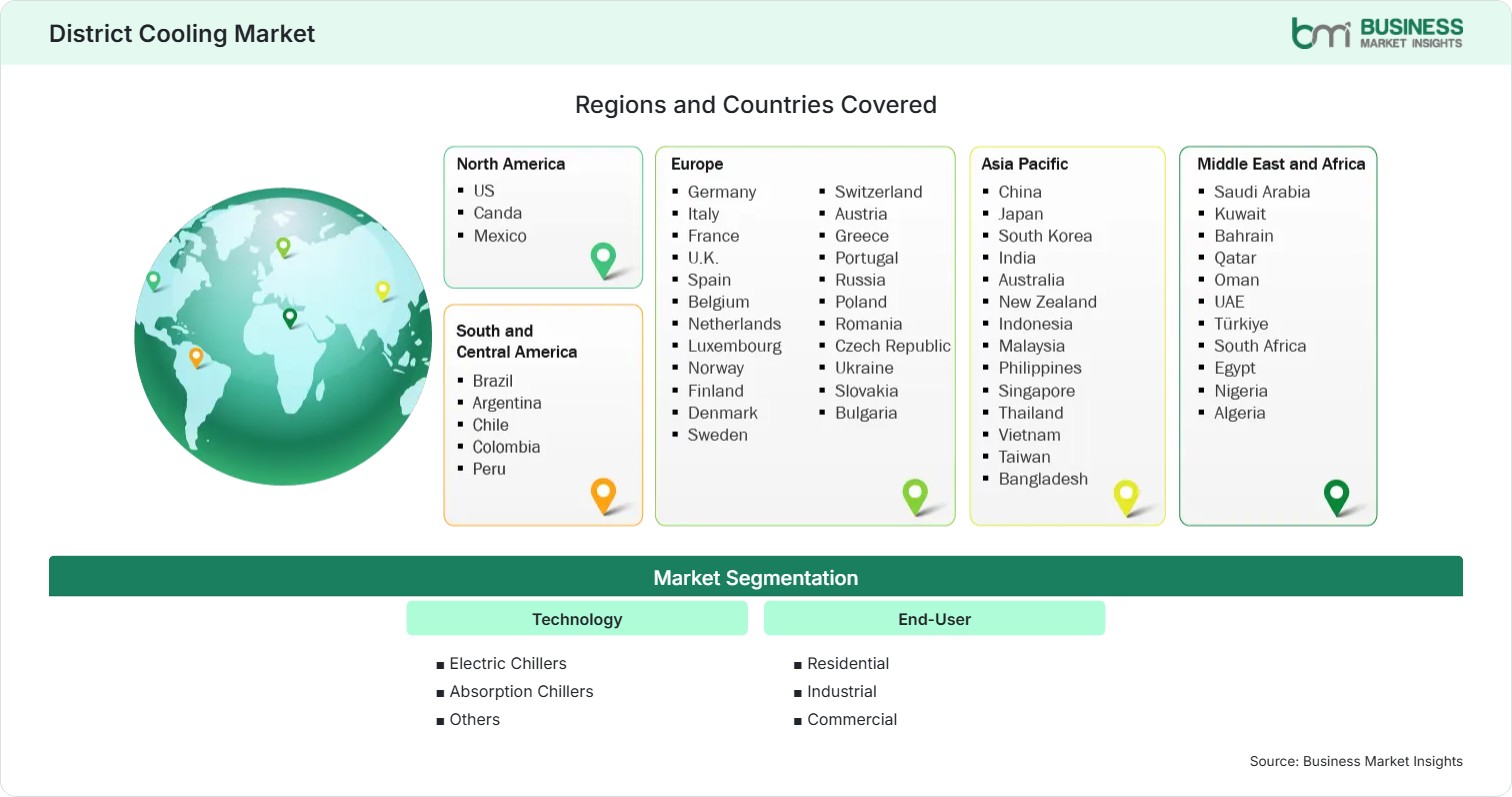
Global Market Geography
FREE PDF
Request your free sample
Request free sample
05 Segment Analysis

District Cooling Market Segmentation

Technology

The technology segment represents the primary cooling technologies utilized within district cooling systems to generate and distribute chilled water efficiently across multiple buildings and facilities. This segment accounts for approximately 56%–59% share in 2025 and is projected to grow at a CAGR of 8.4%–9.1% through 2033. The expanding District Cooling Market Scope is supported by increasing urbanization, rising demand for energy-efficient cooling infrastructure, and growing adoption of sustainable district energy solutions.

  • Electric Chillers: Electric chillers dominate the market due to their high efficiency, operational reliability, scalability, and widespread deployment across commercial and mixed-use district cooling projects.
  • Absorption Chillers: Absorption chillers continue gaining adoption owing to their ability to utilize waste heat, district heating sources, and renewable energy inputs for cooling generation.
  • Others: Other technologies include hybrid cooling systems, thermal energy storage-integrated solutions, and advanced centralized cooling technologies designed to improve operational efficiency.

End-User

The end-user segment highlights the major sectors utilizing district cooling systems to improve energy efficiency and manage large-scale cooling requirements. This segment accounts for approximately 47%–50% share in 2025 and is expected to register a CAGR of 8.9%–9.6% through 2033. Current District Cooling Market Trends indicate increasing adoption across commercial complexes, smart cities, airports, healthcare facilities, and large urban developments.

  • Residential: Residential adoption is growing due to increasing development of large-scale housing communities and integrated smart city projects.
  • Industrial: Industrial facilities utilize district cooling systems to improve energy utilization, process cooling efficiency, and sustainability performance.
  • Commercial: Commercial applications dominate the market owing to extensive deployment across office buildings, shopping malls, airports, hospitals, hotels, educational campuses, and mixed-use developments.
06 Market Forces

District Cooling Market Dynamics

Key Market Drivers

Rising Demand for Energy-Efficient Cooling Solutions

Growing concerns regarding energy consumption and carbon emissions are significantly increasing demand for energy-efficient cooling technologies worldwide. District cooling systems provide centralized cooling generation that enables higher efficiency compared to conventional standalone air-conditioning systems. These systems reduce electricity consumption, optimize resource utilization, and support sustainability objectives across urban developments. Governments, utility providers, and real estate developers are increasingly prioritizing energy-efficient infrastructure investments to achieve environmental targets and reduce operating costs. As cooling demand continues rising globally, district cooling solutions are expected to play an increasingly important role in sustainable urban development.

Growing Urbanization and Large-Scale Infrastructure Development

Rapid urbanization and population growth are driving extensive investments in residential, commercial, and mixed-use infrastructure projects worldwide. Expanding cities require scalable and efficient cooling solutions capable of supporting large building clusters and high-density developments. District cooling systems offer centralized infrastructure that improves operational efficiency while reducing equipment redundancy across buildings. Governments and developers are increasingly integrating district cooling into urban master plans to support sustainable growth and infrastructure modernization. As urban expansion continues across developed and emerging economies, demand for district cooling systems is expected to increase substantially.

Increasing Focus on Reducing Building Energy Consumption

Building owners and facility operators are increasingly implementing technologies that reduce energy use and improve operational performance. Cooling systems often represent a significant portion of total building energy consumption, creating strong incentives for efficiency improvements. District cooling solutions help optimize cooling generation, reduce maintenance requirements, and improve overall building sustainability. In addition, stricter energy-efficiency regulations and green building certification programs are encouraging adoption of centralized cooling systems. As organizations continue focusing on operational efficiency and carbon reduction initiatives, district cooling demand is expected to strengthen further.

Key Market Opportunities

Rising Demand in High-Density Urban Developments

High-density urban developments represent a major growth opportunity for district cooling providers. Mixed-use communities, business districts, residential clusters, and smart city projects require reliable and scalable cooling infrastructure capable of serving large populations and building concentrations. District cooling systems offer significant advantages in such environments by reducing equipment duplication and improving energy efficiency. Urban planners increasingly recognize the benefits of centralized cooling for sustainable city development. As metropolitan areas continue expanding globally, district cooling is expected to become an increasingly attractive infrastructure solution.

Expansion of District Cooling in Emerging Economies

Emerging economies are investing heavily in infrastructure modernization, urban development, and energy-efficient utility systems. Rising temperatures, economic development, and increasing commercial construction activities are creating significant demand for advanced cooling infrastructure. Governments are also promoting sustainable development initiatives that encourage adoption of centralized energy systems. District cooling providers have opportunities to establish long-term partnerships in rapidly developing urban markets. These trends are expected to generate substantial growth opportunities across Asia, the Middle East, Africa, and Latin America.

Growing Adoption Across Airports, Hospitals, and Commercial Complexes

Large commercial and institutional facilities increasingly require reliable cooling solutions capable of supporting continuous operations and high occupancy levels. Airports, hospitals, educational campuses, government facilities, and commercial complexes are adopting district cooling systems to improve energy efficiency and operational performance. Centralized cooling infrastructure provides economies of scale while reducing maintenance complexity. Technological improvements are further enhancing system reliability and performance. Long-term District Cooling Market Forecast projections remain favorable as adoption expands across major institutional and commercial developments worldwide.

Market Restraints and Challenges

High Initial Investment for Cooling Infrastructure

Factor: District cooling projects require substantial capital investment for central cooling plants, distribution networks, piping systems, thermal storage facilities, and supporting infrastructure. Project development often involves significant planning and financing requirements.

Impact: High upfront investment costs can limit project feasibility and delay adoption, particularly in regions with budget constraints or limited financing availability. Long payback periods may also affect investment decisions among developers and infrastructure operators.

Complex Installation and Distribution Network Requirements

Factor: District cooling systems require extensive underground distribution networks and complex engineering coordination across multiple buildings and service areas. Installation activities can be challenging in densely populated urban environments.

Impact: Infrastructure complexity may increase project execution timelines, operational risks, and overall development costs. Project stakeholders often need to manage regulatory approvals, construction coordination, and long-term maintenance requirements, which can influence market growth and adoption rates.

07 Company Analysis

Competitive Landscape

The District Cooling Market Analysis is characterized by competition among district energy providers, cooling infrastructure developers, thermal management solution companies, and energy efficiency technology suppliers. Market participants are focusing on high-efficiency cooling systems, sustainable energy solutions, smart cooling networks, thermal energy storage technologies, and integrated district energy platforms to strengthen their market positions. Rising urbanization, increasing demand for energy-efficient infrastructure, and growing investments in smart city developments continue driving innovation across the market. Companies are investing in digital energy management systems, sustainable cooling technologies, and large-scale cooling infrastructure projects to address evolving urban cooling requirements.

Company Name

Overview

Products and Services relevant to this market

Veolia

Global provider of energy, water, and environmental solutions.

District cooling systems, energy management services, sustainable cooling infrastructure, and utility solutions.

Danfoss

Technology company specializing in energy-efficient solutions.

District cooling components, heat exchangers, cooling controls, and energy optimization technologies.

Emicool

District cooling provider serving large-scale urban developments.

Centralized cooling services, district cooling infrastructure, and energy-efficient cooling solutions.

SHINRYO CORPORATION

Engineering and construction company serving building infrastructure markets.

Cooling systems, energy infrastructure, district cooling engineering, and facility management services.

ALFA LAVAL

Industrial equipment and thermal solutions provider.

Heat exchangers, thermal transfer systems, district cooling technologies, and energy efficiency solutions.

ADC Energy Systems

Provider of district energy and cooling solutions.

District cooling plants, energy infrastructure solutions, and centralized cooling technologies.

DAIKIN INDUSTRIES, Ltd.

Global manufacturer of air-conditioning and cooling systems.

Chillers, district cooling systems, energy-efficient HVAC technologies, and thermal management solutions.

Tabreed

District cooling company focused on sustainable cooling infrastructure.

District cooling services, chilled water networks, cooling plant operations, and energy solutions.

AtkinsRéalis

Engineering and infrastructure consulting company.

District cooling project development, engineering services, energy infrastructure planning, and sustainability consulting.

Keppel Ltd.

Infrastructure and energy solutions provider.

District cooling networks, urban utility infrastructure, sustainable energy systems, and smart city solutions.

10 Trust & Transparency

Research Methodology

The market analysis combines proprietary research with secondary data from government agencies, company disclosures, regulatory filings, industry databases and expert interviews. Market estimates are validated through data triangulation, cross-market benchmarking and analyst review.

View Full Research Methodology

11 Questions Answered

Frequently Asked Questions

How are smart city initiatives influencing the district cooling industry?

Smart city initiatives are increasing adoption of centralized cooling infrastructure by promoting energy efficiency, sustainability, optimized resource utilization, and long-term urban development objectives.

What does this District Cooling Market Report cover?

This report covers technology analysis, end-user assessment, regional trends, competitive landscape analysis, market drivers, opportunities, restraints, challenges, and future growth prospects through 2033.

Why is Commercial the leading end-user segment?

Commercial applications lead the market because airports, shopping malls, office complexes, hotels, hospitals, and mixed-use developments require large-scale, energy-efficient cooling infrastructure.

Which technology segment dominates the market?

Electric Chillers dominate the market due to their high operational efficiency, reliability, scalability, and widespread implementation in large district cooling systems.

What is driving growth in the District Cooling market?

Rising demand for energy-efficient cooling solutions, growing urbanization and large-scale infrastructure development, increasing focus on reducing building energy consumption, and expanding smart city initiatives are major factors driving market growth.

Access the Full District Cooling Market Report

Get segment-level forecasts, regional estimates, competitive benchmarking, company profiles and downloadable Excel datasets.

Access the full District Cooling Market Report
350 pages PDF & Excel | 2026-08-20