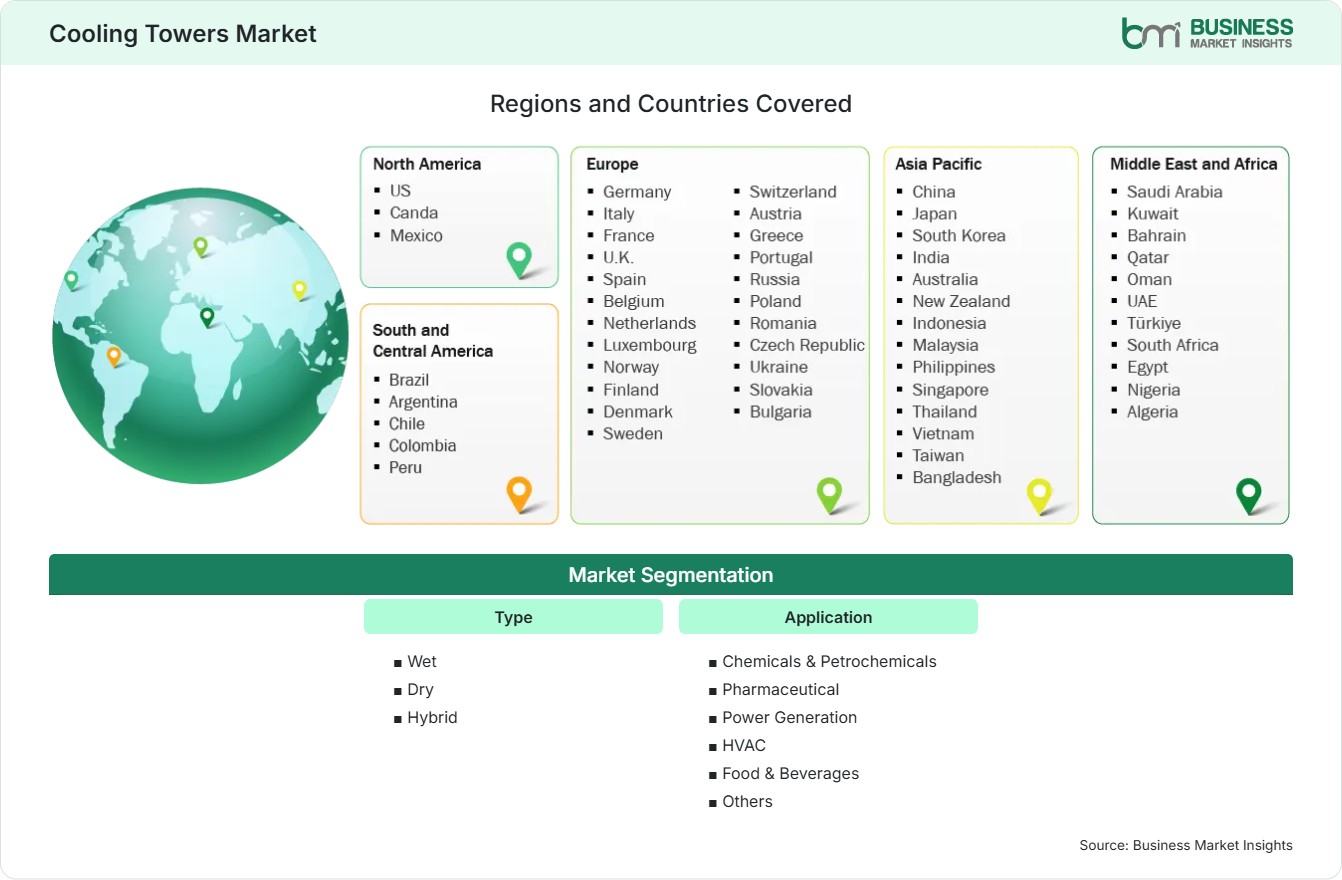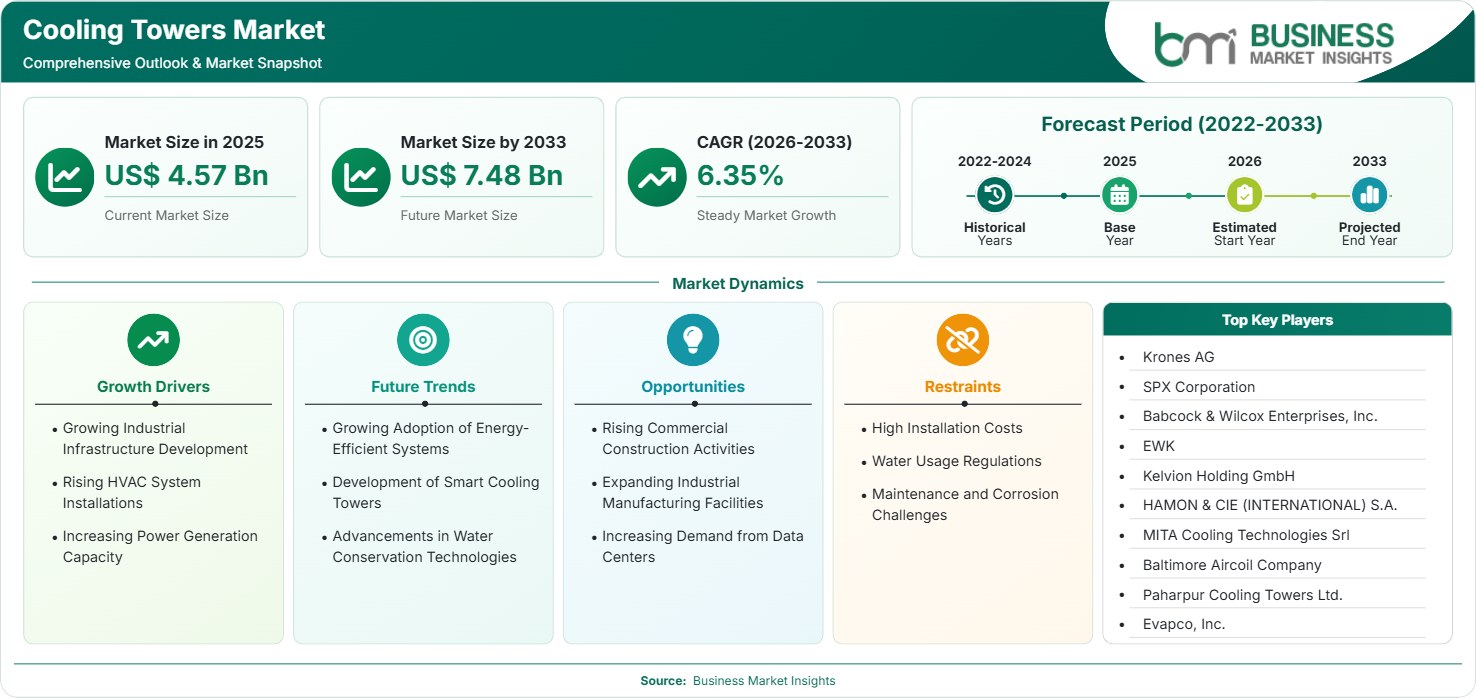
Cooling Towers Market Regional Highlights
North America Cooling Towers Market
North America accounted for a 32%–35% share in 2025 and is projected to expand at a CAGR of 6.10%–6.50% during 2026–2033. The region benefits from established industrial infrastructure, replacement demand, and investments in energy-efficient cooling technologies. Cooling Towers Market share remains supported by power plants, commercial facilities, and manufacturing industries adopting advanced systems. The US and Canada continue driving adoption through modernization programs and sustainability-focused industrial upgrades.
- Growing data center construction across North America is increasing demand for reliable cooling infrastructure, particularly systems designed for continuous operation, improved efficiency, and optimized water management capabilities in large-scale facilities.
- Industrial modernization initiatives are encouraging replacement of aging cooling equipment with advanced designs offering enhanced thermal performance, corrosion resistance, and reduced operational expenses across manufacturing and processing industries.
- Environmental regulations promoting water conservation are driving adoption of hybrid and closed-loop cooling solutions that minimize resource consumption while maintaining effective heat rejection performance for industrial users.
- Expansion of pharmaceutical, chemical, and food processing facilities is supporting demand for customized cooling solutions capable of meeting strict operational requirements and maintaining process stability.
US Cooling Towers Market
The US held a 27%–30% share within North America in 2025 and is expected to grow at a CAGR of 6.20%–6.60% during 2026–2033. The country remains a major contributor due to strong industrial activity, commercial construction, and increasing data center investments. Cooling Towers Market share is strengthened by replacement projects, infrastructure upgrades, and demand for efficient thermal management systems across multiple end-use industries.
- Increasing investments in hyperscale data centers are creating demand for high-capacity cooling systems capable of supporting intensive computing operations while improving energy efficiency and operational reliability.
- Manufacturing expansion across chemicals, pharmaceuticals, and advanced materials sectors is increasing adoption of customized cooling tower solutions designed for continuous industrial processes and temperature control requirements.
- Utility companies are upgrading existing power generation infrastructure with efficient cooling technologies to improve plant performance, reduce maintenance requirements, and comply with evolving environmental standards.
Europe Cooling Towers Market
Europe represented a 24%–27% share in 2025, growing at a CAGR of 5.80%–6.20% during 2026–2033. The region demonstrates steady adoption due to industrial decarbonization efforts, energy efficiency initiatives, and replacement of outdated systems. Germany, France, and the UK remain leading markets, while Eastern European countries show increasing demand through manufacturing investments. Cooling Towers Market growth is supported by regulatory emphasis on sustainable industrial operations.
- Germany is witnessing increased demand for advanced cooling systems due to strong chemical, automotive, and manufacturing industries requiring efficient heat management solutions.
- France and the UK are investing in modern industrial facilities and commercial infrastructure, creating opportunities for energy-efficient cooling technologies with improved operational performance.
- European sustainability regulations are encouraging industries to adopt water-saving cooling solutions, including hybrid systems that reduce environmental impact while maintaining process efficiency.
- Growth in pharmaceutical and food processing industries is supporting demand for reliable cooling infrastructure with precise temperature control capabilities.
Asia Pacific Cooling Towers Market
Asia Pacific accounted for a 28%–31% share in 2025 and is expected to register a CAGR of 7.00%–7.40% through 2033. The region represents the fastest-growing market due to rapid industrialization, urban development, and expanding power infrastructure. China, India, Japan, and Southeast Asian economies are driving installations. Cooling Towers Market trends indicate rising demand for efficient systems supporting manufacturing, energy, and commercial development.
- China continues expanding industrial capacity, creating demand for large-scale cooling systems across power generation, chemical processing, and manufacturing facilities requiring efficient thermal management.
- India’s infrastructure development and industrial investment programs are increasing adoption of cooling solutions across power plants, commercial buildings, and process industries.
- Southeast Asian countries are attracting manufacturing investments, supporting demand for cooling infrastructure in electronics, food processing, and industrial production facilities.
- Japan and South Korea are focusing on energy-efficient cooling technologies aligned with industrial automation and sustainability initiatives.
Rest of World Cooling Towers Market
Latin America, Middle East, and Africa represented a 12%–15% share in 2025 and are projected to grow at a CAGR of 5.50%–6.00% during 2026–2033. South America benefits from mining, power, and industrial projects, while Middle Eastern countries invest in energy and infrastructure developments. The adoption is increasing as industries seek reliable cooling systems for challenging environmental conditions and expanding operations.
- Brazil and Mexico are supporting regional demand through industrial expansion, power sector development, and increasing investments in manufacturing facilities requiring thermal management solutions.
- Middle Eastern countries are deploying advanced cooling technologies in energy-intensive industries, including oil processing, petrochemicals, and large-scale infrastructure projects.
- African markets are gradually adopting cooling systems through power generation projects, industrial development, and urban infrastructure expansion initiatives.
- Water scarcity concerns in arid regions are encouraging adoption of efficient cooling designs with improved water utilization and operational optimization.
- Mining activities across developing economies are creating demand for durable cooling systems capable of operating under demanding industrial conditions.