
Tower Crane Market Outlook: Size, Share, Trends, Growth Analysis, Competitive Landscape & Forecast, 2022-2033

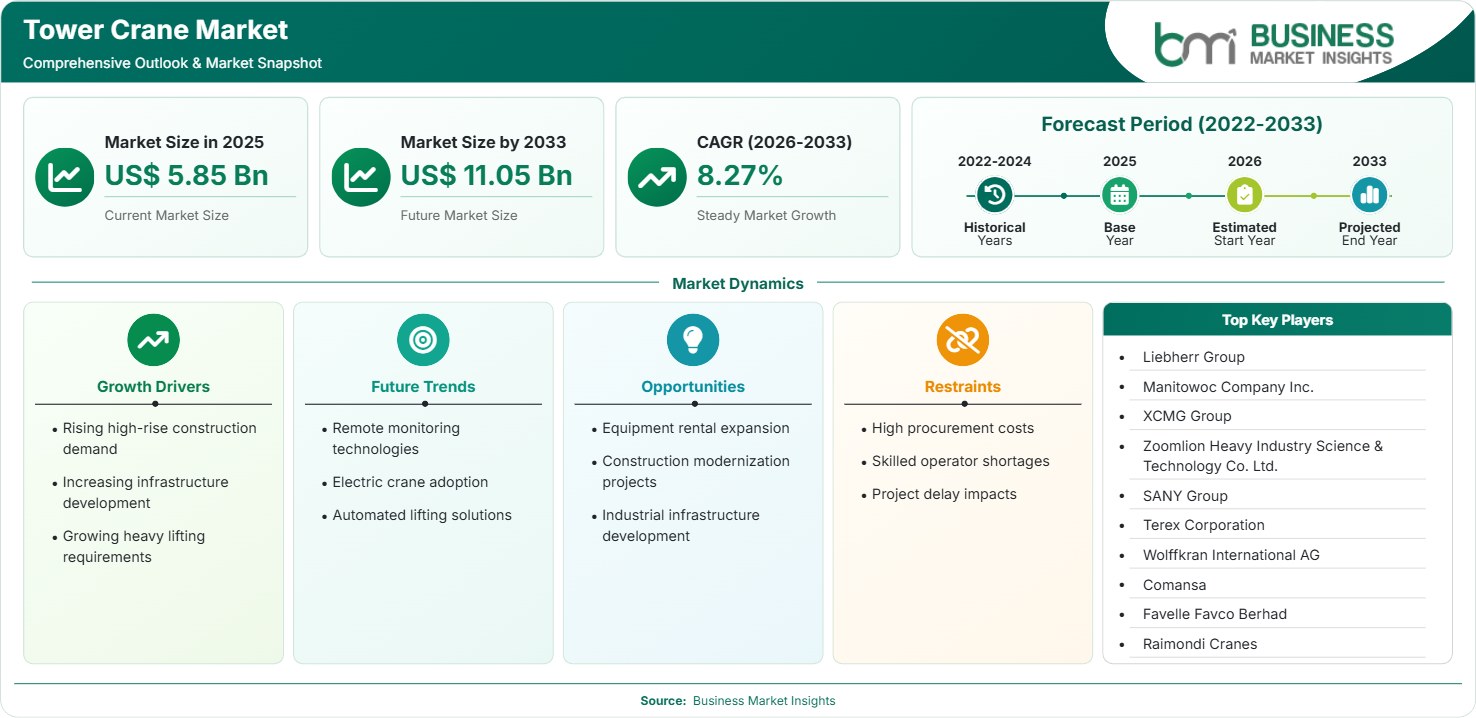
The Tower Crane Market size was valued at US$ 5.85 billion in 2025 and is projected to reach US$ 11.05 billion by 2033, growing at a CAGR of 8.27% during 2026–2033. Rising high-rise construction demand, increasing infrastructure development, and growing heavy lifting requirements continue driving market expansion, while equipment rental services, construction modernization, and industrial infrastructure investments create new growth opportunities.

Report Coverage
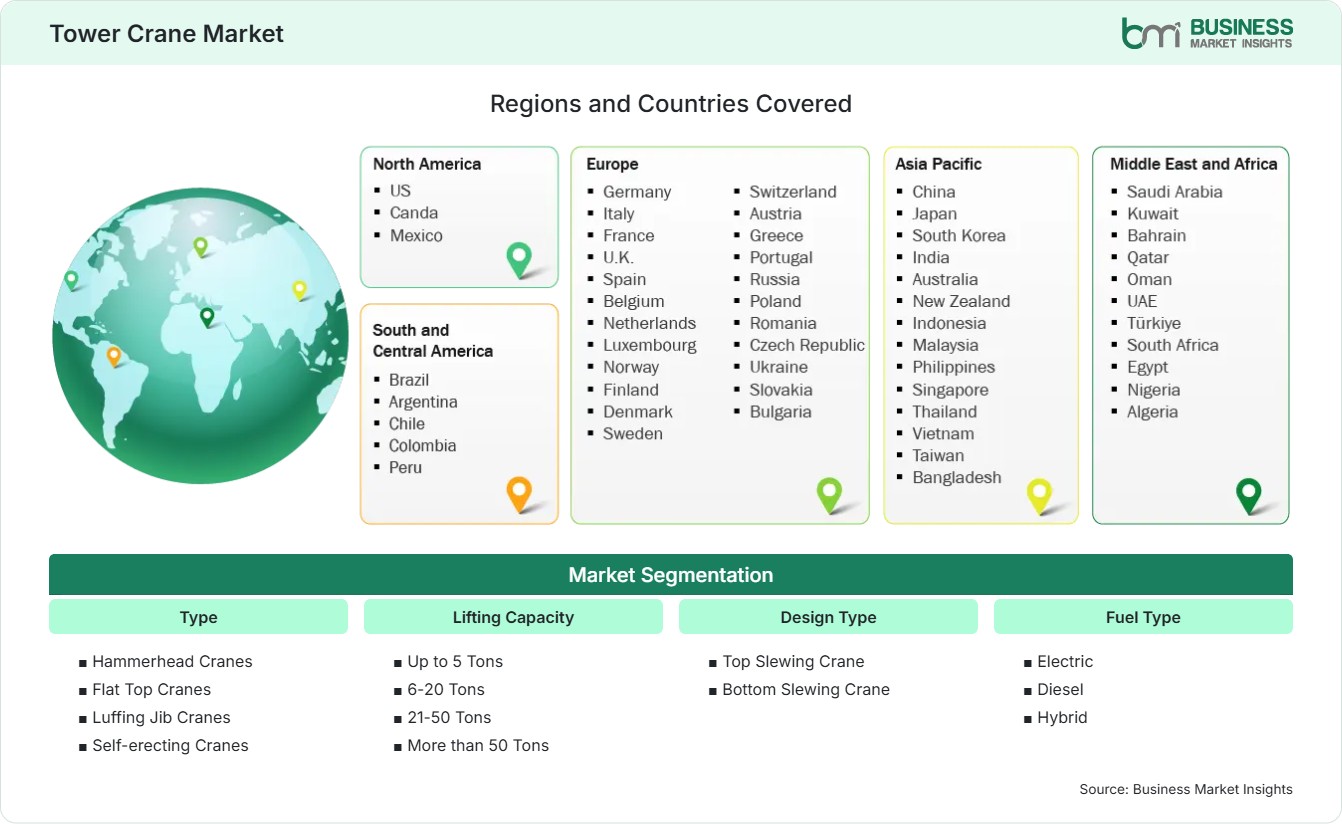
  • Type: Hammerhead Cranes, Flat Top Cranes, Luffing Jib Cranes, Self-erecting Cranes
  • Lifting Capacity: Up to 5 Tons, 6-20 Tons, 21-50 Tons, More than 50 Tons
  • Design Type: Top Slewing Crane, Bottom Slewing Crane
  • Fuel Type: Electric, Diesel, Hybrid
  • End User: Construction Companies, Mining, Utilities, Others
US$ 5.85 Bn Market size in 2025
US$ 11.05 Bn Market Size by 2033
8.27% CAGR, 2026 - 2033
2026-2033 Forecast Period

AI Overview

Tower Crane Market Summary

  • North America Region: North America accounted for 20%–23% of global market revenue in 2025 and is projected to grow at a CAGR of 7.8%–8.5% during 2026–2033. Commercial construction, infrastructure rehabilitation, and industrial development support regional expansion. The United States leads the regional market with a CAGR of 7.9%–8.6%, driven by transportation, manufacturing, and mixed-use construction projects.
  • Fastest Growing Region: Asia Pacific represented 46%–49% of global revenue in 2025 and is forecast to register the highest CAGR of 9.1%–9.8% through 2026–2033. Urbanization, smart city initiatives, industrial infrastructure, and high-rise residential developments continue driving equipment demand.
  • Leading Segment: Hammerhead Cranes held 34%–37% of the market in 2025 and are expected to expand at a CAGR of 8.0%–8.7% during 2026–2033. Their versatility, lifting capability, and suitability for large commercial construction projects sustain market leadership.
  • High Growth Segment: Hybrid tower cranes accounted for 10%–13% of market revenue in 2025 and are projected to record a CAGR of 10.5%–11.2% through 2026–2033. Lower fuel consumption, emission reduction goals, and sustainable construction practices accelerate adoption.
  • Key Market Opportunity: Expanding infrastructure megaprojects and increasing adoption of rental fleets equipped with telematics, remote diagnostics, and energy-efficient technologies create long-term growth opportunities for manufacturers and rental providers.
  • Major Market Players: Liebherr Group, The Manitowoc Company, Inc., XCMG Group, Zoomlion Heavy Industry Science & Technology Co., Ltd., SANY Group, Terex Corporation, Wolffkran International AG, Comansa, Favelle Favco Berhad, and Raimondi Cranes.
Strategic Insights

Tower Crane Market: Strategic Insights

Tower Crane Market Strategic Framework
FREE PDF
Request your free sample
Request free sample
Stakeholder View

Key Takeaways

  • The market ecosystem includes crane manufacturers, crane parts suppliers, crane rental companies, digital solutions providers, construction contractors, and maintenance services firms to enhance efficiency.
  • Hybrid and electric cranes offer the biggest growth prospect because the focus is on sustainability, low emission, and cost-saving in operations.
  • Technological advancements, such as telematics, remote diagnostics, predictive maintenance, collision avoidance technology, and automation, keep evolving in terms of fleet management and efficiency on the worksites.
  • Asia Pacific offers the most promising geographical location for investments because of urbanization, infrastructure spending, industrialization, and residential building construction.
  • Crane rentals businesses keep growing with new investments in fleet, technological asset management, and leasing solutions that allow reducing contractor costs.
Geographic Outlook

Tower Crane Market Regional Highlights

North America Tower Crane Market

North America accounted for 20%–23% of global revenue in 2025 and is projected to expand at a CAGR of 7.8%–8.5% during 2026–2033. Large commercial developments, industrial construction, transportation infrastructure upgrades, and renewable energy projects continue driving equipment demand. The Tower Crane Market share remains supported by growing investments in modern construction technologies and infrastructure renewal programs.

  • Infrastructure modernization programs continue increasing demand for heavy lifting equipment across transportation and public utility projects.
  • Commercial real estate development supports adoption of technologically advanced cranes with improved operational efficiency.
  • Equipment rental companies expand modern fleets featuring telematics, remote monitoring, and predictive maintenance capabilities.
  • Renewable energy construction projects create additional demand for high-capacity lifting solutions.
  • Safety regulations encourage contractors to replace aging crane fleets with technologically advanced equipment.

US Tower Crane Market

The United States represented approximately 16%–18% of global market revenue in 2025 and is projected to register a CAGR of 7.9%–8.6% through 2026–2033. Continued investments in transportation infrastructure, manufacturing facilities, commercial developments, and mixed-use construction projects support sustained equipment demand.

  • Federal infrastructure funding strengthens long-term demand for tower cranes across transportation and utility construction.
  • High-rise residential developments continue supporting adoption of advanced lifting equipment.
  • Digital fleet management solutions improve operational efficiency and equipment utilization.
  • Industrial expansion drives procurement of cranes with higher lifting capacities and improved safety features.

Europe Tower Crane Market

Europe accounted for 24%–27% of global revenue in 2025 and is projected to grow at a CAGR of 7.9%–8.6% during 2026–2033. Infrastructure renovation, commercial construction, and sustainable building projects continue supporting equipment demand. Germany remains the leading regional market, while Poland demonstrates the fastest projected growth.

  • Germany continues leading demand through industrial construction and commercial infrastructure investments.
  • Poland is projected to register a CAGR of 8.9%–9.6% driven by urban infrastructure expansion and residential development.
  • Green building initiatives encourage adoption of energy-efficient and electric-powered cranes.
  • Rental companies increasingly modernize fleets with digitally connected equipment.
  • Aging infrastructure modernization strengthens replacement demand across multiple construction sectors.

Asia Pacific Tower Crane Market

Asia Pacific represented 46%–49% of global market revenue in 2025 and is projected to record the fastest CAGR of 9.1%–9.8% through 2026–2033. The Tower Crane Market growth is supported by rapid urbanization, industrialization, smart city projects, and transportation infrastructure investments. China dominates regional demand, while India records the fastest projected growth.

  • China remains the largest regional market due to continuous high-rise construction and infrastructure investments.
  • India is projected to register a CAGR of 10.0%–10.7% supported by urban housing, metro rail, industrial corridors, and logistics infrastructure.
  • Government-backed smart city initiatives continue increasing construction equipment demand.
  • Manufacturing capacity expansion supports local production and exports of tower cranes.
  • Commercial and industrial developments continue driving deployment of higher-capacity crane models.

Rest of World Tower Crane Market

The Rest of World accounted for 7%–9% of global revenue in 2025 and is expected to expand at a CAGR of 8.1%–8.8% during 2026–2033.

South & Central America continue benefiting from mining and infrastructure investments, while the Middle East & Africa witness growing demand from commercial developments, energy projects, and megacity construction initiatives. Brazil leads regional demand, whereas Saudi Arabia demonstrates the fastest projected growth.

  • Brazil continues investing in commercial infrastructure, industrial facilities, and transportation construction.
  • Saudi Arabia is projected to register a CAGR of 9.3%–10.0% supported by giga-projects, tourism developments, and smart city construction.
  • Mining projects increase demand for high-capacity heavy lifting equipment.
  • Infrastructure expansion creates opportunities for rental fleet operators and crane manufacturers.
  • Industrial diversification programs continue supporting long-term construction equipment demand.
Global Market Geography
FREE PDF
Request your free sample
Request free sample
Segment Analysis

Tower Crane Market Segmentation

Type

Tower crane selection is increasingly influenced by project height, lifting precision, operational flexibility, and site constraints. Hammerhead Cranes accounted for 34%–37% of market revenue in 2025 and are projected to grow at a CAGR of 8.0%–8.7% during 2026–2033. The Tower Crane Market scope continues expanding as urban infrastructure projects, commercial complexes, and industrial developments require versatile lifting solutions capable of handling heavy structural components efficiently.

  • Hammerhead Cranes: Widely utilized in commercial buildings, industrial facilities, bridges, and high-rise construction because of their superior lifting capacity, long horizontal reach, and operational stability.
  • Flat Top Cranes: Preferred for congested construction sites where multiple cranes operate simultaneously, offering simplified assembly, lower interference risks, and improved operational efficiency.
  • Luffing Jib Cranes: Increasingly adopted for dense urban construction projects with restricted space due to their adjustable jib movement and ability to operate near surrounding buildings.
  • Self-erecting Cranes: Suitable for low-rise residential projects, infrastructure maintenance, and smaller construction sites because of rapid installation, reduced labor requirements, and operational flexibility.

Lifting Capacity

Demand varies according to project scale, structural complexity, and material handling requirements. The 6 to 20 Tons segment accounted for 39%–42% of market revenue in 2025 and is projected to expand at a CAGR of 8.4%–9.1% through 2026–2033 owing to broad deployment across commercial, residential, and infrastructure construction projects.

  • Upto 5 Tons: Primarily used for residential buildings, renovation projects, light commercial construction, and municipal infrastructure requiring compact lifting solutions.
  • 6 to 20 Tons: Represents the largest installed base due to versatility across commercial towers, hospitals, industrial buildings, and transportation infrastructure developments.
  • 21 to 50 Tons: Supports heavy industrial construction, bridge projects, power plants, manufacturing facilities, and large commercial developments requiring higher lifting capacities.
  • More than 50 Tons: Utilized for megaprojects, energy infrastructure, mining operations, ports, and specialized engineering projects requiring exceptional lifting performance.

Design Type

Design configuration significantly influences crane stability, operational flexibility, and project suitability. Top Slewing Crane accounted for 72%–75% of market revenue in 2025 and is projected to register a CAGR of 8.3%–9.0% through 2026–2033. Their ability to support high-rise construction and heavy lifting operations continues sustaining dominant market demand.

  • Top Slewing Crane: Extensively deployed across skyscrapers, industrial plants, commercial buildings, and infrastructure projects requiring superior height and lifting capability.
  • Bottom Slewing Crane: Commonly installed for low-rise buildings, residential developments, confined construction sites, and short-duration projects because of simplified installation and mobility.

Fuel Type

Growing sustainability initiatives and lower operating costs are accelerating adoption of cleaner powertrain technologies. Electric cranes accounted for 47%–50% of market revenue in 2025 and are expected to expand at a CAGR of 8.8%–9.5% during 2026–2033 through increasing deployment across urban construction environments.

  • Electric: Increasingly preferred due to lower operating costs, reduced emissions, quieter operation, and compatibility with sustainable construction practices.
  • Diesel: Continues serving remote construction sites, mining operations, and infrastructure projects lacking reliable electrical power supply.
  • Hybrid: Represents the fastest-growing fuel category through improved fuel efficiency, lower emissions, operational flexibility, and compliance with evolving environmental regulations.

End User

Construction activity remains the primary demand generator as governments and private developers continue expanding infrastructure investments. Construction Companies accounted for 64%–67% of market revenue in 2025 and are projected to grow at a CAGR of 8.2%–8.9% through 2026–2033. Continued urban expansion and commercial development sustain long-term equipment utilization.

  • Construction Companies: Largest customer group driven by residential towers, commercial buildings, transportation infrastructure, and mixed-use development projects.
  • Mining: Deploys tower cranes for material handling, equipment installation, processing facilities, and heavy industrial infrastructure construction.
  • Utilities: Increasingly utilizes tower cranes for renewable energy installations, transmission infrastructure, substations, and large utility construction projects.
Market Forces

Tower Crane Market Dynamics

Key Market Drivers

Rising high-rise construction demand

Urbanization and rapid population growth have contributed significantly towards the increasing construction of residential tower blocks, commercial buildings, and smart cities around the world. High-rise buildings need tower cranes that can lift heavy building materials to high altitudes while being safe and efficient at the same time. Urban skylines in Asia-Pacific, the Middle East, and North America are contributing towards increased demand for such equipment.

Increasing infrastructure development

Governments across the globe keep investing in roads, railways, airports, ports, renewable energy plants, and infrastructure to aid economic development. For construction of huge structures, it is necessary to have lifting equipment that can lift oversized structures. Hence, public infrastructure upgrade schemes are also significant for the consistent requirement for tower cranes.

Growing heavy lifting requirements

Heavy lifting machinery that is able to carry out heavy loads is increasingly becoming important for industrial projects, construction sites, power plants, logistics centers, and large-scale business projects. Prefabrication techniques that are currently used in the construction industry have raised the need for such types of machines.

Key Market Opportunities

Equipment rental expansion

Rapid growth in the number of construction equipment rental firms offers contractors a cost-efficient solution to obtain technologically-advanced cranes without making major financial investments. According to Tower Crane Market Forecasts, renting penetration is expected to keep growing owing to contractor needs for flexibility, reduced costs, higher fleet availability, and availability of digital crane solutions.

Construction modernization projects

Construction technologies such as BIM, telematics, automation, and predictive maintenance are providing more avenues for smart tower cranes. This has become one of the important Tower Crane Market Trends. The manufacturers are still investing in connected systems that will improve safety, visibility, project coordination, and lifecycle performance, thus allowing construction firms to operate efficiently and effectively.

Industrial infrastructure development

Construction of manufacturing facilities, logistics centers, semiconductor manufacturing factories, renewable energy facilities, and industrial estates is leading to an ongoing need for medium- to heavy-capacity tower cranes. Diversification of industries in the developing nations has also played a role in providing procurement prospects.

Market Restraints and Challenges

High procurement costs

Factor: Purchasing modern tower cranes requires substantial capital expenditure covering equipment acquisition, transportation, installation, commissioning, maintenance, and regulatory compliance. Impact: High ownership costs encourage contractors to rely on rental providers instead of direct purchases, particularly among small and medium-sized construction companies. Longer investment recovery periods can delay equipment replacement despite technological improvements and higher operational efficiency.

Skilled operator shortages

Factor: Safe operation of advanced tower cranes requires certified operators with specialized technical expertise, continuous training, and familiarity with increasingly sophisticated digital control systems. Impact: Labor shortages reduce equipment utilization, extend project timelines, increase operational risks, and elevate labor costs. Construction companies and equipment manufacturers continue investing in operator training programs, automation technologies, and remote monitoring solutions to address workforce constraints and improve project productivity.

Company Analysis

Competitive Landscape

The competitive landscape in the tower cranes business around the world is shaped by technology advancements, load capacity, advanced digital fleets management, energy-saving power plants, and global services networks. From the Tower Cranes Market Analysis, it can be observed that top companies are increasing their production capacity and incorporating telematics, collision avoidance systems, remote diagnostics, predictive maintenance, and hybrid power sources into their operations.

Company Name

Overview

Products and Services Relevant to this Market

Liebherr Group

Global construction equipment manufacturer with extensive expertise in lifting technologies and heavy machinery.

Tower cranes, mobile cranes, crawler cranes, lifting solutions, digital fleet management, and maintenance services.

The Manitowoc Company, Inc.

Leading global manufacturer of cranes serving construction, energy, and industrial infrastructure sectors.

Tower cranes, crawler cranes, lifting equipment, crane services, telematics, and aftermarket support.

XCMG Group

Chinese heavy equipment manufacturer with broad international presence in construction machinery.

Tower cranes, construction equipment, intelligent lifting systems, industrial machinery, and digital equipment management.

Zoomlion Heavy Industry Science & Technology Co., Ltd.

Major construction equipment producer focused on intelligent and sustainable lifting technologies.

Flat top cranes, luffing jib cranes, tower cranes, smart construction equipment, and fleet monitoring systems.

SANY Group

International heavy machinery manufacturer supplying advanced construction and industrial equipment globally.

Tower cranes, crawler cranes, heavy lifting equipment, intelligent control technologies, and maintenance services.

Terex Corporation

Global manufacturer specializing in aerial work platforms, cranes, and material handling equipment.

Tower cranes, rough terrain cranes, lifting solutions, digital monitoring, and equipment lifecycle services.

Wolffkran International AG

Specialized tower crane manufacturer recognized for premium lifting solutions and engineering expertise.

Top slewing cranes, luffing jib cranes, crane engineering, installation services, and maintenance solutions.

Comansa

International tower crane manufacturer serving commercial, infrastructure, and industrial construction projects.

Flat top cranes, luffing cranes, heavy lifting equipment, crane components, and technical support services.

Favelle Favco Berhad

Engineering company specializing in high-capacity tower cranes for complex construction projects.

Heavy-duty tower cranes, offshore cranes, specialized lifting systems, engineering solutions, and project support.

Raimondi Cranes

Italian manufacturer focused on technologically advanced tower cranes for global construction markets.

Hammerhead cranes, flat top cranes, luffing cranes, digital crane systems, and aftermarket support.

Industry Activity

Recent Developments

April 2026

Liebherr announced the deployment of an additional Liebherr 1000 EC-H high-top tower crane at the Crazy Horse Memorial project in South Dakota through its long-standing collaboration with Morrow Equipment, supporting continued large-scale construction activities.

April 2026

Liebherr announced a partnership with Tenstar Simulation to integrate Liebherr tower cranes into advanced crane operator training simulators, enhancing digital training, safety, and operational efficiency for tower crane operators.

December 2025

The Manitowoc Company (Potain) introduced the new Potain MCT 105 topless tower crane at EXCON 2025 in India, expanding its topless tower crane portfolio for residential, commercial, and infrastructure construction applications.

November 2025

The Manitowoc Company (Potain) launched the new Potain MCR 505 J25 luffing jib tower crane, expanding its luffing jib portfolio with enhanced lifting performance and optimized operation for high-rise and congested urban construction projects.

Trust & Transparency

Research Methodology

The market analysis combines proprietary research with secondary data from government agencies, company disclosures, regulatory filings, industry databases and expert interviews. Market estimates are validated through data triangulation, cross-market benchmarking and analyst review.

View Full Research Methodology

Questions Answered

Frequently Asked Questions

What future opportunities will support market expansion?

Key opportunities include equipment rental growth, hybrid and electric crane adoption, digital fleet management, smart construction technologies, infrastructure megaprojects, renewable energy installations, and industrial modernization initiatives.

Which companies are included in the Market Report?

The Tower Crane Market Report profiles Liebherr Group, The Manitowoc Company, Inc., XCMG Group, Zoomlion Heavy Industry Science & Technology Co., Ltd., SANY Group, Terex Corporation, Wolffkran International AG, Comansa, Favelle Favco Berhad, and Raimondi Cranes.

Which tower crane type leads the market?

Hammerhead cranes account for the largest market share because of their high lifting capacity, long operational reach, structural stability, and broad suitability across commercial, industrial, and infrastructure construction projects.

Which region dominates the Market?

Asia Pacific holds the largest market share owing to rapid urbanization, extensive residential and commercial construction, smart city projects, transportation infrastructure expansion, and strong manufacturing capabilities.

What factors are driving the Market?

Major growth drivers include increasing high-rise construction, expanding infrastructure investments, rapid urbanization, industrial development, modernization of construction practices, and rising demand for efficient heavy lifting equipment.

Access the Full Tower Crane Market Report

Get segment-level forecasts, regional estimates, competitive benchmarking, company profiles and downloadable Excel datasets.

Access the full Tower Crane Market Report
350 pages PDF & Excel | 2026-07-31