
Mobile Crane Market Outlook: Size, Share, Trends, Growth Analysis, Competitive Landscape & Forecast, 2026-2033

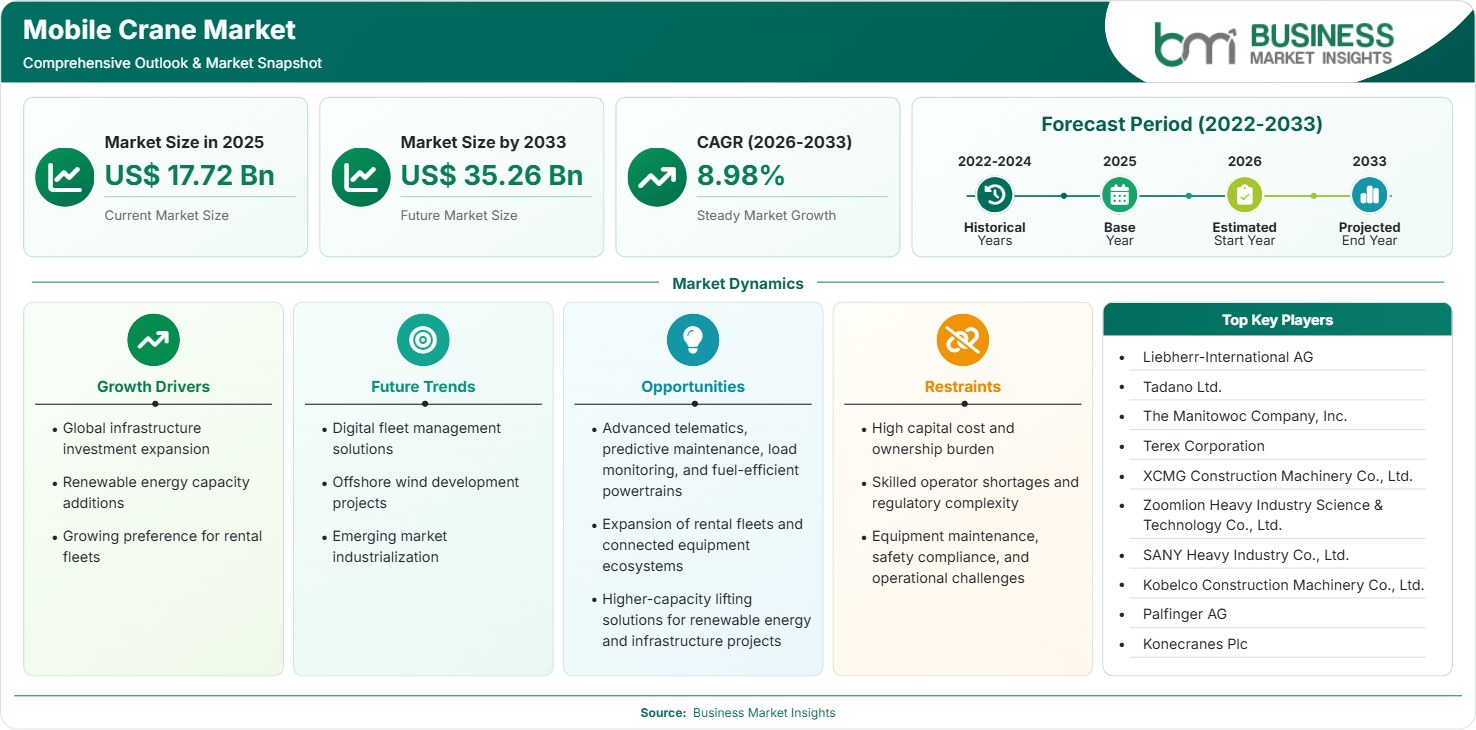
The Mobile Crane Market size was valued at US$ 17.72 Billion in 2025 and is projected to reach US$ 35.26 Billion by 2033, growing at a CAGR of 8.98% during 2026–2033. Key growth drivers include infrastructure megaprojects, renewable energy investments, fleet modernization, digital crane technologies, and increasing demand for versatile lifting solutions across construction, utilities, and industrial sectors.

Report Coverage
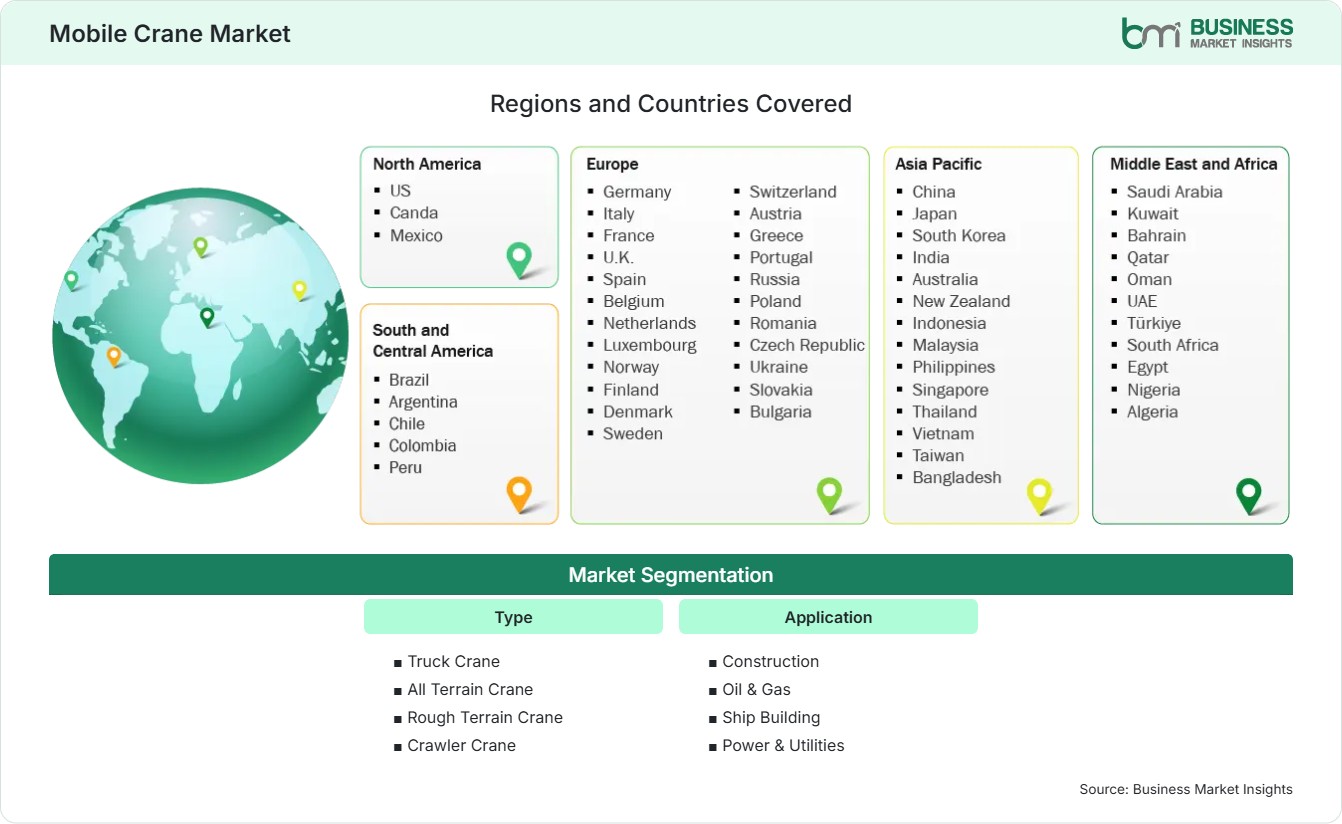
  • Type: Truck Crane, All Terrain Crane, Rough Terrain Crane, Crawler Crane
  • Application: Construction, Oil & Gas, Ship Building, Power & Utilities
US$ 17.72 Bn Market size in 2025
US$ 35.26 Bn Market Size by 2033
8.98% CAGR, 2026 - 2033
2026-2033 Forecast Period

AI Overview

Mobile Crane Market Summary

  • North America Region: Holds 24%–27% share in 2025, growing at a CAGR of 7.5%–8.3% during 2026–2033. Infrastructure renewal, energy investments, equipment rental expansion, and advanced telematics adoption support growth. Opportunities emerge from grid modernization and wind-energy installations.
  • US market analysis: The US leads regional demand through transportation, energy, and industrial projects, advancing at approximately 7.8%–8.5% CAGR.
  • Fastest Growing Region: Asia Pacific holds 41%–44% share in 2025, growing at a CAGR of 10.2%–11.0% during 2026–2033. Urbanization, industrial expansion, transport infrastructure programs, and manufacturing investments accelerate crane deployment across emerging economies.
  • Leading Segment: Construction accounts for 44%–47% share in 2025 and expands at 9.2%–10.0% CAGR. Sustainable urban development, transportation corridors, commercial projects, and industrial facilities create persistent equipment demand and replacement opportunities.
  • High Growth Segment: All Terrain Crane represents 22%–25% share in 2025 and grows at 10.0%–10.8% CAGR. Mobility, lifting flexibility, renewable-energy applications, and operational efficiency support adoption across diverse project environments.
  • Key Market Opportunity: Expansion of renewable-energy infrastructure, including onshore and offshore wind installations, is increasing demand for higher-capacity lifting equipment, creating long-term opportunities for manufacturers, rental providers, service networks, and technology suppliers.
  • Major Market Players: Liebherr-International AG, Tadano Ltd., The Manitowoc Company, Inc., Terex Corporation, XCMG Construction Machinery Co., Ltd., Zoomlion Heavy Industry Science & Technology Co., Ltd., SANY Heavy Industry Co., Ltd., Kobelco Construction Machinery Co., Ltd., Palfinger AG, Konecranes Plc.
Strategic Insights

Mobile Crane Market: Strategic Insights

Mobile Crane Market Strategic Framework
FREE PDF
Request your free sample
Request free sample
Stakeholder View

Key Takeaways

  • Rental companies occupy an increasingly strategic position within the value chain as contractors prioritize asset flexibility and lower capital expenditure.
  • Renewable energy, utilities, and large-scale transportation projects offer the strongest long-term demand upside for equipment suppliers and fleet operators.
  • Remote diagnostics, telematics integration, automation capabilities, and predictive maintenance platforms are becoming central product differentiation factors.
  • India, Southeast Asia, and Gulf Cooperation Council economies offer compelling investment conditions supported by infrastructure spending and industrial diversification.
  • Consolidation among manufacturers, distributors, and rental providers is strengthening aftermarket capabilities and expanding geographic coverage.
  • Sustainability requirements are driving interest in lower-emission powertrains, hybrid systems, and energy-efficient lifting technologies.
Geographic Outlook

Mobile Crane Market Regional Highlights

North America Mobile Crane Market

North America accounts for approximately 24%–27% of global demand in 2025 and is projected to expand at a CAGR of 7.5%–8.3% through 2033. Strong infrastructure modernization programs, power-sector investment, industrial construction activity, and equipment replacement cycles support regional expansion. The Mobile Crane Market share remains significant due to mature rental ecosystems, advanced safety standards, and ongoing spending on transportation corridors, grid upgrades, and manufacturing facilities.

  • Infrastructure Investment and Jobs Act projects continue stimulating heavy lifting equipment demand.
  • Utility-scale renewable projects require high-capacity cranes for installation activities.
  • Rental fleet operators increasingly deploy connected and telematics-enabled equipment.
  • Industrial reshoring initiatives create additional opportunities across manufacturing hubs.

US Mobile Crane Market

The United States represents roughly 78%–82% of North American demand and advances at a CAGR of 7.8%–8.5%. Transportation infrastructure upgrades, energy-sector investments, data-center construction, and manufacturing expansion support equipment utilization. Strong contractor adoption of specialized lifting solutions enhances fleet modernization and operational efficiency.

  • Energy transition projects increase deployment of high-capacity lifting platforms.
  • Data-center construction accelerates demand for versatile all-terrain equipment.
  • Industrial automation investments contribute to sustained project execution activity.
  • Rental penetration remains among the highest globally.

Europe Mobile Crane Market

Europe captures approximately 21%–24% share in 2025, progressing at a CAGR of 7.8%–8.6% through 2033. Germany leads regional demand, while Eastern European countries display stronger momentum. Energy-transition projects, transportation modernization, and industrial redevelopment programs sustain procurement activity. Strict safety and emissions requirements also accelerate adoption of advanced lifting technologies.

  • Germany remains the leading national market with diversified industrial demand.
  • Poland and selected Eastern European countries exhibit above-regional growth.
  • Offshore wind investments stimulate demand for specialized lifting solutions.
  • Fleet modernization initiatives favor technologically advanced equipment.

Asia Pacific Mobile Crane Market

Asia Pacific holds the largest Mobile Crane Market share at 41%–44% in 2025 and records the fastest CAGR of 10.2%–11.0% through 2033. China remains the dominant market, while India delivers one of the strongest growth profiles. Extensive infrastructure development, urbanization, manufacturing investments, and increasing industrial activity continue supporting regional expansion.

  • China maintains leadership through large-scale infrastructure and industrial projects.
  • India benefits from transportation, urban development, and energy investments.
  • Southeast Asia records increasing adoption across construction and logistics sectors.
  • Domestic manufacturing capabilities strengthen equipment availability and competitiveness.

Rest of World Mobile Crane Market

Rest of World represents approximately 10%–13% of global demand and expands at a CAGR of 8.8%–9.6%. Middle East activity is supported by megaprojects and energy investments, while Latin America benefits from mining, infrastructure, and industrial development. Regional Mobile Crane Market growth increasingly reflects diversification of economic activity beyond traditional sectors.

  • Saudi Arabia and the UAE remain leading Middle Eastern markets.
  • Brazil drives demand within South and Central America.
  • Mining projects support equipment utilization across resource-rich economies.
  • Industrial diversification strategies create long-term investment opportunities.
Global Market Geography
FREE PDF
Request your free sample
Request free sample
Segment Analysis

Mobile Crane Market Segmentation

Type

Type segment accounts for core equipment demand across construction, energy, industrial, and infrastructure applications. The segment represents approximately 53%–56% market share in 2025 and advances at 8.9%–9.7% CAGR. Mobile Crane Market scope continues expanding through higher lifting capacities, improved mobility, digital monitoring capabilities, and increasing fleet replacement activities.

  • Truck Crane: Widely adopted for transportation infrastructure, municipal projects, and general construction due to mobility, operational efficiency, and accessibility.
  • All Terrain Crane: Benefits from versatility across varied operating environments, making it attractive for infrastructure, utilities, and renewable-energy developments.
  • Rough Terrain Crane: Preferred for off-road locations where maneuverability and stability are critical to project execution.
  • Crawler Crane: Strongly utilized in large-scale industrial facilities, energy projects, and heavy construction requiring exceptional lifting capacities.

Application

Application demand is led by construction activities, which account for approximately 44%–47% market share during 2025 and continue expanding at 9.2%–10.0% CAGR. Mobile Crane Market trends reflect strong deployment across infrastructure, utilities, industrial developments, and energy-transition projects requiring specialized lifting solutions.

  • Construction: Largest application area supported by transportation, commercial, residential, and industrial infrastructure projects.
  • Oil & Gas: Demand linked to refinery upgrades, pipeline developments, and offshore project activities.
  • Ship Building: Utilized for heavy material movement, assembly activities, and dockyard operations.
  • Power & Utilities: Growth supported by renewable-energy installations, transmission projects, and grid modernization programs.
Market Forces

Mobile Crane Market Dynamics

Key Market Drivers

Global Infrastructure Investment Expansion

Governments and private investors continue allocating substantial capital toward transportation corridors, industrial facilities, smart-city developments, ports, airports, and energy infrastructure. Rapid urbanization across emerging economies increases demand for efficient heavy-lifting solutions capable of supporting large-scale construction schedules. Mobile crane deployment is benefiting from rising project complexity and stricter productivity requirements. Growth in public-private partnerships, increasing construction output, and expansion of industrial parks collectively reinforce procurement activity. Mobile Crane Market growth remains closely associated with infrastructure spending patterns, particularly across Asia Pacific, North America, and selected Middle Eastern economies.

Renewable Energy Capacity Additions

Wind and utility-scale renewable-energy projects require advanced lifting equipment capable of handling larger turbine components and associated infrastructure. International Energy Agency projections indicate continued growth in renewable-energy deployment globally, supporting long-term equipment utilization. Higher turbine heights and larger component dimensions favor cranes with improved lifting capacities and operational flexibility. Demand from onshore and offshore developments supports premium product categories while encouraging fleet modernization. Equipment suppliers are expanding specialized offerings to address installation requirements associated with evolving renewable infrastructure deployments.

Growing Preference for Rental Fleets

Contractors now opt for rentals to avoid owning machinery due to cost reduction, maintenance avoidance, less storage space needed, and capital investment. The renting companies get the advantage of having varied usage and better availability of advanced technology. The above situation hastens the replacement cycle and makes the equipment with remote monitoring attractive. Mobile Crane Market trends indicate greater reliance on professionally managed fleets capable of delivering higher availability and operational performance. Rental expansion also improves market penetration among medium-sized contractors participating in infrastructure and industrial development projects.

Key Market Opportunities

Digital Fleet Management Solutions

Combining telematics technology, predictive maintenance, sensors, and real-time fleet management brings immense value to operations. Technology increases efficiency, reduces downtime, enhances safety compliance and maintenance planning. The trend for equipment providers is to integrate communication technology in new cranes. Mobile Crane Market Forecasts continue to highlight growing demand for intelligent fleet-management ecosystems that improve project productivity while reducing lifecycle operating costs. Vendors capable of delivering integrated hardware and software solutions are positioned to capture larger shares of future investments.

Offshore Wind Development Projects

The rapid expansion of offshore wind capacity across Europe, Asia Pacific, and North America is creating significant demand for specialized heavy-lifting equipment and related support services. In line with the growing size and capacity of offshore wind turbines, there is a need for sophisticated lifting solutions that can operate in the harsh marine environment. Equipment companies that are able to provide such solutions have high chances of taking up lucrative opportunities with attractive margins. There is also good visibility for the sector because of long-term projects backed by government funding.

Emerging Market Industrialization

Rapid industrialization across India, Southeast Asia, Africa, and selected Latin American markets is creating significant opportunities for equipment adoption. The development of manufacturing facilities, logistics facilities, transportation systems, and energy infrastructure projects is causing an increasing demand for flexible and effective lifting devices. With increased construction and industrial activity, equipment producers can enhance their market position through localized production, partnerships, and strong service networks. Making early investments in these emerging markets will allow companies to benefit from a growing number of contractors, needs for equipment, and complexity of projects.

Market Restraints and Challenges

High Capital Cost and Ownership Burden

Factor: Mobile cranes require significant upfront investment, including equipment acquisition, financing, maintenance, insurance, and regulatory compliance costs. Additional expenses related to skilled operator wages, safety certifications, inspections, and routine servicing further increase the total cost of ownership. These financial requirements can be particularly challenging for smaller contractors and businesses operating with limited capital budgets.

Impact: The high cost of ownership can encourage smaller contractors to delay the purchase of equipment and thus minimize the cost of direct ownership and the pace of purchasing. While the rental of equipment can be used to alleviate the cost of the initial investment, there is no doubt that the cost of life cycle continues to impact on purchasing decisions during times of economic uncertainties and changes in the level of construction activity. There is, therefore, the need for manufacturers to reconcile technological advancement, efficiency, and safety with low prices.

Skilled Operator Shortages and Regulatory Complexity

Factor: The operation of mobile cranes relies on the existence of very competent and licensed operators who have to fulfill certain safety, training, and regulatory requirements. Nevertheless, due to constant shortage of personnel and qualifications, it may be rather difficult for construction and industrial firms to find people with experience. On the other hand, there is an emerging need for new safety requirements, certification, inspections, and so forth.

Impact: Qualified crane operators can influence project timing, lower equipment utilization rate, and decrease operational efficiency. Organizations have to invest in ongoing training for their workforce, certification processes, safety technologies, and operational solutions to overcome these issues. Additional compliance obligations can increase costs related to both administration and operation, especially for those companies that operate many machines at different locations. The absence of properly trained workers and compliant machinery can lead to safety issues, delays in projects, and fines. Therefore, workforce development and compliance management become critical for efficient crane operation.

Company Analysis

Competitive Landscape

Mobile Crane Market analysis indicates competition is driven by lifting capacity, technology integration, global distribution networks, aftermarket services, rental partnerships, and energy-sector project expertise.

Company Name

Overview

Products and Services relevant to this market

Liebherr-International AG

Global lifting equipment leader with strong presence in infrastructure and energy applications.

All-terrain cranes, crawler cranes, telematics solutions, maintenance services.

Tadano Ltd.

Major manufacturer focused on safety, reliability, and lifting innovation.

Rough terrain, all-terrain, truck cranes, fleet support services.

The Manitowoc Company, Inc.

International crane producer serving construction and industrial customers.

Mobile cranes, crawler cranes, aftermarket support, parts solutions.

Terex Corporation

Diversified equipment manufacturer with established crane portfolio.

Rough terrain cranes, utility equipment, service offerings.

XCMG Construction Machinery Co., Ltd.

Large-scale equipment supplier with expanding international footprint.

Truck cranes, all-terrain cranes, lifting technology solutions.

Zoomlion Heavy Industry Science & Technology Co., Ltd.

Significant construction equipment producer serving global projects.

Mobile lifting equipment, intelligent crane systems, support services.

SANY Heavy Industry Co., Ltd.

Leading heavy machinery company with strong manufacturing capacity.

Truck cranes, crawler cranes, industrial lifting equipment.

Kobelco Construction Machinery Co., Ltd.

Established construction machinery provider emphasizing reliability.

Crawler cranes, heavy lifting equipment, maintenance services.

Palfinger AG

Specialist in lifting and loading technologies.

Truck-mounted cranes, service networks, engineered lifting solutions.

Konecranes Plc

Industrial lifting specialist with global service capabilities.

Crane technologies, modernization services, digital monitoring tools.

Trust & Transparency

Research Methodology

The market analysis combines proprietary research with secondary data from government agencies, company disclosures, regulatory filings, industry databases and expert interviews. Market estimates are validated through data triangulation, cross-market benchmarking and analyst review.

View Full Research Methodology

Questions Answered

Frequently Asked Questions

Why is the Mobile Crane Market Report valuable for stakeholders?

The report provides insight into regional opportunities, competitive positioning, technology trends, growth drivers, investment priorities, and evolving application demand patterns.

How does technology influence competitiveness?

Telematics, predictive maintenance, fleet monitoring, digital controls, and advanced safety systems improve operational efficiency and create differentiation among manufacturers.

Which application segment dominates demand?

Construction remains the dominant application because of ongoing investments in transportation networks, commercial buildings, residential developments, and industrial facilities.

Which region leads revenue generation?

Asia Pacific leads global revenue generation due to extensive construction activity, manufacturing growth, urbanization, and large-scale government infrastructure investments.

What is driving demand for mobile cranes globally?

Infrastructure development, renewable-energy installations, industrial expansion, and increasing adoption of equipment rental models are the primary demand drivers supporting long-term industry expansion.

Access the Full Mobile Crane Market Report

Get segment-level forecasts, regional estimates, competitive benchmarking, company profiles and downloadable Excel datasets.

Access the full Mobile Crane Market Report
350 pages PDF & Excel | 2026-08-31