Market Summary
Executive Summary and Global Market Analysis
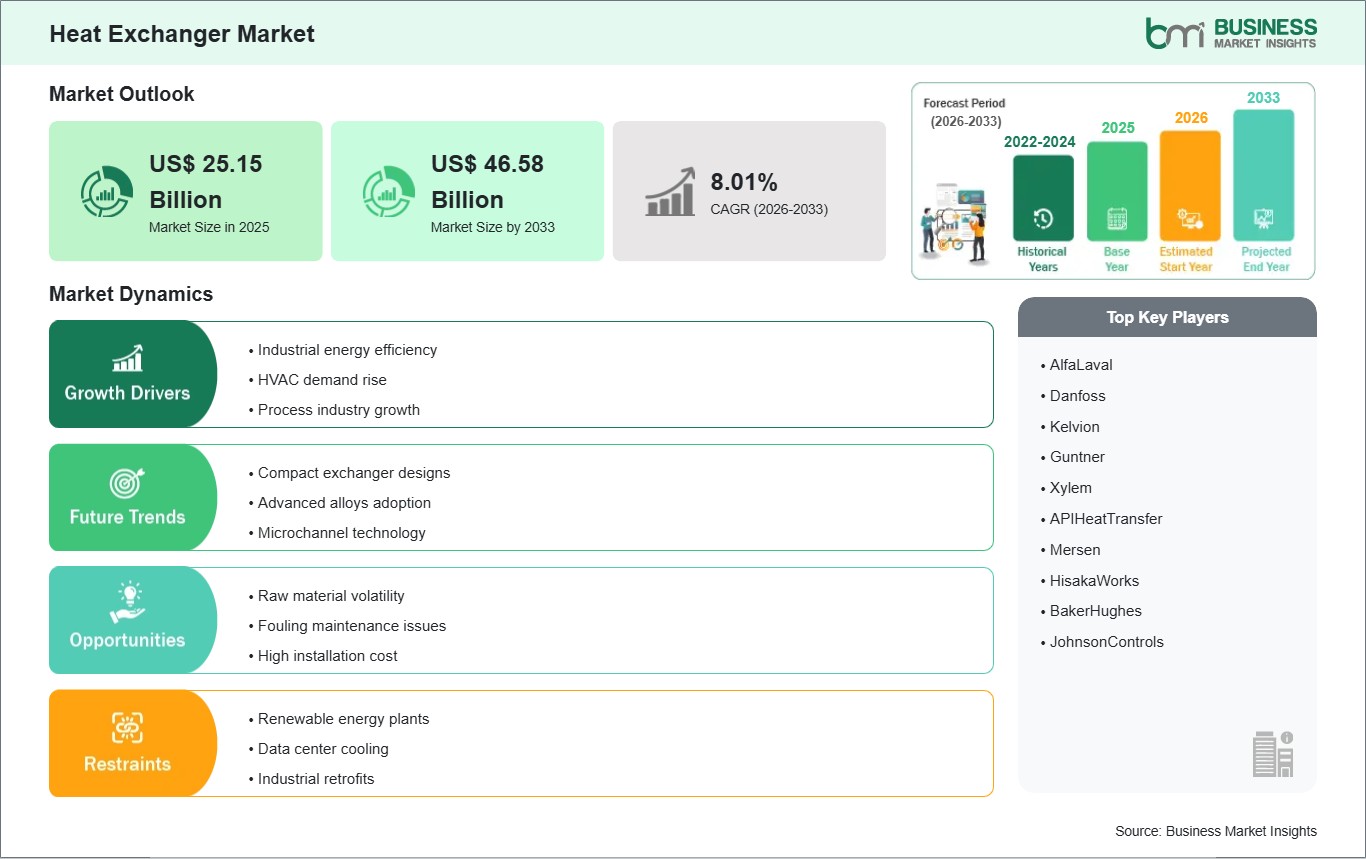
Heat exchangers are thermal systems that transfer heat between fluids without direct mixing. They are widely applied in industrial processes, energy systems, and climate control equipment. Their function improves energy efficiency while maintaining controlled temperature conditions in critical operations.
Industrial energy optimization and process efficiency requirements support broader deployment of heat exchangers. Industries are focusing on minimizing heat loss and maximizing thermal recovery in operations. Expanding infrastructure projects and stricter environmental compliance are also shaping purchasing decisions.
The Heat Exchanger market is segmented by product, material, and end-use applications. Plate and frame systems cater to compact designs, while shell and tube models suit large-scale operations. Metals and alloy-based materials define durability, while end-use sectors such as HVAC and oil and gas create distinct demand patterns.
Technological improvements are reshaping product configurations and performance standards. Designs are becoming more compact, modular, and efficient in handling variable temperature and pressure conditions. Integration with automated systems and improved corrosion resistance materials is influencing system longevity.
The competitive environment is shaped by a mix of global manufacturers and specialized engineering providers. Market participants focus on product innovation, customization capabilities, and long-term service offerings. Strategic expansion into emerging industrial regions continues to influence competitive positioning.
Segment Analysis
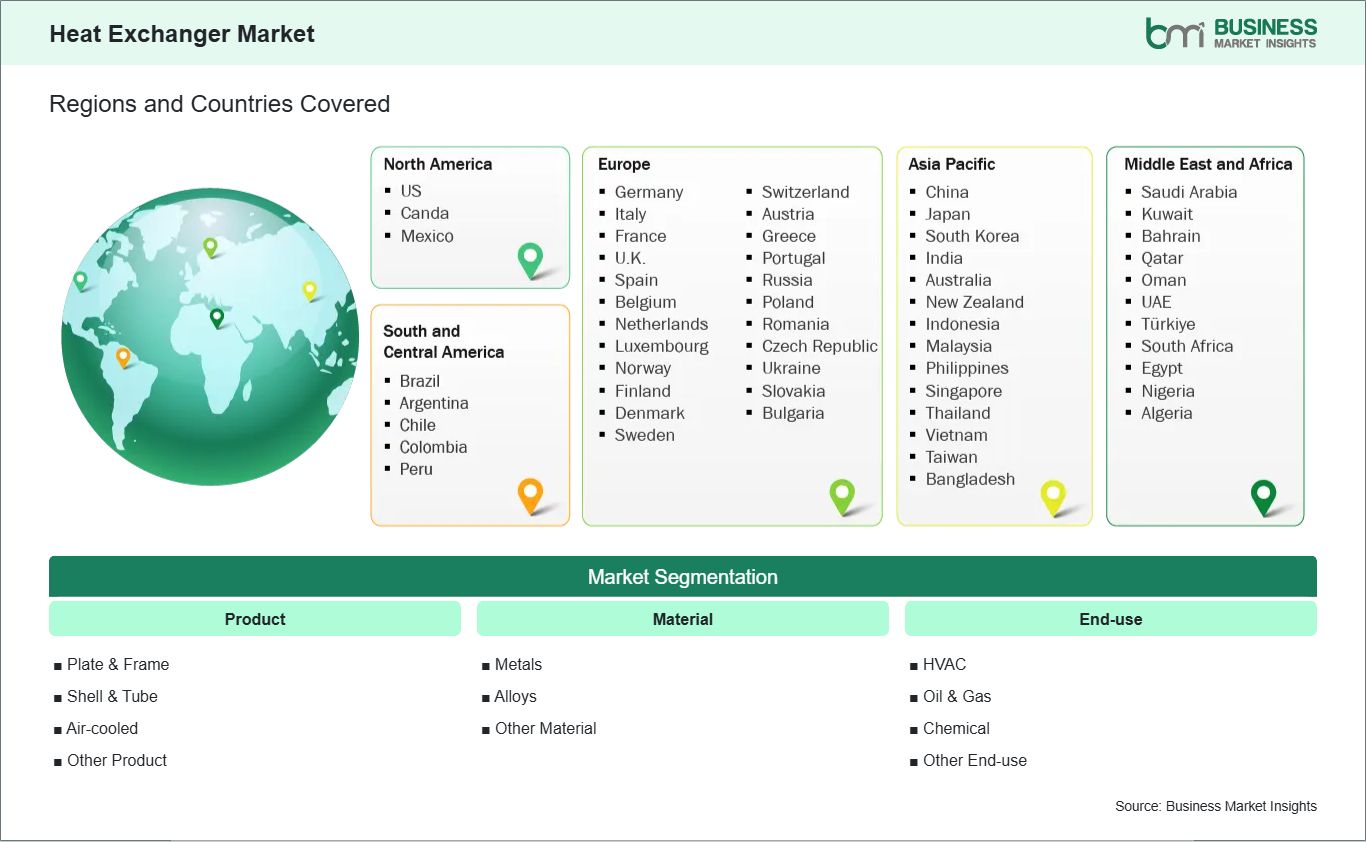
Heat Exchanger Market Segmentation
The market demonstrates diversified adoption across product, material end-use.
By Product:
- Plate & Frame: Compact heat exchangers offering high efficiency and easy maintenance, widely used in HVAC and process industries
- Shell & Tube: Robust design suitable for high-pressure and high-temperature applications, commonly used in oil & gas and chemical sectors
- Air-cooled: Uses ambient air for cooling, ideal for water-scarce locations and power plants
- Others Product: Includes specialized and hybrid heat exchanger types for niche industrial applications
By Material Type:
- Metals: Commonly used due to good thermal conductivity and cost-effectiveness in standard applications
- Alloys: Used in corrosive and high-temperature environments for enhanced durability and performance
- Other Materials: Includes advanced composite and specialty materials for specific industrial needs
By End-use
- HVAC: Used in heating, ventilation, and air conditioning systems for efficient temperature regulation
- Oil & Gas: Applied in refining, processing, and heat recovery operations under extreme conditions
- Chemical: Used in chemical processing plants for controlled heat transfer and reaction management
- Other End-use: Includes food processing, power generation, and various industrial applications
Market Forces
Heat Exchanger Market Drivers and Opportunities
Industrial Energy Efficiency Requirements
Industries are focusing on reducing energy waste while maintaining consistent process performance. Heat exchangers address this need by improving thermal recovery and lowering operational losses. Sectors such as manufacturing, refining, and building systems are increasingly incorporating advanced thermal solutions to meet efficiency goals and manage energy consumption more effectively.
This trend aligns with regulatory frameworks targeting emissions and resource optimization in industrial operations. Governments are encouraging energy-efficient equipment adoption across various industries. As compliance requirements strengthen, heat exchanger installations gain importance, particularly in facilities aiming to optimize energy usage without compromising output quality.
Advancement in Compact and Modular Designs
Emerging product designs emphasize compactness and modularity, making installation more adaptable across industries. Manufacturers are developing systems that fit into constrained environments while maintaining performance standards. This shift enables easier integration into modern infrastructure, including retrofitting older systems with updated thermal equipment.
Future expansion opportunities include broader adoption in decentralized energy systems and smart infrastructure projects. As industries seek flexible and scalable solutions, modular heat exchangers are likely to gain wider deployment. Over time, these innovations may redefine installation approaches and improve lifecycle performance across multiple applications.
Heat Exchanger Market Size and Share Analysis
Shell and tube exchangers hold a dominant position due to their suitability for heavy-duty industrial applications. Plate and frame systems maintain strong presence in compact and modular installations. Air-cooled variants are positioned prominently in regions facing water constraints.
HVAC applications represent a major share due to the need for temperature regulation in buildings. Oil and gas sectors continue to drive demand through refining and processing needs. Chemical industries rely on heat exchangers for controlled thermal reactions and process stability.
Size and Share Analysis
Heat Exchanger Market Size and Share Analysis
The Heat Exchanger Market is projected to grow from US$ 25.15 Billion in 2025 to US$ 46.58 Billion by 2033 , registering a CAGR of 8.01% from 2026 to 2033.
- Heat Exchanger market size and forecast at global, regional, and country levels for all the key market segments covered under the scope
- Heat Exchanger market trends, as well as market dynamics such as drivers, restraints, and key opportunities
- Heat Exchanger market analysis covering key market trends, global and regional framework, major players, regulations, and recent market developments
- Industry landscape and competition analysis covering market concentration, heat map analysis, prominent players, and recent developments for the Heat Exchanger market
- Detailed company profiles, including SWOT analysis
Report Coverage
Heat Exchanger Market Report Coverage and Deliverables
The "Heat Exchanger Market Size and Forecast (2022–2033)" report provides a detailed analysis of the market covering below areas:
- Heat Exchanger market size and forecast at global, regional, and country levels for all the key market segments covered under the scope
- Heat Exchanger market trends, as well as market dynamics such as drivers, restraints, and key opportunities
- Heat Exchanger market analysis covering key market trends, global and regional framework, major players, regulations, and recent market developments
- Industry landscape and competition analysis covering market concentration, heat map analysis, prominent players, and recent developments for the Heat Exchanger market
- Detailed company profiles, including SWOT analysis
Geographic Insights
Heat Exchanger Market Geographic Insights
The Heat Exchanger market shows diverse regional adoption patterns influenced by industrial development, infrastructure, and energy regulations. Demand varies across regions based on economic activity and sector-specific requirements. Developed markets emphasize efficiency upgrades, while emerging regions invest in new installations.
North America demonstrates steady adoption driven by modernization of industrial facilities and building systems. The United States leads with strong demand from HVAC and oil refining sectors. Canada also contributes through investments in energy infrastructure and climate control systems.
Asia Pacific reflects significant expansion due to industrial growth and urban development. Countries such as China and India are increasing deployment across manufacturing and energy sectors. Japan continues to invest in advanced technologies and efficiency-focused equipment.
Europe shows consistent utilization supported by environmental policies and sustainable practices. Germany and France emphasize energy-efficient installations across industries. Emerging markets in Latin America and the Middle East are seeing increased adoption, particularly in oil processing and infrastructure projects.
Industry Activity
Recent Developments
The Heat Exchanger market is evaluated by gathering qualitative and quantitative data post primary and secondary research, which includes important corporate publications, association data, and databases. A few of the key developments in the Heat Exchanger market are:
- In 2025: Alfa Laval launched the TS25 semi-welded heat exchanger. It is designed for high-efficiency heat transfer in hydrogen, industrial heat pumps, and process industries, improving energy efficiency and supporting decarbonization.
- In 2026: Mersen launched a new air-to-air heat exchanger for industrial electrical cabinets, designed to improve cooling while keeping internal air sealed from dust and moisture. It offers low maintenance, no moving parts, and higher reliability for power electronics systems.
Trust & Transparency
Research Methodology
The market analysis combines proprietary research with secondary data from government agencies, company disclosures, regulatory filings, industry databases and expert interviews. Market estimates are validated through data triangulation, cross-market benchmarking and analyst
review.
View Full Research Methodology
Key Sources Referred:
Industry reports on sustainable tire manufacturing and automotive mobility Government transportation and environmental policy publications Automotive trade journals and tire technology periodicals Company annual reports and sustainability disclosures Academic studies on bio-based polymers and recycled materials International automotive production and mobility assessments Research publications covering tire material innovation and efficiency trends Company website Company annual reports Company investor presentations