Market Summary
Executive Summary and Global Market Analysis
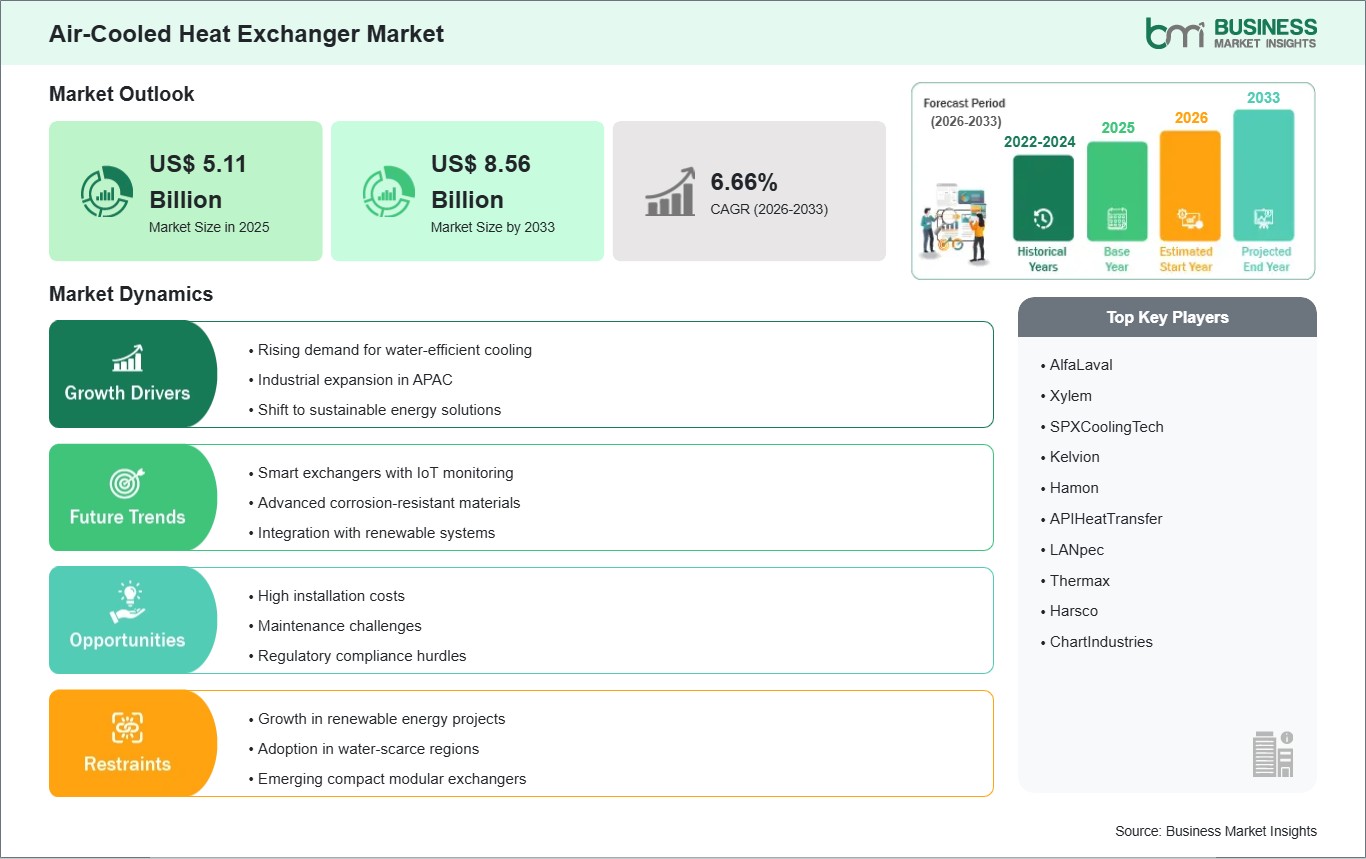
Air-Cooled heat exchangers are industrial cooling systems that use ambient air to reduce the temperature of process fluids without relying on water-based cooling methods. These systems are widely used in industries such as oil & gas, petrochemicals, power generation, chemicals, and HVAC because they help improve operational efficiency while reducing water consumption. The market is growing as industries increasingly focus on sustainable cooling technologies, energy efficiency, and compliance with environmental regulations. Rising industrial infrastructure development and expansion of refinery and processing facilities are also supporting market demand. Advanced fin technologies, corrosion-resistant materials, and improved airflow management systems are helping enhance heat transfer performance and equipment durability in harsh operating environments.
There are several challenges that may affect market growth during the forecast period. High installation and maintenance costs associated with large industrial heat exchanger systems can limit adoption among smaller industrial facilities. In regions with extremely high ambient temperatures, cooling efficiency may decline, requiring more advanced thermal management designs and additional operational adjustments. Retrofitting older industrial plants with modern Air-Cooled heat exchangers can also be difficult because of infrastructure limitations and space constraints. In addition, fluctuations in raw material prices and the need for skilled engineering expertise may increase project costs and delay industrial installations.
Despite these challenges, the market is expected to grow steadily due to increasing investments in industrial modernization and energy-efficient cooling solutions. Opportunities are emerging from the adoption of smart monitoring systems, predictive maintenance technologies, and advanced fan control systems that improve operational reliability and reduce energy consumption. Growing demand for sustainable industrial infrastructure and reduced dependence on water-intensive cooling technologies are further supporting market expansion. Industries are also exploring lightweight materials and advanced thermal engineering solutions to improve cooling efficiency while lowering operational costs and environmental impact.
Segment Analysis
Air-Cooled Heat Exchanger Market Segmentation
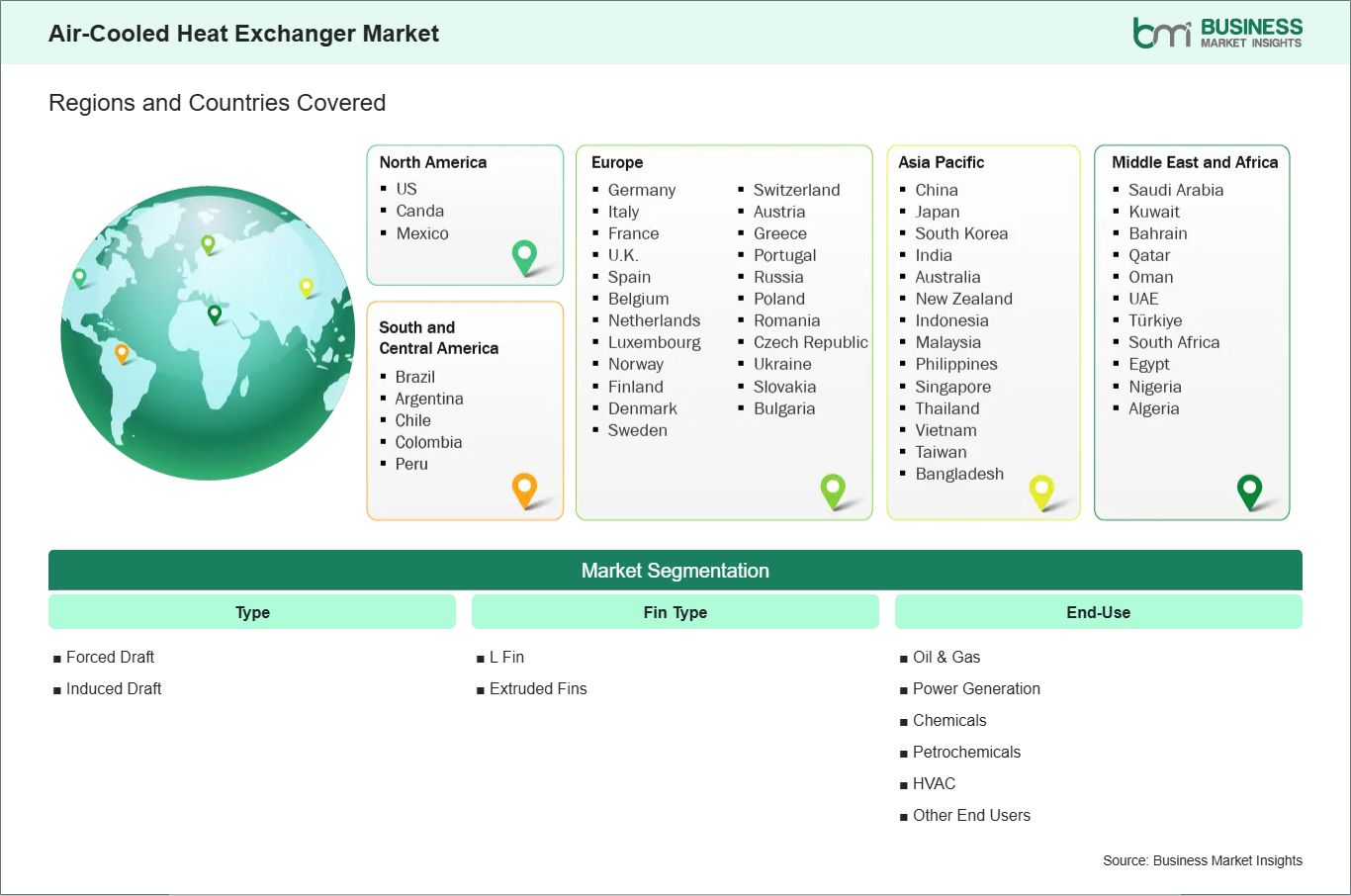
The Air-Cooled Heat Exchanger market is segmented based on type, fin type, and end-use industry. Different industries select exchanger configurations according to cooling efficiency, operational environment, and process requirements.
By Type
- Forced Draft: These systems use fans placed below the tube bundle to push air through the exchanger and are widely adopted in large industrial applications requiring efficient airflow management.
- Induced Draft: These systems pull air across the tube bundle using fans mounted on top, offering improved temperature distribution and reduced recirculation risks.
By Fin Type
- L Fin: L fin heat exchangers are commonly used because of their cost efficiency, reliable heat transfer capability, and suitability for moderate industrial operating conditions.
- Extruded Fins: Extruded fin designs provide enhanced durability and stronger bonding between fin and tube surfaces, making them suitable for corrosive and high-temperature environments.
By End-Use
- Oil & Gas: Air-Cooled heat exchangers are extensively used for hydrocarbon processing, gas compression, and refinery cooling operations.
- Power Generation: Thermal power facilities utilize these systems for condenser cooling and temperature control applications.
- Chemicals: Chemical processing industries deploy heat exchangers for maintaining stable process temperatures and operational safety.
- Petrochemicals: Petrochemical plants use these systems to support large-scale fluid cooling and heat recovery operations.
- HVAC: Commercial and industrial HVAC systems use Air-Cooled heat exchangers for efficient air conditioning and refrigeration processes.
- Other End Users: Additional applications include food processing, mining, marine, and manufacturing industries.
Market Forces
Air-Cooled Heat Exchanger Market Drivers and Opportunities
Rising Industrial Focus on Water Conservation and Sustainable Cooling
Industries across the world are increasingly shifting toward water-efficient technologies due to rising environmental concerns and tightening industrial regulations regarding water consumption. Air-Cooled heat exchangers provide an effective alternative to water-cooled systems because they use ambient air for cooling operations. This advantage is particularly important in regions experiencing water scarcity, where industries are under pressure to reduce freshwater dependency and improve sustainability performance.
The oil & gas, petrochemical, and power generation sectors are among the major adopters of these systems because large-scale industrial operations require continuous and reliable heat dissipation. Governments and environmental agencies are also encouraging industries to adopt sustainable thermal management systems that minimize wastewater generation and reduce ecological impact. In addition, industrial operators are seeking equipment that lowers long-term operating costs and reduces maintenance associated with water treatment systems.
Expansion of High-Efficiency Industrial Infrastructure
The growing development of advanced industrial infrastructure is creating significant opportunities for the Air-Cooled Heat Exchanger market. Rapid industrialization in emerging economies is increasing the construction of new refineries, petrochemical facilities, power plants, and manufacturing units that require efficient thermal management solutions. Air-Cooled heat exchangers are gaining attention because they offer flexible installation, lower water usage, and compatibility with modern industrial automation systems.
Emerging trends such as smart monitoring, predictive maintenance, and energy-efficient fan technologies are improving the operational capabilities of heat exchanger systems. Industrial operators are increasingly investing in digital monitoring solutions that optimize thermal performance, reduce downtime, and improve energy efficiency. In addition, the integration of computational fluid dynamics and advanced engineering simulation tools is enabling manufacturers to develop customized exchanger designs for complex industrial applications.
Size and Share Analysis
Air-Cooled Heat Exchanger Market Size and Share Analysis
The Air-Cooled Heat Exchanger Market is projected to grow from US$ 5.11 Billion in 2025 to US$ 8.56 Billion by 2033 , registering a CAGR of 6.66% from 2026 to 2033.
By type, forced draft systems account for a significant share due to their strong airflow performance and wide usage across large industrial processing facilities. Induced draft systems are also gaining adoption because they provide improved airflow distribution and reduced recirculation risks in demanding industrial environments. Increasing investments in refinery expansion, chemical processing plants, and industrial cooling infrastructure continue to support demand for both exchanger types.
By fin type, L fin heat exchangers hold a notable market share because of their cost efficiency and reliable thermal performance in standard industrial applications. Extruded fins are witnessing increasing adoption due to their enhanced durability, corrosion resistance, and suitability for high-temperature operating conditions.
By end-use, the oil & gas sector dominates the market owing to extensive use of thermal management systems in upstream and downstream operations. Power generation, petrochemicals, and HVAC industries are also contributing significantly to market growth as industrial operators increasingly focus on energy-efficient and sustainable cooling technologies.
Report Coverage
Air-Cooled Heat Exchanger Market Report Coverage and Deliverables
The "Air-Cooled Heat Exchanger Size and Forecast (2022-2033)" report provides a detailed analysis of the market covering below areas:
- Market size and forecast at global, regional, and country levels for all the key market segments covered under the scope
- Market trends, as well as market dynamics such as drivers, restraints, and key opportunities
- Market analysis covering key market trends, global and regional framework, major players, regulations, and recent market developments
- Industry landscape and competition analysis covering market concentration, heat map analysis, prominent players, and recent developments for the market
- Detailed company profiles, including SWOT analysis
Geographic Insights
Air-Cooled Heat Exchanger Market Geographic Insights
The Air-Cooled Heat Exchanger Market shows diverse regional adoption patterns influenced by industrial expansion, energy infrastructure development, and increasing focus on sustainable cooling technologies.
North America, being a developed region, has a well-established industrial infrastructure and a high adoption rate of advanced thermal management systems. The area includes the United States and Canada, wherein there is an investment in refining technologies, chemical development, and high-energy efficient machinery. The area emphasizes the reduction in water use in industries and the improvement of their efficiency via sustainable cooling processes. The area has good engineering capacity and established production channels, thus enabling the adoption of Air-Cooled Heat Exchangers by the industries in oil and gas, power production, and chemicals.
Asia Pacific is growing significantly, driven by rapid industrialization, infrastructure development, and the expansion of manufacturing activities. The region comprises countries such as China, India, and Japan, where increasing investments in petrochemical plants, power facilities, and industrial HVAC systems are creating strong demand for Air-Cooled heat exchangers. Development of this area centers around the enhancement of industrial productivity and infrastructure development using energy-efficient cooling systems. Growth of industries and increased government spending on infrastructural development are additional factors driving market growth.
Both regions are contributing significantly to the growth of the Air-Cooled Heat Exchanger Market, focusing on industrial infrastructure development, increasing energy demand, and the adoption of efficient and environmentally sustainable cooling systems.
Industry Activity
Recent Developments
The Air-Cooled Heat Exchanger Market is analyzed using a mix of primary and secondary research sources, including corporate publications, industry associations, and verified databases. This approach ensures accurate tracking of innovation trends and strategic developments influencing the market.
- In March 2025, Evapco introduced the eco-Air Titan air-cooled heat exchanger designed for large-scale industrial applications including power generation, carbon capture, and data centers. The system features optimized finned tube bundles, high-efficiency fans, and advanced thermal engineering aimed at improving cooling efficiency while reducing maintenance requirements. The launch highlights growing demand for high-capacity and energy-efficient industrial cooling systems.
- In March 2025, Vertiv announced the launch of its CoolLoop RDHx rear door heat exchanger solution for AI and high-performance computing applications. The product was developed to support advanced thermal management requirements in high-density computing environments. The launch reflects increasing integration of air-cooled and hybrid cooling technologies across modern industrial and digital infrastructure applications.
Trust & Transparency
Research Methodology
The market analysis combines proprietary research with secondary data from government agencies, company disclosures, regulatory filings, industry databases and expert interviews. Market estimates are validated through data triangulation, cross-market benchmarking and analyst
review.
View Full Research Methodology
Key Sources Referred:
World Bank - Global Trade Indicators World Trade Organization (WTO) International Monetary Fund (IMF) International Trade Administration (ITA) Company Websites Company Annual Reports Company Investor Presentations