
Brazed Plate Heat Exchangers Market Outlook: Size, Share, Trends, Growth Analysis, Competitive Landscape & Forecast, 2026-2033

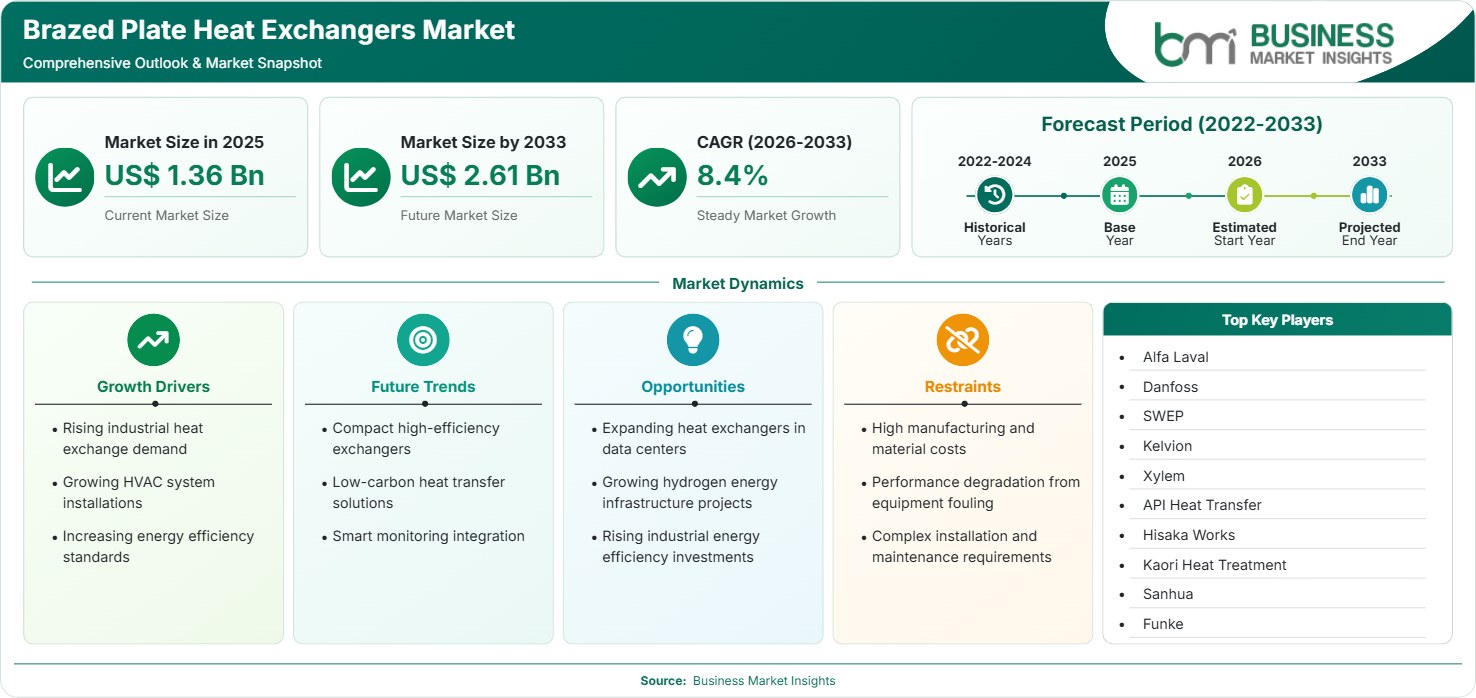
The Brazed Plate Heat Exchangers Market size was valued at US$ 1.36 Billion in 2025 and is projected to reach US$ 2.61 Billion by 2033, growing at a CAGR of 8.4% from 2026 to 2033. Increasing industrial heat transfer requirements, expanding HVAC installations, rising energy efficiency regulations, growing data center cooling demand, and investments in sustainable energy infrastructure are supporting market expansion.

Report Coverage
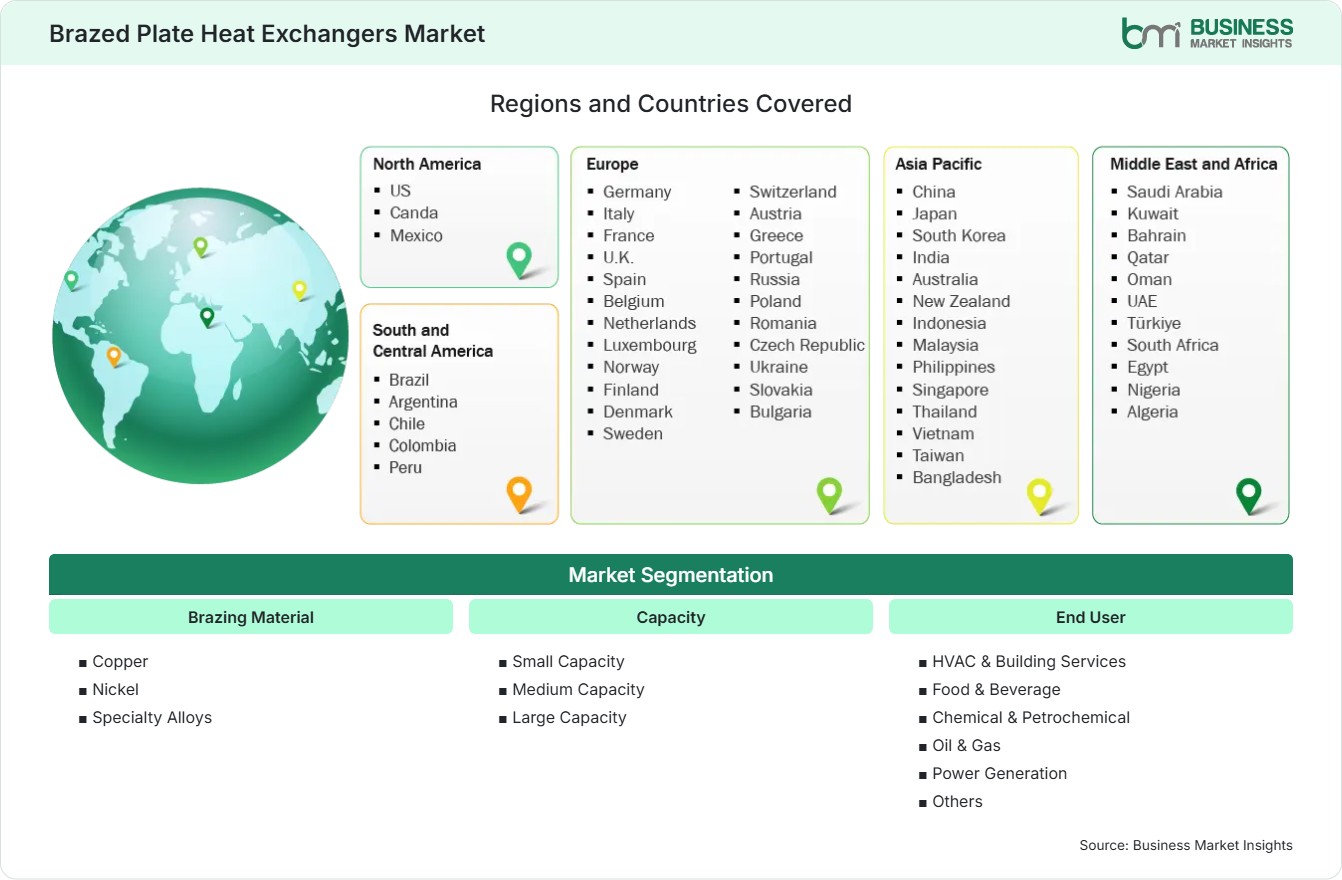
  • Brazing Material: Copper, Nickel, Specialty Alloys
  • Capacity: Small Capacity, Medium Capacity, Large Capacity
  • End User: HVAC & Building Services, Food & Beverage, Chemical & Petrochemical, Oil & Gas, Power Generation, Others
US$ 1.36 Bn Market size in 2025
US$ 2.61 Bn Market Size by 2033
8.4% CAGR, 2026 - 2033
2026-2033 Forecast Period

01 AI Overview

Brazed Plate Heat Exchangers Market Summary

  • North America Region: North America holds a market share of 30%–33% in 2025 and is projected to grow at a CAGR of 7.8%–8.4% during 2026–2033. Growth is supported by HVAC modernization, industrial energy optimization, data center expansion, and stringent efficiency standards. The US market is advancing with a CAGR of 8.0%–8.6% due to commercial construction activity, industrial upgrades, and demand for compact thermal management systems.
  • Fastest Growing Region: Asia Pacific accounts for 34%–37% share in 2025 and is expected to register a CAGR of 9.0%–9.7% through 2026–2033. Industrialization, urban development, manufacturing expansion, and increasing investments in energy-efficient cooling systems are accelerating adoption across emerging economies.
  • Leading Segment: HVAC & Building Services represents 35%–38% market share in 2025 and is projected to grow at a CAGR of 8.2%–8.8% during 2026–2033. Increasing commercial construction, district cooling projects, and replacement of conventional heat exchange systems are driving demand.
  • High Growth Segment: Large Capacity (>500 kW) systems account for 28%–31% share in 2025 and are estimated to grow at a CAGR of 8.8%–9.4% through 2026–2033. Growth is influenced by industrial processing, power generation applications, and large-scale cooling infrastructure requirements.
  • Key Market Opportunity: Expanding data center infrastructure, hydrogen energy projects, and industrial decarbonization initiatives are creating opportunities for advanced brazed heat exchanger solutions offering high efficiency, compact designs, and improved thermal performance.
  • Major Market Players: Alfa Laval, Danfoss, SWEP, Kelvion, Xylem, API Heat Transfer, Hisaka Works, Kaori Heat Treatment, Sanhua, Funke.
02 Strategic Insights

Brazed Plate Heat Exchangers Market: Strategic Insights

Brazed Plate Heat Exchangers Market Strategic Framework
FREE PDF
Request your free sample
Request free sample
03 Stakeholder View

Key Takeaways

  • The market value chain includes heat exchanger manufacturers, material suppliers, HVAC contractors, industrial equipment providers, and end users requiring efficient thermal transfer solutions. Product reliability, customization capabilities, and energy performance are becoming major selection factors.
  • HVAC and industrial applications provide significant growth opportunities as commercial buildings, manufacturing facilities, and energy systems increasingly adopt compact heat exchange technologies to improve operational efficiency.
  • Innovation is focused on improved plate geometry, advanced brazing materials, enhanced corrosion resistance, and digital monitoring capabilities that enable better thermal performance and predictive maintenance.
  • Asia Pacific presents strong investment potential due to manufacturing expansion, urban infrastructure development, rising cooling demand, and increasing adoption of energy-efficient industrial equipment.
  • Strategic partnerships and product expansion initiatives are increasing as manufacturers seek opportunities in emerging applications such as data center cooling, hydrogen infrastructure, and industrial sustainability projects.
  • Long-term competitiveness will depend on manufacturers’ ability to deliver cost-effective, high-efficiency solutions while addressing material availability, maintenance requirements, and application-specific performance demands.
04 Geographic Outlook

Brazed Plate Heat Exchangers Market Regional Highlights

North America Brazed Plate Heat Exchangers Market

North America accounted for a 30%–33% share of the Brazed Plate Heat Exchangers Market in 2025 and is projected to grow at a CAGR of 7.8%–8.4% during 2026–2033. The region benefits from advanced HVAC infrastructure, industrial modernization, rising data center construction, and increasing focus on energy conservation. The United States and Canada are key contributors due to commercial building upgrades and adoption of efficient thermal management technologies.

  • The United States leads regional demand through HVAC replacement projects, industrial efficiency initiatives, and increasing deployment of compact heat exchange systems.
  • Canada is expanding adoption through commercial infrastructure development, district energy projects, and demand for sustainable heating and cooling solutions.
  • Manufacturers are focusing on high-efficiency designs that support reduced energy consumption and improved thermal performance across industrial applications.
  • Data center investments are increasing demand for reliable cooling technologies capable of supporting high-density computing environments and continuous operations.

US Brazed Plate Heat Exchangers Market

The US represented a 27%–30% share of the Brazed Plate Heat Exchangers Market in 2025 and is estimated to expand at a CAGR of 8.0%–8.6% through 2026–2033. Demand is supported by HVAC modernization, industrial automation, energy efficiency initiatives, and expansion of commercial infrastructure. The country continues adopting compact heat transfer solutions across buildings, manufacturing facilities, and energy applications.

  • Commercial construction activity is driving demand for efficient heating and cooling systems requiring compact and reliable thermal exchange equipment.
  • Industrial facilities are upgrading thermal systems to improve energy performance, reduce operational costs, and comply with efficiency requirements.
  • Data center expansion is creating new opportunities for advanced cooling solutions with higher heat transfer capabilities.
  • Food processing and chemical industries are adopting efficient heat exchangers to optimize process operations and reduce energy consumption.

Europe Brazed Plate Heat Exchangers Market

Europe held a 25%–28% share of the Brazed Plate Heat Exchangers Market in 2025 and is expected to grow at a CAGR of 8.1%–8.7% during 2026–2033. The region benefits from strict energy efficiency regulations, industrial decarbonization efforts, and increasing adoption of sustainable HVAC systems. Germany, the United Kingdom, France, and Nordic countries represent leading markets due to advanced industrial infrastructure.

  • Germany demonstrates strong demand through manufacturing modernization, energy efficiency investments, and advanced industrial heating and cooling applications.
  • The United Kingdom is adopting efficient thermal systems through commercial building upgrades and sustainability-focused infrastructure development.
  • France is increasing deployment of compact heat exchangers across industrial facilities, HVAC systems, and renewable energy applications.
  • Nordic countries are supporting adoption through district heating projects and emphasis on energy-efficient building technologies.

Asia Pacific Brazed Plate Heat Exchangers Market

Asia Pacific captured a 34%–37% share of the Brazed Plate Heat Exchangers Market in 2025 and is forecast to achieve a CAGR of 9.0%–9.7% from 2026–2033. The region represents the fastest-growing market due to industrial expansion, urbanization, manufacturing growth, and rising cooling demand. China, India, Japan, and Southeast Asian countries are driving adoption through infrastructure investments and energy efficiency programs.

  • China is expanding heat exchanger adoption through industrial development, manufacturing growth, and large-scale HVAC infrastructure requirements.
  • India is witnessing increasing demand due to commercial construction, industrial expansion, and investments in energy-efficient cooling systems.
  • Japan is adopting advanced thermal technologies for industrial applications, building efficiency improvements, and energy management initiatives.
  • Southeast Asian markets are growing through urban development, manufacturing investments, and rising demand for efficient cooling infrastructure.

Rest of World Brazed Plate Heat Exchangers Market

Rest of World accounted for a 7%–10% share of the Brazed Plate Heat Exchangers Market in 2025 and is projected to grow at a CAGR of 8.5%–9.2% during 2026–2033. South America and the Middle East & Africa are witnessing increased adoption due to industrial development, energy projects, and infrastructure modernization. Brazil, Saudi Arabia, UAE, and South Africa represent emerging opportunities.

The Middle East is investing in cooling infrastructure due to extreme climate conditions, while South American industries are adopting efficient thermal systems to improve energy utilization and reduce operational expenses.

  • Brazil is expanding adoption through industrial processing growth, commercial infrastructure development, and modernization of energy systems.
  • Saudi Arabia is investing in efficient cooling solutions through industrial projects, energy diversification initiatives, and large infrastructure developments.
  • The United Arab Emirates is increasing demand through commercial construction, district cooling projects, and advanced building systems.
  • South Africa is adopting heat exchanger technologies across industrial facilities, energy applications, and infrastructure improvement projects.
Global Market Geography
FREE PDF
Request your free sample
Request free sample
05 Segment Analysis

Brazed Plate Heat Exchangers Market Segmentation

Brazing Material

Brazing material selection determines the longevity of heat exchangers, as well as their efficiency and resistance to corrosion and other factors. Copper is extensively used due to its low-cost and high-quality heat transfer properties. On the other hand, Nickel and other alloy materials are becoming increasingly popular for their superior chemical resistance, making them suitable for harsh industrial conditions. The brazing plate heat exchanger market will witness a CAGR of 8.0%-8.6% during 2026-2033 due to industrial growth, the HVAC industry, and increasing demand for thermal solutions. The Brazed Plate Heat Exchangers trends indicate rising development of advanced materials for improved performance.

  • Copper: Copper brazing materials are extensively used due to excellent thermal conductivity, cost advantages, and suitability across HVAC, refrigeration, and commercial heat transfer applications.
  • Nickel: Nickel-based brazing materials support applications requiring enhanced corrosion resistance and durability, particularly in chemical processing and challenging industrial environments.
  • Specialty Alloys: Specialty alloy materials provide improved performance under extreme temperatures, pressures, and corrosive conditions, supporting advanced industrial and energy applications.

Capacity

The capacity segmentation is based on various needs within residential, commercial, and industrial heating applications. Large Capacity (larger than 500 kW) is experiencing rising adoption in industrial processes, power generation, and large cooling applications that demand efficient heat transfer. The market is expected to exhibit a CAGR of 8.8%–9.4% during 2026–2033, owing to growth in infrastructure development and improvements in industrial energy efficiency investments. Medium and small capacity systems continue supporting HVAC and distributed applications.

  • Small Capacity (<50 kW): Small capacity systems are widely used in residential, light commercial, and compact applications requiring efficient heat transfer with limited installation space.
  • Medium Capacity (50-500 kW): Medium capacity exchangers support commercial buildings, industrial facilities, and HVAC applications requiring balanced performance, efficiency, and operational flexibility.
  • Large Capacity (>500 kW): Large capacity systems serve industrial plants, energy facilities, and large cooling infrastructure requiring high thermal transfer capabilities and continuous operation.

End User

End-user segmentation covers HVAC & Building Services, Food & Beverage, Chemical & Petrochemical, Oil & Gas, Power Generation, and Others. HVAC & Building Services represents the Brazed Plate Heat Exchangers market share-leading application area due to increasing construction activity, energy efficiency standards, and demand for compact cooling systems. Industrial users are also expanding adoption to improve process efficiency and reduce energy consumption. The segment is expected to achieve a CAGR of 8.3%–8.9% during 2026–2033.

  • HVAC & Building Services: HVAC applications drive adoption through commercial construction, building modernization, district cooling projects, and demand for efficient heating and cooling solutions.
  • Food & Beverage: Food and beverage industries utilize heat exchangers for processing, refrigeration, and temperature control applications requiring hygiene compliance and reliable thermal performance.
  • Chemical & Petrochemical: Chemical and petrochemical facilities adopt advanced heat exchangers for process heating, cooling, and fluid management under demanding operating conditions.
  • Oil & Gas: Oil and gas industries use heat exchangers for processing operations, energy optimization, and equipment cooling across upstream and downstream applications.
  • Power Generation: Power generation facilities implement heat exchanger technologies to improve thermal efficiency, optimize cooling processes, and support reliable plant operations.
06 Market Forces

Brazed Plate Heat Exchangers Market Dynamics

Key Market Drivers

Rising Industrial Heat Exchange Demand

Efficient heat exchangers are now widely used across various industrial sectors to improve process efficiency and reduce energy costs. Small but robust heat exchangers capable of operating under harsh thermal conditions are required in the manufacturing, chemical, food processing, and energy industries. The Brazed Plate Heat Exchangers Market growth is supported by the transition toward efficient industrial equipment and the modernization of aging thermal infrastructure. It can be observed that people are increasingly looking at options that have more efficient heat transfer capabilities, require less space during installation, and require minimal maintenance as opposed to existing heat exchanger methods. The expansion of industry in developing countries is contributing to increased usage.

Growing HVAC System Installations

The increased levels of construction, urbanization, and the need for energy-efficient buildings have led to greater use of HVAC systems with advanced capabilities. Commercial and residential buildings, as well as institutions, are employing compact heat exchanger technology to enhance the efficiency of heating and cooling operations while reducing energy consumption. Regulations by the government on efficiency and sustainability have prompted the owners of buildings to employ advanced thermal management technologies in place of the old technology. There is an increase in the use of district cooling and smart building technologies, which will further boost demand for brazed plate heat exchangers.

Increasing Energy Efficiency Standards

The worldwide trend towards minimizing the use of energy and carbon emissions is prompting industries as well as building operators to adopt high-efficiency heat transfer systems. The regulatory environment supporting energy conservation is influencing equipment purchase decisions. Brazed plate heat exchangers offer efficient heat transfer performance, compactness, and low operating needs; hence, they can be used for efficiency-oriented operations. Organizations are now considering the total cost of ownership of their equipment rather than the upfront capital costs.

Key Market Opportunities

Expanding Heat Exchangers in Data Centers

The fast-growing trend in building data centers is opening major avenues for brazed plate heat exchanger companies, as there is a need for efficient cooling systems to manage temperatures in data centers housing dense computing equipment. The growing demand for artificial intelligence applications, cloud-based services, and digital infrastructures has increased the demand for thermal management. There is a need to find efficient and effective cooling systems to ensure the uninterrupted functioning of the data centers. This opportunity is strengthened by rising investment in hyperscale data centers and increasing focus on Brazed Plate Heat Exchangers Market trends in sustainable digital infrastructure development.

Growing Hydrogen Energy Infrastructure Projects

Hydrogen energy development is creating new opportunities for advanced thermal management systems used in production, storage, and processing applications. Hydrogen-related infrastructure requires efficient cooling and heating solutions capable of supporting complex operating conditions. Brazed plate heat exchangers are now attracting considerable interest owing to their compact design, high efficiency, and potential for use in energy transition programs. More investments in hydrogen plants, renewables, and decarbonization plans would generate further demand. Companies creating dedicated products for hydrogen use can capitalize on new energy projects and the global trend towards lower carbon intensity in industry.

Rising Industrial Energy Efficiency Investments

Industries are investing increasingly in energy optimization schemes to cut costs and achieve sustainability goals. Heat exchangers have become a key component of efficiency plans due to improved thermal management and reduced energy waste. Manufacturing facilities, processing plants, and energy companies are evaluating advanced equipment to improve system reliability and reduce environmental impact. Brazed plate heat exchanger providers can capture opportunities by offering customized solutions designed for specific industrial processes. The increased use of energy management and upgrading of industrial infrastructure will keep on aiding predictions about the Brazed Plate Heat Exchangers Market forecasts for efficient thermal exchange technologies.

Market Restraints and Challenges

High Manufacturing and Material Costs

Factor: Increasing prices of raw materials, specialized manufacturing processes, and advanced alloy requirements contribute to higher production costs for brazed plate heat exchangers. Impact: Elevated equipment costs can limit adoption among price-sensitive customers and create challenges for manufacturers seeking competitive pricing. Fluctuations in copper, nickel, and specialty alloys directly affect production costs and supply chain stability. Companies must balance performance improvements with cost control to maintain market competitiveness. While energy-efficient solutions provide long-term operational benefits, the initial investment remains a consideration for smaller businesses and developing markets, where limited capital availability may hinder faster adoption.

Performance Degradation from Equipment Fouling

Factor: Accumulation of deposits, contaminants, and scaling within heat exchanger systems can reduce thermal performance over time. Impact: Fouling increases maintenance requirements, reduces operational efficiency, and may lead to higher lifecycle costs for end users. Industrial environments involving complex fluids or demanding operating conditions are particularly affected by fouling-related challenges. Manufacturers are addressing this issue through improved plate designs, surface treatments, and optimized flow configurations. However, regular maintenance and cleaning requirements remain important considerations for users evaluating equipment reliability. Reducing the impact of fouling remains a key focus for enhancing long-term heat exchanger performance.

07 Company Analysis

Competitive Landscape

The Brazed Plate Heat Exchangers Market analysis highlights increasing competition among thermal management solution providers, industrial equipment manufacturers, and HVAC technology companies. Leading players are focusing on improving product efficiency, expanding application coverage, advancing material utilization, and providing customized solutions for industrial, commercial, and energy applications. Companies are investing in compact designs, improved corrosion resistance, and sustainable heat transfer technologies to address rising demand for energy-efficient thermal systems.

Company Name

Overview

Products and Services relevant to this market

Alfa Laval

Global heat transfer technology provider serving industrial, marine, energy, and HVAC applications.

Brazed plate heat exchangers, thermal systems, process equipment, and energy-efficient heat transfer solutions.

Danfoss

Engineering company specializing in energy-efficient technologies and climate solutions.

Brazed plate heat exchangers, HVAC components, refrigeration systems, and thermal management solutions.

SWEP

Heat transfer technology company focused on compact and efficient thermal solutions.

Brazed plate heat exchangers for HVAC, refrigeration, industrial, and energy applications.

Kelvion

Heat exchanger manufacturer providing thermal solutions across multiple industrial sectors.

Brazed plate heat exchangers, cooling systems, industrial heat transfer equipment, and customized solutions.

Xylem

Water technology company offering advanced equipment for industrial and commercial applications.

Heat transfer solutions, water management technologies, cooling equipment, and related thermal systems.

API Heat Transfer

Thermal engineering company providing heat exchanger solutions for industrial applications.

Brazed plate heat exchangers, process cooling systems, thermal equipment, and engineered solutions.

Hisaka Works

Japanese manufacturer specializing in heat transfer and process equipment technologies.

Plate heat exchangers, thermal processing systems, industrial heat transfer equipment, and related services.

Kaori Heat Treatment

Heat exchanger manufacturer focused on compact thermal management technologies.

Brazed plate heat exchangers, refrigeration solutions, HVAC systems, and industrial applications.

Sanhua

Industrial technology company providing components for HVAC and refrigeration markets.

Brazed plate heat exchangers, refrigeration components, HVAC solutions, and thermal control systems.

Funke

Heat transfer equipment manufacturer serving industrial and commercial customers globally.

Plate heat exchangers, thermal systems, process heating solutions, and customized heat transfer products.

08 Industry Activity

Recent Developments

February 2026

Danfoss expanded its brazed plate heat exchanger manufacturing capacity by beginning production at its expanded Monterrey, Mexico facility, strengthening regional supply chains in North America and supporting rising demand for energy-efficient cooling solutions, including data center applications.

December 2025

SWEP launched the B327 and B224 brazed plate heat exchangers designed for data center cooling and district energy applications, addressing increased demand for liquid cooling solutions driven by artificial intelligence and high-performance computing infrastructure.

May 2025

Danfoss introduced the H48T-CH CO₂/water brazed plate heat exchanger based on Micro Plate technology, targeting transcritical CO₂ systems in supermarkets and commercial refrigeration applications with improved heat recovery performance and reduced pressure losses.

April 2025

SWEP launched brazed plate heat exchangers manufactured with CO₂-reduced steel, offering customers a lower-carbon heat transfer solution for residential and commercial heating applications while maintaining product performance standards.

10 Trust & Transparency

Research Methodology

The market analysis combines proprietary research with secondary data from government agencies, company disclosures, regulatory filings, industry databases and expert interviews. Market estimates are validated through data triangulation, cross-market benchmarking and analyst review.

View Full Research Methodology

11 Questions Answered

Frequently Asked Questions

What factors affect the selection of brazed plate heat exchangers market?

Users evaluate thermal efficiency, material compatibility, operating pressure, maintenance requirements, lifecycle costs, application conditions, and compliance with energy efficiency objectives.

How are data centers influencing market demand?

Growing data center construction is increasing demand for compact cooling technologies capable of supporting high-performance computing environments, continuous operations, and improved energy efficiency.

Which capacity segment is gaining higher adoption in the brazed plate heat exchangers market report?

Large Capacity (>500 kW) systems are gaining demand from industrial facilities, power generation projects, and large-scale cooling infrastructure requiring efficient thermal management.

Why are brazed plate heat exchangers preferred over conventional systems?

They provide compact designs, efficient heat transfer performance, reduced installation space requirements, and lower maintenance needs compared with many traditional heat exchanger technologies.

What industries primarily use brazed plate heat exchangers?

Brazed plate heat exchangers are widely used in HVAC and building services, food processing, chemical and petrochemical industries, oil and gas operations, power generation, refrigeration, and industrial energy systems.

Access the Full Brazed Plate Heat Exchangers Market Report

Get segment-level forecasts, regional estimates, competitive benchmarking, company profiles and downloadable Excel datasets.

Access the full Brazed Plate Heat Exchangers Market Report
350 pages PDF & Excel | 2026-07-31