Market Summary
Executive Summary and Global Market Analysis
Plate tube heat exchangers are thermal transfer systems designed to combine plate-based flow efficiency with tube-side mechanical durability in demanding process environments. Their configuration supports compact heat recovery, strong pressure handling, and efficient thermal exchange across industrial duties where fluids differ in temperature, viscosity, or fouling behavior. These systems are selected when operators need a balance between serviceability, thermal performance, and material adaptability across corrosive or high-load applications. Their relevance continues to expand as industrial facilities modernize heat management infrastructure.
Procurement momentum is linked to plant-level efficiency targets, process intensification, and stricter operating expectations across energy and industrial sectors. Operators in power generation, oil and gas, chemicals, refrigeration, and marine settings increasingly evaluate exchanger technologies through lifecycle performance rather than initial hardware cost alone. This preference supports wider use of plate tube designs in installations where thermal recovery, footprint reduction, and maintenance accessibility influence capital allocation. As facilities seek more stable and efficient process control, these exchangers are becoming more integrated into equipment upgrade programs.
Segment positioning is shaped mainly by metallurgy and end-use operating conditions. Stainless steel remains highly relevant because it supports corrosion resistance, fabrication practicality, and broad process compatibility, while titanium and nickel alloys address more aggressive service environments. On the application side, power generation and oil and gas retain strong commercial importance because both depend on durable thermal systems that can operate under continuous and technically demanding conditions. Refrigeration, chemicals, and marine applications broaden the market by requiring tailored thermal configurations rather than standardized units.
Technology development is moving toward higher thermal efficiency, lower fouling tendency, and improved compatibility with harsher duty cycles. Manufacturers are refining welded and semi-welded designs, extending material options, and creating larger heat transfer platforms suited to energy transition projects and heavy industry. Product direction also reflects interest in reduced footprint and lower operating cost without compromising pressure capability. These advances strengthen the position of plate tube and adjacent hybrid exchanger concepts in modern industrial processing.
Competitive conditions are evolving through product specialization, capacity expansion, and application-led innovation. Suppliers are differentiating through engineered designs for high-pressure duties, broader manufacturing reach, and solutions tailored to sectors facing decarbonization and process efficiency demands. The market therefore reflects a technical competition centered on durability, thermal intensity, and adaptability across industrial operating environments.
Segment Analysis
Plate Tube Heat Exchanger Market Segmentation
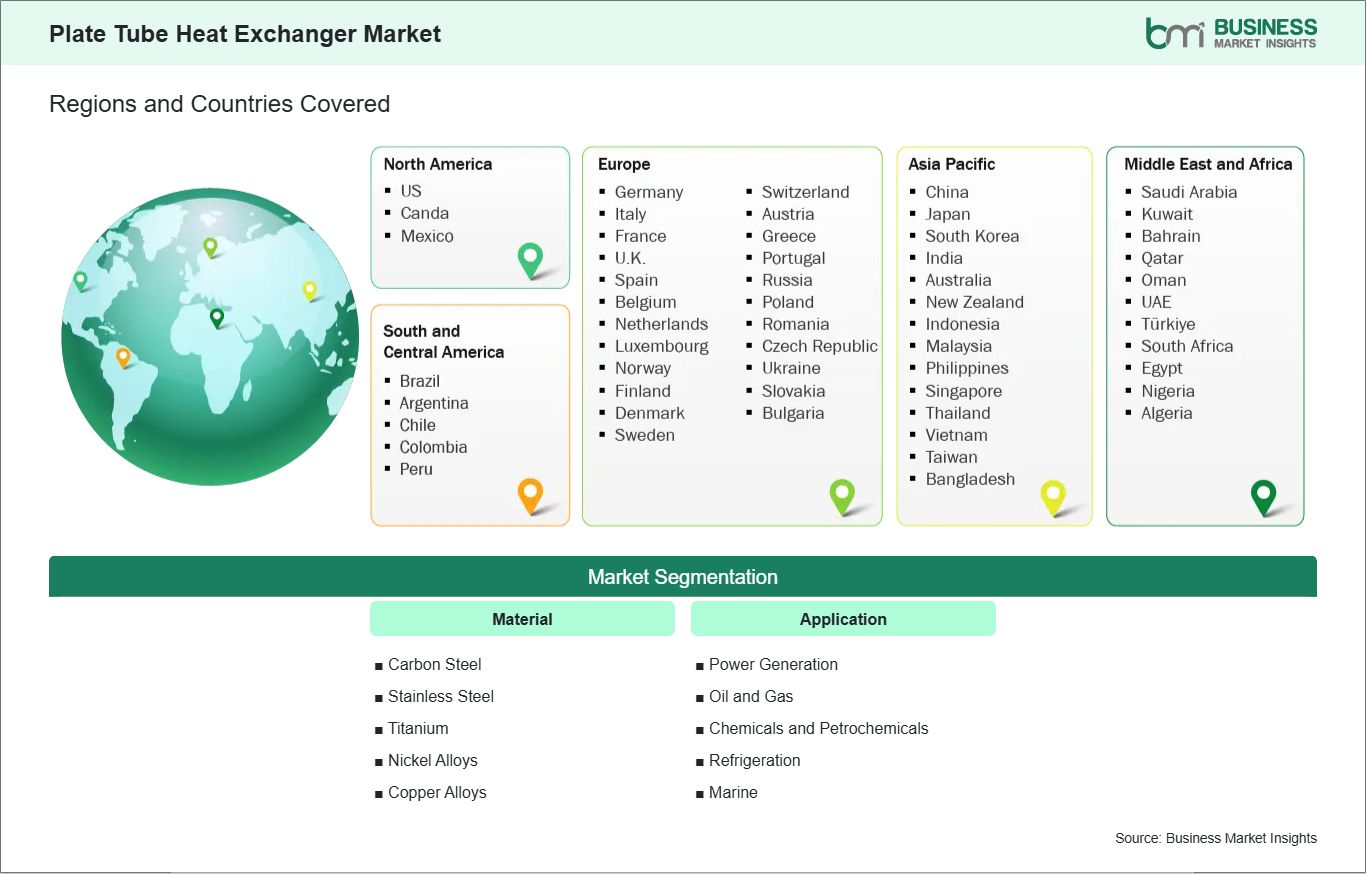
The plate tube heat exchanger market is segmented based on material and application, highlighting distinct operational priorities and evolving deployment strategies across various end uses.
By Material
- Carbon Steel: Chosen for cost-conscious duties with manageable corrosion exposure.
- Stainless Steel: Balances corrosion resistance, fabrication ease, and broad industrial compatibility.
- Titanium: Handles aggressive media and marine conditions with strong durability.
- Nickel Alloys: Supports severe chemical environments and elevated thermal stress.
- Copper Alloys: Performs well in applications requiring strong thermal conductivity.
By Application
- Power Generation: Relies on efficient heat transfer for continuous plant operation.
- Oil and Gas: Requires rugged exchangers for pressure-intensive and corrosive process streams.
- Chemicals and Petrochemicals: Prioritizes material resilience and process-specific thermal control.
- Refrigeration: Favors compact systems with effective cooling performance and service access.
- Marine: Uses corrosion-resistant equipment for constrained and demanding onboard environments.
Market Forces
Plate Tube Heat Exchanger Market Drivers and Opportunities
Industrial Focus on Thermal Efficiency and Process Reliability
Industrial operators are placing greater attention on heat recovery, stable operating conditions, and equipment efficiency as energy costs and process complexity reshape capital priorities. In this setting, exchanger selection increasingly centers on technologies that improve thermal transfer while accommodating pressure, corrosion, and maintenance constraints. Plate tube heat exchangers address these needs by combining compact transfer characteristics with mechanical strength suited to demanding plant conditions. Their use becomes more attractive where downtime, energy loss, and service limitations directly affect operating margins across power, chemicals, and hydrocarbon processing environments.
The market impact is visible in projects where plant modernization depends on better thermal management rather than wholesale process redesign. Facilities seeking performance improvement often prioritize equipment that can be integrated into existing systems while enhancing heat exchange efficiency and serviceability. This makes plate tube systems commercially relevant in applications where operational continuity outweighs low-cost standardization. As more sectors evaluate lifecycle efficiency and resilience together, the industry gains traction through technically specific replacement and upgrade demand.
Advanced Materials and High-Performance Hybrid Designs
A clear opportunity is emerging through exchanger designs that combine material sophistication with application-specific engineering. Industrial users are seeking systems that can tolerate harsher fluids, support more compact layouts, and maintain performance under tougher duty cycles. In response, manufacturers are expanding welded and semi-welded platforms, broadening alloy choices, and introducing larger high-capacity designs aimed at energy transition and heavy industrial service. These developments improve suitability for corrosive chemicals, marine environments, advanced cooling duties, and thermal systems linked to modern power infrastructure.
Future scope is especially promising in projects where footprint, efficiency, and durability must be optimized simultaneously. High-performance materials such as titanium and nickel alloys support expansion into applications where conventional exchanger formats face operational limits. At the same time, innovation in compact heavy-duty platforms creates room for deployment in new process configurations and retrofit programs. This opens a pathway for the market to compete on engineering value, not merely on equipment replacement cycles.
Size and Share Analysis
Plate Tube Heat Exchanger Market Size and Share Analysis
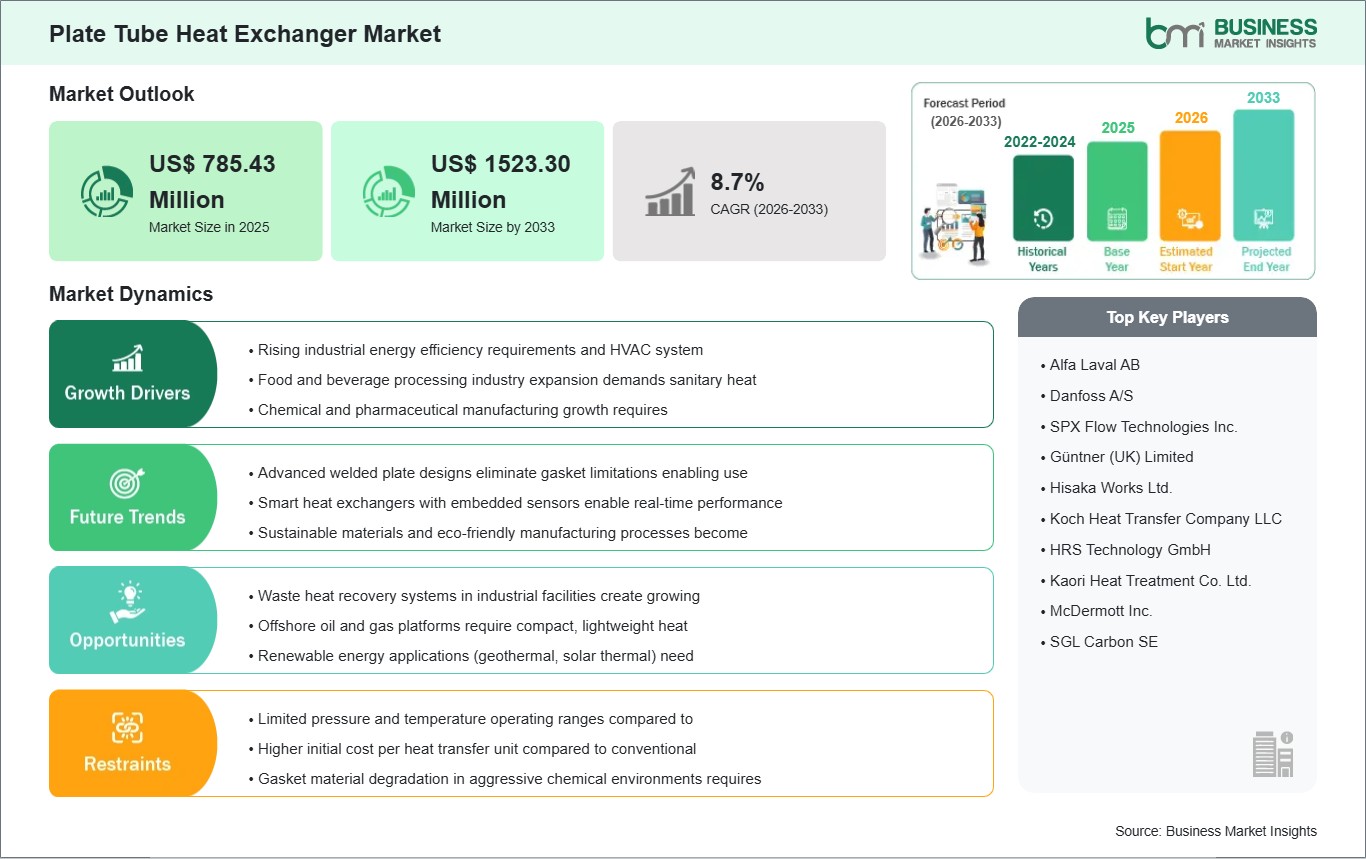
The plate tube heat exchanger market is projected to grow from US$ 0.78 billion in 2025 to US$ 1.52 billion by 2033. The market is estimated to record a CAGR of 8.70% from 2026 to 2033.
This growth path indicates a sector moving into broader industrial relevance as operators place more emphasis on energy efficiency, compact thermal systems, and application-specific process equipment. The market’s trajectory reflects strengthening acceptance in technically demanding environments rather than volume-led commoditization.
By material, stainless steel holds a central position because it offers a practical balance of corrosion resistance, cost control, and fabrication flexibility. Titanium and nickel alloys maintain importance in severe-duty environments where media aggressiveness and long service life shape procurement decisions. Carbon steel and copper alloys remain applicable in selected duties where operating conditions align with their economic and thermal characteristics.
By application, power generation retains strong influence due to its constant requirement for efficient thermal transfer and reliable equipment operation. Oil and gas and chemicals also represent significant demand centers because process intensity and fluid complexity favor engineered exchanger solutions. Refrigeration and marine segments contribute additional scope through compact installation requirements and corrosion-sensitive operating settings.
Report Coverage
Plate Tube Heat Exchanger Market Report Coverage and Deliverables
The "Plate Tube Heat Exchanger Market Size and Forecast (2022–2033)" report provides a detailed analysis of the market covering below areas:
- Market size and forecast at global, regional, and country levels for all the key market segments covered under the scope
- Market trends, as well as market dynamics such as drivers, restraints, and key opportunities
- Market analysis covering key market trends, global and regional framework, major players, regulations, and recent market developments
- Industry landscape and competition analysis covering market concentration, heat map analysis, prominent players, and recent developments for the market
- Detailed company profiles, including SWOT analysis
Geographic Insights
Plate Tube Heat Exchanger Market Geographic Insights
The Plate Tube Heat Exchanger market shows diverse regional adoption patterns influenced by industrial heat recovery priorities, process plant complexity, metallurgy requirements, and energy infrastructure investment. Across the global landscape, deployment is shaped by the need for compact and durable heat transfer equipment that can perform reliably in high-load environments. Regional differences emerge from the structure of local industries, the prevalence of heavy process sectors, and the pace of thermal system modernization.
North America presents a replacement and optimization-oriented market environment where operators seek high-performance thermal equipment for established industrial assets. Demand is tied closely to oil and gas processing, chemical production, refrigeration infrastructure, and power-related thermal systems. Buyers in the region tend to emphasize lifecycle reliability, maintainability, and compatibility with stringent operating standards when selecting advanced exchanger platforms.
Asia Pacific reflects a broader expansion profile linked to industrial buildout, marine activity, refining operations, and refrigeration demand across manufacturing networks. The region benefits from continued investment in process industries that require compact thermal systems capable of serving both conventional and modernized plant configurations. Material choice and application fit remain especially important here because plant operators often balance scale, performance, and cost sensitivity within fast-moving industrial programs.
Europe shows a more efficiency-centered pattern shaped by energy transition goals, engineering specialization, and tight process performance expectations. Industrial users in the region increasingly favor exchanger systems that support lower energy intensity, reliable heat recovery, and compact installation in constrained operating environments. Beyond these established regions, selective opportunities are emerging in the Middle East, Africa, and Latin America where refining, marine infrastructure, and industrial cooling needs create room for technically robust exchanger deployment.
Industry Activity
Recent Developments
The plate tube heat exchanger market is evaluated by gathering qualitative and quantitative data post primary and secondary research, which includes important corporate publications, association data, and databases. Recent developments and news in the market include:
- In June 2026, Alfa Laval announces the launch of TS45, the company’s largest semi-welded plate heat exchanger to date, engineered to secure competitiveness and resilience by meeting growing demands for high-capacity, high-pressure heat transfer across energy transition, industrial, and energy efficiency applications. Developed to support industries facing rising energy demand and high efficiency requirements, TS45 expands Alfa Laval’s semi-welded portfolio into duties traditionally served by shell and tube technologies. The new TS45 enables customers to scale up heat transfer performance while maintaining a compact footprint, high energy efficiency, and full serviceability.
- In February 2026, Danfoss launched the B3-260C brazed plate heat exchanger specifically for cooling distribution units (CDUs) used in data centers. The product addresses increasing demand for efficient thermal management in AI and hyperscale computing facilities
Trust & Transparency
Research Methodology
The market analysis combines proprietary research with secondary data from government agencies, company disclosures, regulatory filings, industry databases and expert interviews. Market estimates are validated through data triangulation, cross-market benchmarking and analyst
review.
View Full Research Methodology
Key Sources Referred:
World Bank – Global Trade Indicators World Trade Organization (WTO) International Monetary Fund (IMF) International Energy Agency (IEA) International Trade Administration (ITA) Company Websites Company Annual Reports Company Investor Presentations