Market Summary
Executive Summary and Global Market Analysis
Electric heat tracing refers to electrically powered heating systems used to maintain or raise the temperature of pipes, vessels, tanks, valves, and process equipment. These systems are designed to prevent freezing, maintain process temperatures, and ensure operational reliability across industrial, commercial, and residential applications. Electric heat tracing has increasingly emerged as a preferred alternative to conventional steam tracing due to its superior energy efficiency, ease of control, and reduced maintenance requirements.
The market is witnessing steady growth as industries prioritize energy-efficient temperature maintenance solutions and operational reliability. Electric heat tracing systems are extensively deployed across oil and gas, chemical processing, power generation, food and beverage, and residential sectors where temperature control is critical to maintaining process continuity and asset integrity. Increasing industrial automation and digitalization are further enhancing adoption across end-use industries.
Growing investments in industrial infrastructure modernization are supporting demand for advanced heat tracing technologies. Facility operators are increasingly adopting electric systems to minimize energy losses, improve temperature accuracy, and reduce lifecycle costs compared to traditional heating methods. The transition toward sustainable industrial operations is further accelerating market expansion.
Technological advancements in self-regulating heating cables, intelligent controllers, remote monitoring platforms, and insulation materials are improving system performance and operational efficiency. Integration of digital control systems enables real-time temperature monitoring, predictive maintenance, and energy optimization across large industrial facilities. These developments are expanding the applicability of electric heat tracing solutions in increasingly complex operating environments.
Segment Analysis
Electric Heat Tracing Market Segmentation
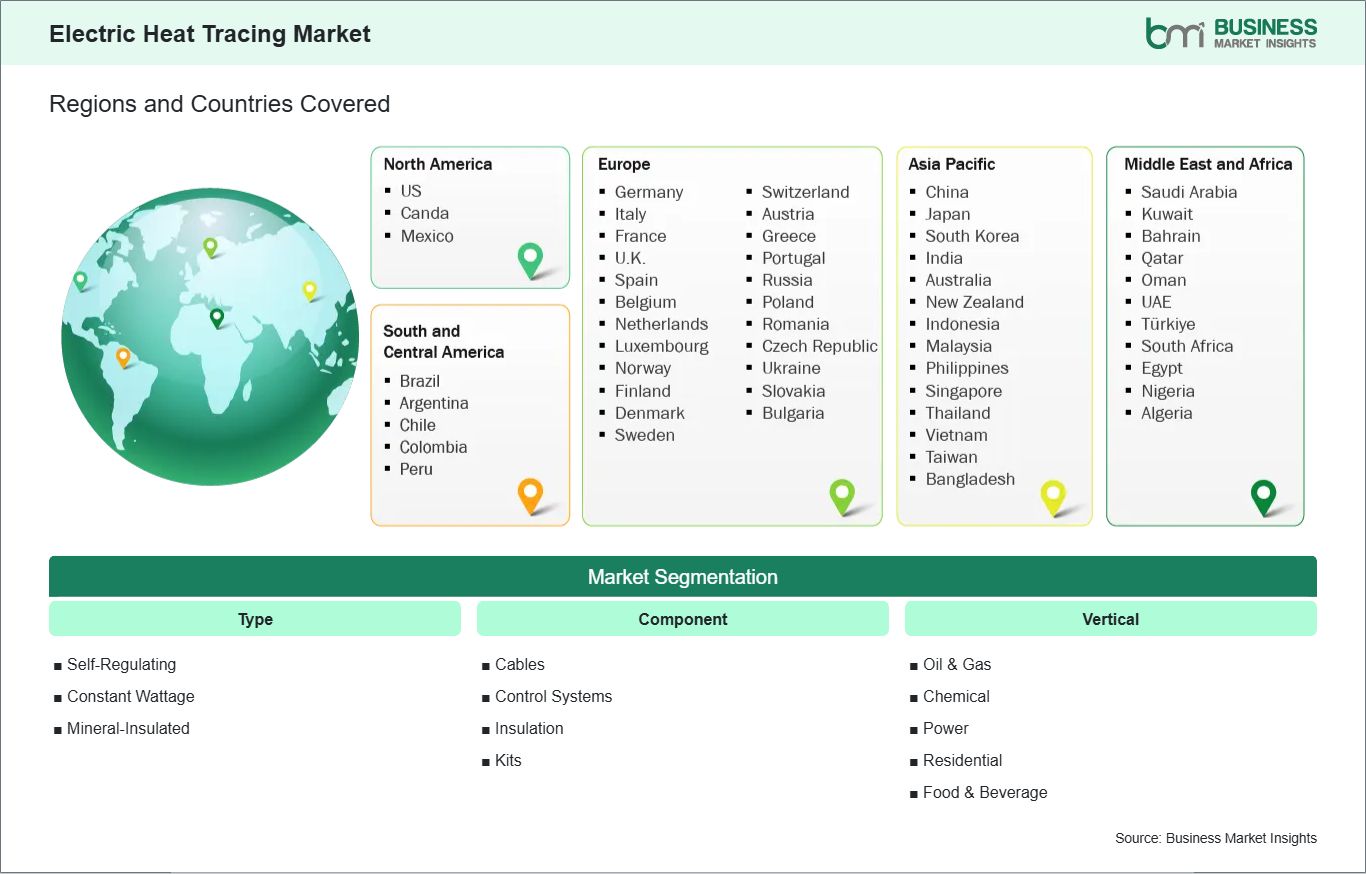
The electric heat tracing market is segmented based on type, component, and vertical, reflecting the growing adoption of advanced temperature maintenance systems across industrial and commercial sectors.
By Type
- Self-Regulating: Dominates the market due to its ability to automatically adjust heat output according to ambient temperature conditions, improving safety and energy efficiency.
- Constant Wattage: Widely utilized in applications requiring consistent heat output and stable temperature maintenance across extended pipe networks.
- Mineral-Insulated: Preferred in high-temperature and hazardous industrial environments due to superior durability, reliability, and resistance to extreme operating conditions.
By Component
- Cables: Represent the largest segment as heating cables form the core functional element of electric heat tracing systems.
- Control Systems: Experiencing strong adoption due to increasing demand for automated temperature monitoring, energy management, and predictive maintenance capabilities.
- Insulation: Plays a critical role in minimizing thermal losses and improving overall system efficiency.
- Kits: Widely used for simplified installation, maintenance, and deployment across residential and commercial applications.
By Vertical
- Oil and Gas: Major application area due to extensive requirements for freeze protection, process temperature maintenance, and operational safety.
- Chemical: Utilized for maintaining process temperatures and ensuring efficient handling of temperature-sensitive materials.
- Power: Increasingly adopted across conventional and renewable power generation facilities to maintain operational continuity.
- Residential: Growing demand for freeze protection, roof de-icing, and water pipe temperature maintenance applications.
- Food and Beverage: Supports product quality, process reliability, and compliance with stringent production standards.
Market Forces
Electric Heat Tracing Market Drivers and Opportunities
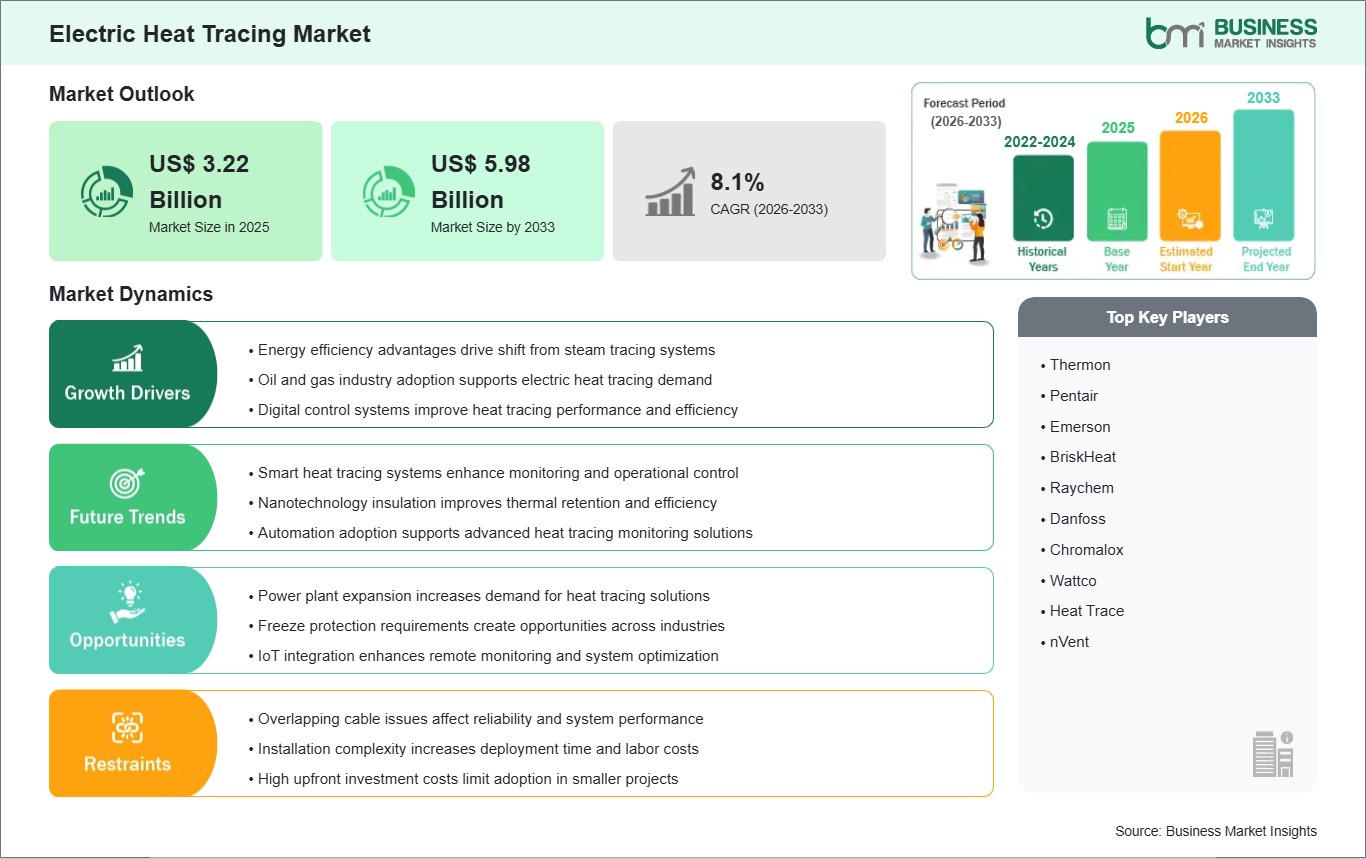
Energy Efficiency Over Steam Tracing
Electric heat tracing systems have several benefits over traditional steam tracing systems including improved accuracy of temperature control, less energy usage and lower maintenance than steam systems. Because of these benefits many industrial operation facilities are installing new electric heat trace systems to replace their obsolete steam heat trace systems.
Electric systems also minimize heat loss and do not use hundreds of miles of steam lines to create steam droplets and transfer them to a heat traced area. Consequently, electric heat tracing systems have lower operating costs and provide better overall energy efficiency. As industries create plans to reduce their carbon footprint and utilize energy as efficiently as possible, electric heat tracing technologies are also becoming an integral part of their larger sustainability efforts.
The trend of switching to electric heat tracing technology is especially prevalent in oil and gas, chemical, and power generation industries, where maintaining the correct temperature is critical to maintain operations. As organizations strive to meet their energy efficiency goals and to comply with environmental regulations, the demand for electric heat tracing systems is expected to continue to grow throughout the forecast period.
Expansion in Power Plants
The expanding and modernizing of the power generation industry is creating a significant opportunity for the electric heat tracing marketplace. As power plants require dependable means of maintaining temperature to prevent freeze-ups, keep process fluids flowing, and provide for the continued operation of critical equipment under a wide array of environmental conditions, electric heat tracing solutions are now commonly being used in conjunction with traditional technologies in both conventional thermal power plants, nuclear power plants, renewable energy facilities, and grid infrastructures. As the focus on improving operational efficiency and reliability continues to increase, investments in advanced technologies to control the temperature of processes in the power marketplace continue to grow.
Intelligent monitoring and automation systems that are capable of integrating with electric heat tracing systems are becoming commonplace at modern power generation facilities. These systems provide for predictive maintenance, optimising the usage of energy, and increasing the reliability of the systems. As global investments in power infrastructure continue to grow, the market for electric heat tracing solutions is expected to continue to grow.
Size and Share Analysis
Electric Heat Tracing Market Size and Share Analysis
The electric heat tracing market is projected to grow from US$ 3.22 billion in 2025 to US$ 5.98 billion by 2033, registering a CAGR of 8.1% from 2026 to 2033.
By type, self-regulating heat tracing systems account for a significant market share due to their energy efficiency, safety advantages, and adaptability across diverse operating environments. Constant wattage systems maintain strong adoption in industrial facilities requiring consistent heating performance, while mineral-insulated solutions serve specialized high-temperature applications.
By component, cables dominate market demand as the primary heating element within heat tracing systems. Control systems are experiencing rapid growth due to increasing adoption of automation and digital monitoring technologies.
By vertical, oil and gas represents the leading market segment due to extensive pipeline and process temperature maintenance requirements. Chemical and power sectors continue to contribute significant demand, while residential and food and beverage applications are expanding steadily.
Report Coverage
Electric Heat Tracing Market Report Coverage and Deliverables
The "Electric Heat Tracing Market Size and Forecast (2022 - 2033)" report provides a detailed analysis of the market covering below areas:
- Market size and forecast at global, regional, and country levels for all key market segments covered under the scope
- Market trends, along with market dynamics such as drivers, restraints, and key opportunities
- Market analysis covering key trends, global and regional frameworks, major players, regulations, and recent developments
- Industry landscape and competitive analysis covering market concentration, heat map analysis, prominent players, and recent developments
- Detailed company profiles, including SWOT analysis
Geographic Insights
Electric Heat Tracing Market Geographic Insights
Regional electric heat tracing markets grow differently based on industrial advancement, climate, energy investment trends, and regulations. Demand remains tied to industrial process optimisation through many sectors' need for frozen protection (through many types of industrial processes).
North America is still the biggest market, due primarily to the oil and gas sector's extensive use of this technology, chemical processing facilities, and power generation facilities. Also, cold winters are common and ongoing efforts within industry to modernise and increase efficiency will continue to support the growth of electric heat tracing in North America.
In Europe, demand remains strong due to strict regulations governing energy efficiency, industrial automation efforts, and an increase in investments in sustainable infrastructure projects. Many industrial operators in Europe are replacing traditional heating processes with newer and more energetically efficient electric heat tracing technologies.
The Asia Pacific region has the potential for the highest growth rate as countries rapidly develop industries and improve energy infrastructure through long-term investments in manufacturing facilities. Major growth areas in this region include China, India, Japan and South Korea - all of which contribute to increasing demand for heat tracing through major industrial development projects and electric power facility construction projects.
As for the Middle East/Africa, and Central/South America - these will see increasing use of electric heat tracing technology due to increased investments in oil/gas industries, increased development of other types of industrial projects, and continued efforts to modernise various types of infrastructure project.
Industry Activity
Recent Developments
The electric heat tracing market is evaluated by gathering qualitative and quantitative data post primary and secondary research, which includes important corporate publications, association data, and databases. Recent developments and news in the market include:
- In January 2025, nVent completed the sale of its Thermal Management business (which included heat tracing operations and the Raychem portfolio) to Brookfield Asset Management for approximately $1.7 billion.
- In May 2025, nVent completed acquisition of the Electrical Products Group business of Avail Infrastructure Solutions. It highlights nVent's post-divestiture strategy, while the former Thermal Management/heat-tracing business continues independently under new ownership.
Trust & Transparency
Research Methodology
The market analysis combines proprietary research with secondary data from government agencies, company disclosures, regulatory filings, industry databases and expert interviews. Market estimates are validated through data triangulation, cross-market benchmarking and analyst
review.
View Full Research Methodology
Key Sources Referred:
International Energy Agency (IEA)World Bank - Global Infrastructure and Energy DataInternational Monetary Fund (IMF)World Trade Organization (WTO)International Trade Administration (ITA)American Petroleum Institute (API)International Association of Oil and Gas Producers (IOGP)