Market Summary
Executive Summary and Global Market Analysis
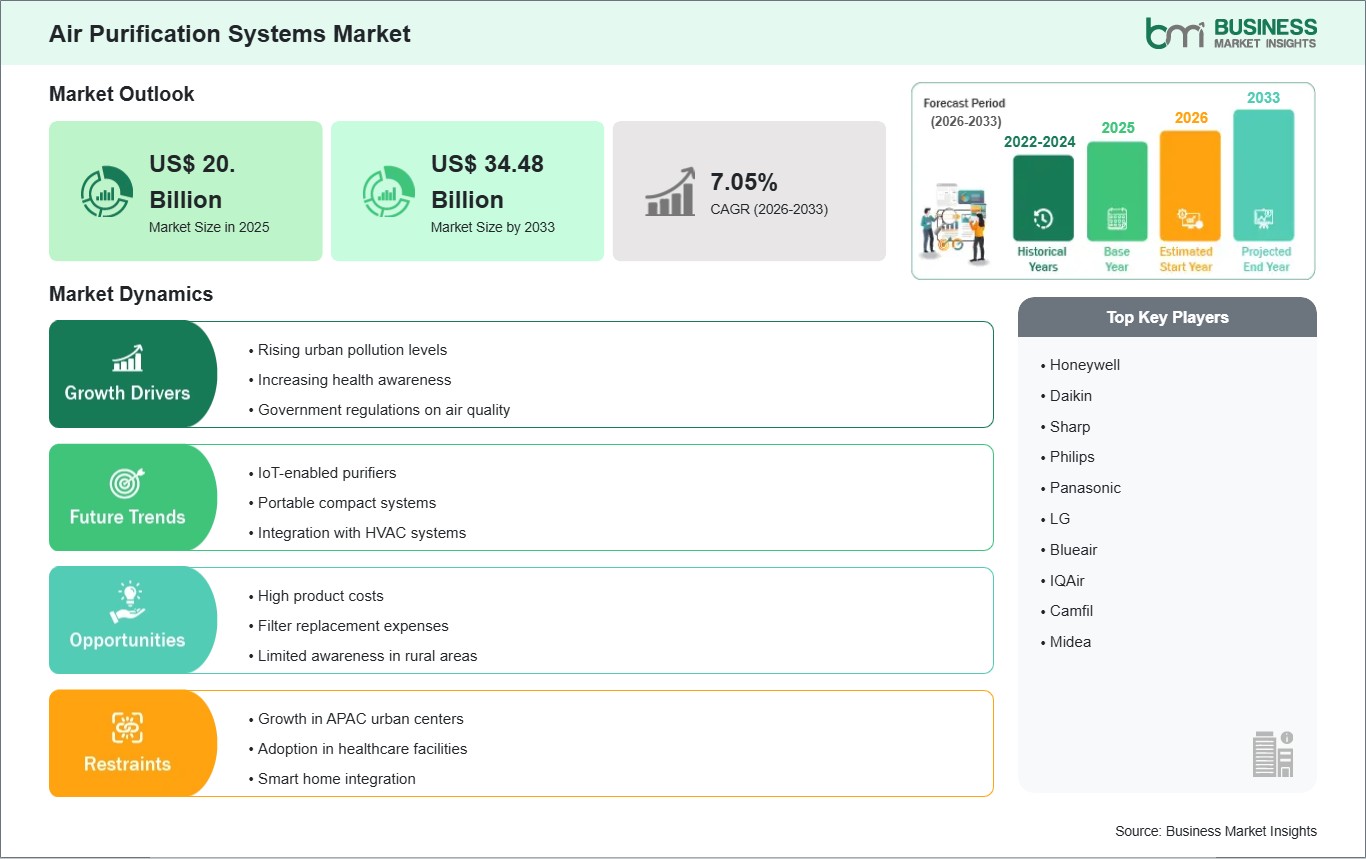
Air purification systems are devices designed to remove airborne pollutants, allergens, dust particles, smoke, bacteria, and harmful gases from indoor environments to improve air quality and support healthier living conditions. These systems are widely used across residential, commercial, healthcare, and industrial facilities where maintaining clean indoor air is essential. The market is growing due to rising concerns related to air pollution, increasing awareness about respiratory health, and growing demand for cleaner indoor environments. The adoption of advanced filtration technologies such as HEPA filters, activated carbon systems, ultraviolet purification, and ionic filtration is increasing across homes, offices, hospitals, and manufacturing facilities. Smart air purification systems with real-time air quality monitoring and energy-efficient operation are also gaining significant attention in both developed and emerging markets.
There are several challenges that could affect market growth during the forecast period. Advanced air purification systems often involve high installation and maintenance costs, which may limit adoption among price-sensitive consumers and smaller commercial facilities. Regular filter replacement and system servicing can also increase long-term operational expenses. In industrial environments, achieving efficient purification in large spaces with varying pollutant levels can be technically complex and energy intensive. In addition, limited consumer awareness in some developing regions and the presence of low-quality filtration products may affect market penetration and reduce confidence in system performance.
Despite these challenges, the market is expected to grow steadily due to increasing investments in indoor air quality management and sustainable building infrastructure. Opportunities are emerging from the integration of artificial intelligence, IoT-enabled monitoring systems, and energy-efficient purification technologies that improve operational efficiency and user convenience. Growing focus on green buildings, workplace wellness, and healthcare infrastructure modernization is also supporting market expansion. The development of compact, portable, and low-energy purification systems is expected to create new growth opportunities for the Air Purification Systems market.
Segment Analysis
Air Purification Systems Market Segmentation
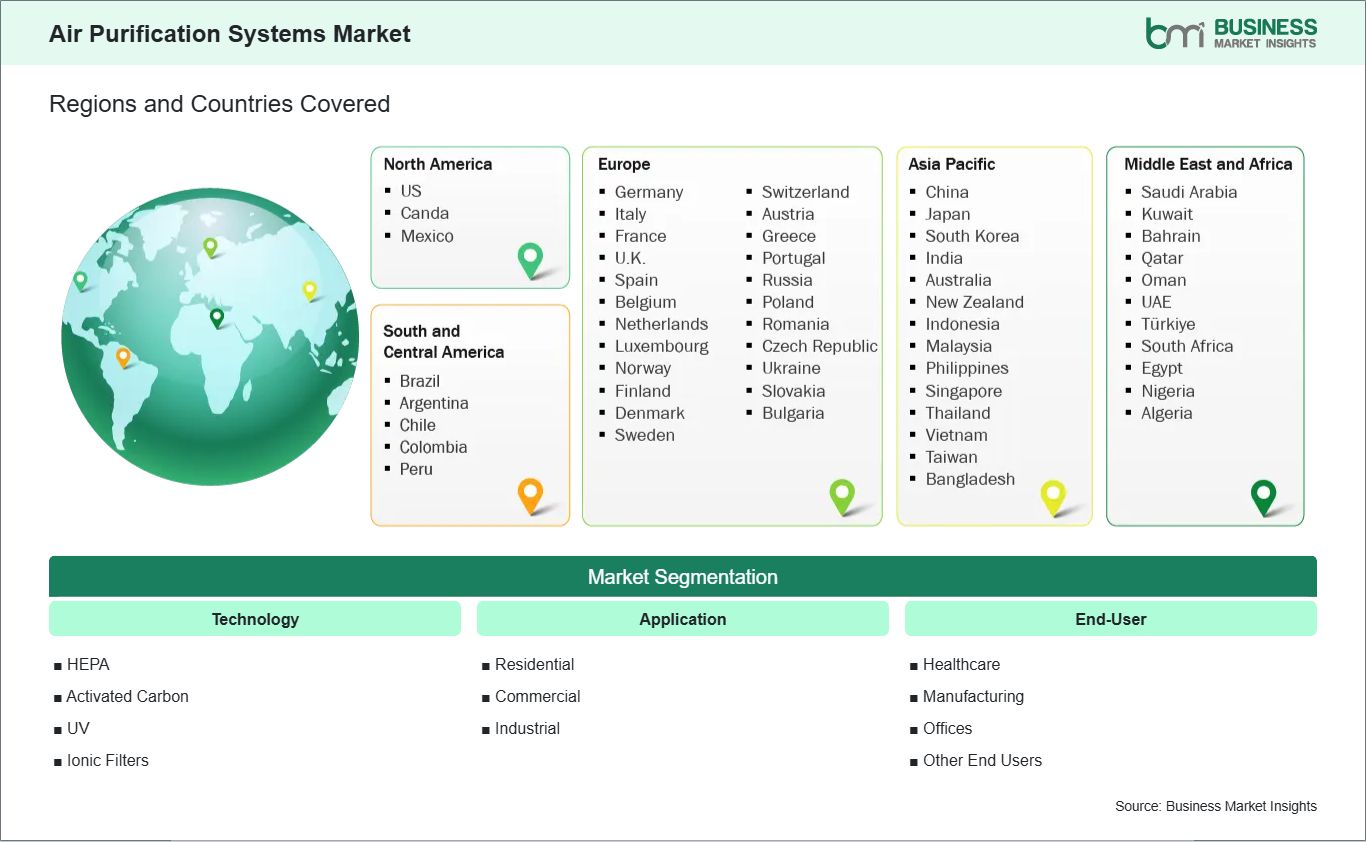
The Air Purification Systems market is segmented based on technology, application, and end-user. Different industries and consumers adopt purification systems according to indoor air quality requirements, operational efficiency, and environmental conditions.
By Technology
- HEPA: HEPA filtration systems are widely adopted because they effectively capture fine airborne particles, allergens, and pollutants in residential and commercial environments.
- Activated Carbon: Activated carbon systems are used to remove odors, smoke, and harmful gases through chemical adsorption processes.
- UV: UV purification systems help eliminate bacteria, viruses, and microorganisms by using ultraviolet light technology.
- Ionic Filters: Ionic filtration systems release charged ions that help remove airborne contaminants and improve indoor air quality.
By Application
- Residential: Residential applications account for significant adoption due to increasing consumer awareness regarding indoor pollution and respiratory health.
- Commercial: Commercial facilities use air purification systems to maintain healthy indoor environments in offices, retail spaces, and hospitality establishments.
- Industrial: Industrial facilities deploy advanced purification systems to manage airborne contaminants and maintain workplace safety standards.
By End-User
- Healthcare: Healthcare facilities use air purification systems to maintain sterile environments and reduce the risk of airborne infections.
- Manufacturing: Manufacturing industries adopt these systems to improve air quality and support safe production environments.
- Offices: Office spaces increasingly use purification systems to improve employee comfort and indoor environmental quality.
- Other End Users: Other end users include educational institutions, hospitality facilities, and public infrastructure environments.
Market Forces
Air Purification Systems Market Drivers and Opportunities
Rising Concerns Related to Indoor Air Quality and Respiratory Health
Increasing awareness regarding indoor air pollution and respiratory health issues is one of the major factors driving the growth of the Air Purification Systems market. Urbanization, industrial emissions, and rising levels of airborne pollutants are encouraging consumers and organizations to invest in effective indoor air quality solutions. Residential users are increasingly adopting purification systems to reduce exposure to allergens, smoke, dust particles, and harmful microorganisms. Commercial facilities, healthcare institutions, and office environments are also focusing on improving indoor air conditions to support occupant health and workplace productivity.
Governments and regulatory agencies are introducing stricter environmental and workplace safety standards related to indoor air quality management. This is encouraging businesses and public institutions to deploy advanced purification systems across commercial buildings, healthcare facilities, and industrial plants. The growing incidence of respiratory disorders and increasing public awareness regarding airborne infections are further supporting market demand. In addition, rising adoption of smart homes and connected building infrastructure is contributing to the integration of intelligent air purification technologies with automated environmental monitoring systems.
Growing Adoption of Smart and Energy-Efficient Purification Technologies
The increasing demand for smart and energy-efficient air purification technologies is creating significant opportunities for the Air Purification Systems market. Consumers and businesses are increasingly looking for systems that combine advanced filtration performance with lower energy consumption and real-time monitoring capabilities. Smart purification systems equipped with IoT connectivity, artificial intelligence, and automated sensors are gaining attention because they provide continuous air quality analysis and optimized operational control.
Manufacturers are also focusing on developing compact and portable purification systems that can be easily integrated into homes, offices, healthcare environments, and transportation infrastructure. Energy-efficient filtration technologies and low-maintenance system designs are becoming important factors influencing purchasing decisions among residential and commercial users. In industrial applications, advanced purification systems are being adopted to improve worker safety and support compliance with environmental regulations.
Size and Share Analysis
Air Purification Systems Market Size and Share Analysis
The Air Purification Systems Market is projected to grow from US$ 20. Billion in 2025 to US$ 34.48 Billion by 2033 , registering a CAGR of 7.05% from 2026 to 2033.
By technology, HEPA filtration systems account for a significant share due to their high efficiency in removing airborne particles, allergens, and fine pollutants from indoor environments. Activated carbon systems continue to witness strong adoption because of their effectiveness in removing odors and harmful gases. UV purification technologies are gaining increasing demand in healthcare and commercial applications due to rising focus on infection control and microbial air purification, while ionic filters are also expanding steadily in residential and office environments.
By application, residential applications dominate the market owing to increasing consumer awareness regarding indoor air quality and health-related concerns. Commercial applications are growing steadily with rising adoption across offices, retail spaces, hospitality facilities, and educational institutions. Industrial applications are also contributing significantly to market demand as manufacturing facilities focus on workplace safety and environmental compliance.
By end-user, healthcare facilities account for a major market share because of strict air quality requirements and increasing investments in advanced healthcare infrastructure and infection prevention systems.
Report Coverage
Air Purification Systems Market Report Coverage and Deliverables
The "Air Purification Systems Size and Forecast (2022-2033)" report provides a detailed analysis of the market covering below areas:
- Market size and forecast at global, regional, and country levels for all the key market segments covered under the scope
- Market trends, as well as market dynamics such as drivers, restraints, and key opportunities
- Market analysis covering key market trends, global and regional framework, major players, regulations, and recent market developments
- Industry landscape and competition analysis covering market concentration, heat map analysis, prominent players, and recent developments for the market
- Detailed company profiles, including SWOT analysis
Geographic Insights
Air Purification Systems Market Geographic Insights
The Air Purification Systems Market shows diverse regional adoption patterns influenced by rising air pollution levels, increasing health awareness, and growing investments in indoor air quality infrastructure.
North America, being a developed region, has a well-established commercial and residential infrastructure along with a high adoption rate of advanced air purification technologies. The region comprises the United States and Canada, where consumers and businesses are increasingly focusing on improving indoor environmental quality and reducing exposure to airborne pollutants. The region emphasizes workplace wellness, healthcare safety, and sustainable building management. It also has strong technological capabilities and established healthcare infrastructure, supporting the widespread use of smart and energy-efficient air purification systems across residential, commercial, and industrial applications.
Asia Pacific is growing significantly, driven by rapid urbanization, industrial expansion, and increasing concerns related to air pollution and respiratory health. The region comprises countries such as China, India, Japan, and South Korea, where rising pollution levels and expanding urban populations are increasing demand for air purification systems. The region focuses on improving public health standards and supporting cleaner indoor environments across homes, offices, healthcare facilities, and manufacturing plants. Growing investments in smart infrastructure and healthcare modernization are also contributing to the expansion of the Air Purification Systems market across the region.
Both regions are contributing significantly to the growth of the Air Purification Systems Market, focusing on indoor air quality improvement, healthcare safety, and adoption of advanced and energy-efficient purification technologies.
Industry Activity
Recent Developments
The Air Purification Systems Market is analyzed using a mix of primary and secondary research sources, including corporate publications, industry associations, and verified databases. This approach ensures accurate tracking of innovation trends and strategic developments influencing the market.
- In September 2025, Daikin announced the expansion of its air purification product portfolio with advanced filtration and smart sensor integration technologies for residential and commercial applications. The systems were developed to improve indoor air quality management while reducing energy consumption and operational complexity. The launch highlights the growing adoption of connected and energy-efficient purification technologies in modern infrastructure projects.
- In February 2024, Honeywell introduced advanced indoor air quality solutions designed for commercial buildings and healthcare environments. The updated systems integrate smart monitoring capabilities and enhanced filtration technologies to improve energy efficiency and indoor environmental performance. The development reflects increasing demand for intelligent and sustainable air purification infrastructure across commercial and institutional facilities.
Trust & Transparency
Research Methodology
The market analysis combines proprietary research with secondary data from government agencies, company disclosures, regulatory filings, industry databases and expert interviews. Market estimates are validated through data triangulation, cross-market benchmarking and analyst
review.
View Full Research Methodology
Key Sources Referred:
World Bank - Global Trade Indicators World Trade Organization (WTO) International Monetary Fund (IMF) International Trade Administration (ITA) Company Websites Company Annual Reports Company Investor Presentations