
Commercial Air Conditioner Market Outlook: Size, Share, Trends, Growth Analysis, Competitive Landscape & Forecast, 2026-2033

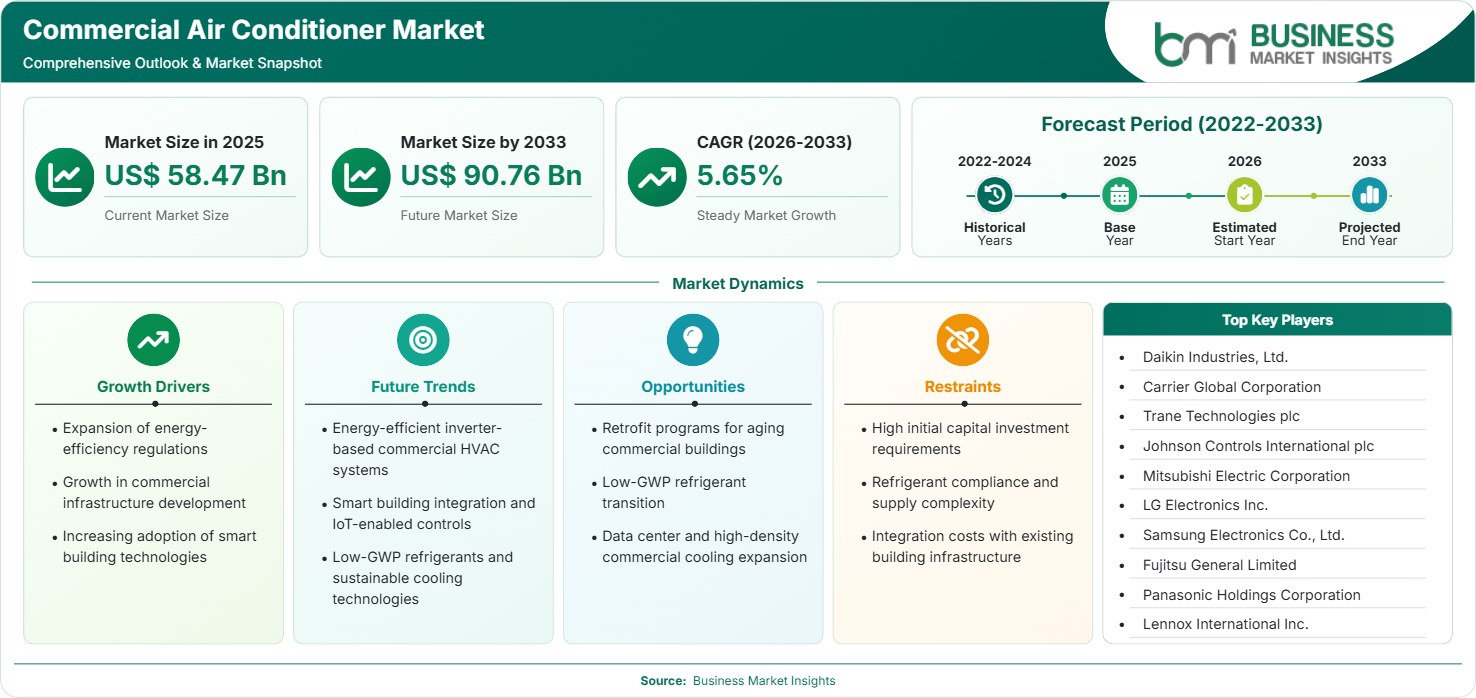
The Commercial Air Conditioner Market size was valued at US$ 58.47 Billion in 2025 and is projected to reach US$ 90.76 Billion by 2033, growing at a CAGR of 5.65% during 2026–2033. Rising demand for energy-efficient cooling systems, commercial infrastructure expansion, smart building integration, refrigerant transitions, and retrofit projects are driving adoption, while data center cooling and green-building investments create significant opportunities.

Report Coverage
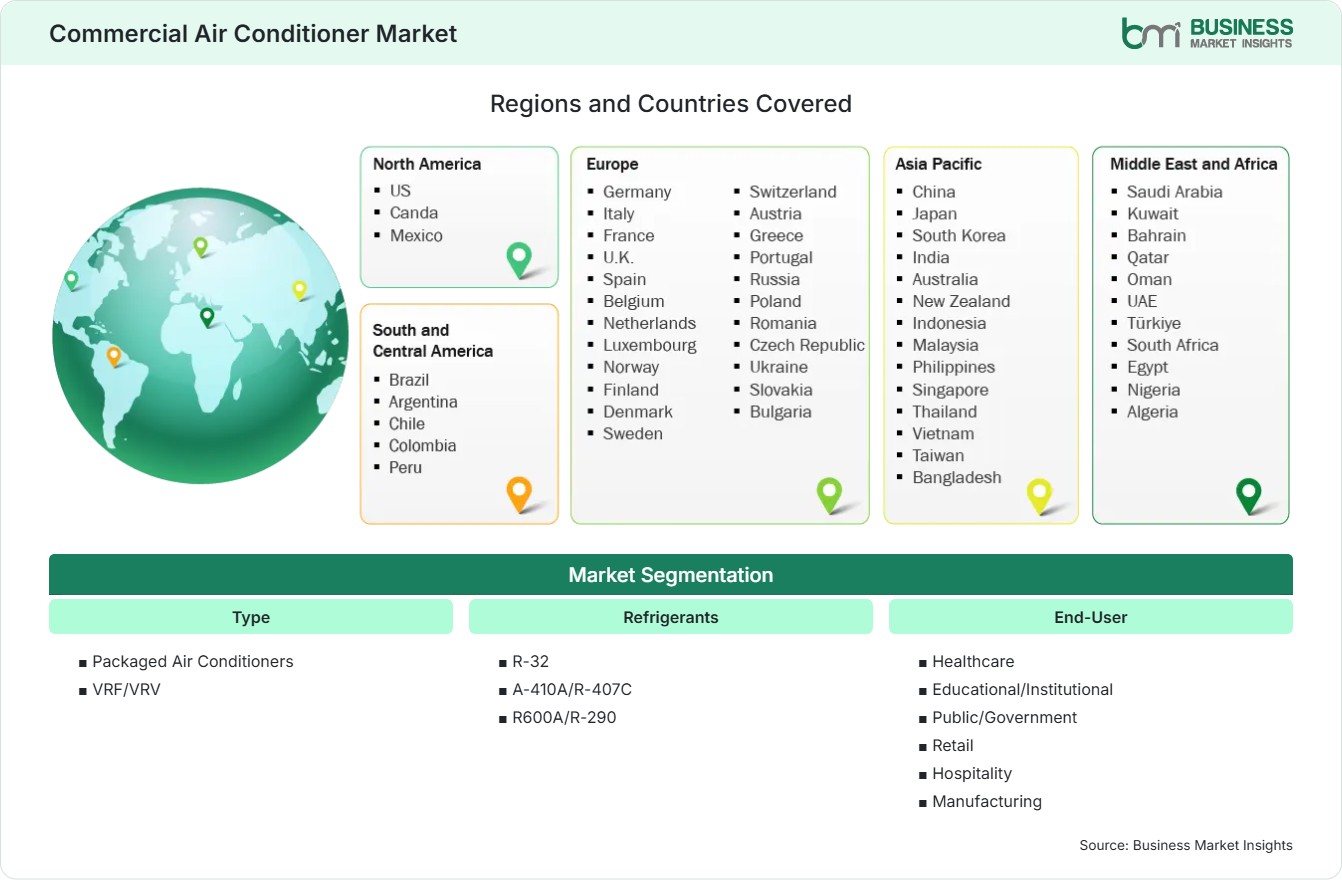
  • Type: Packaged Air Conditioners, VRF/VRV
  • Refrigerants (R-32, A-410A/R-407C, R600A/R-290
  • End-User: Healthcare, Educational/Institutional, Public/Government, Retail, Hospitality, Manufacturing
US$ 58.47 Bn Market size in 2025
US$ 90.76 Bn Market Size by 2033
5.65% CAGR, 2026 - 2033
2026-2033 Forecast Period

AI Overview

Commercial Air Conditioner Market Summary

  • North America Region: North America holds a market share of 32%–35% in 2025, growing at a CAGR of 4.8%–5.3% during 2026–2033. Demand is supported by replacement cycles, smart building deployments, and efficiency regulations. Data-center cooling investments and decarbonization initiatives create additional growth opportunities. The U.S. dominates regional demand through commercial retrofits, healthcare expansion, and energy-efficiency programs, advancing at approximately 5.0%–5.4% CAGR.
  • Fastest Growing Region: Asia Pacific holds 29%–32% share in 2025 and is forecast to grow at 6.8%–7.4% CAGR. Urban construction, hospitality growth, manufacturing investments, sustainable cooling regulations, and increasing adoption of VRF systems support long-term market expansion opportunities.
  • Leading Segment: VRF/VRV accounts for 52%–56% share in 2025 and is expected to grow at 6.2%–6.8% CAGR. Energy optimization, zoning capability, lower lifecycle costs, and integration with smart building platforms continue strengthening commercial adoption globally.
  • High Growth Segment: R-32 refrigerant solutions represent 28%–32% share in 2025 and expand at 7.0%–7.8% CAGR. Lower global-warming potential, regulatory alignment, improved efficiency, and accelerating replacement of legacy refrigerants support widespread deployment across commercial facilities.
  • Key Market Opportunity: Retrofitting aging commercial buildings with intelligent cooling systems creates opportunities through energy savings, emissions reduction, predictive maintenance capabilities, digital controls integration, enhanced occupant comfort, and regulatory compliance requirements.
  • Major Market Players: Daikin Industries, Ltd.; Carrier Global Corporation; Trane Technologies plc; Johnson Controls International plc; Mitsubishi Electric Corporation; LG Electronics Inc.; Samsung Electronics Co., Ltd.; Fujitsu General Limited; Panasonic Holdings Corporation; Lennox International Inc.
Strategic Insights

Commercial Air Conditioner Market: Strategic Insights

Commercial Air Conditioner Market Strategic Framework
FREE PDF
Request your free sample
Request free sample
Stakeholder View

Key Takeaways

  • The value chain is increasingly centered on integrated solutions combining compressors, controls, software, refrigerants, and predictive maintenance services rather than standalone equipment sales.
  • Healthcare facilities, educational campuses, and hospitality infrastructure present strong upside due to stringent indoor-air-quality requirements and long equipment replacement cycles.
  • Innovation is moving toward AI-enabled controls, digital twins, remote diagnostics, and low-GWP refrigerants that improve both operational efficiency and sustainability performance.
  • Asia Pacific offers the strongest investment proposition, supported by urbanization, commercial real-estate expansion, and government-backed infrastructure spending.
  • Strategic acquisitions continue targeting building automation, energy-management software, and sustainable cooling technologies to strengthen recurring service revenues.
  • Data center development is creating a specialized demand stream for high-reliability cooling systems with advanced monitoring and energy optimization capabilities.
Geographic Outlook

Commercial Air Conditioner Market Regional Highlights

North America Commercial Air Conditioner Market

North America accounts for 32%–35% Commercial Air Conditioner Market share in 2025 and advances at 4.8%–5.3% CAGR through 2033. Demand is driven by replacement installations in aging commercial buildings, strict energy-efficiency standards, and expanding digital infrastructure. Growth remains strongest in healthcare, logistics, and data-center applications. Rising adoption of smart controls and connected HVAC ecosystems enhances operational performance while supporting sustainability goals across commercial real-estate portfolios.

  • Commercial retrofitting projects continue accelerating due to energy-cost pressures and ESG commitments among corporate building owners.
  • Data-center construction across the United States and Canada supports demand for precision cooling solutions and intelligent monitoring technologies.
  • Public-sector sustainability programs stimulate replacement of aging systems in schools, government facilities, and transportation infrastructure.
  • Smart-building integration improves equipment utilization, maintenance scheduling, and energy-performance benchmarking across commercial assets.

US Commercial Air Conditioner Market

The United States represents 74%–78% of the North American market and grows at 5.0%–5.4% CAGR. Strong commercial renovation activity, federal efficiency incentives, and expanding healthcare infrastructure sustain equipment demand. Hospitality investments and warehouse development further support installations. Building owners increasingly adopt connected cooling systems capable of reducing operating expenses and supporting long-term carbon-reduction objectives.

  • Healthcare and pharmaceutical facilities increasingly deploy advanced cooling systems to maintain indoor environmental stability.
  • Warehouse expansion and logistics infrastructure development support demand for packaged and VRF technologies.
  • State-level decarbonization mandates encourage low-emission refrigerants and high-efficiency equipment adoption.
  • Service contracts and predictive-maintenance solutions are becoming major revenue contributors across the installed base.

Europe Commercial Air Conditioner Market

Europe captures 24%–27% share in 2025 and expands at 5.1%–5.7% CAGR. Regulatory emphasis on emissions reduction and refrigerant transition remains a primary demand catalyst. Germany leads regional revenue generation, while Eastern European markets exhibit faster growth momentum. Commercial modernization programs across public infrastructure, offices, and hospitality establishments continue encouraging replacement of aging equipment.

  • Germany remains the largest national market due to industrial strength and commercial building upgrades.
  • Poland and Romania demonstrate attractive expansion rates supported by new commercial construction activities.
  • Low-GWP refrigerant regulations accelerate transition from legacy cooling technologies.
  • Smart energy-management systems are increasingly integrated with HVAC equipment across office and institutional facilities.

Asia Pacific Commercial Air Conditioner Market

Asia Pacific holds 29%–32% share in 2025 and records the highest CAGR of 6.8%–7.4%. China remains the largest regional market, while India demonstrates the fastest commercial construction-driven expansion. Rapid urbanization, hospitality development, manufacturing investments, and rising demand for sustainable cooling solutions continue strengthening regional consumption and production activity.

  • China benefits from extensive commercial real-estate development and strong manufacturing capabilities.
  • India experiences rapid demand growth due to retail, hospitality, office, and healthcare infrastructure expansion.
  • Southeast Asian countries increasingly adopt VRF systems to improve energy efficiency.
  • Rising temperatures and urban density support long-term cooling equipment demand across metropolitan areas.
  • Government efficiency standards encourage adoption of advanced refrigerants and intelligent systems.

Rest of World Commercial Air Conditioner Market

The Rest of World region accounts for 11%–14% share and grows at 5.8%–6.4% CAGR. South and Central America benefit from retail and mixed-use project development, while Middle East and Africa growth is supported by hospitality, tourism, and government infrastructure investments. Gulf countries lead regional spending, whereas selected African nations present emerging opportunities through urban development initiatives.

  • Saudi Arabia and the UAE lead demand through large-scale tourism and commercial developments.
  • Brazil remains a key market supported by retail, healthcare, and office construction investments.
  • Infrastructure modernization programs strengthen adoption within public-sector facilities.
  • High ambient temperatures increase dependence on efficient commercial cooling systems.
  • International hotel chains continue supporting installation activity throughout major urban centers.
Global Market Geography
FREE PDF
Request your free sample
Request free sample
Segment Analysis

Commercial Air Conditioner Market Segmentation

Type

Type segment dynamics reflect rising demand for efficiency and flexibility. The segment represents the operational core of cooling investments, with VRF/VRV holding the largest position at 52%–56% share in 2025 and expanding at 6.2%–6.8% CAGR. Commercial Air Conditioner Market scope continues widening as building owners prioritize intelligent zoning, reduced energy consumption, and lifecycle optimization.

  • Packaged Air Conditioners: Widely used across retail stores, educational facilities, and mid-sized commercial buildings because of installation simplicity, cost efficiency, and reliable performance in standardized operating environments.
  • VRF/VRV: Increasingly adopted within offices, hotels, healthcare facilities, and mixed-use developments due to zoning flexibility, energy optimization, smart controls integration, and enhanced occupant comfort.

Refrigerants

Refrigerants are undergoing rapid transition due to environmental regulations and sustainability objectives. R-32 solutions lead technological adoption with 28%–32% share in 2025 and achieve 7.0%–7.8% CAGR. Commercial Air Conditioner Market trends increasingly favor lower-global-warming-potential alternatives that balance environmental performance with operational efficiency.

  • R-32: Favored for improved efficiency, lower environmental impact, and compatibility with evolving regulatory frameworks across commercial applications.
  • A-410A/R-407C: Remains extensively deployed within installed systems, particularly in replacement and maintenance markets where infrastructure compatibility remains essential.
  • R600A/R-290: Adoption grows within sustainability-focused projects seeking reduced emissions and compliance with future refrigerant-transition requirements.

End-User

End-user demand remains diversified, with healthcare contributing the largest position at approximately 22%–25% share in 2025 and expanding at 5.9%–6.4% CAGR due to stringent indoor-air-quality requirements and infrastructure investments. Commercial Air Conditioner Market size benefits from resilient institutional and commercial spending patterns across multiple sectors.

  • Healthcare: Requires reliable temperature control, air-quality management, compliance standards, and continuous operational performance.
  • Educational/Institutional: Demand is driven by campus modernization projects, energy-efficiency mandates, and public-sector infrastructure spending.
  • Public/ Government: Government buildings increasingly adopt sustainable cooling technologies to reduce energy consumption and operating costs.
  • Retail: Shopping centers and commercial stores prioritize customer comfort, efficient operations, and intelligent building-management systems.
  • Hospitality: Hotels and resorts invest in advanced cooling solutions to enhance guest experience and operational sustainability.
  • Manufacturing: Industrial facilities deploy commercial cooling systems to protect equipment, maintain processes, and improve workforce productivity.
Market Forces

Commercial Air Conditioner Market Dynamics

Key Market Drivers

Expansion of Energy-Efficiency Regulations

Governments across North America, Europe, and Asia continue implementing stricter building-energy standards, encouraging replacement of outdated cooling equipment with high-efficiency systems. International Energy Agency assessments highlight buildings as a major energy-consuming sector, increasing pressure on commercial operators to reduce consumption. Commercial Air Conditioner Market trends are moving closer to smart control, variable speed compressors, and digital energy management solutions. Companies focused on meeting their sustainability goals are investing in modern air conditioning units that help reduce electricity consumption without compromising occupant comfort. With increasing regulations, replacement purchases will continue to play a major role in procurement.

Growth in Commercial Infrastructure Development

Healthcare facilities, educational campuses, hospitality projects, logistics hubs, and mixed-use developments continue expanding globally. Urbanization across emerging economies is increasing demand for scalable cooling systems capable of serving higher-density commercial environments. Commercial Air Conditioner Market growth is positively impacted by the continuous investments in institutional infrastructure and programs for modernization. There has been increasing adoption of intelligent cooling systems during the early stages of the design of new construction to ensure improved efficiency and certification of the system. As economies move towards service-based economies, there will be increasing needs for cooling systems.

Increasing Adoption of Smart Building Technologies

Building owners are linking HVAC systems with IoT-enabled management platforms to improve efficiency, occupancy control, and predictive maintenance. Through digitalization, it is possible to track energy usage and equipment efficiency continuously. There is an increased tendency for businesses to assess cooling solutions based on lifecycle productivity in addition to purchase cost. The use of connected technology ensures uptime and improves reliability, particularly in the healthcare industry. Implementation of smart buildings also generates opportunities for recurring revenue streams from services. Such tendencies are helping to reinforce technological differentiation among key players.

Key Market Opportunities

Retrofit Programs for Aging Commercial Buildings

A substantial portion of commercial building stock across developed economies operates with aging cooling infrastructure. Retrofitting projects offer opportunities to replace inefficient systems with digitally connected alternatives. Commercial Air Conditioner Market Forecasts point to long-term demand possibilities owing to efforts related to the modernization of buildings by focusing on cost savings, reduction of emissions, and compliance. More and more investors are interested in such retrofitting because improvements in energy performance usually yield positive financial outcomes within known time frames. Retrofitting of equipment helps in integrating smart building, monitoring, and control systems.

Low-GWP Refrigerant Transition

Environmental regulations are accelerating migration toward refrigerants with lower global-warming potential. Organizations involved in developing R-32 and new technology products may see an advantage in replacement demand because companies will need to have future-proof solutions. Increasingly, compliance with regulations is a factor in buying decisions, especially for large commercial real estate estates. Buyers are looking for solutions that combine performance, safety, and sustainability. There is also an opportunity in installation and retrofit services. Organizations that can offer migration solutions will attract more commercial customers.

Data Center Cooling Expansion

Rapid growth in cloud computing, artificial intelligence infrastructure, and digital services is driving data-center construction worldwide. The systems used in such facilities need to be highly reliable with sophisticated monitoring capabilities. The specialized cooling systems are highly priced due to their emphasis on operational continuity. Manufacturers of such equipment are developing more sophisticated thermal management systems. Energy efficiency is also of great concern to users of such facilities due to power requirements. This makes for great growth potential in the future for such specialized commercial cooling systems.

Market Restraints and Challenges

High Initial Capital Requirements

Factor: Advanced cooling systems incorporating digital controls, high-efficiency compressors, and low-GWP refrigerants often require substantial upfront investment. Impact: Organizations operating under strict budgetary constraints may also postpone plans to modernize operations, even when lifecycle economics favor such an undertaking. Issues related to financing become more pertinent in the case of small businesses and government entities, which have fixed budgets. Although the implementation of an effective system lowers operational costs, high procurement costs may hinder its adoption. The installation process and associated costs become other factors that escalate the level of investment needed.

Refrigerant Compliance and Supply Complexity

Factor: Regulatory transitions create uncertainty regarding refrigerant availability, standards compliance, technician training, and future equipment requirements. Impact: Purchasing could be delayed by the end user until the regulatory path is better defined. Adaptations in the supply chain further complicate things for manufacturers that have to deal with multiple product platforms and geographic needs. Installation and maintenance of equipment will need specific knowledge for service companies due to the changes in refrigerants. This complicates things from the standpoint of additional cost and delays in adoption time.

Company Analysis

Competitive Landscape

Commercial Air Conditioner Market analysis indicates competition is centered on energy efficiency, refrigerant innovation, smart-building integration, service capabilities, and global distribution networks.

Company Name

Overview

Products and Services relevant to this market

Daikin Industries, Ltd.

Global HVAC leader with strong commercial cooling presence and extensive international manufacturing network.

VRV systems, packaged units, chillers, controls, refrigerant technologies, maintenance services.

Carrier Global Corporation

Major provider of climate-control solutions focused on efficient and connected building systems.

Commercial HVAC systems, rooftop units, chillers, digital monitoring, lifecycle services.

Trane Technologies plc

Focuses on sustainable climate technologies and commercial infrastructure solutions.

Commercial air conditioners, energy management, controls, service and optimization offerings.

Johnson Controls International plc

Strong building technology portfolio integrated with automation platforms.

HVAC equipment, smart-building controls, chillers, maintenance and facility services.

Mitsubishi Electric Corporation

Known for advanced variable refrigerant flow technologies and efficient cooling systems.

VRF systems, controls, commercial cooling equipment, connected solutions.

LG Electronics Inc.

Expanding commercial HVAC footprint through efficient intelligent cooling products.

Multi-V systems, commercial air conditioners, energy-management software.

Samsung Electronics Co., Ltd.

Develops connected HVAC systems integrated with smart-building ecosystems.

Commercial cooling units, VRF technologies, controls and monitoring platforms.

Fujitsu General Limited

Specialized HVAC manufacturer with strong presence in variable refrigerant systems.

Commercial VRF solutions, air-conditioning units, service support.

Panasonic Holdings Corporation

Focuses on sustainable and energy-efficient climate technologies.

Commercial cooling systems, air-quality solutions, controls and services.

Lennox International Inc.

Established HVAC supplier serving commercial building operators globally.

Packaged rooftop systems, commercial cooling units, aftermarket support services.

Trust & Transparency

Research Methodology

The market analysis combines proprietary research with secondary data from government agencies, company disclosures, regulatory filings, industry databases and expert interviews. Market estimates are validated through data triangulation, cross-market benchmarking and analyst review.

View Full Research Methodology

Questions Answered

Frequently Asked Questions

What does a Commercial Air Conditioner Market Report typically evaluate?

It generally assesses market size, competitive positioning, technology trends, regulatory developments, segment performance, regional dynamics, investment opportunities, and future growth outlook.

How does refrigerant transition affect the industry?

Regulations encouraging lower-global-warming-potential refrigerants are accelerating replacement demand, influencing product design, maintenance practices, and long-term procurement strategies.

Why are VRF systems gaining popularity globally?

VRF systems offer zoning flexibility, superior efficiency, improved occupant comfort, and easier integration with intelligent building-management platforms, making them attractive for commercial facilities.

Which end-user industry creates the most resilient demand?

Healthcare remains one of the most resilient sectors because cooling performance, air quality, and operational continuity are critical requirements regardless of economic cycles.

What are the primary factors influencing purchasing decisions in commercial cooling projects?

Energy efficiency, lifecycle costs, refrigerant compliance, maintenance requirements, smart-control compatibility, and building sustainability goals are the most influential purchasing criteria for commercial buyers.

Access the Full Commercial Air Conditioner Market Report

Get segment-level forecasts, regional estimates, competitive benchmarking, company profiles and downloadable Excel datasets.

Access the full Commercial Air Conditioner Market Report
350 pages PDF & Excel | 2026-08-27