Market Summary
Executive Summary and Global Market Analysis
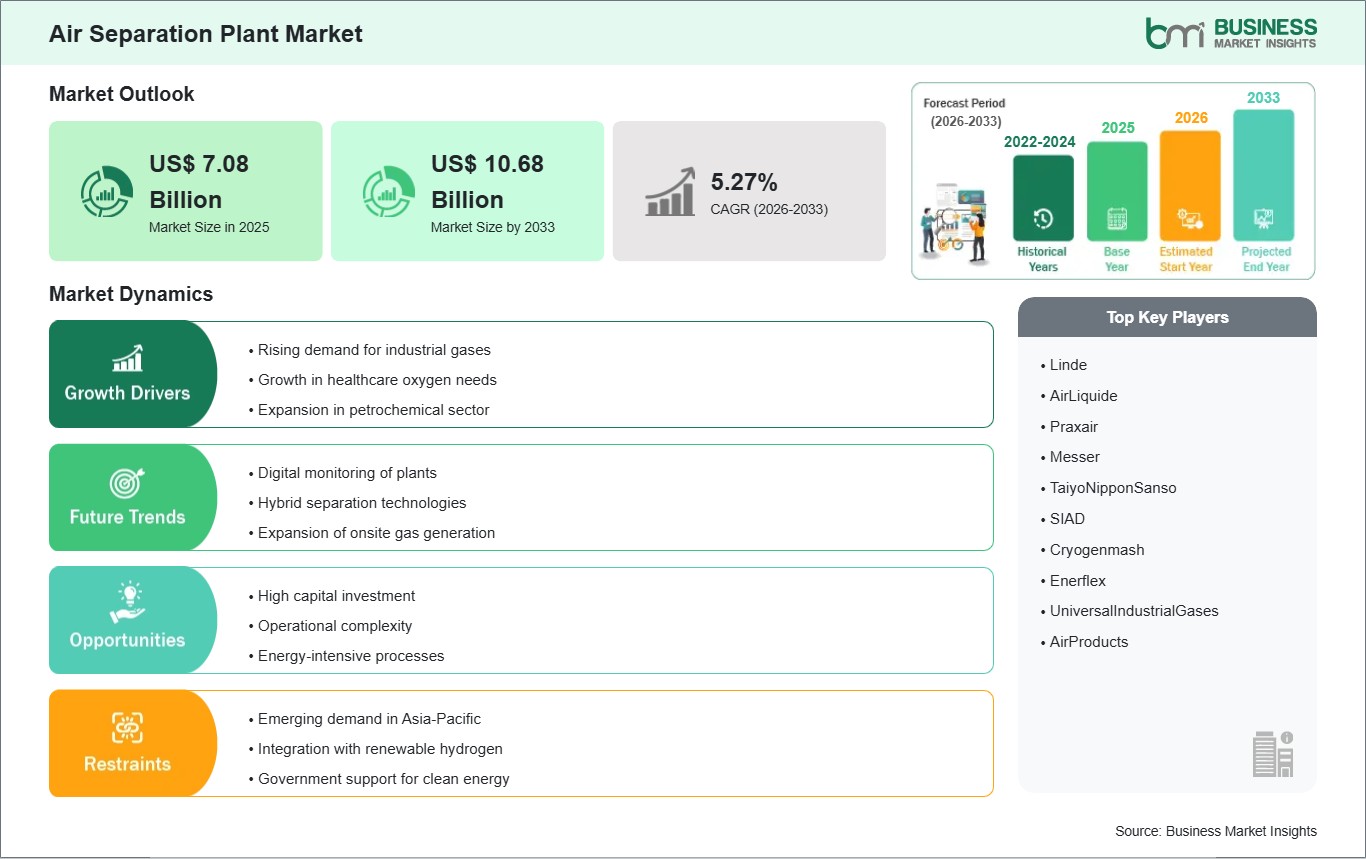
Air separation plants are industrial facilities designed to separate atmospheric air into primary gases such as oxygen, nitrogen, and argon through cryogenic and non-cryogenic technologies. These gases are widely used across metallurgy, healthcare, chemicals, oil and gas, and industrial manufacturing applications. The market is growing as industries continue to increase the use of industrial gases for production efficiency, process optimization, and environmental management. Rising steel production, expanding healthcare infrastructure, and growing demand for high-purity industrial gases are supporting market growth globally. Cryogenic air separation plants are widely adopted for large-scale gas production due to their efficiency and ability to produce multiple gases simultaneously, while non-cryogenic systems are gaining attention for smaller and decentralized industrial operations. Increasing investments in industrial automation and energy infrastructure are also contributing to the demand for advanced air separation technologies.
There are several challenges that could affect market growth during the forecast period. Air separation plants require high initial capital investment and involve complex installation and maintenance processes, which can limit adoption among small and medium-sized industries. Cryogenic systems also consume significant amounts of energy, increasing operational costs in regions with fluctuating electricity prices. In addition, maintaining operational safety and ensuring consistent gas purity levels require advanced technical expertise and continuous monitoring systems. Environmental regulations related to industrial emissions and energy efficiency standards may also increase compliance costs for plant operators and manufacturers.
Despite these challenges, the market is expected to grow steadily due to increasing industrialization and expanding use of industrial gases across multiple sectors. Opportunities are emerging from advancements in energy-efficient separation technologies, digital monitoring systems, and modular plant designs that improve operational flexibility and reduce maintenance requirements. The growing adoption of hydrogen production, carbon capture projects, and clean energy initiatives is also creating new growth opportunities for the Air Separation Plant market.
Segment Analysis
Air Separation Plant Market Segmentation
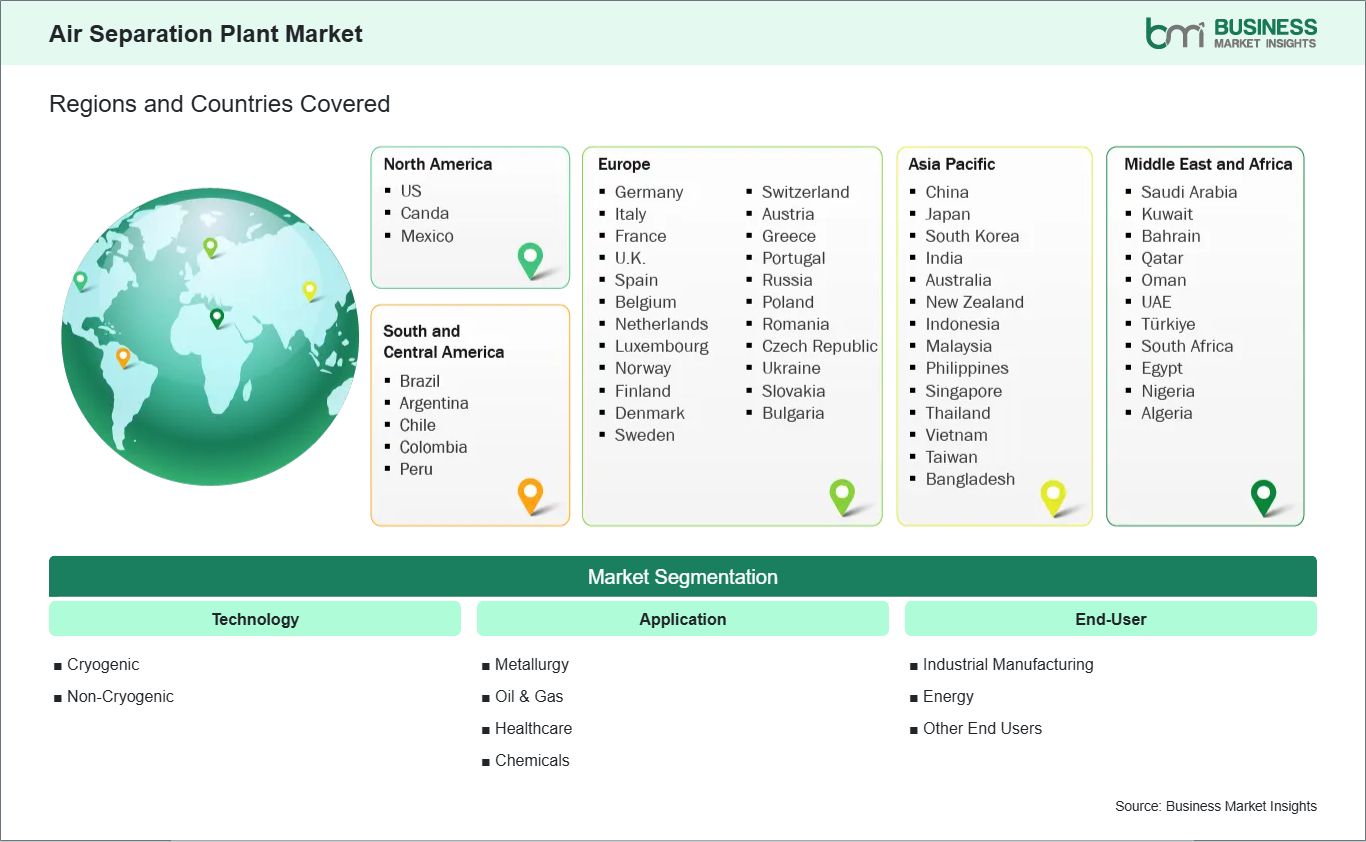
The Air Separation Plant market is segmented based on technology, application, and end-user. Different industries adopt air separation systems according to production capacity, gas purity requirements, and operational efficiency needs.
By Technology
- Cryogenic: Cryogenic air separation plants are widely used for large-scale production of oxygen, nitrogen, and argon with high purity levels and operational efficiency.
- Non-Cryogenic: Non-cryogenic systems are increasingly adopted for small and medium-scale industrial applications due to lower operational complexity and flexible deployment.
By Application
- Metallurgy: Metallurgical industries use industrial gases for steel production, welding, and metal processing operations.
- Oil & Gas: Oil and gas facilities deploy air separation systems for refining processes, enhanced recovery operations, and safety applications.
- Healthcare: Healthcare applications require high-purity oxygen and medical gases for hospitals, emergency care, and pharmaceutical operations.
- Chemicals: Chemical industries use industrial gases for production processes, storage operations, and process optimization activities.
By End-User
- Industrial Manufacturing: Industrial manufacturing facilities account for major demand due to extensive use of oxygen and nitrogen in production operations.
- Energy: Energy sector applications include gas processing, power generation, and clean energy projects.
- Other End Users: Other end users include food processing, electronics, and research facilities.
Market Forces
Air Separation Plant Market Drivers and Opportunities
Rising Demand for Industrial Gases Across Manufacturing and Healthcare
The increasing demand for industrial gases across manufacturing, healthcare, and energy industries is one of the major factors driving the growth of the Air Separation Plant market. Industrial gases such as oxygen, nitrogen, and argon are essential for a wide range of industrial operations including steel production, chemical processing, welding, refining, and healthcare applications. Expanding industrialization and infrastructure development activities are increasing the need for reliable and high-capacity gas production systems. Healthcare facilities are also increasing the use of medical oxygen and high-purity gases for critical care services, pharmaceutical manufacturing, and emergency healthcare infrastructure.
Industrial manufacturers are focusing on improving operational efficiency and reducing process downtime through continuous and on-site gas supply systems. This is encouraging investments in advanced cryogenic and non-cryogenic air separation technologies. Environmental regulations and industrial safety standards are also supporting the use of controlled and efficient gas production infrastructure. In addition, increasing investments in refinery modernization, metal processing facilities, and energy infrastructure projects are contributing significantly to the growing demand for air separation plants across both developed and emerging markets.
Expansion of Clean Energy and Modular Plant Technologies
The growing focus on clean energy projects and advanced modular plant technologies is creating significant opportunities for the Air Separation Plant market. Industrial sectors are increasingly adopting energy-efficient and compact air separation systems that offer flexible deployment, lower maintenance requirements, and reduced operational costs. Modular air separation plants are gaining popularity because they can be installed quickly and customized according to industrial gas demand and operational conditions.
The increasing development of hydrogen production projects and carbon capture initiatives is also supporting demand for high-purity oxygen and nitrogen systems. Air separation technologies are becoming an important part of clean energy infrastructure due to their role in gas processing and industrial emission management. In addition, digital monitoring systems and automation technologies are improving plant efficiency, operational safety, and predictive maintenance capabilities.
Size and Share Analysis
Air Separation Plant Market Size and Share Analysis
The Air Separation Plant Market is projected to grow from US$ 7.08 Billion in 2025 to US$ 10.68 Billion by 2033 , registering a CAGR of 5.27% from 2026 to 2033.
By technology, cryogenic air separation plants account for a significant share due to their ability to produce large volumes of high-purity industrial gases with operational efficiency. Non-cryogenic systems are gaining steady demand because of their suitability for smaller industrial facilities and decentralized gas production operations. The increasing adoption of modular and energy-efficient separation technologies is also contributing to market growth across industrial sectors.
By application, metallurgy dominates the market owing to the extensive use of oxygen and nitrogen in steel manufacturing, welding, and metal processing operations. Oil and gas applications continue to witness strong demand due to refinery modernization and gas processing activities, while healthcare applications are expanding steadily with rising demand for medical oxygen and healthcare infrastructure development.
By end-user, industrial manufacturing holds a major market share because of increasing industrialization and the continuous requirement for industrial gases across production facilities and processing operations.
Report Coverage
Air Separation Plant Market Report Coverage and Deliverables
The "Air Separation Plant Size and Forecast (2022-2033)" report provides a detailed analysis of the market covering below areas:
- Market size and forecast at global, regional, and country levels for all the key market segments covered under the scope
- Market trends, as well as market dynamics such as drivers, restraints, and key opportunities
- Market analysis covering key market trends, global and regional framework, major players, regulations, and recent market developments
- Industry landscape and competition analysis covering market concentration, heat map analysis, prominent players, and recent developments for the market
- Detailed company profiles, including SWOT analysis
Geographic Insights
Air Separation Plant Market Geographic Insights
The Air Separation Plant Market shows diverse regional adoption patterns influenced by industrial expansion, energy infrastructure development, and growing demand for industrial gases across manufacturing and healthcare sectors.
North America, being a developed region, has a well-established industrial infrastructure and a high adoption rate of advanced gas production technologies. The region comprises the United States and Canada, where industrial manufacturing, healthcare facilities, and energy operations require continuous supply of high-purity industrial gases. The region focuses on improving operational efficiency, industrial automation, and environmental compliance across manufacturing and refinery operations. It also benefits from advanced technological capabilities and established energy infrastructure, supporting the deployment of large-scale cryogenic air separation plants and automated gas production systems.
Asia Pacific is growing significantly, driven by rapid industrialization, infrastructure development, and expanding steel and chemical production activities. The region comprises countries such as China, India, Japan, and South Korea, where growing industrial manufacturing and healthcare investments are increasing the demand for oxygen, nitrogen, and argon production systems. The region focuses on strengthening industrial output and supporting energy modernization through advanced gas processing infrastructure. Rising investments in refinery expansion, clean energy projects, and healthcare facility development are also contributing to the growth of the Air Separation Plant Market across the region.
Both regions are contributing significantly to the growth of the Air Separation Plant Market, focusing on industrial modernization, healthcare infrastructure development, and adoption of efficient gas production technologies.
Industry Activity
Recent Developments
The Air Separation Plant Market is analyzed using a mix of primary and secondary research sources, including corporate publications, industry associations, and verified databases. This approach ensures accurate tracking of innovation trends and strategic developments influencing the market.
- In July 2025, Linde announced the commissioning of a new air separation plant to support industrial manufacturing and clean energy applications. The facility was designed with advanced automation and energy optimization technologies to improve production efficiency and reduce operational emissions. The development reflects growing investments in modern industrial gas infrastructure and sustainable manufacturing operations.
- In March 2024, Air Liquide announced the expansion of its industrial gas production infrastructure through the development of advanced air separation units designed to improve energy efficiency and operational reliability. The project supports growing industrial demand for oxygen and nitrogen across manufacturing and energy sectors. The development highlights the increasing focus on sustainable and high-capacity gas production technologies.
Trust & Transparency
Research Methodology
The market analysis combines proprietary research with secondary data from government agencies, company disclosures, regulatory filings, industry databases and expert interviews. Market estimates are validated through data triangulation, cross-market benchmarking and analyst
review.
View Full Research Methodology
Key Sources Referred:
World Bank - Global Trade Indicators World Trade Organization (WTO) International Monetary Fund (IMF) International Trade Administration (ITA) Company Websites Company Annual Reports Company Investor Presentations