
Compressed Air Treatment Equipment Market Outlook: Size, Share, Trends, Growth Analysis, Competitive Landscape & Forecast, 2026-2033

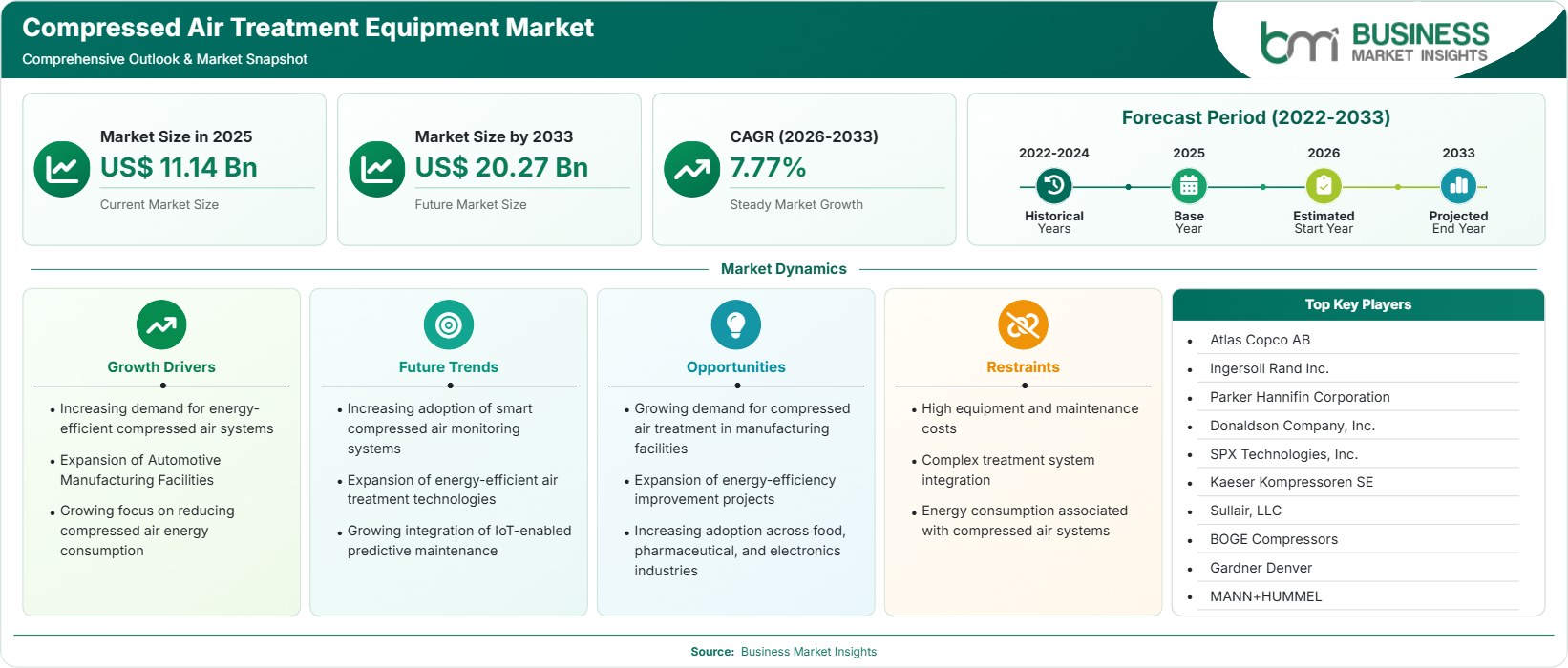
The Compressed Air Treatment Equipment Market size was valued at US$ 11.14 Billion in 2025 and is projected to reach US$ 20.27 Billion by 2033, growing at a CAGR of 7.77% during 2026–2033. Growth is driven by increasing demand for energy-efficient compressed air systems, expansion of automotive manufacturing facilities, and growing emphasis on reducing compressed air energy consumption. Rising industrial automation and stringent air quality requirements continue creating opportunities across manufacturing and process industries.

Report Coverage
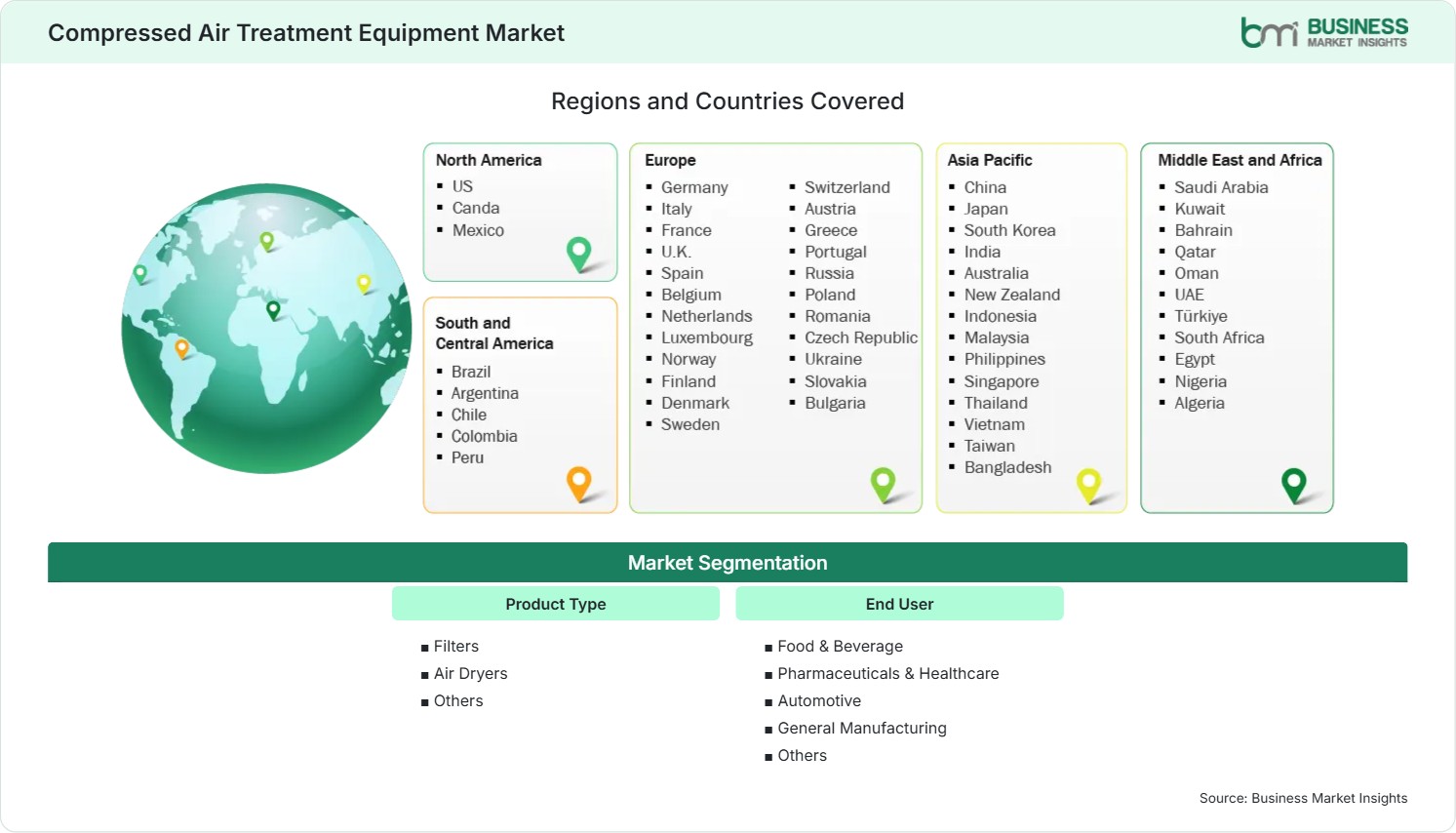
  • Product Type: Filters, Air Dryers, Others
  • End User: Food & Beverage, Pharmaceuticals & Healthcare, Automotive, General Manufacturing, Others
US$ 11.14 Bn Market size in 2025
US$ 20.27 Bn Market Size by 2033
7.77% CAGR, 2026 - 2033
2026-2033 Forecast Period

01 AI Overview

Compressed Air Treatment Equipment Market Summary

  • North America Region: North America holds a 34%–37% share in 2025 and is projected to expand at a 7.2%–7.8% CAGR during 2026–2033. Demand is supported by industrial modernization, energy-efficiency initiatives, increasing adoption of advanced filtration technologies, compressed air quality regulations, automation investments, manufacturing expansion, maintenance optimization programs, and growing demand for operational reliability across industrial facilities. The U.S. remains the leading regional market, supported by advanced manufacturing infrastructure and automation investments, growing at a 7.3%–7.9% CAGR.
  • Fastest Growing Region: Asia Pacific accounts for 28%–31% share in 2025 and is anticipated to register a 8.8%–9.4% CAGR through 2033. Rapid industrialization, manufacturing expansion, infrastructure investments, energy-efficiency projects, increasing compressed air adoption, and growing quality standards continue accelerating market demand.
  • Leading Segment: Filters represent 46%–50% share in 2025 and are expected to grow at a 7.9%–8.5% CAGR during 2026–2033. Rising demand for contamination-free compressed air, equipment protection, regulatory compliance, productivity enhancement, and operational reliability continues supporting segment leadership.
  • High Growth Segment: Food & Beverage accounts for 26%–30% share in 2025 and is forecast to advance at a 8.5%–9.1% CAGR through 2033. Stringent product quality standards, contamination control requirements, and increased processing capacity investments are driving adoption.
  • Key Market Opportunity: Expanding deployment of advanced treatment technologies across food processing, pharmaceutical production, electronics manufacturing, and energy-efficient industrial projects is generating strong opportunities for equipment suppliers.
  • Major Market Players: Atlas Copco AB, Ingersoll Rand Inc., Parker Hannifin Corporation, Donaldson Company, Inc., SPX Technologies, Inc., Kaeser Kompressoren SE, Sullair, LLC, BOGE Compressors, Gardner Denver, and MANN+HUMMEL.
02 Strategic Insights

Compressed Air Treatment Equipment Market: Strategic Insights

Compressed Air Treatment Equipment Market Strategic Framework
FREE PDF
Request your free sample
Request free sample
03 Stakeholder View

Key Takeaways

  • The market ecosystem is increasingly focused on integrating filtration, drying, monitoring, and energy-management technologies to improve compressed air quality while reducing operational costs across industrial facilities.
  • Food & beverage processing offers significant growth opportunities due to stringent contamination-control requirements and increasing regulatory emphasis on product safety and manufacturing quality standards.
  • Product innovation is shifting toward smart filtration systems, energy-efficient dryers, real-time monitoring solutions, and predictive maintenance capabilities that improve system reliability and operational efficiency.
  • Asia Pacific presents a compelling investment opportunity driven by rapid industrialization, manufacturing expansion, infrastructure projects, and increasing focus on compressed air quality management.
  • Manufacturers are expanding service portfolios and aftermarket offerings to address growing customer demand for maintenance optimization, lifecycle cost reduction, and operational performance improvements.
  • Sustainability initiatives are encouraging industrial operators to invest in advanced compressed air treatment solutions that reduce energy consumption and improve equipment efficiency.
04 Geographic Outlook

Compressed Air Treatment Equipment Market Regional Highlights

North America Compressed Air Treatment Equipment Market

North America accounted for approximately 34%–37% of the Compressed Air Treatment Equipment Market share in 2025 and is expected to grow at a 7.2%–7.8% CAGR through 2033. Strong industrial automation adoption, advanced manufacturing infrastructure, and rising demand for contamination-free compressed air continue supporting market growth. Industries across food processing, pharmaceuticals, automotive manufacturing, and electronics production increasingly invest in advanced treatment technologies to improve productivity and maintain regulatory compliance. Growing awareness regarding energy conservation and preventive maintenance further supports equipment adoption across industrial facilities.

  • Manufacturing facilities continue investing in advanced filtration and drying systems to improve product quality and operational efficiency.
  • Energy-efficiency initiatives are accelerating upgrades of legacy compressed air treatment equipment across industrial operations.
  • Pharmaceutical and healthcare industries remain major adopters due to strict compressed air purity requirements.
  • Predictive maintenance and smart monitoring technologies are increasingly integrated into treatment systems.

US Compressed Air Treatment Equipment Market

The United States accounts for approximately 76%–80% share within North America and is projected to expand at a 7.3%–7.9% CAGR during 2026–2033. Demand is supported by extensive industrial operations, modernization investments, and growing use of energy-efficient compressed air technologies. Increasing focus on reducing operating costs and ensuring system reliability continues driving investment in filtration and drying solutions. Strong manufacturing activity and stringent air quality requirements are expected to support long-term Compressed Air Treatment Equipment market growth.

  • Industrial operators increasingly prioritize compressed air quality to protect equipment and improve production efficiency.
  • Expansion of advanced manufacturing facilities continues supporting demand for treatment technologies.
  • Energy management programs are encouraging replacement of older compressed air systems.
  • Food and pharmaceutical production facilities remain key contributors to equipment demand.

Europe Compressed Air Treatment Equipment Market

Europe represented approximately 26%–29% share in 2025 and is forecast to grow at a 7.4%–8.0% CAGR through 2033. The market benefits from strong industrial standards, sustainability initiatives, and increasing investments in advanced manufacturing technologies. Germany remains the leading regional Compressed Air Treatment Equipment Market, while Eastern European countries continue expanding industrial production capabilities. Demand is supported by growing adoption of energy-efficient equipment and strict product quality standards across end-use sectors.

  • Germany leads regional demand through its extensive industrial manufacturing and engineering sectors.
  • Sustainability programs continue promoting investments in energy-efficient treatment equipment.
  • Food processing industries increasingly adopt advanced filtration systems to comply with quality requirements.
  • Industrial modernization initiatives support replacement demand across multiple sectors.

Asia Pacific Compressed Air Treatment Equipment Market

Asia Pacific accounted for approximately 28%–31% share in 2025 and is projected to register the highest growth at a 8.8%–9.4% CAGR through 2033. Rapid industrialization, manufacturing expansion, and infrastructure development are driving equipment demand. China remains the largest Compressed Air Treatment Equipment Market, while India is among the fastest-growing countries due to industrial investments and production capacity expansion. Increasing awareness of compressed air efficiency and quality management continues creating opportunities across the region.

  • China dominates regional demand due to extensive manufacturing and industrial processing activities.
  • India is witnessing increasing adoption as industrial and infrastructure projects expand.
  • Automotive and electronics industries continue investing in advanced compressed air treatment systems.
  • Industrial efficiency initiatives are accelerating deployment of energy-saving solutions.

Rest of World Compressed Air Treatment Equipment Market

The Rest of World region accounted for approximately 7%–9% share in 2025 and is expected to grow at a 7.5%–8.2% CAGR through 2033. Growth is supported by industrial diversification, energy-sector development, and increasing manufacturing investments across South and Central America, the Middle East, and Africa in Compressed Air Treatment Equipment Market. Demand for reliable compressed air systems in production and processing facilities continues encouraging adoption of advanced treatment equipment across emerging markets.

  • Brazil remains an important market supported by industrial and manufacturing investments.
  • Middle Eastern industrial projects continue driving demand for air treatment solutions.
  • Mining and processing operations are increasing demand for reliable compressed air quality systems.
  • Industrial development programs are creating opportunities for equipment suppliers.
Global Market Geography
FREE PDF
Request your free sample
Request free sample
05 Segment Analysis

Compressed Air Treatment Equipment Market Segmentation

Product Type

The product type segment is dominated by filters, accounting for approximately 46%–50% share in 2025 and expected to expand at a 7.9%–8.5% CAGR through 2033. Increasing demand for contaminant-free compressed air, protection of downstream equipment, and compliance with industrial quality standards continue supporting Compressed Air Treatment Equipment Market growth. Adoption is further driven by energy-efficiency initiatives and rising investments in advanced compressed air systems across manufacturing facilities.

  • Filters: The largest product category owing to growing requirements for particle removal, oil separation, moisture control, and protection of critical industrial equipment from contamination-related failures.
  • Air Dryers: Increasingly adopted to eliminate moisture from compressed air systems, improve operational reliability, reduce corrosion risks, and maintain product quality across industrial processes.

End User

The end-user segment is led by the food & beverage industry, accounting for approximately 26%–30% share in 2025 and projected to grow at a 8.5%–9.1% CAGR during 2026–2033. Stringent hygiene requirements, contamination prevention measures, and regulatory compliance standards continue driving investment in compressed air treatment solutions. Rising industrial automation and manufacturing activity further support equipment demand across diverse end-use sectors in Compressed Air Treatment Equipment Market forecasts.

  • Food & Beverage: Strong demand is driven by strict air purity requirements, contamination control standards, and growing investments in advanced food processing facilities.
  • Pharmaceuticals & Healthcare: Adoption continues increasing due to regulatory compliance requirements and the need for high-purity compressed air in production and healthcare operations.
  • Automotive: Growing vehicle production and expansion of manufacturing facilities support demand for reliable compressed air treatment systems across assembly and production lines.
  • General Manufacturing: Strong utilization is supported by widespread use of compressed air systems in production, packaging, processing, and equipment operation activities.
06 Market Forces

Compressed Air Treatment Equipment Market Dynamics

Key Market Drivers

Increasing Demand for Energy-Efficient Compressed Air Systems

Efficient compressed air systems are becoming more popular in the industry because companies realize they can save on operating costs and increase productivity. Treatment of compressed air equipment is very important for minimizing energy losses caused by water, contaminants, and pressure drops. With advanced filtration and drying technologies, it is possible to enhance equipment efficiency and extend its lifespan. Awareness of the energy requirements across the system's entire lifecycle has been driving growth in this market.

Expansion of Automotive Manufacturing Facilities

Increases in global automotive production and investments in vehicle manufacturing plants are driving demand for compressed air treatment systems. Modern car manufacturing plants utilize compressed air systems extensively in various operations including painting, assembling, welding, automation and materials handling. High-quality air is important for providing consistent products and efficient operations. Growing investment in manufacturing capacities and modernization efforts result in greater investments in advanced air treatment equipment. Shifts towards electric car manufacturing are also providing new opportunities for compressed air systems and treatment technologies.

Growing Focus on Reducing Compressed Air Energy Consumption

Energy consumption associated with compressed air systems remains a significant issue for industrial plants. Efficiency enhancement programs are becoming common practice among firms seeking to reduce energy consumption and waste. High-quality treatment machines play an important role in improving the efficiency of these air systems by delivering higher-quality air, minimizing pressure loss, and ensuring efficient system performance. The advantages of efficient compressed air systems are increasingly being recognized by companies due to the associated cost savings.

Key Market Opportunities

Growing Demand for Compressed Air Treatment in Manufacturing Facilities

Manufacturing facilities increasingly rely on clean and reliable compressed air to maintain production quality and operational efficiency. Growing automation levels, precision manufacturing processes, and quality assurance requirements are encouraging investment in advanced treatment solutions. Industries including electronics, packaging, chemicals, and industrial equipment manufacturing require improved air quality to prevent equipment malfunctions and product defects. As manufacturing output expands globally, demand for filtration, drying, and air purification technologies is expected to grow steadily. This trend creates significant opportunities for equipment suppliers focused on industrial productivity enhancement.

Expansion of Energy-Efficiency Improvement Projects

Energy-efficiency improvement initiatives are driving adoption of modern compressed air treatment systems that reduce waste and improve operational performance. Industrial organizations are increasingly evaluating entire compressed air networks to identify opportunities for energy optimization and cost reduction. Treatment equipment capable of reducing pressure drops, moisture issues, and contamination-related inefficiencies is becoming an integral part of these projects. Growing support for industrial sustainability programs and energy management initiatives continues creating long-term opportunities for technology providers delivering innovative air treatment solutions.

Increasing Adoption Across Food, Pharmaceutical, and Electronics Industries

Industries operating under strict quality and contamination-control requirements are increasingly investing in advanced compressed air treatment technologies. Food processing facilities, pharmaceutical manufacturers, and electronics producers demand highly purified compressed air to ensure product integrity and regulatory compliance. Growth in these sectors is resulting in higher installation rates of filtration and drying systems. Expanding production facilities and increasing quality standards continue supporting demand for specialized treatment equipment designed to meet industry-specific operational requirements.

Market Restraints and Challenges

High Equipment and Maintenance Costs

Factor: Advanced compressed air treatment systems require significant capital investment, specialized components, and ongoing maintenance activities to ensure optimal operation. Impact: High ownership costs can limit adoption, particularly among small and medium-sized enterprises operating with constrained budgets. Maintenance requirements, replacement parts, and service expenses may further increase lifecycle costs. These financial considerations can delay purchasing decisions and slow market penetration despite the long-term efficiency and reliability benefits provided by modern treatment equipment.

Complex Treatment System Integration

Factor: Integrating filtration, drying, monitoring, and air quality management technologies into existing compressed air infrastructure often involves technical complexity and operational planning. Impact: Installation challenges, compatibility concerns, and potential production disruptions can increase project timelines and implementation costs. Industrial operators may require specialized expertise to optimize system performance and ensure compliance with operational requirements. These factors can create challenges for widespread adoption, particularly in facilities utilizing legacy compressed air systems.

07 Company Analysis

Competitive Landscape

The competitive landscape is characterized by continuous investment in energy-efficient technologies, smart monitoring systems, advanced filtration solutions, and integrated compressed air management platforms. The Compressed Air Treatment Equipment Market analysis indicates that manufacturers are focusing on improving air purity, reducing lifecycle operating costs, and enhancing energy performance to strengthen their competitive positions across industrial applications.

Company Name

Overview

Products and Services relevant to this market

Atlas Copco AB

Global industrial technology company with extensive expertise in compressed air systems, treatment solutions, and industrial productivity technologies.

Compressed air filters, air dryers, condensate management systems, monitoring technologies, and energy-efficiency optimization solutions.

Ingersoll Rand Inc.

Leading provider of industrial air solutions serving manufacturing, processing, and infrastructure sectors worldwide.

Air treatment equipment, compressed air filtration systems, dryers, controls, and maintenance support services.

Parker Hannifin Corporation

Diversified engineering company with strong capabilities in filtration and industrial air quality solutions.

Compressed air filters, purification systems, separators, air preparation equipment, and industrial filtration technologies.

Donaldson Company, Inc.

Global filtration specialist delivering advanced contamination control and industrial air management products.

Air filtration systems, compressed air purification solutions, replacement filter elements, and industrial contamination control products.

SPX Technologies, Inc.

Industrial equipment manufacturer offering engineered solutions focused on reliability and operational performance.

Air dryers, filtration systems, moisture removal equipment, and industrial compressed air treatment technologies.

Kaeser Kompressoren SE

Major compressed air systems provider recognized for energy-efficient air management and treatment solutions.

Refrigerated dryers, desiccant dryers, filtration systems, condensate treatment products, and compressed air management technologies.

Sullair, LLC

Industrial air solutions company supporting diverse manufacturing and processing industries worldwide.

Air treatment systems, dryers, filtration equipment, compressed air accessories, and maintenance services.

BOGE Compressors

Compressor and air treatment specialist serving industrial applications requiring dependable air quality solutions.

Compressed air dryers, filters, monitoring systems, and air quality management technologies.

Gardner Denver

Industrial equipment provider with a broad portfolio of compressed air and process technology solutions.

Air treatment equipment, filtration solutions, dryers, compressed air systems, and operational efficiency services.

MANN+HUMMEL

Global filtration technology leader focused on industrial, environmental, and process filtration applications.

Industrial filtration products, compressed air filters, purification systems, and contamination control technologies.


10 Trust & Transparency

Research Methodology

The market analysis combines proprietary research with secondary data from government agencies, company disclosures, regulatory filings, industry databases and expert interviews. Market estimates are validated through data triangulation, cross-market benchmarking and analyst review.

View Full Research Methodology

11 Questions Answered

Frequently Asked Questions

What factors influence compressed air treatment equipment market selection?

Selection depends on required air quality levels, operating environment, industry regulations, energy-efficiency objectives, maintenance requirements, and overall system performance expectations.

Which region is expected to grow the fastest in Compressed Air Treatment Equipment Market report?

Asia Pacific is anticipated to record the fastest growth owing to rapid industrialization, manufacturing expansion, infrastructure development, and increasing adoption of energy-efficient industrial technologies.

Which end-user industry generates the highest demand?

Food & beverage represents one of the largest demand segments due to stringent air quality requirements, contamination prevention standards, and regulatory compliance obligations.

Why are air dryers important in compressed air systems?

Air dryers remove moisture that can cause corrosion, equipment damage, reduced operational efficiency, and product contamination, helping maintain system reliability and performance.

What is compressed air treatment equipment?

Compressed air treatment equipment includes filters, dryers, separators, and related systems designed to remove contaminants, moisture, oil, and particles from compressed air to ensure reliable and efficient operation.

Access the Full Compressed Air Treatment Equipment Market Report

Get segment-level forecasts, regional estimates, competitive benchmarking, company profiles and downloadable Excel datasets.

Access the full Compressed Air Treatment Equipment Market Report
350 pages PDF & Excel | 2026-08-20