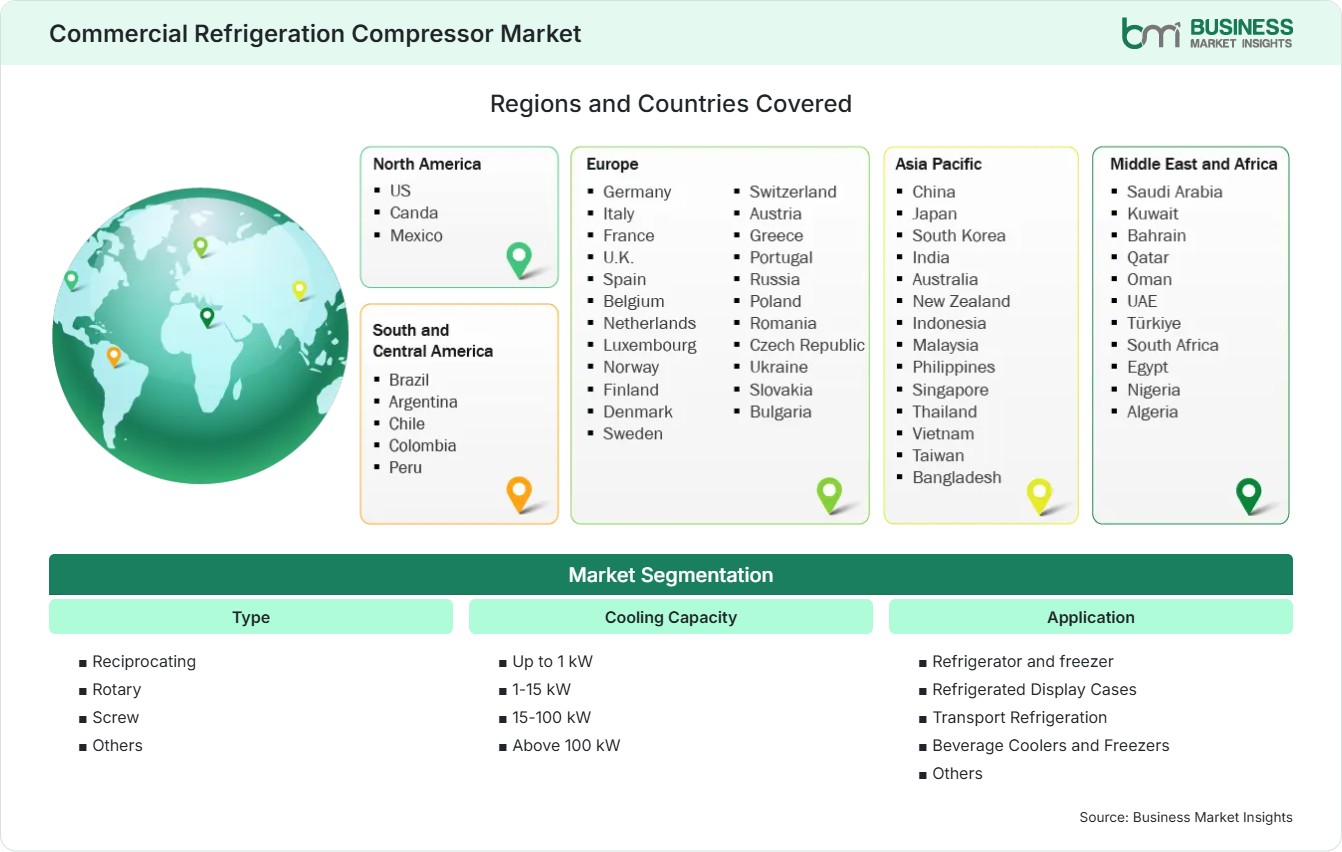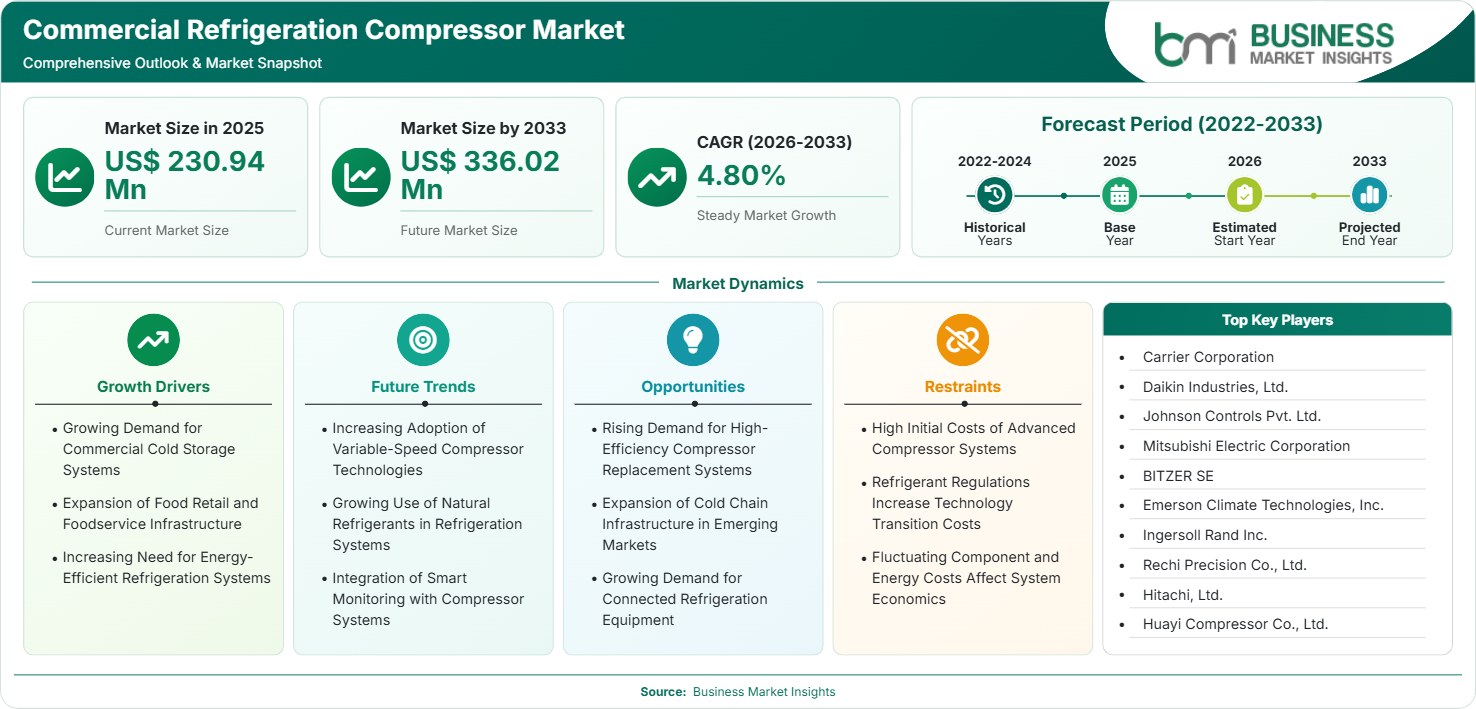
Commercial Refrigeration Compressor Market Regional Highlights
North America Commercial Refrigeration Compressor Market
North America represented a 25%–29% share in 2025 and is projected to expand at a 4.3%–5.0% CAGR during 2026–2033. Demand is supported by supermarket modernization, refrigerated warehouses, foodservice, beverage distribution, pharmaceutical logistics, and replacement of aging equipment. Established infrastructure creates recurring aftermarket demand. Regulatory attention toward refrigerants and energy performance is also encouraging equipment upgrades. The Commercial Refrigeration Compressor Market share reflects a mature environment in which replacement, efficiency, and compliance increasingly influence purchasing decisions.
- Supermarkets are advancing their refrigeration systems to cut back on their power usage while still maintaining consistent temperatures throughout their chilled and frozen items.
- Cold storage businesses are beginning to consider efficient compressors, system redundancies, and service more and more often since refrigeration is an essential part of their operations.
- Natural refrigerants are becoming a factor when choosing equipment, especially for larger refrigeration systems for retailers and manufacturers.
- The need for replacement is key due to old compressors leading to increased electricity usage and maintenance issues.
US Commercial Refrigeration Compressor Market
The US represented approximately a 22%–25% global share in 2025 and is projected to grow at a 4.2%–4.9% CAGR during 2026–2033. Demand is supported by supermarkets, restaurants, food processing, refrigerated warehouses, beverage distribution, and pharmaceutical logistics. Operators increasingly evaluate equipment based on lifecycle cost, energy efficiency, refrigerant compliance, and serviceability. The US regulatory environment is also influencing technology choices as refrigeration manufacturers and customers transition toward lower-GWP solutions and more efficient equipment.
- Grocery retailing companies are focusing on effective refrigeration since factors such as power cost, compliance, maintenance, and product loss have financial implications.
- Logistics warehouses that need to store temperature sensitive products including foods, beverages, medicines and others require reliable compressors.
- This presents an opportunity for retrofit projects in the sense that refrigeration elements can be updated without rebuilding the entire facility.
Europe Commercial Refrigeration Compressor Market
Europe represented a 27%–31% commercial refrigeration compressor market share in 2025, expanding at a 4.5%–5.2% CAGR during 2026–2033. Germany, France, Italy, the UK, and Nordic economies provide important opportunities because of advanced food retail, cold-chain infrastructure, engineering capabilities, and sustainability requirements. European refrigerant regulation is accelerating the transition away from higher-GWP technologies, supporting demand for compatible compressor platforms. UNEP identifies refrigerant transition and energy efficiency as interconnected priorities for refrigeration-system modernization.
- Germany is still seen as a huge opportunity owing to industrial refrigeration, food retailing, engineering skills, and efficient machinery.
- The demand in France and UK stems from their supermarket modernization efforts, cold chain investments, food service refrigeration and the requirement to replace old machinery.
- Refrigeration systems in the Nordic countries are focused on energy efficiency and environmental friendly refrigerants leading to efficient compressors and controls.
- There is demand in Italy in food processing, hospitality refrigeration, retail refrigeration, beverages and temperature controlled logistics.
Asia Pacific Commercial Refrigeration Compressor Market
Asia Pacific represented a 34%–38% share in 2025 and is projected to achieve the fastest 5.2%–6.0% CAGR during 2026–2033. China, India, Japan, South Korea, Australia, and Southeast Asia offer diverse growth opportunities. Urbanization, organized retail, food processing, pharmaceuticals, restaurants, e-commerce, and cold storage are increasing refrigeration requirements. Expansion of temperature-controlled supply chains is particularly important because developing markets continue building infrastructure for food quality, distribution efficiency, and product preservation.
- China provides demand through food processing, supermarkets, beverage production, cold storage, and large-scale temperature-controlled logistics.
- India offers opportunities from modern grocery retail, dairy, pharmaceuticals, food processing, restaurants, and cold-chain infrastructure.
- Japan and South Korea represent mature commercial refrigeration compressor market emphasizing compactness, efficiency, reliability, advanced controls, and refrigerant transition.
- Southeast Asia is developing commercial refrigeration capacity alongside urbanization, foodservice expansion, modern retail, and temperature-sensitive logistics.
Rest of World Commercial Refrigeration Compressor Market
Rest of World represented approximately a 7%–10% share in 2025, growing at a 4.0%–4.8% CAGR during 2026–2033. Latin American demand is supported by supermarkets, food processing, beverage manufacturing, agricultural exports, restaurants, and refrigerated logistics. Brazil and Mexico are particularly relevant because of their large food sectors and developing modern retail networks. Replacement demand also benefits from efforts to improve energy efficiency and refrigerant management.
The Middle East and Africa provide opportunities on a long-term basis through hospitality, food imports, supermarket developments, pharmaceuticals logistics, and temperature-sensitive logistics. The Gulf countries have greater potential to invest in infrastructure, whereas some African countries are increasing their cold-chain logistics. Service provision, equipment efficiency, energy efficiency, and skills of technicians are key factors in purchases.
- Brazil provides opportunities across food retail, food processing, beverages, agricultural logistics, cold storage, and temperature-controlled distribution.
- Mexico benefits from modern retail, food manufacturing, beverage production, and integrated supply chains serving domestic and international markets.
- Gulf economies are investing in supermarkets, hospitality, food logistics, pharmaceutical distribution, and modern temperature-controlled infrastructure.
- Selected African economies provide longer-term opportunities as cold-chain infrastructure, food distribution, healthcare logistics, and modern retail expand.