
Commercial Greenhouse Market Outlook: Size, Share, Trends, Growth Analysis, Competitive Landscape & Forecast, 2026-2033
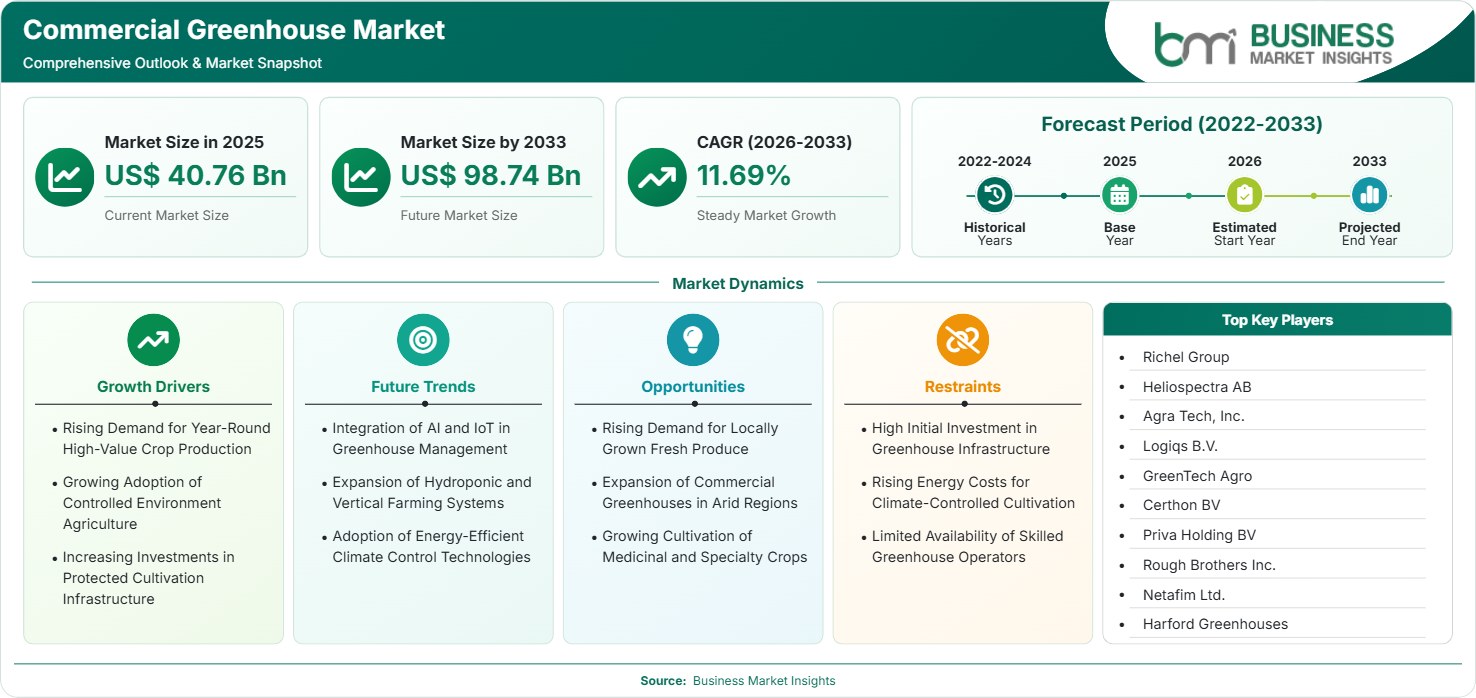
The Commercial Greenhouse Market size was valued at US$ 40.76 Billion in 2025 and is projected to reach US$ 98.74 Billion by 2033, growing at a CAGR of 11.69% during 2026–2033. The rising acceptance of controlled environment agriculture, rising demand for year-round crop production, rising concern over food security, and advancements in greenhouse technology are driving the growth in the market. There is potential arising from precision agriculture, automation systems, and sustainable agriculture.
Report Coverage
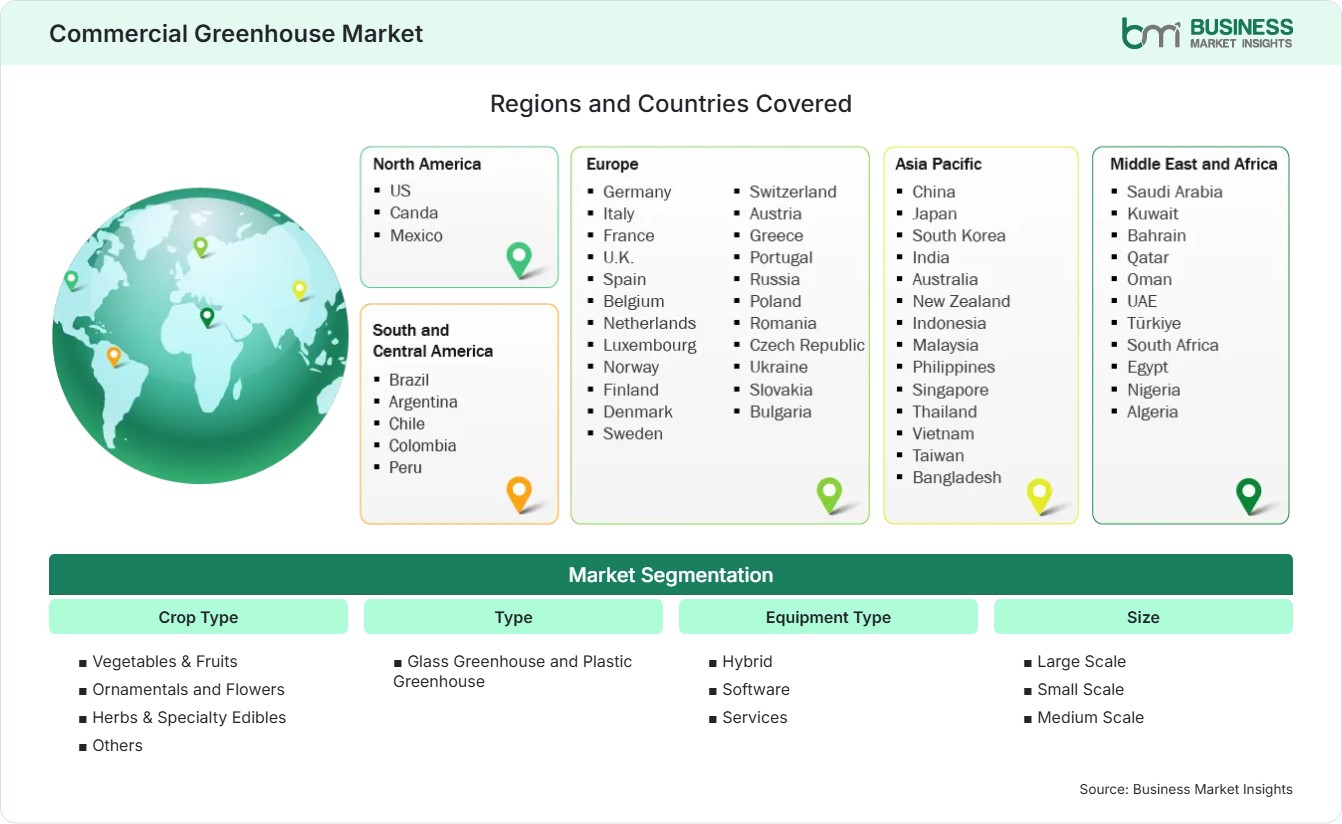
- Crop Type: Vegetables & Fruits, Ornamentals and Flowers, Herbs & Specialty Edibles, Others
- Type: Glass Greenhouse, Plastic Greenhouse
- Equipment Type: Hybrid, Software, Services
- Size: Large Scale, Small Scale, Medium Scale
- End-Use: Commercial Growers, Research Institutes, Nurseries & Garden Centers
US$ 40.76 Bn
Market size in 2025
US$ 98.74 Bn
Market Size by 2033
11.69%
CAGR, 2026 - 2033
2026-2033
Forecast Period
AI Overview
Commercial Greenhouse Market Summary
- North America Region: North America holds a commercial greenhouse market share of 21%–24% in 2025 and is projected to grow at a CAGR of 10.8%–11.8% during 2026–2033. Increasing adoption of high-tech farming practices, labor optimization solutions, and demand for locally grown produce continue supporting regional growth. The US market is projected to grow at a CAGR of 11.0%–12.0% through 2033.
- Fastest Growing Region: Asia Pacific accounts for 32%–35% share in 2025 and is expected to grow at a CAGR of 12.5%–13.5% during the forecast period. Rapid population growth, food demand expansion, and government support for protected cultivation are driving regional growth.
- Leading Segment: Vegetables & Fruits represent 52%–55% share in 2025 and are projected to grow at a CAGR of 11.8%–12.8% through 2033. Rising demand for fresh produce and increasing adoption of greenhouse-grown vegetables continue supporting segment leadership.
- High Growth Segment: Glass Greenhouses hold 42%–45% share in 2025 and are projected to grow at a CAGR of 12.8%–13.8% during 2026–2033 due to superior light transmission, durability, and suitability for high-tech cultivation.
- Key Market Opportunity: Growing deployment of automated climate control systems, smart irrigation technologies, and precision farming solutions is creating significant opportunities across the commercial greenhouse market.
- Major Market Players: Richel Group, Heliospectra AB, Agra Tech, Inc., Logiqs B.V., GreenTech Agro, Certhon BV, Priva Holding BV, Rough Brothers Inc., Netafim Ltd., and Harford Greenhouses.
Strategic Insights
Commercial Greenhouse Market: Strategic Insights
Stakeholder View
Key Takeaways
- Vegetables and fruits remain the largest crop category due to strong consumer demand for fresh produce, higher crop yields, and the ability to support year-round cultivation under controlled environmental conditions.
- Commercial growers continue to account for the majority of greenhouse investments, driven by the need to improve productivity, optimize resource utilization, and ensure consistent crop quality across large-scale agricultural operations.
- Asia Pacific maintains market leadership owing to rapid adoption of protected cultivation practices, expanding commercial farming activities, supportive government initiatives, and increasing investments in modern agricultural infrastructure.
- A key commercial greenhouse market trend is the growing adoption of smart greenhouse technologies, including IoT-enabled sensors, AI-based climate control, automated irrigation, and precision agriculture solutions that enhance operational efficiency and reduce production costs.
- Glass greenhouse installations continue expanding across technologically advanced agricultural regions because of their durability, superior light transmission, and suitability for high-value crop cultivation.
- Water conservation and resource optimization remain strategic priorities, encouraging the adoption of efficient irrigation systems, hydroponics, climate control technologies, and data-driven farm management platforms to maximize productivity.
- The commercial greenhouse market forecast suggest that the growing concerns regarding food security and sustainable agriculture are accelerating investments in controlled-environment farming, creating new opportunities for commercial greenhouse industry worldwide.
Commercial Greenhouse Market Segmentation
Crop Type
Crop selection plays a critical role in greenhouse profitability, resource utilization, and production planning. Vegetables & Fruits accounted for 52%–55% share in 2025 and are projected to grow at a CAGR of 11.8%–12.8% through 2033 due to rising consumer demand for fresh produce, year-round cultivation, and increasing adoption of protected farming methods.
- Vegetables & Fruits: This segment dominates the industry due to strong demand for fresh, high-quality produce such as tomatoes, cucumbers, peppers, strawberries, lettuce, and leafy greens. Controlled cultivation enables year-round production, higher yields, and consistent quality.
- Ornamentals & Flowers: Commercial floriculture continues driving demand for greenhouse cultivation by supporting year-round production of flowers and ornamental plants for domestic and export markets.
- Herbs & Specialty Edibles: Rising consumer preference for premium herbs, microgreens, and specialty crops is accelerating greenhouse adoption.
- Others: This category includes nursery plants, seedlings, exotic crops, medicinal plants, and other emerging greenhouse-grown agricultural products supporting commercial greenhouse commercial greenhouse market diversification.
Type
Greenhouse type selection depends on climate conditions, crop requirements, investment capacity, and operational objectives. Plastic Greenhouse accounted for 55%–58% share in 2025 and is projected to grow at a CAGR of 10.8%–11.8% through 2033 due to affordability, installation flexibility, and widespread adoption across developing agricultural regions.
- Glass Greenhouse: The fastest-growing segment, accounting for 42%–45% of the commercial greenhouse market share in 2025, is projected to register a CAGR of 12.8%–13.8% through 2033. Growth is driven by superior durability, excellent light transmission, longer operational lifespan, and compatibility with advanced automation, climate control, and precision farming technologies.
- Plastic Greenhouse: The leading segment due to its lower installation costs, lightweight structure, easier maintenance, and flexibility. It is widely adopted for commercial cultivation across diverse crops, offering a cost-effective solution for growers seeking improved productivity and year-round agricultural production.
Equipment Type
Equipment investments are increasing as growers seek to improve crop quality, operational efficiency, and resource optimization. Hardware/Hybrid Systems accounted for 48%–51% share in 2025 and are projected to grow at a CAGR of 11.5%–12.5% through 2033.
- Hybrid: The dominant segment, driven by the widespread deployment of integrated greenhouse solutions combining climate control systems, LED grow lighting, precision irrigation, environmental sensors, automation, and monitoring technologies to improve productivity and operational efficiency.
- Software: A rapidly growing segment as greenhouse operators increasingly adopt farm management platforms, analytics tools, remote monitoring systems, AI-based crop management, and predictive farming solutions to optimize cultivation and resource utilization.
- Services: Demand continues to rise for installation, maintenance, consulting, automation integration, system upgrades, and technical support services, ensuring efficient greenhouse operations and maximizing long-term equipment performance.
Size
Greenhouse size influences investment requirements, production capacity, technology adoption, and operational management practices. Large Scale facilities accounted for 46%–49% share in 2025 and are projected to grow at a CAGR of 12.0%–13.0% through 2033 due to increasing commercialization of greenhouse farming operations.
- Large Scale: The leading segment as commercial operators expand production facilities to meet growing demand for greenhouse-grown crops.
- Small Scale: Maintains stable demand among independent farmers and specialty crop producers serving local markets.
- Medium Scale: Continues growing steadily as growers transition from traditional farming methods toward protected cultivation models.
End-Use
End-user demand is shaped by agricultural commercialization, research activities, and the increasing adoption of advanced cultivation technologies. Commercial Growers accounted for 63%–66% share in 2025 and are projected to grow at a CAGR of 11.9%–12.9% through 2033.
- Commercial Growers: The dominant segment driven by increasing investments in high-yield production systems, year-round cultivation, and premium crop production.
- Research Institutes: Demand is supported by agricultural innovation programs, crop development projects, and controlled-environment research activities.
- Nurseries & Garden Centers: Continue utilizing greenhouse systems for plant propagation, seedling production, ornamental cultivation, and retail horticulture operations.
Commercial Greenhouse Market Dynamics
Key Market Drivers
Rising Demand for Year-Round High-Value Crop Production
Growing consumer demand for fresh fruits, vegetables, flowers, herbs, and specialty crops throughout the year is encouraging agricultural producers to adopt commercial greenhouse cultivation systems. Controlled production environments enable growers to overcome seasonal limitations by maintaining optimal temperature, humidity, lighting, and irrigation conditions, ensuring consistent product quality and uninterrupted supply. Greenhouse cultivation also supports the production of premium and high-value crops that deliver higher profitability than conventional open-field farming. Rising urbanization, changing dietary preferences, and increasing demand from supermarkets, food service providers, and export markets are further boosting greenhouse adoption. The ability to minimize crop losses while improving productivity and quality continues driving investments in commercial greenhouse market.
Growing Adoption of Controlled Environment Agriculture
Controlled Environment Agriculture (CEA) is increasingly being used as a critical part of contemporary agriculture, as farmers try to improve their efficiency by reducing reliance on unstable climatic conditions. Modern greenhouse technologies that include climate control, irrigation, LED lighting, fertigation, environmental sensors, and live monitoring ensure that crops are optimized for their entire growing cycle. Modern innovations make it possible to achieve high yields, improve crop quality, conserve water and fertilizers, and minimize risks. The need to focus on sustainability in food production, as well as effective use of resources and reduced negative impact on the environment, is rapidly promoting CEA in both developed and developing countries.
Increasing Investments in Protected Cultivation Infrastructure
Governments, agricultural enterprises, cooperatives, and private investors are significantly increasing investments in protected cultivation infrastructure to strengthen food security, improve agricultural productivity, and enhance supply chain resilience. Greenhouse systems help reduce production risks associated with extreme weather events, climate variability, pests, and diseases while enabling year-round crop cultivation. Investments are expanding across advanced greenhouse structures, automated irrigation systems, climate control equipment, hydroponic technologies, renewable energy integration, and precision farming solutions. Supportive government initiatives, financial incentives, and modernization programs are encouraging wider adoption of protected cultivation practices. As global food demand continues to grow alongside concerns about climate change and resource scarcity, investment in greenhouse infrastructure is expected to remain a major driver of commercial greenhouse market.
Key Market Opportunities
Rising Demand for Locally Grown Fresh Produce
Consumers are increasingly preferring locally grown fruits, vegetables, herbs, and other fresh produce due to their perceived freshness, superior quality, and lower environmental impact associated with reduced transportation distances. Greenhouse cultivation enables year-round production close to urban and metropolitan markets, allowing growers to supply fresh products regardless of seasonal weather conditions. This localized production model helps shorten supply chains, reduce post-harvest losses, and improve product availability. Retailers, supermarkets, and food service providers are also emphasizing local sourcing strategies to enhance supply chain resilience and meet consumer preferences for sustainably produced food. These factors are creating attractive growth opportunities for commercial greenhouse operators located near major consumption centers.
Expansion of Commercial Greenhouses in Arid Regions
Water scarcity, declining arable land availability, and increasing climate variability are driving the expansion of commercial greenhouse farming across arid and semi-arid regions. Greenhouse cultivation uses advanced irrigation systems, climate control technologies, and water recycling methods to maximize resource efficiency while maintaining high crop yields. These controlled environments enable cultivation in areas where conventional farming is difficult due to extreme temperatures and limited rainfall. Countries seeking to reduce dependence on food imports are investing in greenhouse infrastructure to strengthen domestic agricultural production and food security. Continuous advancements in cooling systems, precision irrigation, renewable energy integration, and resource management technologies are further improving the economic viability of greenhouse farming in challenging climatic conditions.
Growing Cultivation of Medicinal and Specialty Crops
Increasing demand for medicinal plants, specialty herbs, premium vegetables, exotic fruits, and high-value horticultural products is creating new growth opportunities for commercial greenhouse market. Controlled growing environments allow producers to maintain optimal temperature, humidity, lighting, and nutrient conditions required for consistent production of specialty crops with superior quality standards. Pharmaceutical, nutraceutical, cosmetic, and specialty food industries are increasingly sourcing greenhouse-grown ingredients to ensure reliable supply and product consistency. Additionally, rising consumer interest in organic, functional, and health-focused products is encouraging growers to diversify beyond conventional crops. This trend is supporting investments in advanced greenhouse technologies and expanding the commercial cultivation of high-value specialty agricultural products.
Market Restraints and Challenges
High Initial Investment in Greenhouse Infrastructure
Factor: Establishing a commercial greenhouse operation requires substantial capital investment in greenhouse structures, climate control systems, irrigation equipment, LED grow lighting, automation platforms, hydroponic systems, and monitoring technologies. Additional costs associated with land preparation, installation, maintenance, and skilled labor further increase the financial burden, particularly for large-scale commercial facilities.
Impact: High upfront investment requirements can discourage adoption among small and medium-sized growers and create challenges in obtaining project financing. Although greenhouse cultivation offers long-term gains through improved productivity, higher crop quality, and year-round production, extended payback periods may delay investment decisions. Consequently, operators increasingly seek government incentives, financing programs, and cost-efficient technologies to improve project viability and support sustainable business growth.
Rising Energy Costs for Climate-Controlled Cultivation
Factor: Commercial greenhouse facilities rely heavily on energy-intensive systems for heating, cooling, ventilation, supplemental lighting, irrigation, and automated climate management to maintain optimal growing conditions throughout the year. Energy demand can increase significantly during extreme weather conditions, making operational efficiency a critical consideration for greenhouse operators.
Impact: Rising electricity and fuel prices can substantially increase operating costs and reduce overall profitability, particularly in regions with high energy tariffs. To remain competitive, greenhouse operators are investing in energy-efficient equipment, LED lighting, renewable energy sources, thermal storage systems, and advanced climate management technologies. These measures help reduce energy consumption, improve resource efficiency, minimize operational risks, and strengthen the long-term sustainability of commercial greenhouse operations.
Competitive Landscape
The commercial greenhouse market analysis is characterized by strong competition among greenhouse infrastructure providers, climate control technology developers, irrigation equipment manufacturers, greenhouse automation specialists, and agricultural technology companies. Market participants are continuously investing in research and development to introduce innovative solutions that improve crop productivity, resource efficiency, and operational performance. Key areas of focus include smart greenhouse technologies, precision irrigation systems, automated climate management, energy-efficient cultivation methods, LED grow lighting, and integrated farm management platforms. Companies are also strengthening their competitive positions through strategic partnerships, acquisitions, product portfolio expansion, and geographic diversification. Increasing investments in digital agriculture, artificial intelligence, IoT-enabled monitoring systems, and sustainable cultivation solutions are expected to intensify competition while supporting long-term industry growth and technological advancement.
| Company Name | Overview | Products and Services Relevant to this Market |
|---|---|---|
| Richel Group | Global greenhouse design and construction company. | Commercial greenhouses, horticultural infrastructure, plastic and glass greenhouse solutions. |
| Heliospectra AB | Agricultural technology company specializing in controlled cultivation solutions. | LED grow lighting, intelligent cultivation systems, and greenhouse lighting technologies. |
| Agra Tech, Inc. | Manufacturer of greenhouse structures and cultivation systems. | Commercial greenhouse structures, climate systems, and turnkey greenhouse solutions. |
| Logiqs B.V. | Greenhouse automation and logistics solutions provider. | Automated cultivation systems, greenhouse logistics, and production management technologies. |
| GreenTech Agro | Supplier of greenhouse cultivation technologies and agricultural infrastructure. | Protected cultivation systems, irrigation technologies, and greenhouse equipment. |
| Certhon BV | Developer of high-tech greenhouse systems. | Greenhouse engineering, automation solutions, climate control systems, and horticultural technologies. |
| Priva Holding BV | Leading provider of climate and process automation solutions. | Climate control platforms, greenhouse software, water management systems, and automation technologies. |
| Rough Brothers Inc. | Greenhouse construction and engineering company. | Commercial greenhouses, research greenhouses, and customized cultivation facilities. |
| Netafim Ltd. | Global irrigation and precision agriculture company. | Drip irrigation solutions, fertigation systems, greenhouse irrigation technologies, and water management solutions. |
| Harford Greenhouses | Greenhouse manufacturer serving commercial cultivation operations. | Greenhouse structures, growing systems, and agricultural infrastructure solutions. |
Research Methodology
The market analysis combines proprietary research with secondary data from government agencies, company disclosures, regulatory filings, industry databases and expert interviews. Market estimates are validated through data triangulation, cross-market benchmarking and analyst review.
View Full Research MethodologyFrequently Asked Questions
What opportunities exist for greenhouse operators and technology providers?
Major opportunities include locally grown produce production, greenhouse expansion in water-scarce regions, specialty crop cultivation, automation technologies, smart farming solutions, and sustainable agriculture initiatives.
Why does Asia Pacific lead commercial greenhouse market growth?
Asia Pacific leads due to rapid population growth, increasing food demand, government support for protected cultivation, agricultural modernization initiatives, and rising adoption of advanced greenhouse technologies.
Which greenhouse type is growing the fastest?
Glass Greenhouses are the fastest-growing segment because of excellent light transmission, longer operational lifespan, compatibility with automation technologies, and suitability for intensive commercial farming.
Which crop type segment dominates the market?
Vegetables & Fruits dominate the market due to strong consumer demand for fresh produce, increasing adoption of greenhouse-based cultivation, and the need for consistent year-round production.
What is driving growth in the commercial greenhouse market report?
Growth is driven by increasing demand for year-round crop production, rising adoption of controlled-environment agriculture, growing food security concerns, and expanding investments in protected cultivation infrastructure.
Access the Full Commercial Greenhouse Market Report
Get segment-level forecasts, regional estimates, competitive benchmarking, company profiles and downloadable Excel datasets.