Market Summary
Executive Summary and Global Market Analysis
Commercial refrigeration equipment includes temperature-controlled systems designed for food preservation, beverage storage, cold-chain transportation, and retail cooling applications across hospitality, retail, and foodservice environments. These systems support product quality maintenance, inventory management, and regulatory compliance within commercial food distribution networks. Expanding urban food consumption and organized retail infrastructure continue strengthening equipment deployment across global markets. Foodservice operators and retail chains are increasingly modernizing refrigeration infrastructure to improve energy efficiency, storage reliability, and temperature consistency.
Rising consumption of packaged meals, frozen foods, and ready-to-eat products has intensified the need for advanced cooling systems across supermarkets, restaurants, and hospitality establishments. Cold-chain expansion within food logistics operations is also accelerating procurement of transportation refrigeration equipment and walk-in cooling systems. Display cases maintain significant utilization within retail environments due to their role in product visibility and temperature-controlled merchandising. Hydrocarbon-based refrigerants are gaining stronger commercial preference as industries transition toward environmentally sustainable cooling solutions.
Restaurants and supermarkets continue representing key application areas because of continuous demand for large-scale food storage and preservation systems. Technological advancements within the industry are centered on energy-efficient compressors, smart monitoring systems, automated temperature management, and low-emission refrigerants. Manufacturers are integrating IoT-enabled diagnostics and intelligent control systems to improve operational reliability and reduce maintenance requirements. Sustainability-focused product development is further reshaping refrigeration equipment design across commercial facilities.
The competitive environment is characterized by product innovation, refrigerant transition strategies, and expansion of energy-efficient equipment portfolios. Market participants are concentrating on environmentally compliant cooling technologies, modular refrigeration systems, and digitally connected monitoring platforms. Strategic investments in sustainable refrigeration infrastructure continue influencing long-term industry transformation.
Segment Analysis
Commercial Refrigeration Equipment Market Segmentation
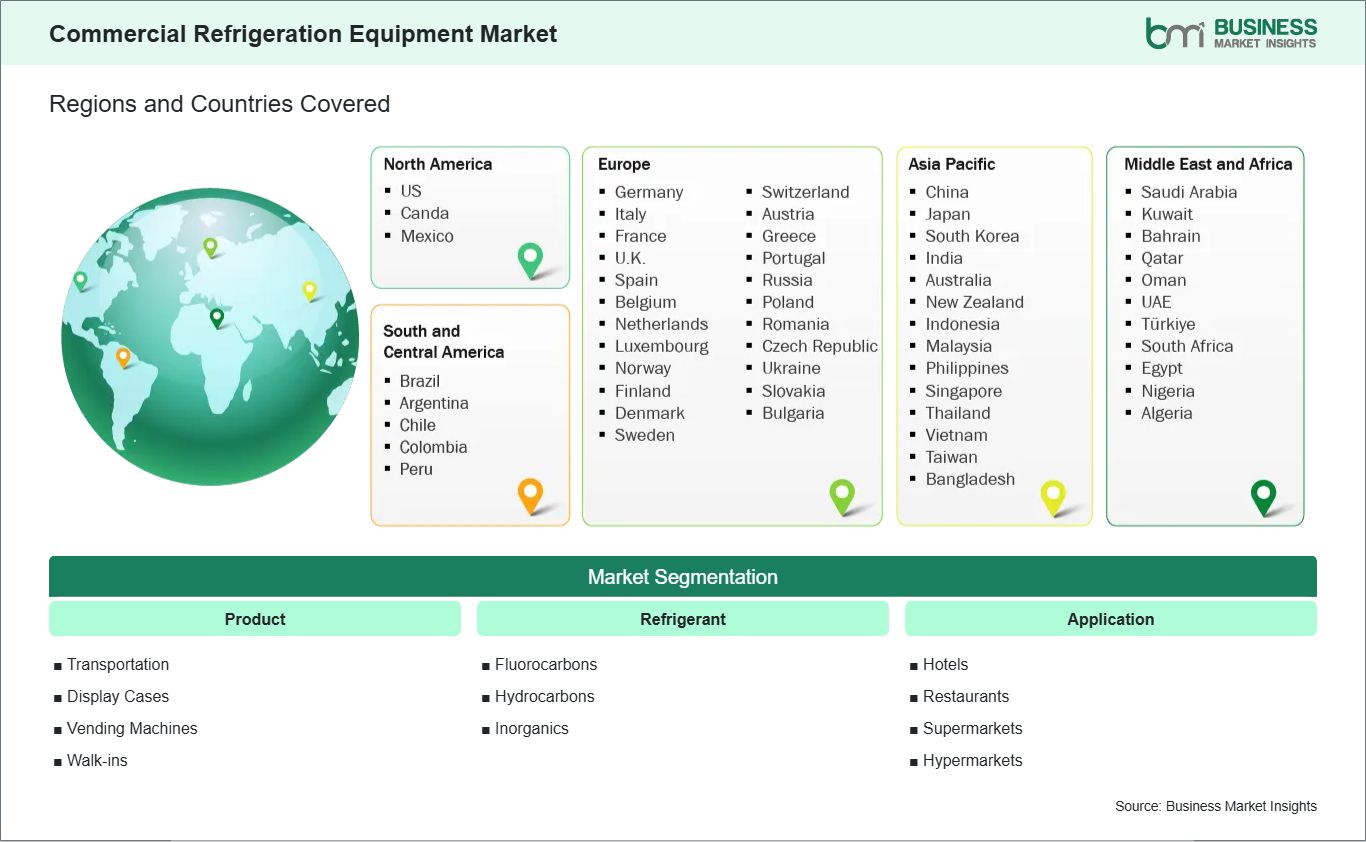
The commercial refrigeration equipment market is segmented based on product, refrigerant, and application, reflecting evolving food preservation requirements, sustainable cooling transitions, and modernization of commercial foodservice infrastructure.
By Product
- Transportation: Mobile refrigeration systems support uninterrupted cold-chain distribution across food logistics operations.
- Display Cases: Retail cooling units improve product visibility while maintaining controlled storage temperatures.
- Vending Machines: Integrated refrigeration enhances beverage and packaged food preservation efficiency.
- Walk-ins: Large-capacity cooling rooms support bulk commercial food storage requirements.
By Refrigerant
- Fluorocarbons: Conventional refrigerants maintain widespread utilization across established cooling infrastructures.
- Hydrocarbons: Sustainable refrigerants improve energy efficiency and reduce environmental impact concerns.
- Inorganics: Industrial-grade refrigerants support high-capacity commercial refrigeration applications.
By Application
- Hotels: Hospitality facilities require reliable refrigeration for food storage and beverage management.
- Restaurants: Commercial kitchens prioritize temperature-controlled systems for operational continuity.
- Supermarkets: Large retail chains depend on advanced refrigeration for perishable product preservation.
- Hypermarkets: Multi-category retail environments utilize extensive cooling infrastructure for inventory management.
Market Forces
Commercial Refrigeration Equipment Market Drivers and Opportunities
Frozen food demand boosting refrigeration
The increasing demand for frozen and processed food products is significantly driving the commercial refrigeration equipment market. Changing consumer lifestyles, rising urbanization, and growing preference for convenient food options are encouraging supermarkets, restaurants, and foodservice providers to expand frozen food storage and display capabilities. Commercial refrigeration equipment plays a critical role in maintaining product freshness, preserving nutritional quality, and extending shelf life across the food supply chain. Rising consumption of frozen meat, seafood, dairy products, ready-to-eat meals, and packaged foods is increasing the need for efficient refrigeration systems in retail and hospitality environments.
Food retailers are increasingly investing in advanced refrigeration technologies to improve temperature control, energy efficiency, and inventory management. Expanding supermarket and hypermarket networks across developing economies are further contributing to the demand for display cases, walk-in coolers, and transportation refrigeration systems. The rapid growth of quick-service restaurants and online grocery delivery platforms is also supporting market expansion, as these businesses require reliable cold chain infrastructure for food preservation and logistics operations. Growing consumer awareness regarding food safety and quality standards is encouraging commercial establishments to adopt modern refrigeration equipment capable of maintaining consistent cooling performance. These factors continue to strengthen the demand for commercial refrigeration systems across global food retail and hospitality industries.
Eco-friendly refrigerants boosting adoption
The growing emphasis on environmental sustainability is creating significant opportunities for eco-friendly refrigerants in the commercial refrigeration equipment market. Governments and regulatory organizations are increasingly implementing stricter environmental regulations to reduce greenhouse gas emissions associated with conventional refrigerants. This is encouraging manufacturers and commercial users to shift toward environmentally safer alternatives such as hydrocarbons and inorganic refrigerants. Eco-friendly refrigerants offer lower global warming potential and improved energy efficiency, making them increasingly attractive for modern refrigeration applications across retail, hospitality, and foodservice industries.
Commercial refrigeration equipment manufacturers are investing in advanced cooling technologies that support natural refrigerants while maintaining high operational performance and regulatory compliance. Businesses are also focusing on sustainability initiatives to reduce energy consumption and achieve environmental targets, which is accelerating the adoption of green refrigeration systems. The growing development of energy-efficient supermarkets, cold storage facilities, and smart retail infrastructure is further increasing the demand for environmentally sustainable refrigeration technologies. Technological advancements in compressor systems, leak detection, and thermal management are improving the safety and performance of eco-friendly refrigerants in commercial applications. Rising investments in sustainable cold chain infrastructure and environmentally responsible food retail operations are expected to generate strong long-term opportunities for advanced refrigeration equipment manufacturers.
Size and Share Analysis
Commercial Refrigeration Equipment Market Size and Share Analysis
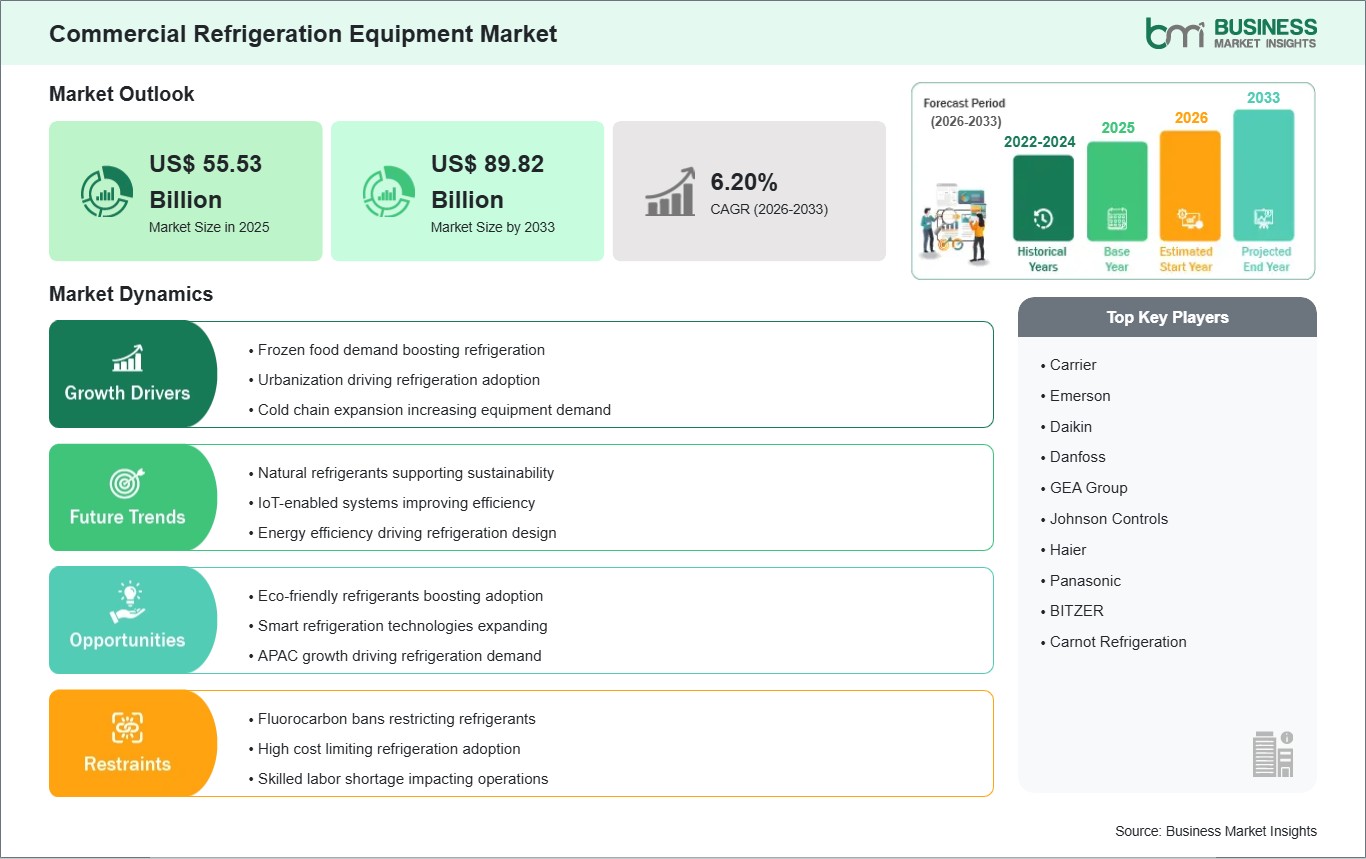
The Commercial Refrigeration Equipment Market is projected to grow from US$ 55.53 Billion in 2025 to US$ 89.82 Billion by 2033 , registering a CAGR of 6.20% from 2026 to 2033.
By product, the display cases dominates the market due to increasing deployment across supermarkets, convenience stores, and food retail chains for effective product visibility, temperature maintenance, and enhanced consumer purchasing experience in refrigerated food sections.
By refrigerant, the fluorocarbons account for highest share owing to their widespread usage in commercial refrigeration systems, strong cooling efficiency, compatibility with existing infrastructure, and continued adoption across retail and foodservice refrigeration applications.
By application, the supermarkets dominates the market driven by expanding organized retail infrastructure, growing frozen and packaged food sales, and increasing installation of advanced refrigeration systems for large-scale food storage and display operations.
Report Coverage
Commercial Refrigeration Equipment Market Report Coverage and Deliverables
The "Commercial Refrigeration Equipment Market Size and Forecast (2022-2033)" report provides a detailed analysis of the market covering below areas:
- The market size and forecast at the regional and country levels for segments covered under the scope
- The market trends, as well as drivers, restraints, and opportunities
- The market analysis covering key trends, regional framework, major players, regulations, and recent developments
- Industry landscape and competition analysis covering market concentration, heat map analysis, prominent players, and recent developments for the market
- Detailed company profiles, including SWOT analysis
Geographic Insights
Commercial Refrigeration Equipment Market Geographic Insights
The Commercial Refrigeration Equipment Market shows diverse regional adoption patterns influenced by advancements in imaging technologies, increasing demand for immersive visual experiences, and rising adoption of automation and smart devices.
North America, being a technologically advanced region, has a strong presence of leading imaging technology companies and advanced digital infrastructure. The region comprises the United States and Canada, where investments are being made in 3D sensing technologies, augmented reality applications, and smart consumer electronics. The region focuses on enhancing imaging accuracy and improving user experiences through advanced depth-sensing and spatial recognition technologies. It has well-established technology and industrial sectors, allowing for the widespread adoption of commercial refrigeration equipments across smartphones, automotive systems, healthcare devices, security systems, and entertainment applications.
Asia Pacific is growing significantly, driven by rapid expansion of the consumer electronics industry, increasing industrial automation, and rising adoption of smart technologies. The region comprises countries such as China, Japan, and South Korea, where manufacturers are actively integrating 3D imaging technologies into smartphones, robotics, and automotive systems. The region focuses on improving manufacturing efficiency and supporting innovation in digital imaging and automation technologies. The expansion of gaming, virtual reality, and smart surveillance sectors is also contributing to the growth of the Commercial Refrigeration Equipment Market, along with increasing investments in research and development activities and advanced semiconductor manufacturing.
Both regions are contributing significantly to the growth of the Commercial Refrigeration Equipment Market, focusing on technological advancements, increasing adoption of smart devices, and rising demand for advanced imaging and sensing solutions across various end-use industries.
Industry Activity
Recent Developments
The commercial refrigeration equipment market is evaluated by gathering qualitative and quantitative data post primary and secondary research, which includes important corporate publications, association data, and databases. A few of the key developments in the commercial refrigeration equipment market are:
- In December 2024, Panasonic announced the completion of its acquisition of Area Cooling Solutions in Poland, expanding its commercial refrigeration equipment manufacturing and cold chain operations in Europe.
- In October 2024, Carrier Global Corporation announced the completion of the US$ 775 million sale of its Commercial Refrigeration business to Haier, as part of its strategic portfolio transformation focused on climate and energy solutions.
- In January 2024, Hussmann Corporation announced the launch of Evolve Technologies™, a new portfolio of sustainable refrigeration solutions utilizing low-GWP refrigerants such as CO₂ and propane for commercial refrigeration applications.
Trust & Transparency
Research Methodology
The market analysis combines proprietary research with secondary data from government agencies, company disclosures, regulatory filings, industry databases and expert interviews. Market estimates are validated through data triangulation, cross-market benchmarking and analyst
review.
View Full Research Methodology
Key Sources Referred:
Air-Conditioning, Heating, and Refrigeration Institute (AHRI)
American Society of Heating, Refrigerating and Air-Conditioning Engineers (ASHRAE)
European Association for Refrigeration, Air Conditioning and Heat Pumps (AREA)
China Refrigeration and Air-Conditioning Industry Association (CRAA)
Indian Society of Heating, Refrigerating and Air Conditioning Engineers (ISHRAE)
Japan Refrigeration and Air Conditioning Industry Association (JRAIA)
Company Websites
Company Annual Reports
Company Investor Presentations