Market Summary
Executive Summary and Global Market Analysis
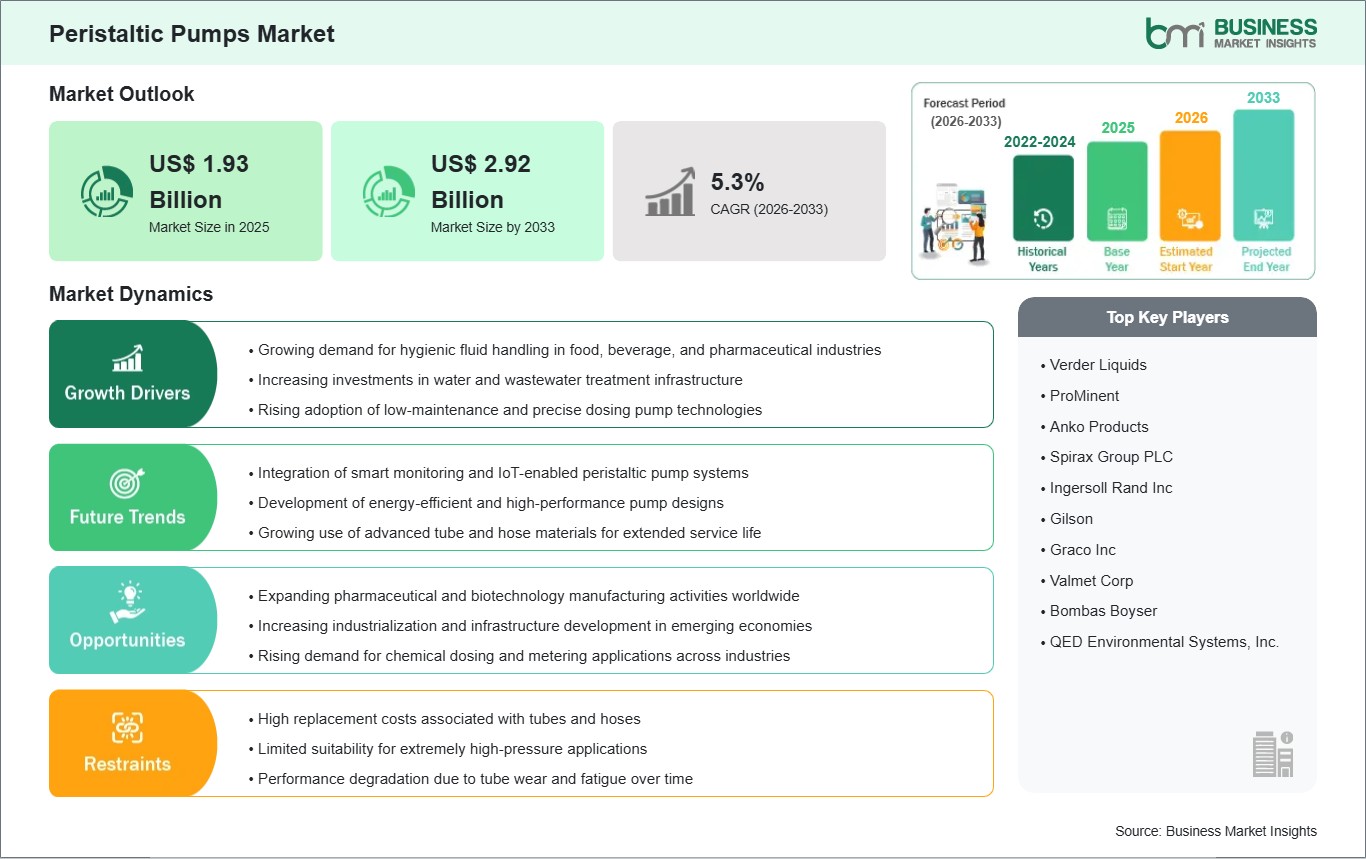
Peristaltic pumps are positive displacement fluid transfer systems that move liquids through the repeated compression of a flexible hose or tube. This operating principle keeps pumped media isolated from internal mechanical components, making the equipment suitable for abrasive, shear-sensitive, sterile, and corrosive fluids. As process industries place greater emphasis on cleanliness, dosing precision, and maintenance simplicity, this equipment category continues to secure a defined role across controlled fluid handling environments.
Market momentum is supported by operational requirements that favor contamination control, predictable flow, and compatibility with demanding media. Water treatment facilities rely on these pumps for chemical metering, while pharmaceutical and food processing lines use them where product integrity must remain protected throughout transfer. Their ability to operate with limited seal-related exposure also aligns with industrial efforts to reduce leakage risk and simplify servicing routines.
From a segmentation perspective, the industry reflects differentiation by pump construction, discharge capacity, and end-use environment. Hose pump configurations are commonly aligned with heavy-duty transfer tasks, whereas tube pump formats are frequently selected for controlled and clean-process applications. Capacity bands address a wide spread of pressure requirements, allowing suppliers to serve both gentle dispensing duties and more demanding transfer conditions across chemicals, pulp and paper, and wastewater operations.
Technology development is reshaping product positioning through better tubing materials, tighter speed control, and improved integration with automated process systems. Manufacturers are refining pump assemblies to support longer service intervals, more stable dosing, and easier replacement of wear components. These improvements are widening the relevance of peristaltic systems in facilities that require process consistency without introducing complex sealing arrangements or extensive operator intervention.
The competitive environment is shaped by product differentiation, application expertise, and the ability to align offerings with hygiene, durability, and process control requirements. Suppliers compete through portfolio breadth, engineering reliability, and service support tailored to sector-specific operating conditions. As end users seek equipment that balances precision with reduced maintenance burden, market participants are focusing on specialized performance features rather than broad, undifferentiated positioning.
Segment Analysis
Peristaltic Pumps Market Segmentation
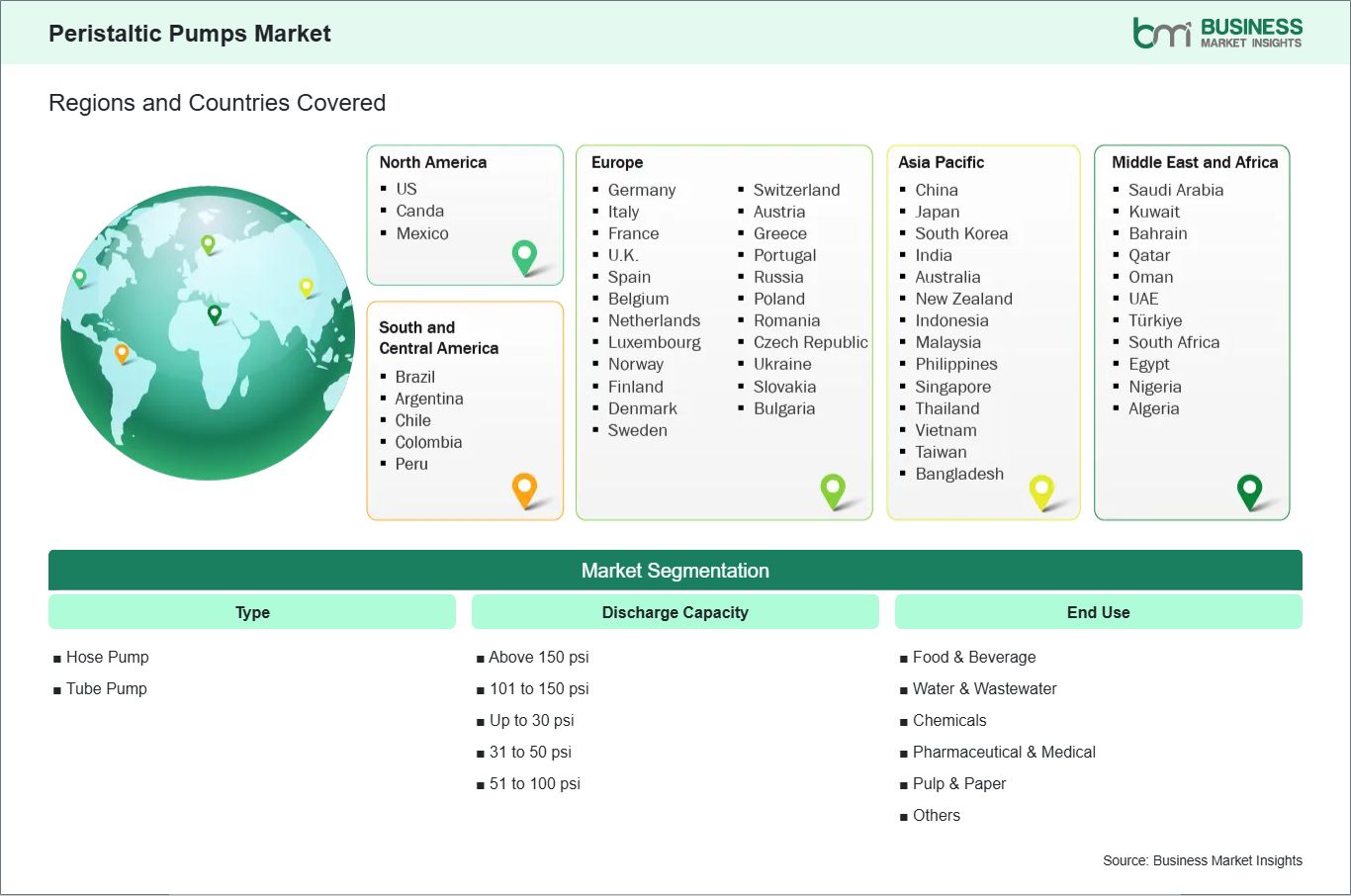
The peristaltic pumps market is segmented based on type, discharge type, and end use, reflecting its critical role in essential sectors like healthcare and water treatment to ensure fluid safety.
By Type
Hose Pump: Suited to abrasive media and heavier-duty transfer conditions.
Tube Pump: Preferred for cleaner dosing tasks requiring compact system design.
By Discharge Capacity
Above 150 psi: Addresses demanding transfer processes with higher pressure tolerance.
101 to 150 psi: Supports industrial dosing where balanced pressure performance is required.
Up to 30 psi: Fits gentle dispensing and light-duty fluid movement applications.
31 to 50 psi: Serves controlled process lines needing moderate discharge handling.
51 to 100 psi: Matches versatile operations spanning treatment and process industries.
By End Use
Food & Beverage: Selected for hygienic transfer of ingredients and processing fluids.
Water & Wastewater: Applied in dosing, sludge movement, and treatment chemical handling.
Chemicals: Handles corrosive and viscous media with contained fluid contact.
Pharmaceutical & Medical: Supports sterile transfer, metering, and laboratory fluid control.
Pulp & Paper: Manages abrasive slurries and additives across processing stages.
Others: Extends to niche operations requiring isolated and repeatable pumping.
Market Forces
Peristaltic Pumps Market Drivers and Opportunities
Expansion of Precision Fluid Handling Requirements Across Regulated Processing Environments
Process operators increasingly need pumping systems that preserve fluid integrity while maintaining accurate transfer under controlled conditions. This requirement is especially visible in pharmaceutical production, food processing, and chemical dosing, where direct contact with mechanical parts can create quality and maintenance concerns. Peristaltic pumps address this need through isolated flow paths, repeatable delivery, and simplified servicing, supporting broader deployment in operations where hygiene and handling consistency remain central purchasing criteria.
The resulting market effect extends beyond equipment replacement into process standardization and system design decisions. Facilities seeking tighter control over chemical feed, ingredient transfer, or sterile media movement often prioritize pump technologies that reduce leakage exposure and maintenance complexity. In this context, peristaltic systems remain relevant because they align with operational reliability goals while fitting process lines that demand dependable dosing without intricate sealing arrangements.
Integration of Smart Control and Advanced Tubing Materials in Industrial Pump Systems
Industrial users are showing greater interest in pump systems that combine automation compatibility with material improvements tailored to demanding fluids. This direction supports innovation in tubing compounds, monitoring functions, and speed control architectures that enhance dosing stability and reduce unplanned intervention. The opportunity is particularly relevant in treatment plants, laboratory workflows, and specialty processing lines where digital oversight and material durability can improve operating continuity.
Over time, this innovation path can broaden the addressable scope of the market across both established and emerging applications. Suppliers that refine hose life, control responsiveness, and system integration are better positioned to serve facilities moving toward automated fluid management. The commercial impact may be most visible where process uptime, traceability, and operator efficiency shape procurement decisions across industrial and hygienic pumping environments.
Size and Share Analysis
Peristaltic Pumps Market Size and Share Analysis
The peristaltic pumps market was valued at USD 1.93 Billion in 2025 and is projected to reach USD 2.92 Billion by 2033, registering a CAGR of 5.3% during 2026 - 2033. This trajectory reflects sustained use of peristaltic pumping systems in applications where fluid isolation, dosing consistency, and easier maintenance remain more important than broad-volume transfer alone.
Within the type landscape, tube pumps maintain strong relevance in applications that prioritize compact design, controlled dispensing, and cleaner operating conditions. Hose pumps remain important where users handle abrasive or higher-viscosity media, creating a market structure in which product selection is closely tied to process characteristics rather than generalized equipment preference.
By application, pharmaceutical and medical settings, water and wastewater treatment, and food and beverage operations represent the most influential demand centers. These end-use categories value contamination control, repeatable metering, and compatibility with sensitive or treatment-oriented fluids, which strengthens the position of peristaltic pumps in specialized transfer and dosing functions.
Report Coverage
Peristaltic Pumps Market Report Coverage and Deliverables
The "Peristaltic Pumps Market Size and Forecast (2022:2033)" report provides a detailed analysis of the market covering below areas:
- Market size and forecast at global, regional, and country levels for all market segments covered under the scope
- Market trends, as well as drivers, restraints, and opportunities
- Market analysis covering key trends, global and regional framework, major players, regulations, and recent developments
- Industry landscape and competition analysis covering market concentration, heat map analysis, prominent players, and recent developments for the market
- Detailed company profiles, including SWOT analysis
Geographic Insights
Peristaltic Pumps Market Geographic Insights
The Peristaltic Pumps market shows diverse regional adoption patterns influenced by industrial processing priorities, water infrastructure requirements, regulatory expectations, and hygiene-focused manufacturing standards. Across the broader global landscape, demand is shaped by the need for accurate dosing, controlled fluid movement, and safe handling of abrasive or sensitive media. These conditions create a market environment where application fit matters more than uniform regional purchasing behavior.
North America reflects a mature operating context where end users emphasize reliability, process compliance, and maintenance efficiency. Demand remains closely linked to pharmaceutical production, municipal and industrial treatment systems, and specialized food processing environments. Buyers in this region often prioritize equipment configurations that support precise metering and seamless integration with automated control architectures used in tightly managed process lines.
Asia Pacific presents a broader mix of replacement demand, industrial expansion, and infrastructure-led equipment deployment. Water treatment upgrades, manufacturing diversification, and wider processing activity strengthen the relevance of peristaltic pumps across multiple countries in the region. The sector benefits from demand conditions that favor durable fluid transfer systems capable of handling chemicals, additives, and treatment media in both established and scaling production environments.
Europe maintains a strong position in hygienic and precision-oriented applications, supported by established industrial standards and process optimization priorities. Beyond Europe, emerging markets in the Middle East, Africa, and South and Central America are creating new demand pockets tied to utilities, industrial processing, and selective modernization of fluid management systems. Together, these regions reinforce a geographically varied industry outlook shaped by distinct operational needs rather than a single expansion pattern.
Industry Activity
Recent Developments
The peristaltic pumps market is evaluated by gathering qualitative and quantitative data post primary and secondary research, which includes important corporate publications, association data, and databases. Recent developments and news in the market include:
- September 2025, Watson-Marlow launched the Bredel CIP (Clean-in-Place) Pump, designed for hygienic applications in food & beverage, pharmaceuticals, and cosmetics manufacturing. The new pump enables efficient cleaning without disassembly, helping reduce downtime and contamination risks while improving operational efficiency.
- September 2025, Albin Pump, an Ingersoll Rand business, launched the RT Series Peristaltic Pump at WEFTEC 2025. The new product features a sealed pump head, simplified maintenance, enhanced operator safety, and FLUXDRIVE motor technology designed to reduce energy consumption and operating costs.
Trust & Transparency
Research Methodology
The market analysis combines proprietary research with secondary data from government agencies, company disclosures, regulatory filings, industry databases and expert interviews. Market estimates are validated through data triangulation, cross-market benchmarking and analyst
review.
View Full Research Methodology
Key Sources Referred:
World Bank – Global Trade IndicatorsWorld Trade Organization (WTO)(International Monetary Fund )IMFInternational Trade Administration (ITA)Company websiteCompany annual reportsCompany investor presentations